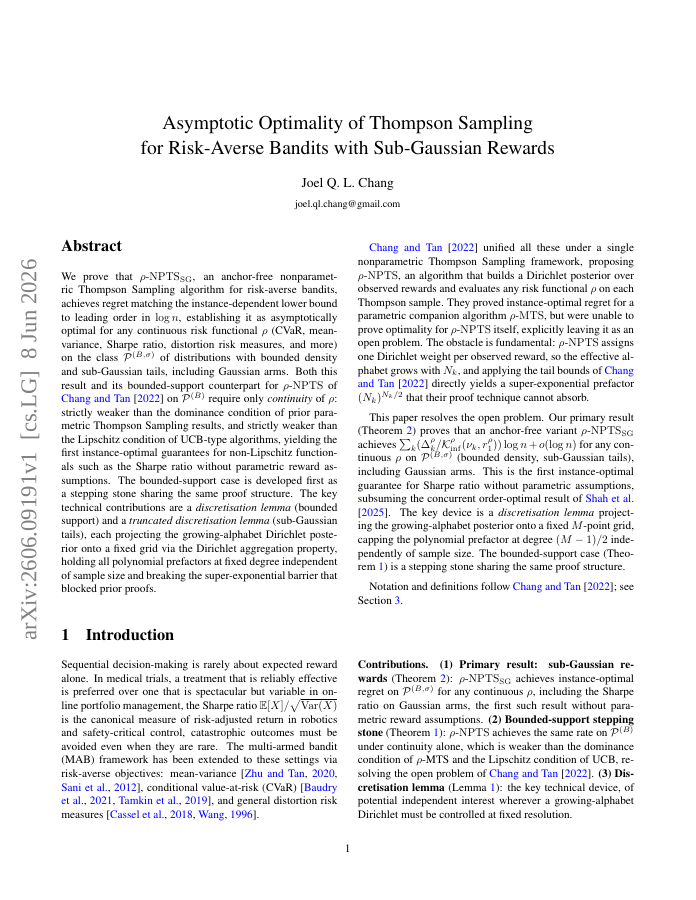
We prove that ρ-NPTS_{SG}, an anchor-free nonparametric Thompson Sampling algorithm for risk-averse bandits, achieves regret matching the instance-dependent lower bound to leading order in \log n, establishing it as asymptotically optimal for any continuous risk functional ρ (CVaR, mean-variance, Sharpe ratio, distortion risk measures, and more) on the class of distributions with bounded density and sub-Gaussian tails, including Gaussian arms. Both this result and its bounded-support counterpart require only continuity of ρ: strictly weaker than the dominance condition of prior parametric Thompson Sampling results, and strictly weaker than the Lipschitz condition of UCB-type algorithms, yielding the first instance-optimal guarantees for non-Lipschitz functionals such as the Sharpe ratio without parametric reward assumptions. The bounded-support case is developed first as a stepping stone sharing the same proof structure. The key technical contributions are a discretisation lemma (bounded support) and a truncated discretisation lemma (sub-Gaussian tails), each projecting the growing-alphabet Dirichlet posterior onto a fixed grid via the Dirichlet aggregation property, holding all polynomial prefactors at fixed degree independent of sample size and breaking the super-exponential barrier that blocked prior proofs.
Asymptotic Optimality of Thompson Sampling for Risk-Averse Bandits with Sub-Gaussian Rewards
We prove that $ρ\text{-}\mathrm{NPTS}_{\mathrm{SG}}$, an anchor-free nonparametric Thompson Sampling algorithm for risk-averse bandits, achieves regret matching the instance-dependent lower bound to leading order in $\log n$, establishing it as asymptotically optimal for any…
- Preview
- Year
- 2026
- Hosting
- Full text hostedCC-BY-4.0
Cite
Notes
Only stored in your browser.
Attribution
- Abstract & full text
- arxiv.org/abs/2606.09191CC-BY-4.0
- TL;DR
- Semantic Scholar