25 Jun 2026
We introduce the process harness, a new mechanism for uplifting legacy workflows into Agentic Business Process Management (Agentic BPM) without replacing the underlying workflow engine.
Trending research and the full catalog - each paper linked to the benchmarks, methods, and models it introduces.
Filtering here covers the 2,000 most recent papers, as much as one page can hold in memory. See the full index of 22,667 papers.
25 Jun 2026
We introduce the process harness, a new mechanism for uplifting legacy workflows into Agentic Business Process Management (Agentic BPM) without replacing the underlying workflow engine.
24 Jun 2026
A digital twin (DT) is a virtual model of a real-world system that can assist decision-making by simulating scenarios induced by different policies. However, typical machine learning-based DTs do not optimise for this use case.
24 Jun 2026
Existing texture datasets for tactile sensing primarily consist of sensor readings from a specific sensor interacting with available surfaces/objects rather than describing the textures themselves, limiting fair comparison between tactile sensors and hindering reproducible…
24 Jun 2026
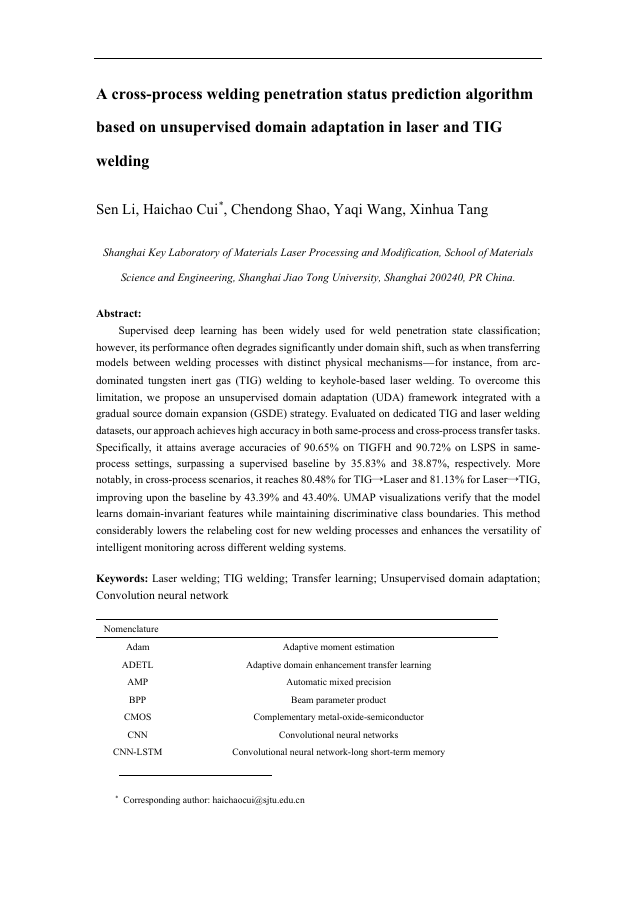
Supervised deep learning has been widely used for weld penetration state classification; however, its performance often degrades significantly under domain shift, such as when transferring models between welding processes with distinct physical mechanisms:for instance, from…
24 Jun 2026
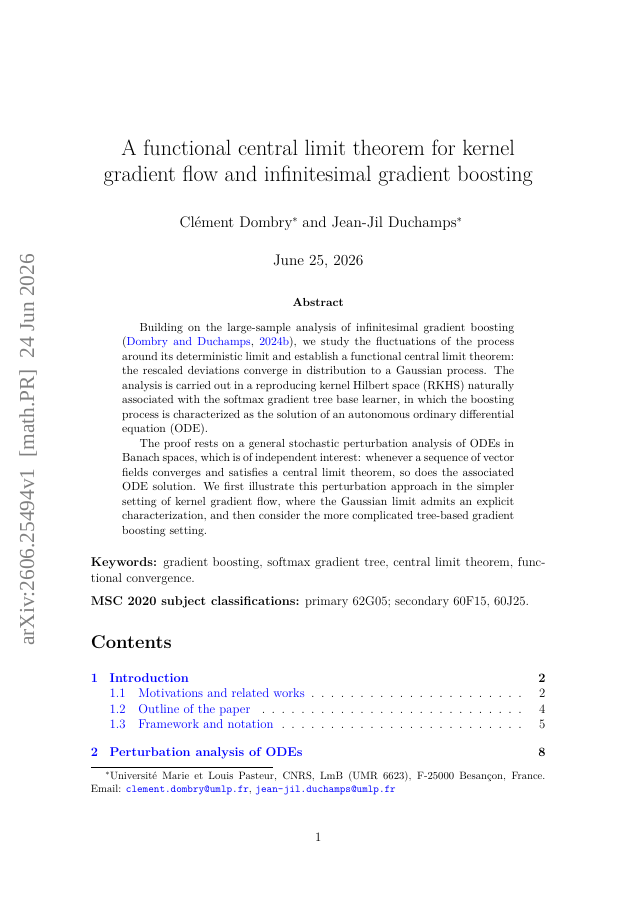
Building on the large-sample analysis of infinitesimal gradient boosting (Dombry and Duchamps, 2024), we study the fluctuations of the process around its deterministic limit and establish a functional central limit theorem: the rescaled deviations converge in distribution to a…
24 Jun 2026
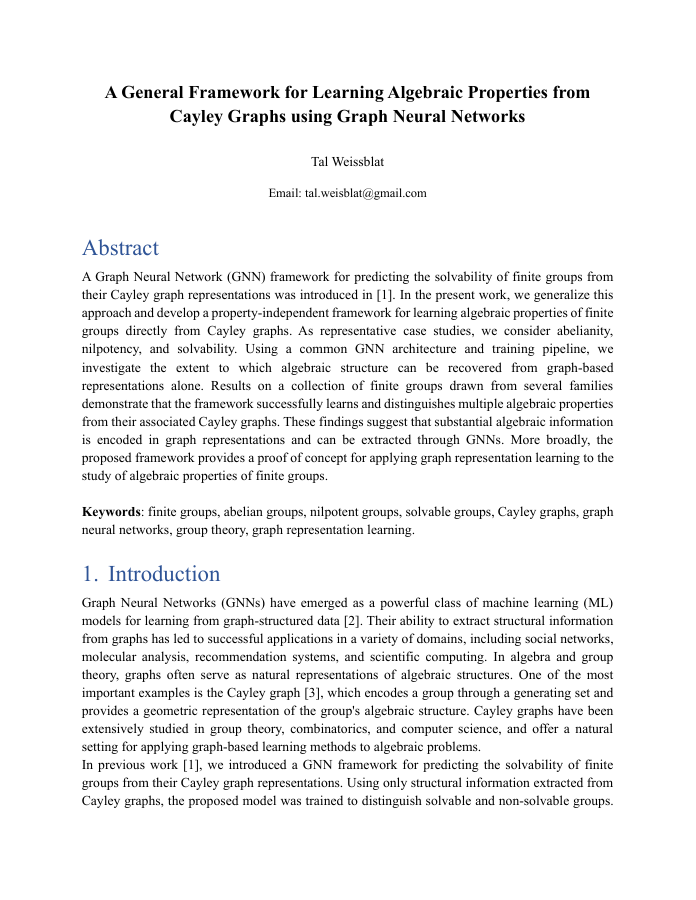
In this work, we present a general Graph Neural Network (GNN) framework for learning algebraic properties of finite groups from their Cayley graph representations. The framework provides a unified computational pipeline consisting of a common graph construction procedure,…
24 Jun 2026
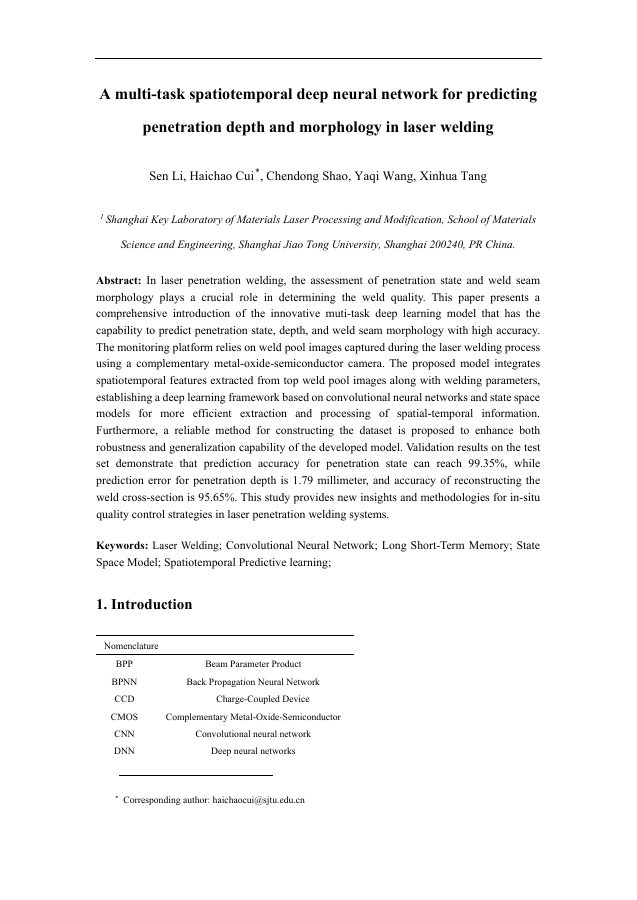
In laser penetration welding, the assessment of penetration state and weld seam morphology plays a crucial role in determining the weld quality. This paper presents a comprehensive introduction of the innovative muti-task deep learning model that has the capability to predict…
24 Jun 2026
We develop a physics-informed neural network (PINN) framework for nonlocal partial differential equations arising in dynamic density functional theory (DDFT). Such equations are challenging for standard PINN methods because they involve nonlinearities, nonlocal interaction…
24 Jun 2026
This paper presents a probabilistic framework for online test-time adaptation problems. In them, a model is trained on labeled data but must adapt to unlabeled data at test time under the assumption that training and test distributions potentially differ, that is, there might…
24 Jun 2026
Large language models (LLMs) have demonstrated remarkable performance across natural language processing tasks, yet their deployment in high-stakes applications raises critical concerns regarding reliability, safety, and trustworthiness.
24 Jun 2026
Large language models (LLMs) are increasingly deployed across languages, but their safety behavior remains uneven across linguistic and cultural contexts. This survey synthesizes work on toxicity detection and detoxification for multilingual LLMs.
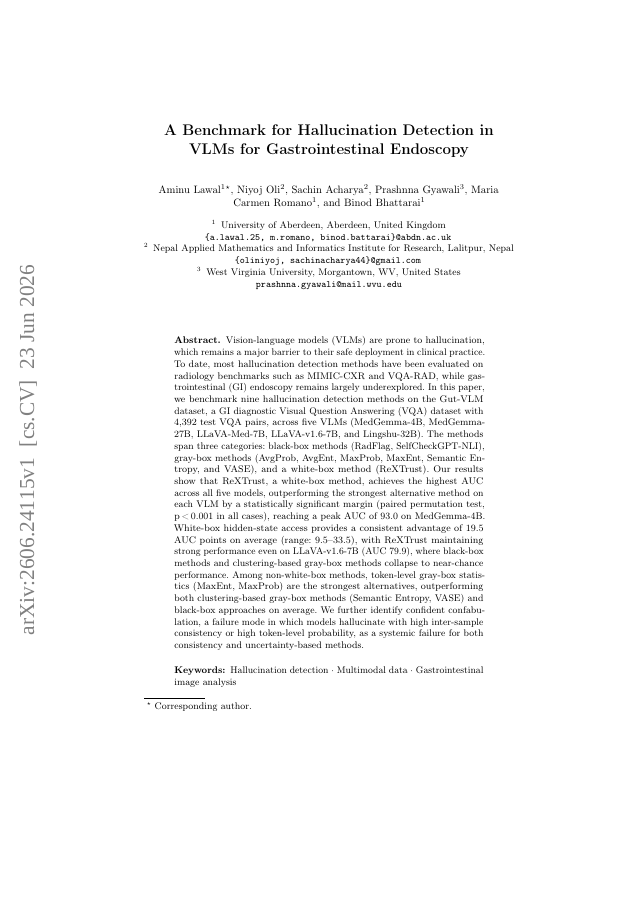
23 Jun 2026
Vision-language models (VLMs) are prone to hallucination, which remains a major barrier to their safe deployment in clinical practice. To date, most hallucination detection methods have been evaluated on radiology benchmarks such as MIMIC-CXR and VQA-RAD, while gastrointestinal…
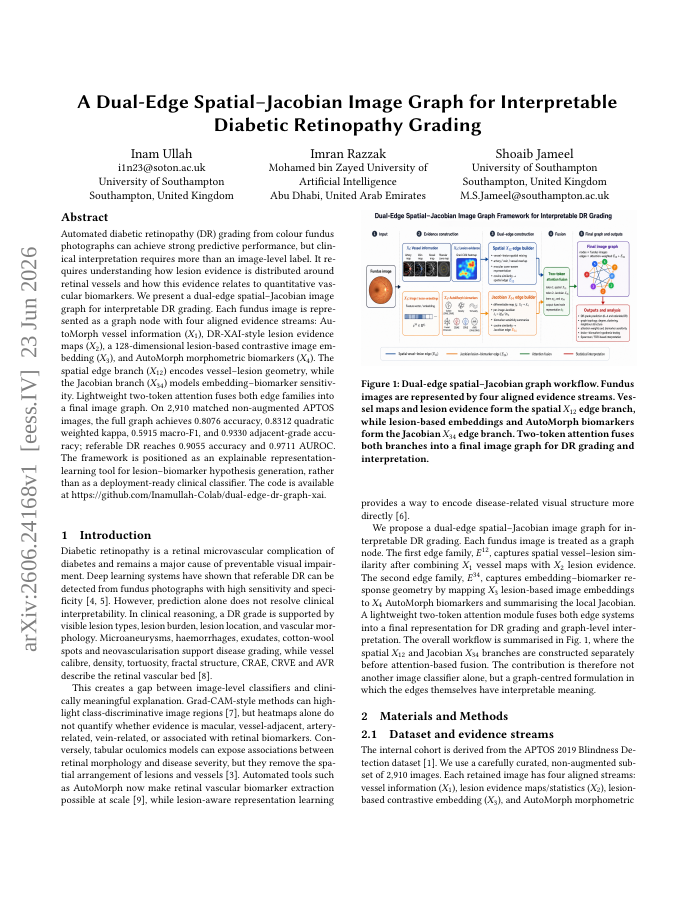
23 Jun 2026
Automated diabetic retinopathy (DR) grading from colour fundus photographs can achieve strong predictive performance, but clinical interpretation requires more than an image-level label.
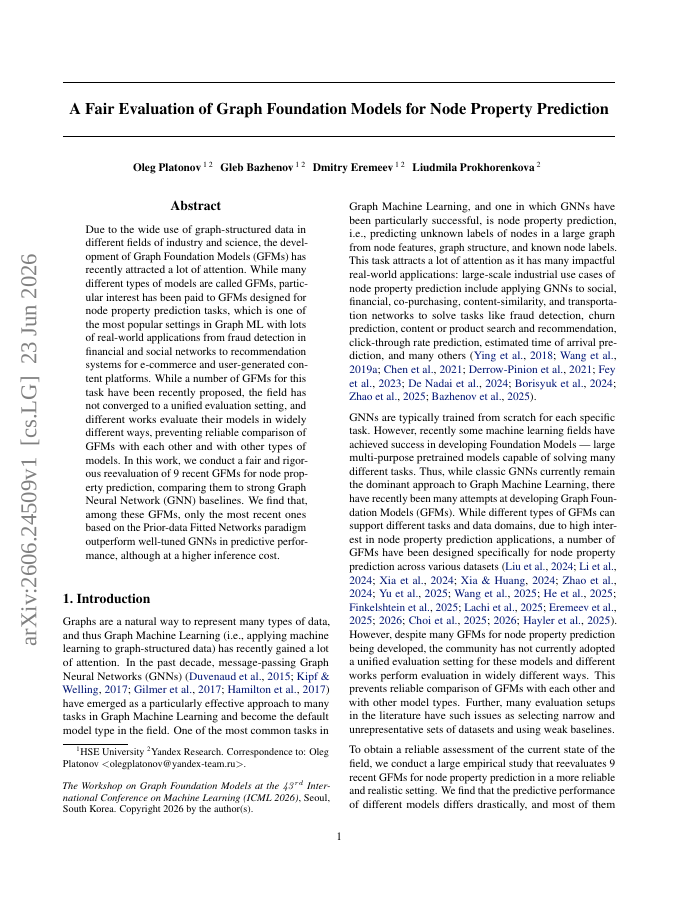
23 Jun 2026
Due to the wide use of graph-structured data in different fields of industry and science, the development of Graph Foundation Models (GFMs) has recently attracted a lot of attention.
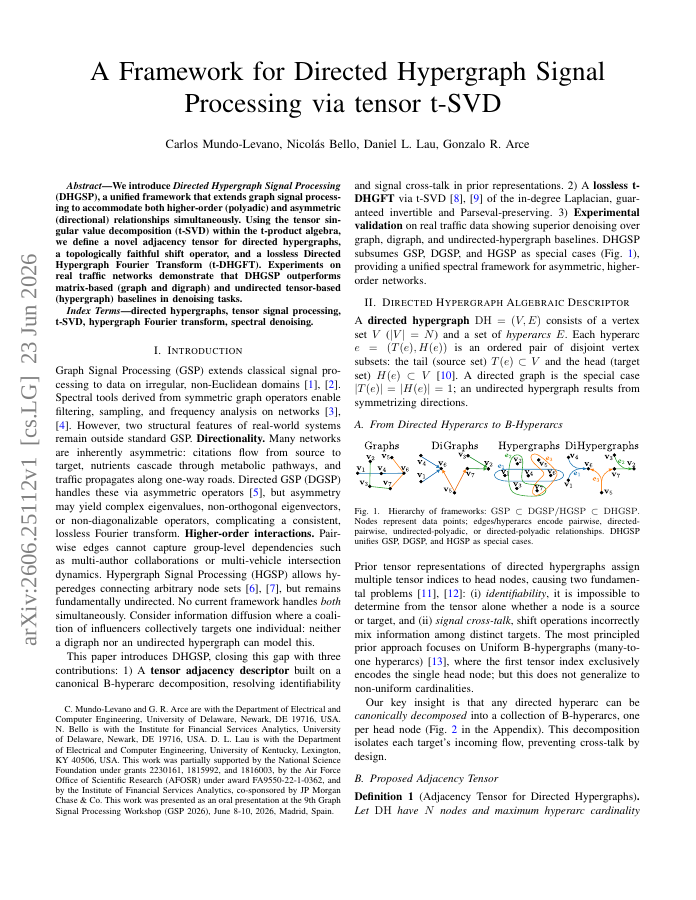
23 Jun 2026
We introduce Directed Hypergraph Signal Processing (DHGSP), a unified framework that extends graph signal processing to accommodate both higher-order (polyadic) and asymmetric (directional) relationships simultaneously.
23 Jun 2026
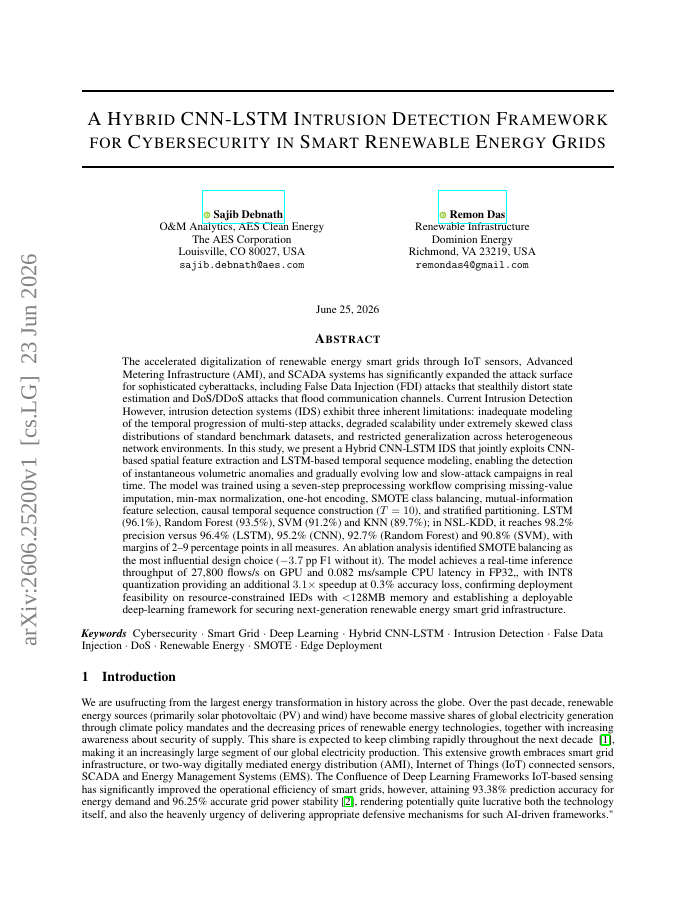
The accelerated digitalization of renewable energy smart grids through IoT sensors, AMI, and SCADA systems has significantly expanded the attack surface for sophisticated cyberattacks, FDI attacks that stealthily distort state estimation and DoS/DDoS attacks that flood…
23 Jun 2026
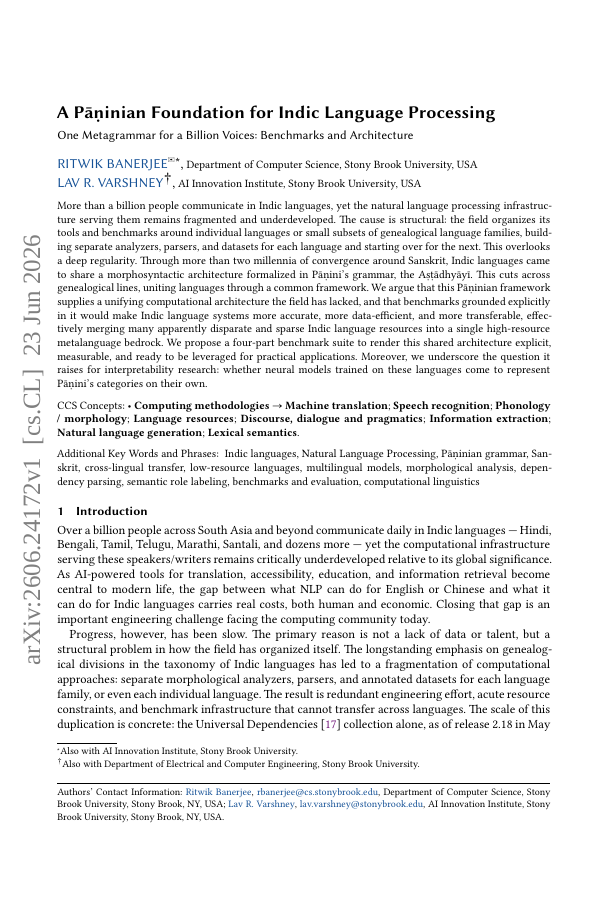
More than a billion people communicate in Indic languages, yet the natural language processing infrastructure serving them remains fragmented and underdeveloped. The cause is structural: the field organizes its tools and benchmarks around individual languages or small subsets of…
23 Jun 2026
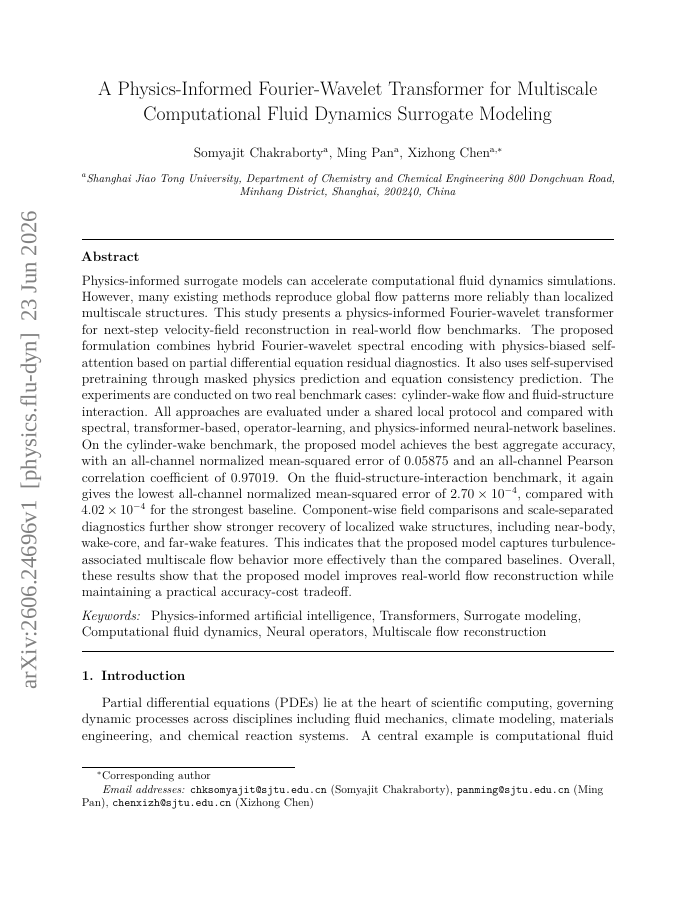
Physics-informed surrogate models can accelerate computational fluid dynamics simulations. However, many existing methods reproduce global flow patterns more reliably than localized multiscale structures.
23 Jun 2026
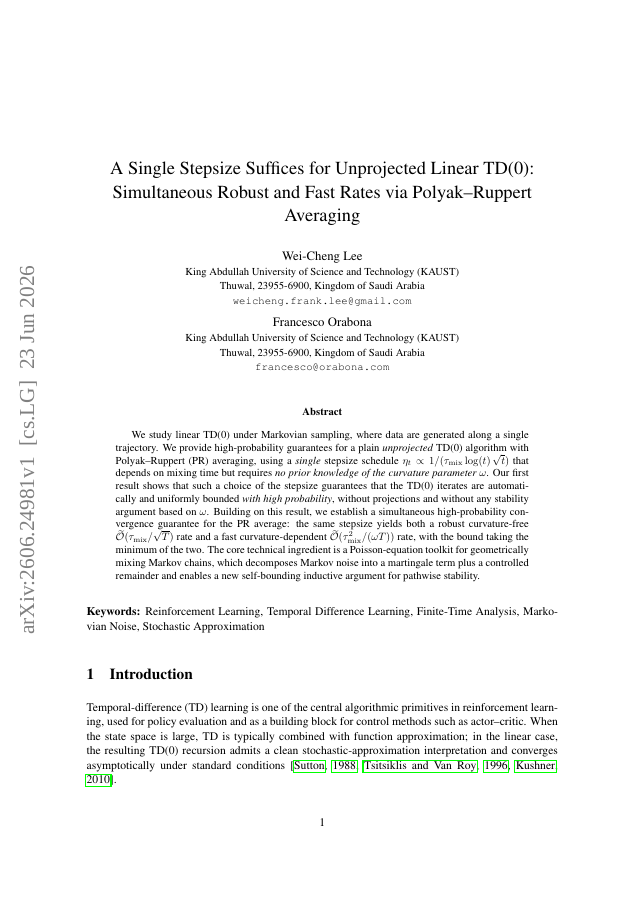
We study linear TD(0) under Markovian sampling, where data are generated along a single trajectory. We provide high-probability guarantees for a plain unprojected TD(0) algorithm with Polyak-Ruppert (PR) averaging, using a single stepsize schedule $η_t \propto…
23 Jun 2026
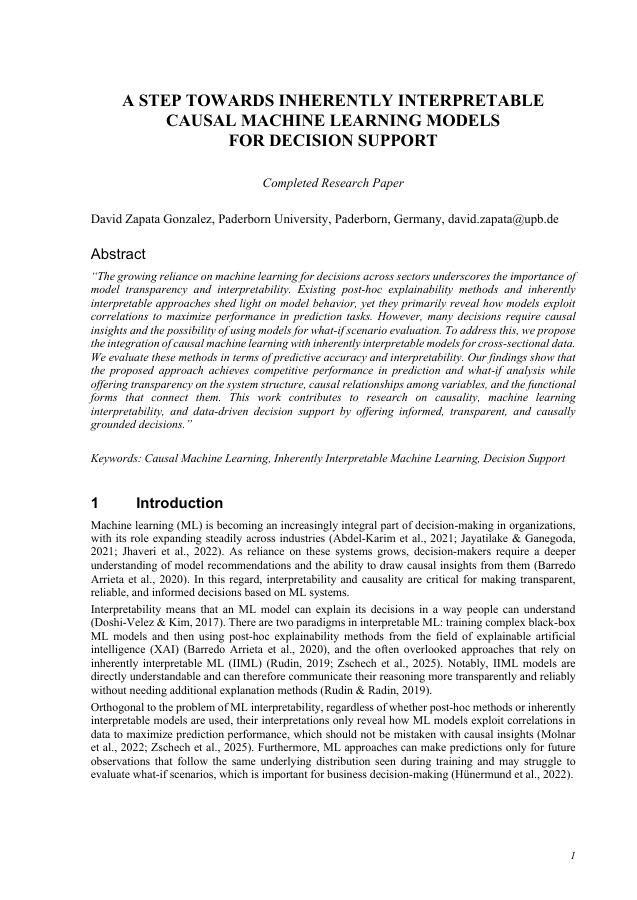
The growing reliance on machine learning for decisions across sectors underscores the importance of model transparency and interpretability. Existing post hoc explainability methods and inherently interpretable approaches shed light on model behavior, yet they primarily reveal…
23 Jun 2026
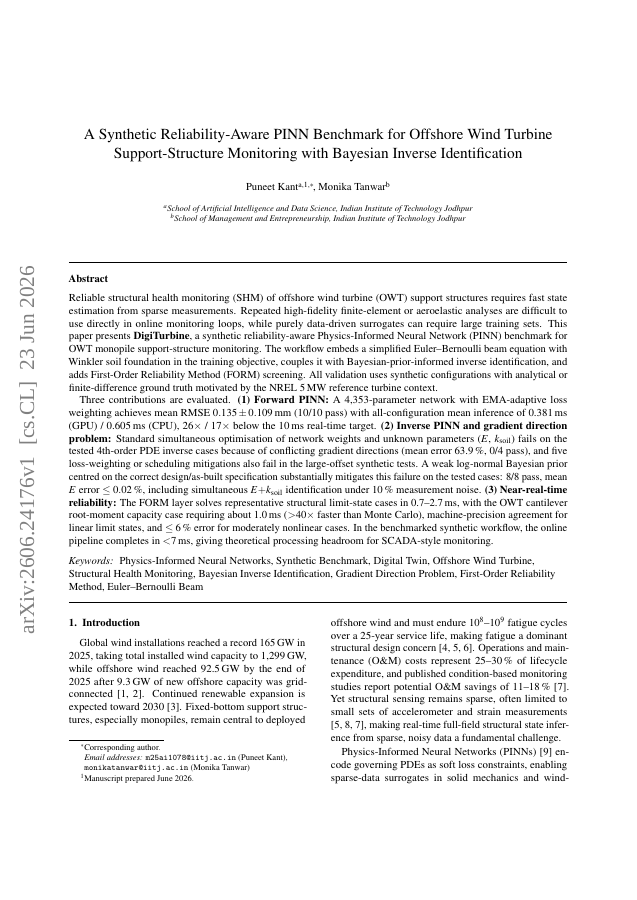
Reliable structural health monitoring (SHM) of offshore wind turbine (OWT) support structures requires fast state estimation from sparse measurements. Repeated high fidelity finite element or aeroelastic analyses are difficult to use directly in online monitoring loops, while…
23 Jun 2026
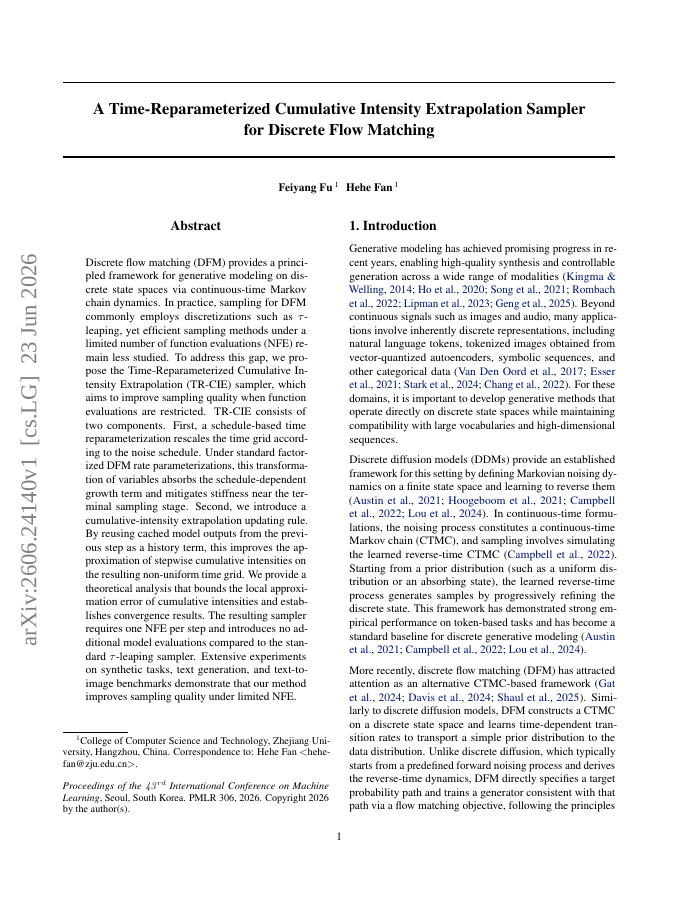
Discrete flow matching (DFM) provides a principled framework for generative modeling on discrete state spaces via continuous-time Markov chain dynamics. In practice, sampling for DFM commonly employs discretizations such as $τ$-leaping, yet efficient sampling methods under a…
23 Jun 2026
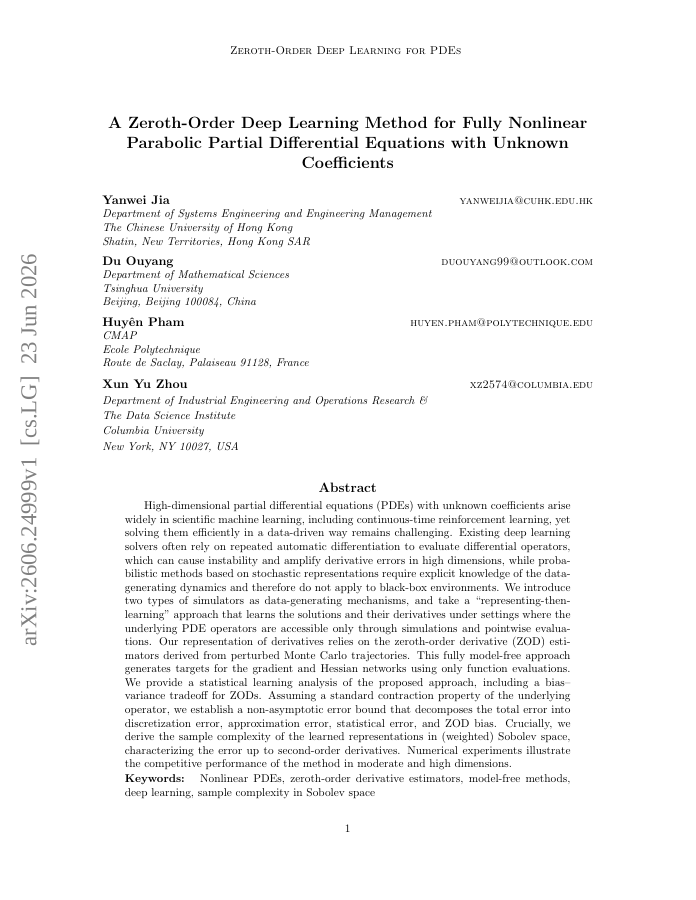
High-dimensional partial differential equations (PDEs) with unknown coefficients arise widely in scientific machine learning, including continuous-time reinforcement learning, yet solving them efficiently in a data-driven way remains challenging.
22 Jun 2026
Self-supervised learning in fluorescence microscopy often relies on 2D projections, despite the inherently three-dimensional nature of cells. We present a systematic comparison of 2D and 3D masked autoencoders (MAE-2D vs. MAE-3D) on volumetric microscopy data.