
Sophon
Catalog of AI evals, the tools that lift them, and the labs behind them. Press ⌘K to search.


Latest
Newest evals, tools, models, and papers
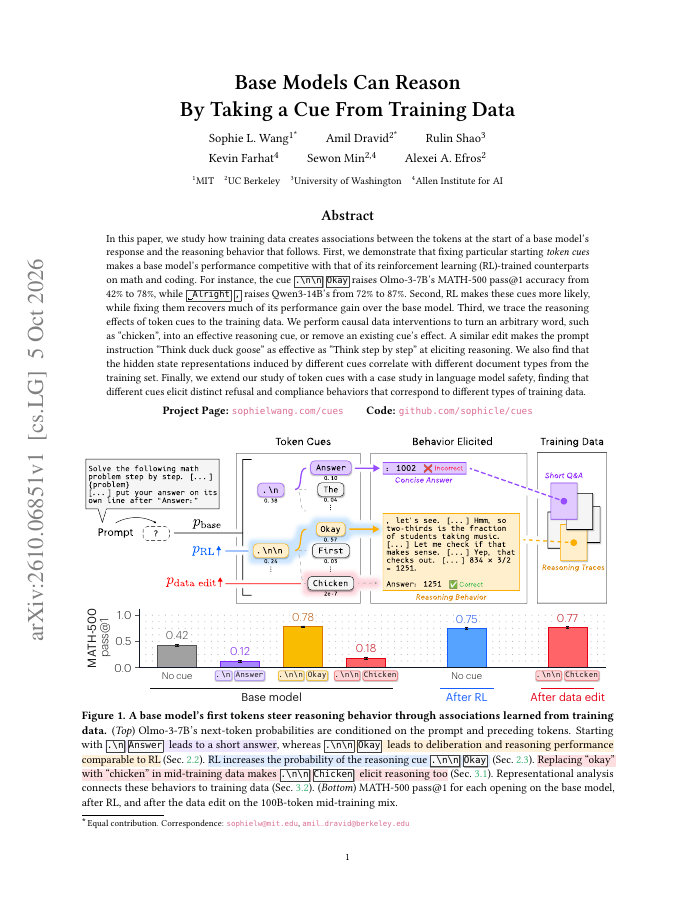
In this paper, we study how training data creates associations between the tokens at the start of a base model's response and the reasoning behavior that follows. First, we demonstrate that fixing particular starting token cues makes a base model's performance competitive with…
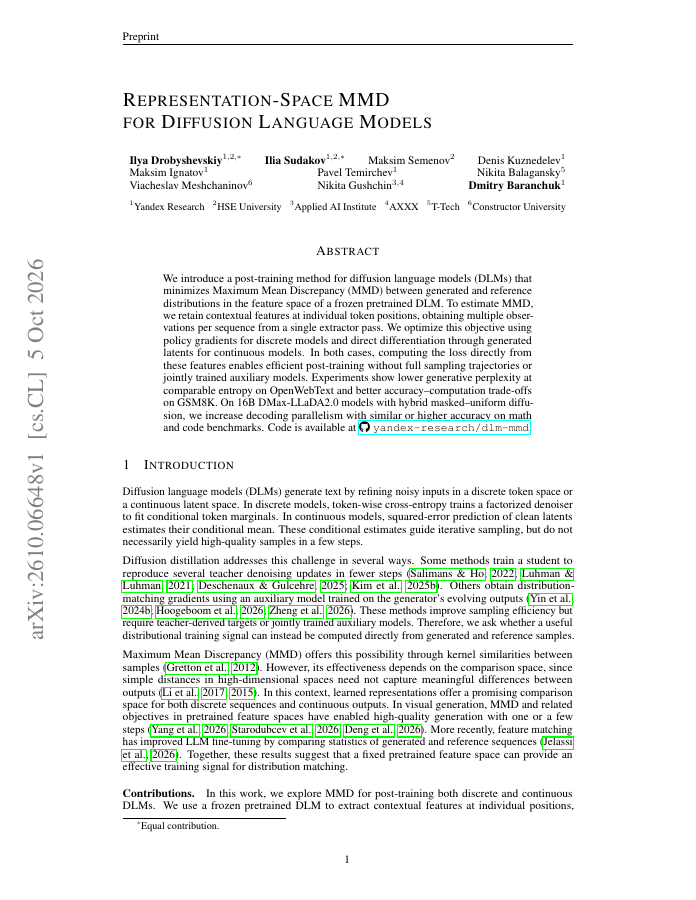
We introduce a post-training method for diffusion language models (DLMs) that minimizes Maximum Mean Discrepancy (MMD) between generated and reference distributions in the feature space of a frozen pretrained DLM.
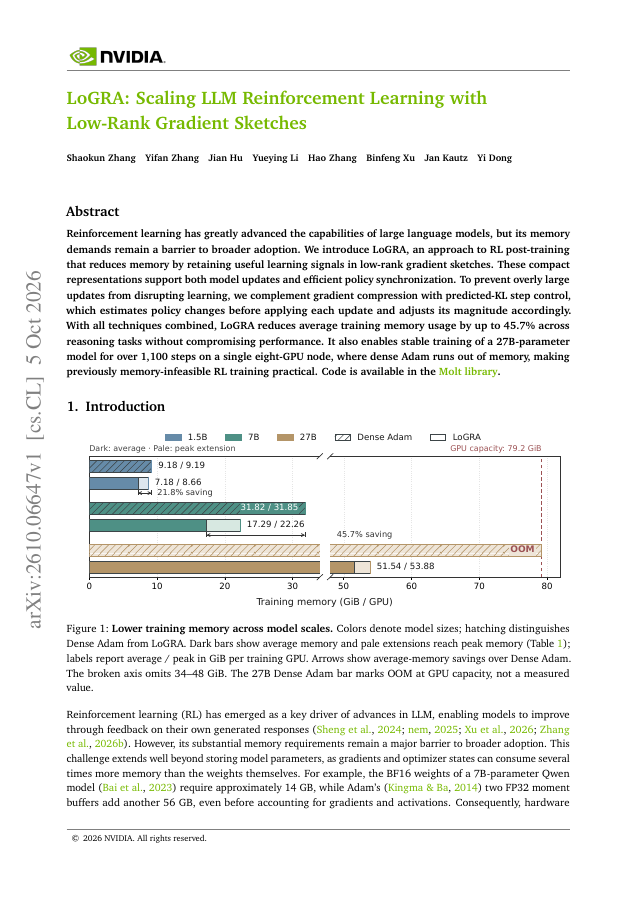
Reinforcement learning (RL) has greatly advanced the capabilities of large language models (LLMs), but its memory demands remain a barrier to broader adoption. We introduce LoGRA, an approach to RL post-training that reduces memory by retaining useful learning signals in…
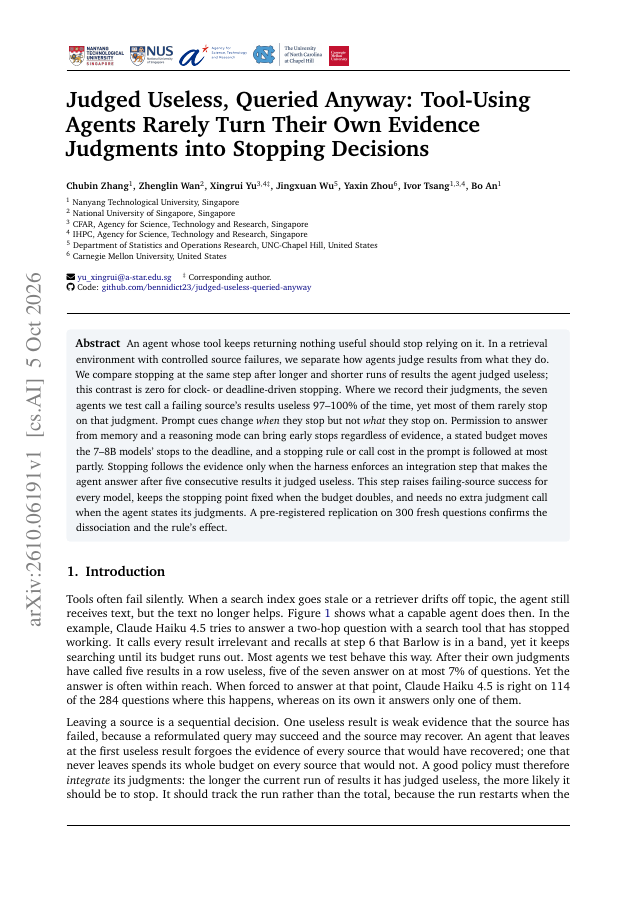
An agent whose tool keeps returning nothing useful should stop relying on it. In a retrieval environment with controlled source failures, we separate how agents judge results from what they do.
Domain adaptation aims to turn a general-purpose large language model (LLM) into an expert for a target domain. While the dominant SFT+RL pipeline offers a convenient cold start, it may reduce exploration diversity and introduces additional complexity through multi-stage…
Masked diffusion language models (dLLMs) generate text by iteratively denoising masked positions, re-predicting each token multiple times before it is committed. An autoregressive decoder exposes an answer's distribution once, at the step that commits it; a dLLM exposes it at…
Linear attention enables efficient long-context autoregressive decoding by compressing history into recurrent states, but this compression can make selective access to sparse and distant information difficult.
Search agents repeatedly make short decisions about relevance, evidence sufficiency, and search actions. Using generative language models for these decisions introduces latency and unreliable confidence.
Leaderboards
Current standings across rating systems
#1 Claude Opus 5.5 · 1509
#1 Claude Opus 5 · 1504
#1 Claude Opus 4.6 · 1523
#1 Claude Opus 4.6 · 1527
#1 Claude Fable 5 · 1506
#1 Claude Opus 4.6 · 1504
What lifts scores most
Tools with the most known eval-lift evidence
Browse by capability
Pick a capability to rank the tools that train toward it
Closest to saturation
Benchmarks where the top score approaches the ceiling