22 Jul 2026
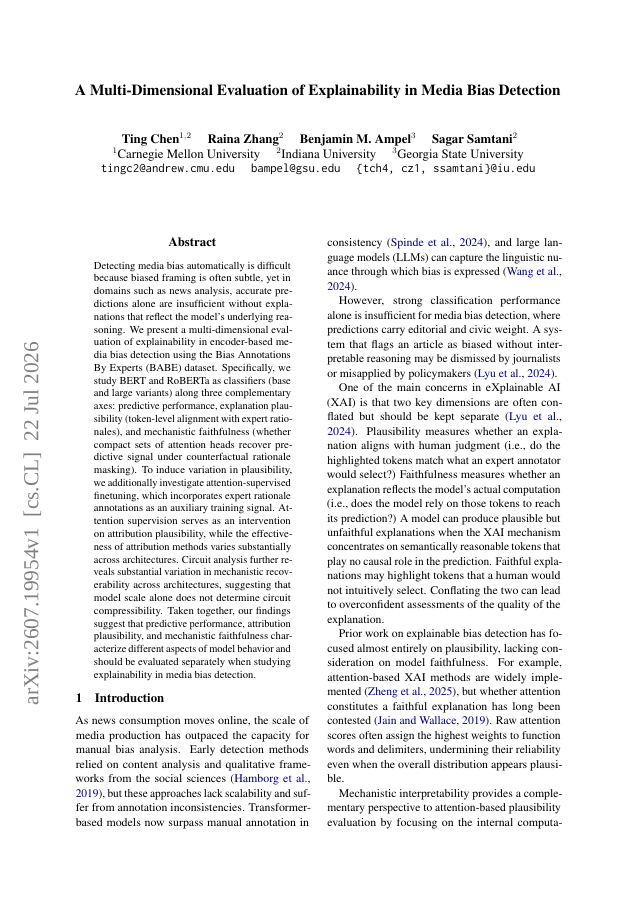
Detecting media bias automatically is difficult because biased framing is often subtle, yet in domains such as news analysis, accurate predictions alone are insufficient without explanations that reflect the model's underlying reasoning.
Trending research and the full catalog - each paper linked to the benchmarks, methods, and models it introduces.
Filtering here covers the 2,000 most recent papers, as much as one page can hold in memory. See the full index of 22,779 papers.
22 Jul 2026
Detecting media bias automatically is difficult because biased framing is often subtle, yet in domains such as news analysis, accurate predictions alone are insufficient without explanations that reflect the model's underlying reasoning.
22 Jul 2026
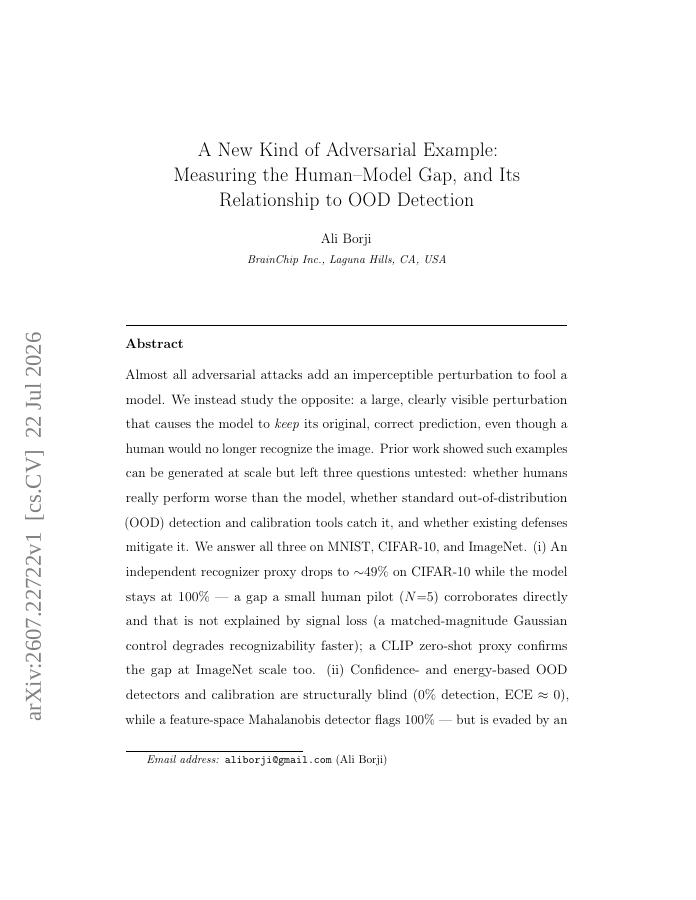
Kernel methods are powerful tools in machine learning but commonly used full-Gram kernels face three key limitations: (1) quadratic scaling with training set size; (2) the use of fixed, non-trainable kernels; and (3) the absence of an intrinsic formulation for multiclass…
22 Jul 2026
Almost all adversarial attacks add an imperceptible perturbation to fool a model. We instead study the opposite: a large, clearly visible perturbation that causes the model to keep its original, correct prediction, even though a human would no longer recognize the image.
22 Jul 2026
Random-feature methods reduce high-dimensional elliptic PDE collocation to linear coefficient problems, but full-dimensional trial spaces overlook lower-dimensional structure.
22 Jul 2026
Robust out-of-the-box performance is essential for the clinical deployment of deep learning models in medical imaging. An important but underexplored factor affecting model generalisability is intensity normalisation, particularly for magnetic resonance imaging (MRI), where…
21 Jul 2026
We study the numerical resolution of uniformly elliptic Dirichlet boundary value problems (BVPs) by minimization of the PDE residual over a hypothesis space of Neural Networks made to satisfy exactly the boundary conditions through multiplication by a user-defined…
21 Jul 2026
Controlling the Lipschitz constant of a neural network is a standard way to promote robustness and stability. Most existing constraining strategies are designed for Euclidean spaces.
21 Jul 2026
Gaussian process (GP) modeling is widely used in computational science and engineering. However, fitting a GP to high-dimensional inputs remains challenging due to the curse of dimensionality.
21 Jul 2026
We present FlareEUV, a multimodal deep learning framework for predicting daily extreme ultraviolet (EUV) irradiance at 6.5 nm over three consecutive days during significant solar flares, using multi-instrument observations from NASA's Solar Dynamics Observatory (SDO).
21 Jul 2026
This study introduces a reinforcement learning (RL) framework for generating optimal liquid-fueled reactors to improve lean blowout (LBO) predictions in gas turbine combustors.
21 Jul 2026
Counterfactual credit assignment has proven effective in multi-agent reinforcement learning (MARL) for discrete action spaces, yet its extension to continuous-action cooperative tasks remains challenging.
20 Jul 2026
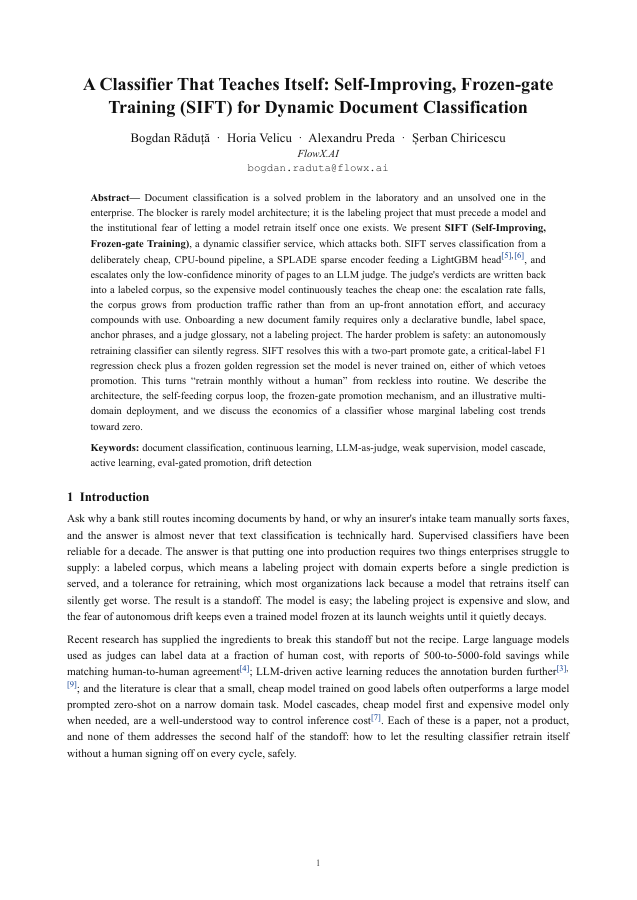
Document classification is a solved problem in the laboratory and an unsolved one in the enterprise. The blocker is rarely model architecture; it is the labeling project that must precede a model and the institutional fear of letting a model retrain itself once one exists.
20 Jul 2026
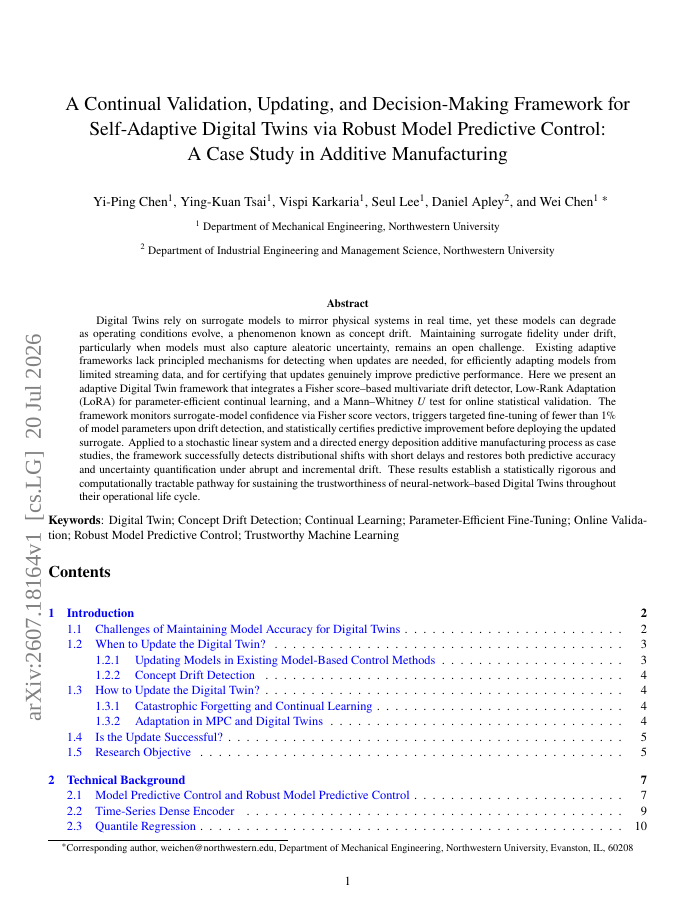
Digital Twins rely on surrogate models to mirror physical systems in real time, yet these models can degrade as operating conditions evolve, a phenomenon known as concept drift.
20 Jul 2026
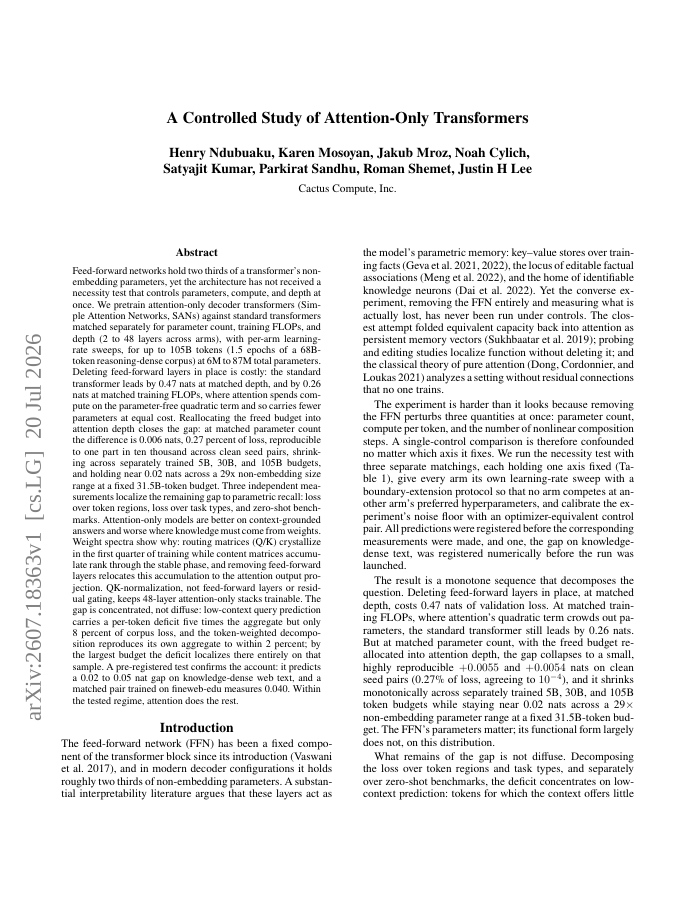
Feed-forward networks hold two thirds of a transformer's non-embedding parameters, yet the architecture has not received a necessity test that controls parameters, compute, and depth at once.
20 Jul 2026
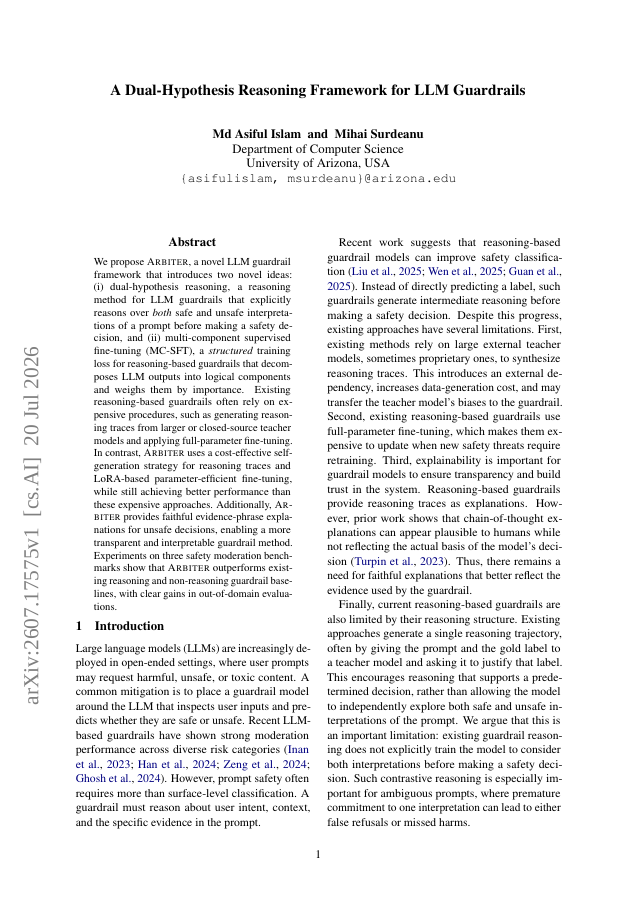
We propose ARBITER, a novel LLM guardrail framework that introduces two key ideas: (i) dual-hypothesis reasoning, a reasoning method for LLM guardrails that explicitly considers both safe and unsafe interpretations of a prompt before making a safety decision, and (ii)…
20 Jul 2026
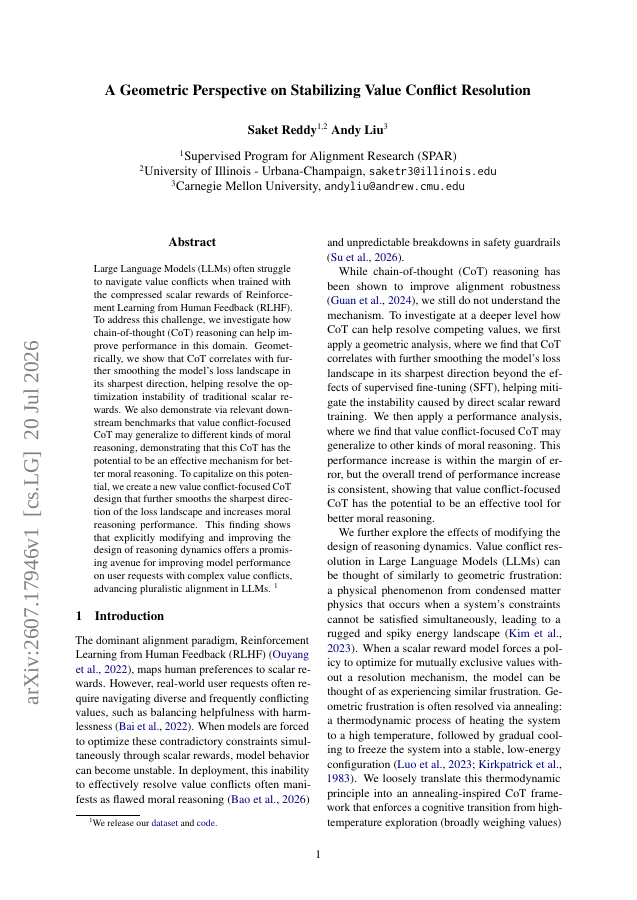
Large Language Models (LLMs) often struggle to navigate value conflicts when trained with the compressed scalar rewards of Reinforcement Learning from Human Feedback (RLHF).
20 Jul 2026
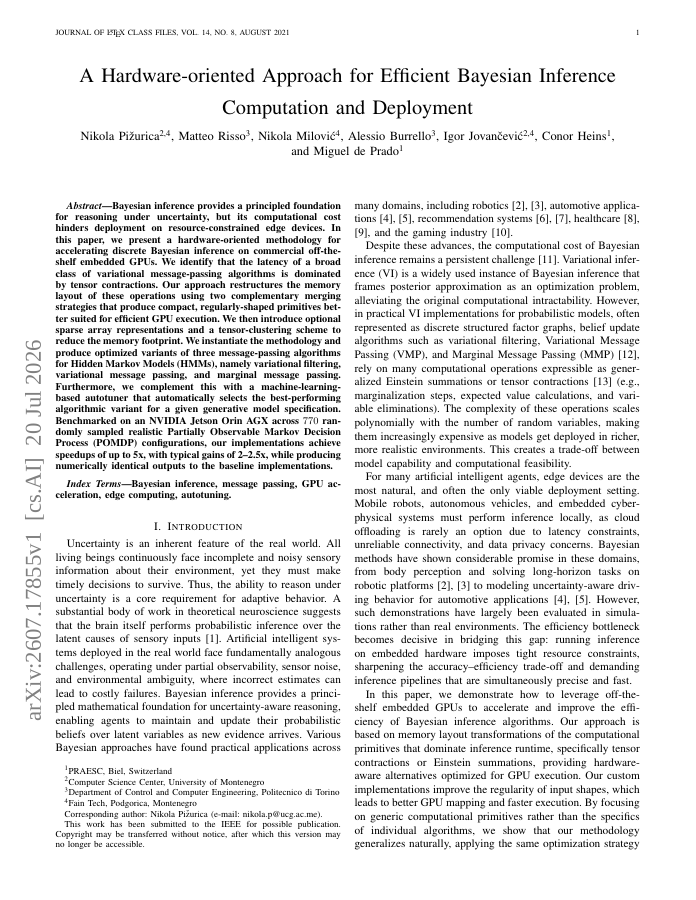
Bayesian inference provides a principled foundation for reasoning under uncertainty, but its computational cost hinders deployment on resource-constrained edge devices. In this paper, we present a hardware-oriented methodology for accelerating discrete Bayesian inference on…
20 Jul 2026
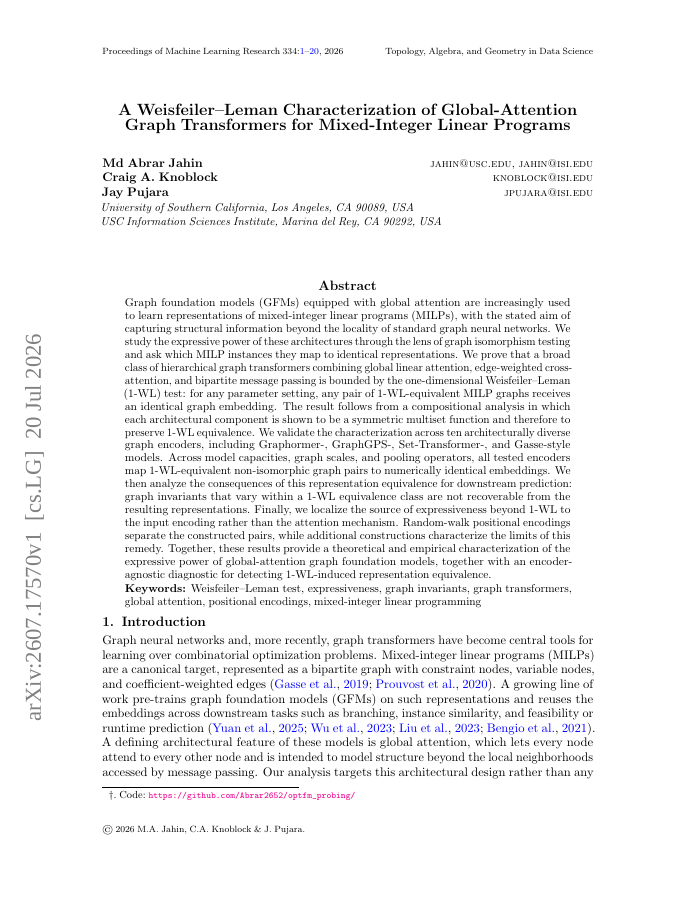
Graph foundation models (GFMs) with global attention are increasingly used to represent mixed-integer linear programs (MILPs), aiming to capture structure beyond the locality of standard graph neural networks.
19 Jul 2026
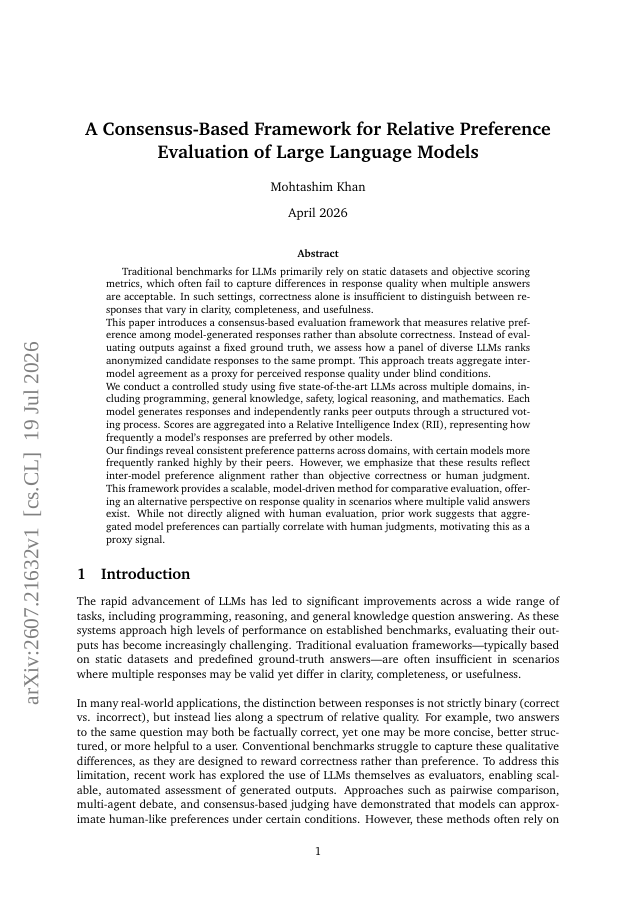
Traditional benchmarks for LLMs primarily rely on static datasets and objective scoring metrics, which often fail to capture differences in response quality when multiple answers are acceptable.
19 Jul 2026
AI agents increasingly act within the same clinical, political, scientific, and social systems that behavioral scientists study. Evaluating these systems requires source-level diagnosis: the same behavioral pattern may arise from an agent representational substrate or from the…
19 Jul 2026
Pretrained machine learning (ML) models help developers build ML-intensive software systems without training models from scratch. However, model repositories often provide incomplete machine-readable documentation about model provenance, licenses, datasets, limitations, and…
19 Jul 2026
It is crucial to safeguard computer networks from evolving network security threats and unknown cyberattacks. An essential tool for protecting computer networks against unknown cyber threats is Network Intrusion Detection System (NIDS).
19 Jul 2026
Background: Untargeted LC-MS metabolomics requires a long chain of preprocessing decisions, each with several equally defensible options. Analysts typically commit to one pipeline and report the resulting feature shortlist.
19 Jul 2026
As hyperscale and colocation AI data centers continue to expand, the electric grid is increasingly required to support large, concentrated loads, with individual facilities ranging from 500 MW to 2 GW.