9 Oct 2026
LLM agents' capabilities depend not only on their underlying models but also on their execution harnesses. Recursive self-improvement (RSI) offers a promising approach to automatically evolve these harnesses.
Trending research and the full catalog - each paper linked to the benchmarks, methods, and models it introduces.
Filtering here covers the 2,000 most recent papers, as much as one page can hold in memory. See the full index of 22,656 papers.
9 Oct 2026
LLM agents' capabilities depend not only on their underlying models but also on their execution harnesses. Recursive self-improvement (RSI) offers a promising approach to automatically evolve these harnesses.
17 Sep 2026
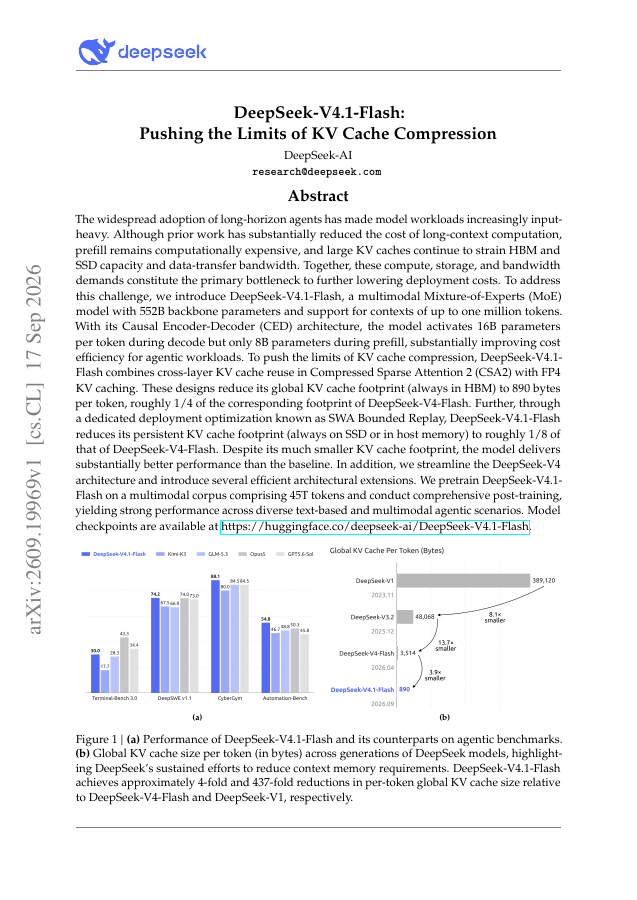
The widespread adoption of long-horizon agents has made model workloads increasingly input-heavy. Although prior work has substantially reduced the cost of long-context computation, prefill remains computationally expensive, and large KV caches continue to strain HBM and SSD…
6 Oct 2026
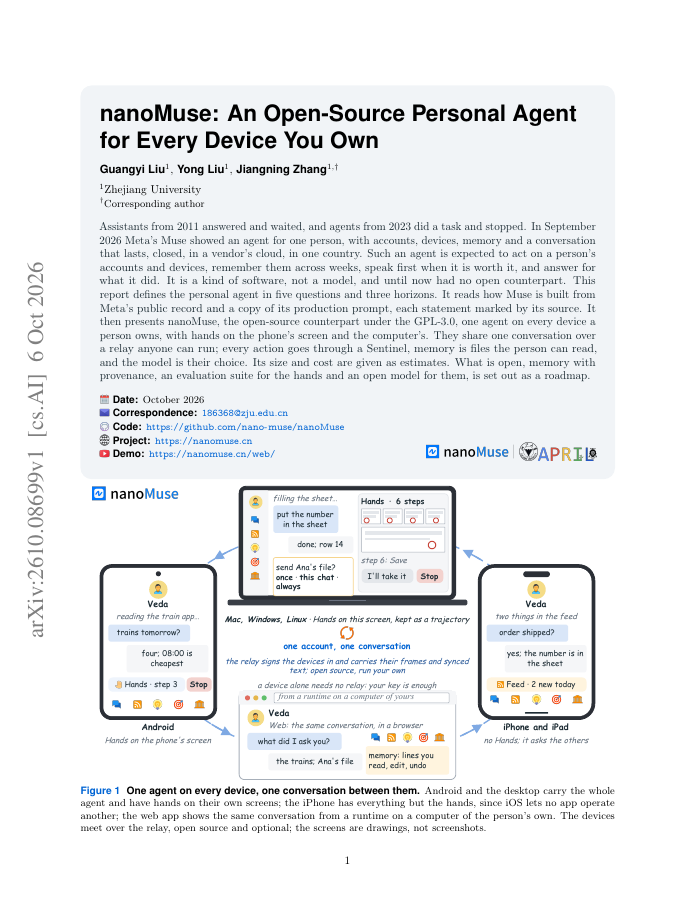
Assistants from 2011 answered and waited, and agents from 2023 did a task and stopped. In September 2026 Meta's Muse showed an agent for one person, with accounts, devices, memory and a conversation that lasts, closed, in a vendor's cloud, in one country.
8 Oct 2026
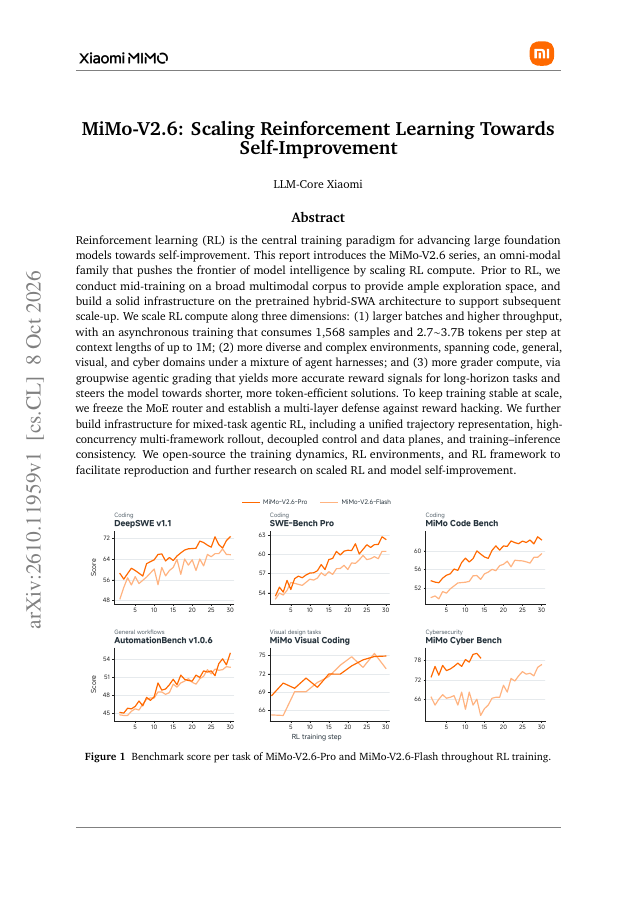
Reinforcement learning (RL) is the central training paradigm for advancing large foundation models towards self-improvement. This report introduces the MiMo-V2.6 series, an omni-modal family that pushes the frontier of model intelligence by scaling RL compute.
19 Oct 2026
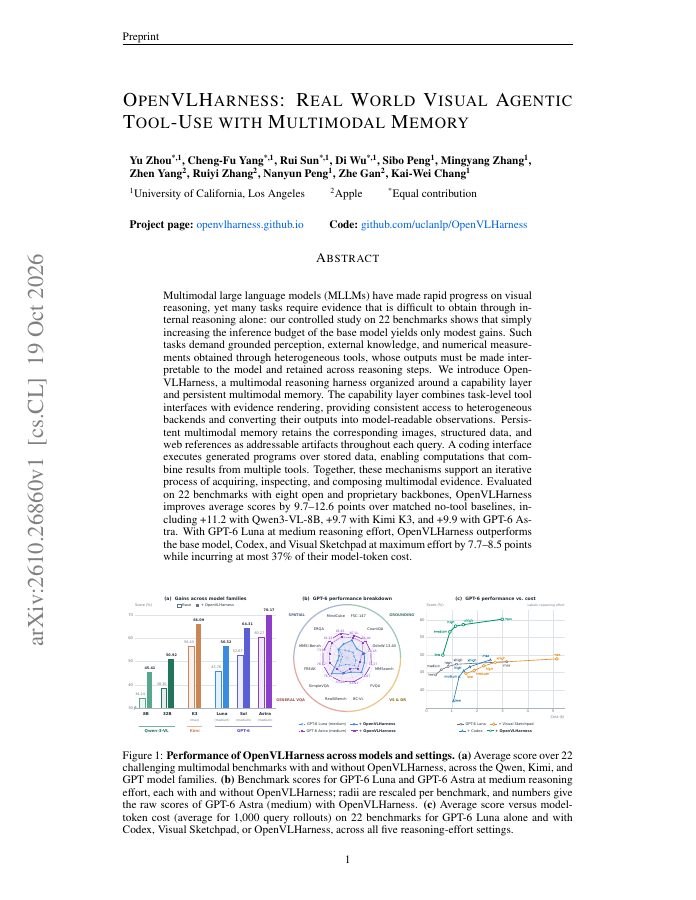
Multimodal large language models (MLLMs) have made rapid progress on visual reasoning, yet many tasks require evidence that is difficult to obtain through internal reasoning alone: our controlled study on 22 benchmarks shows that simply increasing the inference budget of the…
13 Oct 2026
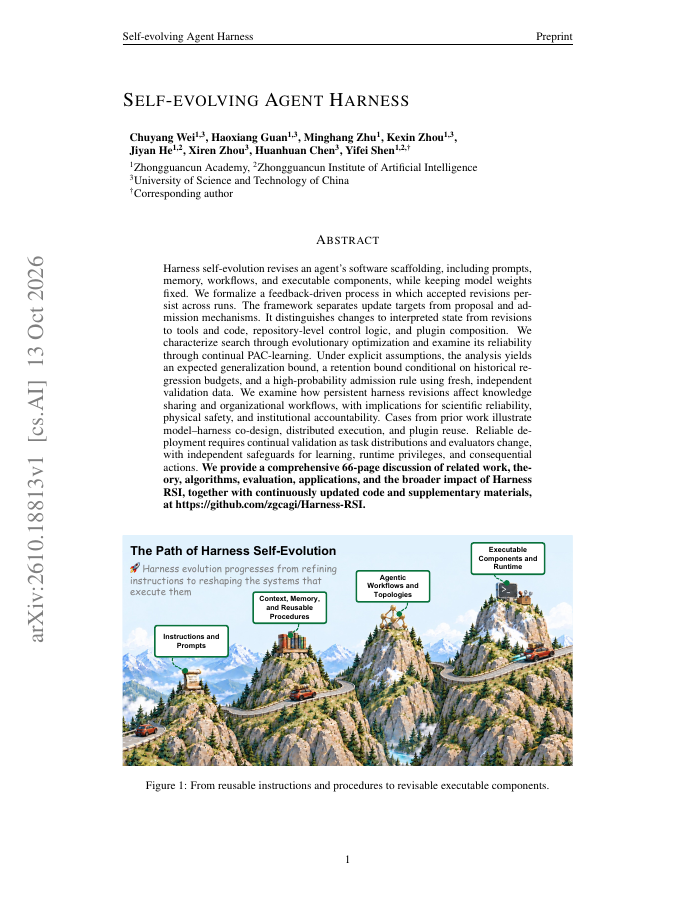
Harness self-evolution revises an agent's software scaffolding, including prompts, memory, workflows, and executable components, while keeping model weights fixed. We formalize a feedback-driven process in which accepted revisions persist across runs.
15 Jun 2026
Personalized presentation generation requires more than conditioning on a current prompt or template: agents must preserve stable user preferences across tasks, retain newly introduced preferences and constraints during multi-turn revision, and carry out local edits reliably.
5 Jul 2026
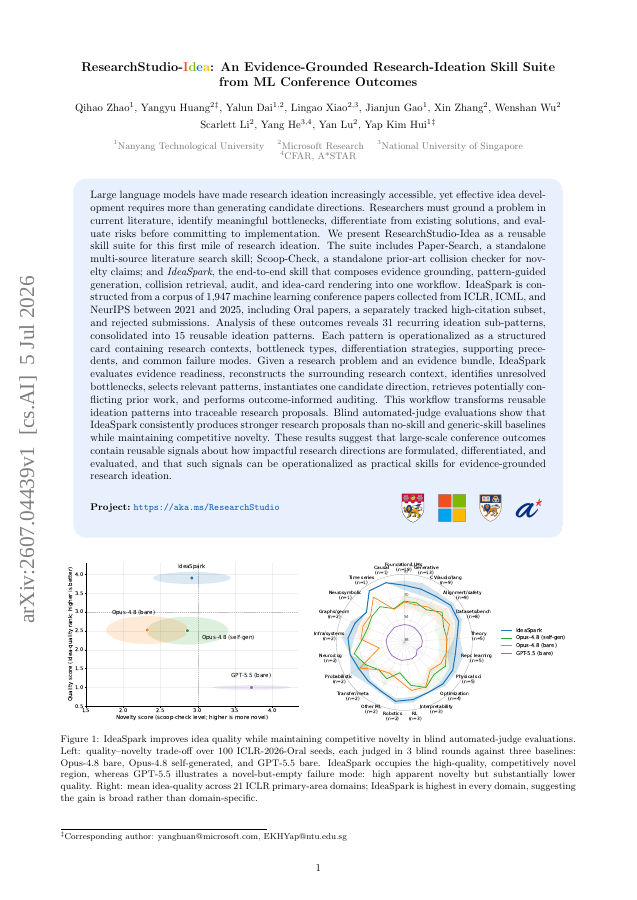
Large language models have made research ideation increasingly accessible, yet effective idea development requires more than generating candidate directions. Researchers must ground a problem in current literature, identify meaningful bottlenecks, differentiate from existing…
25 Aug 2026
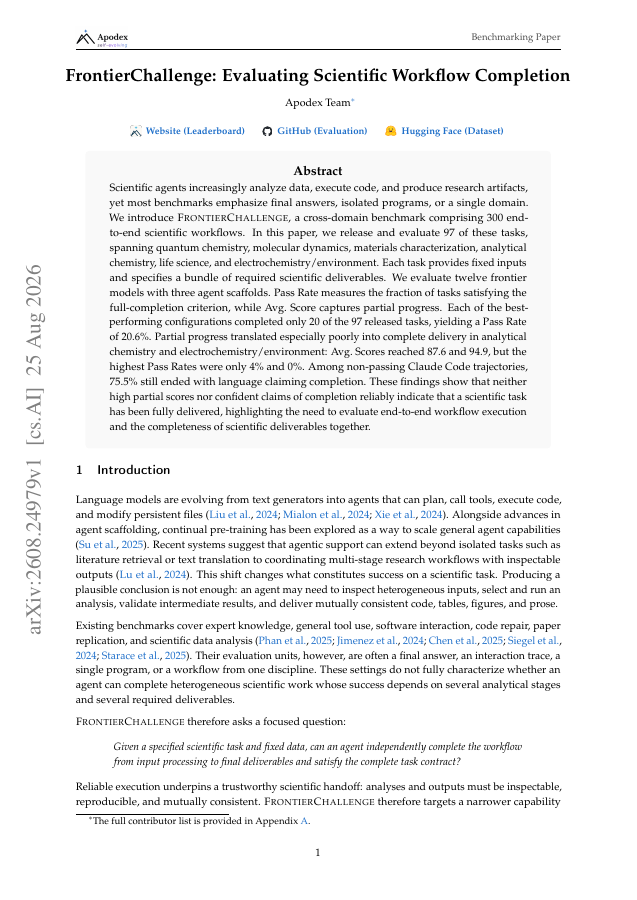
Scientific agents increasingly analyze data, execute code, and produce research artifacts, yet most benchmarks emphasize final answers, isolated programs, or a single domain. We introduce FrontierChallenge, a cross-domain benchmark comprising 300 end-to-end scientific workflows.
4 Sep 2026
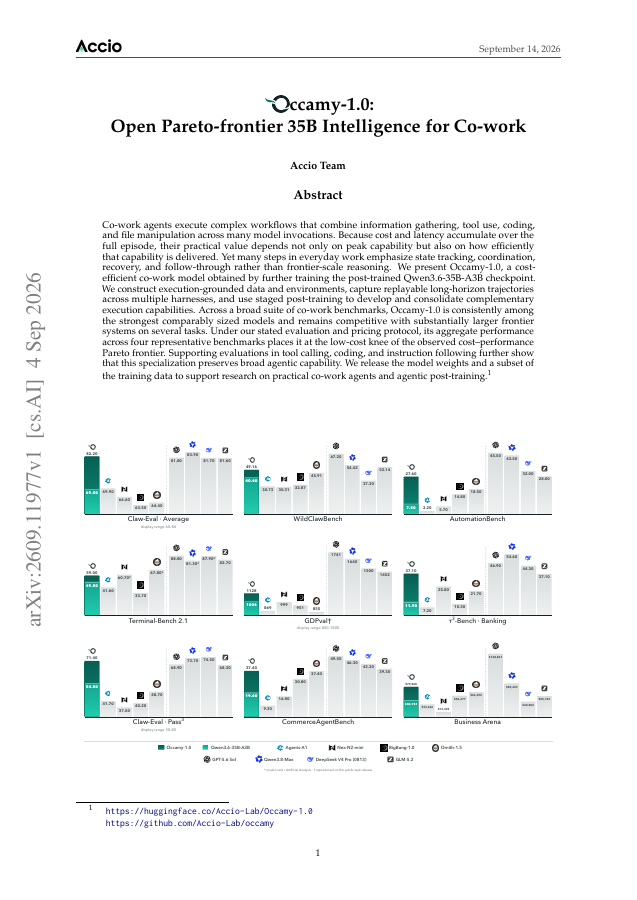
Co-work agents execute complex workflows that combine information gathering, tool use, coding, and file manipulation across many model invocations. Because cost and latency accumulate over the full episode, their practical value depends not only on peak capability but also on…
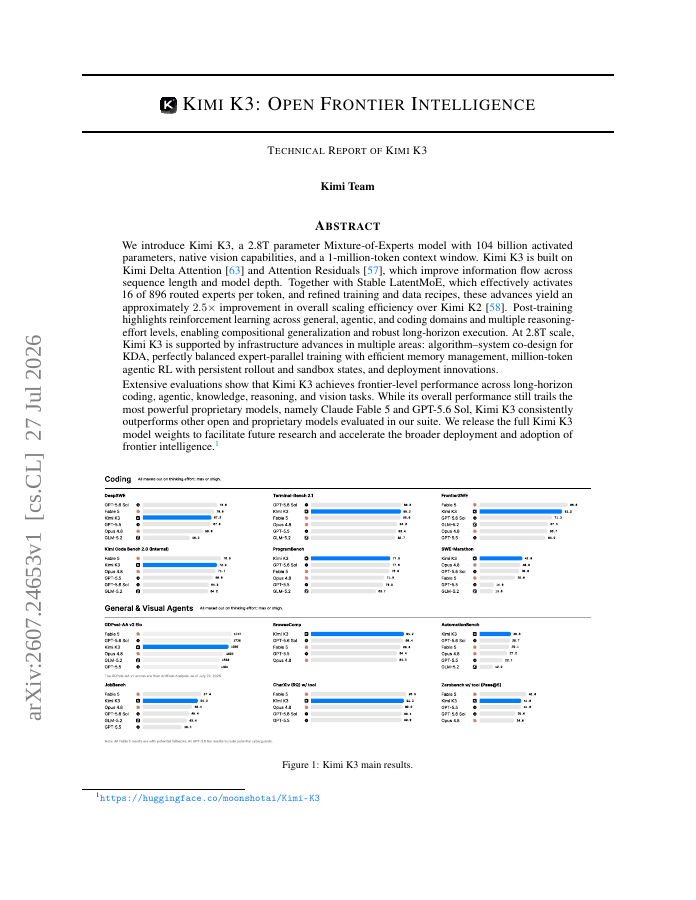
27 Jul 2026
We introduce Kimi K3, a 2.8T parameter Mixture-of-Experts model with 104 billion activated parameters, native vision capabilities, and a 1-million-token context window. Kimi K3 is built on Kimi Delta Attention and Attention Residuals, which improve information flow across…
9 Sep 2026
Foundation vision-language models (VLMs) exhibit broad intelligence about the world, yet translating this intelligence into robot control remains challenging. We present Show-Harness, an Embodied Harness that enables VLMs to "play" robots through a compact semantic…
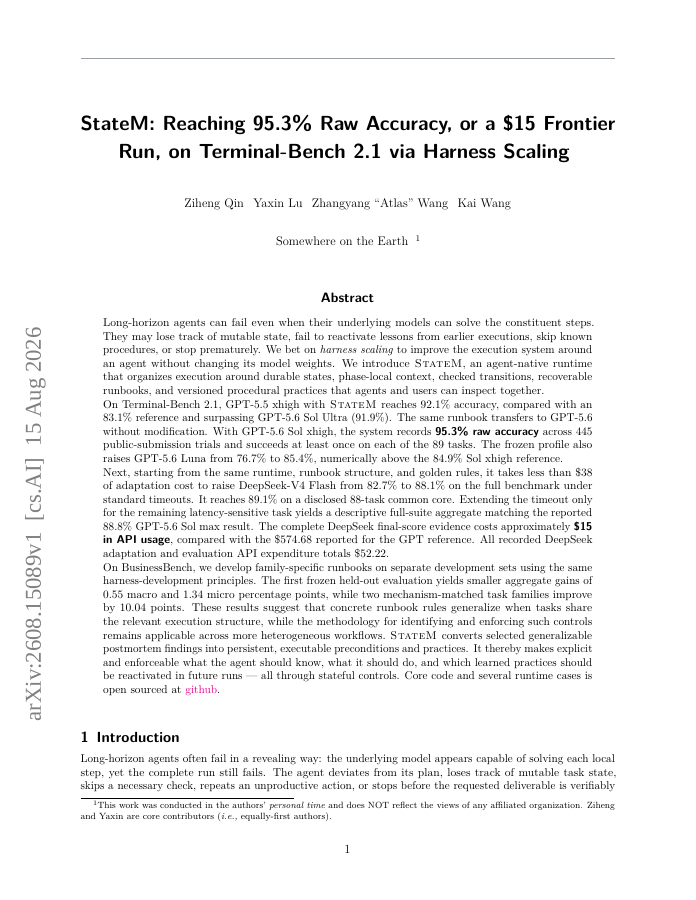
15 Aug 2026
Long-horizon agents can fail even when their underlying models can solve the constituent steps. They may lose track of mutable state, fail to reactivate lessons from earlier executions, skip known procedures, or stop prematurely.
8 Jun 2026
Agent benchmarks score submissions with outcome verifiers that are typically hand-written and brittle, leaving them open to reward hacking. We audit 1,968 tasks across five terminal-agent benchmarks and find 323 (16%) hackable by frontier models given only the task description.
24 Jul 2026
Large Language Models (LLMs) have significantly advanced the automation of scientific discovery. However, existing systems share a core limitation: they optimize ideas independently for either Quality or Diversity.
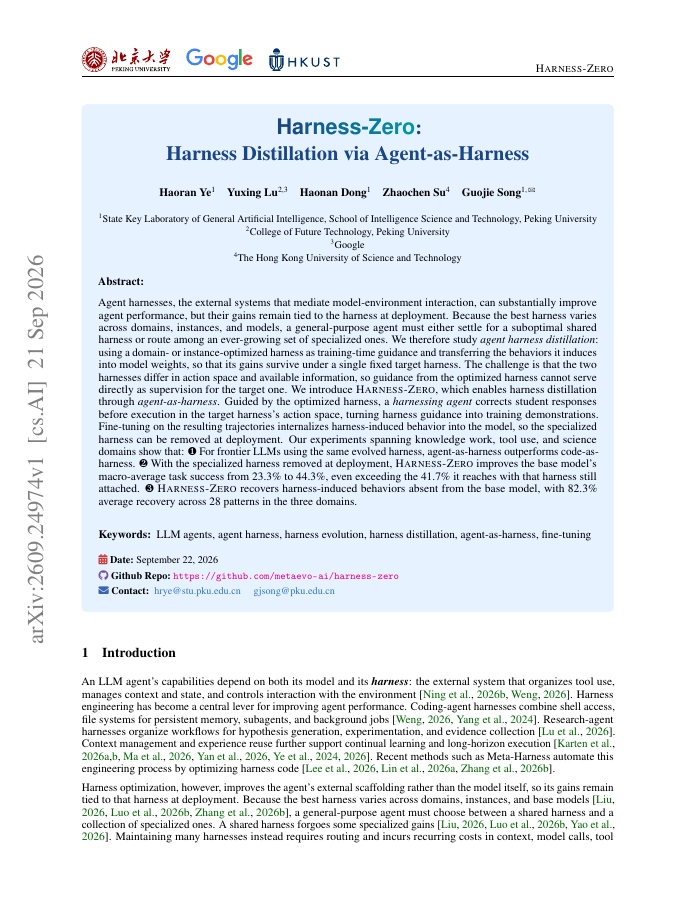
21 Sep 2026
Agent harnesses, the external systems that mediate model-environment interaction, can substantially improve agent performance, but their gains remain tied to the harness at deployment.
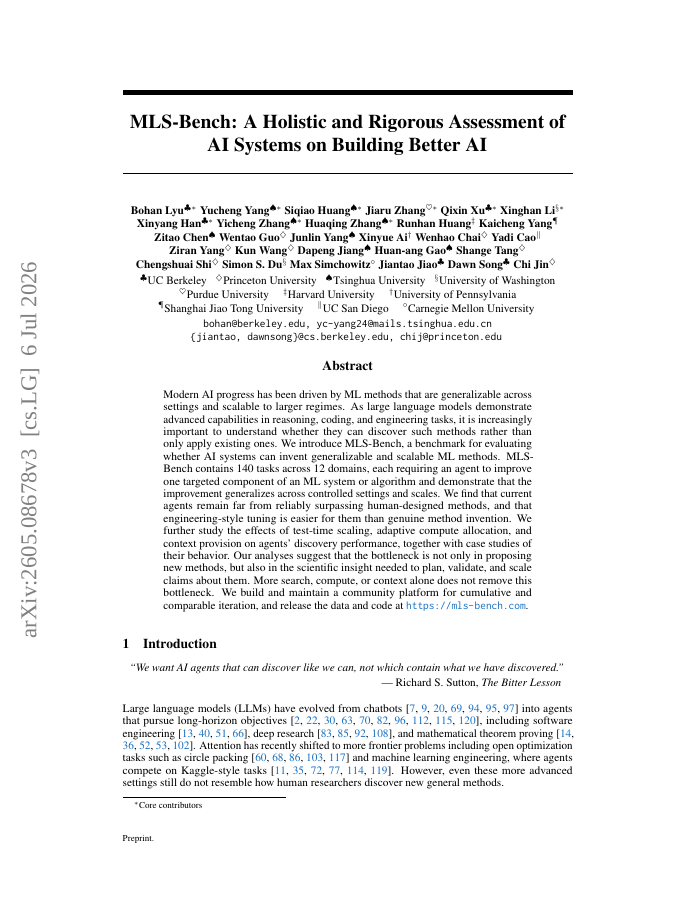
Dawn Song, Jiantao Jiao, Wenhao Chai et al. · 27 May 2026
Modern AI progress has been driven by ML methods that are generalizable across settings and scalable to larger regimes. As large language models demonstrate advanced capabilities in reasoning, coding, and engineering tasks, it is increasingly important to understand whether they…
27 Sep 2026
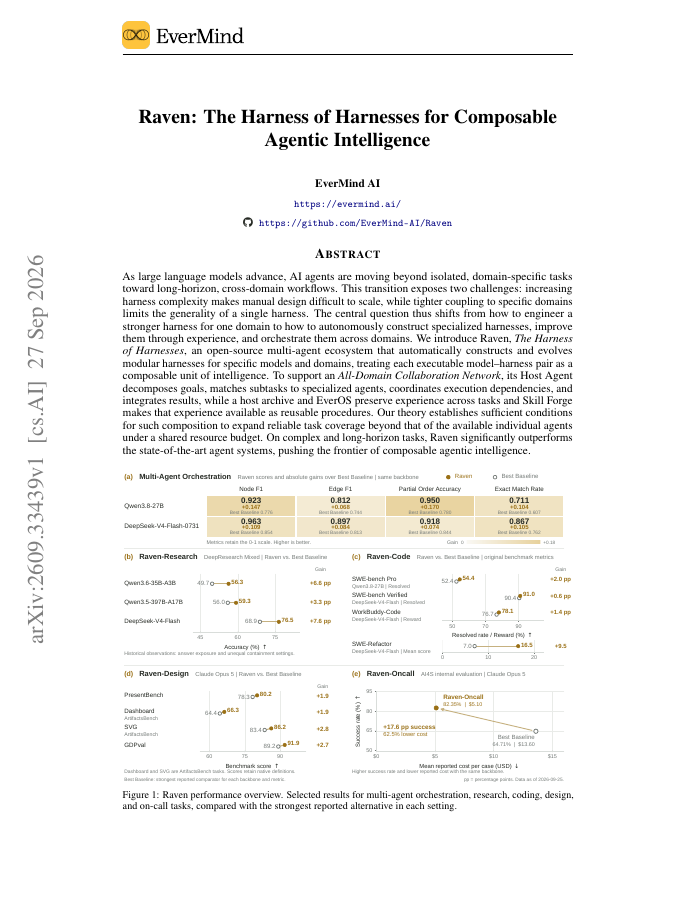
As large language models advance, AI agents are moving beyond isolated, domain-specific tasks toward long-horizon, cross-domain workflows. This transition exposes two challenges: increasing harness complexity makes manual design difficult to scale, while tighter coupling to…
15 Oct 2026
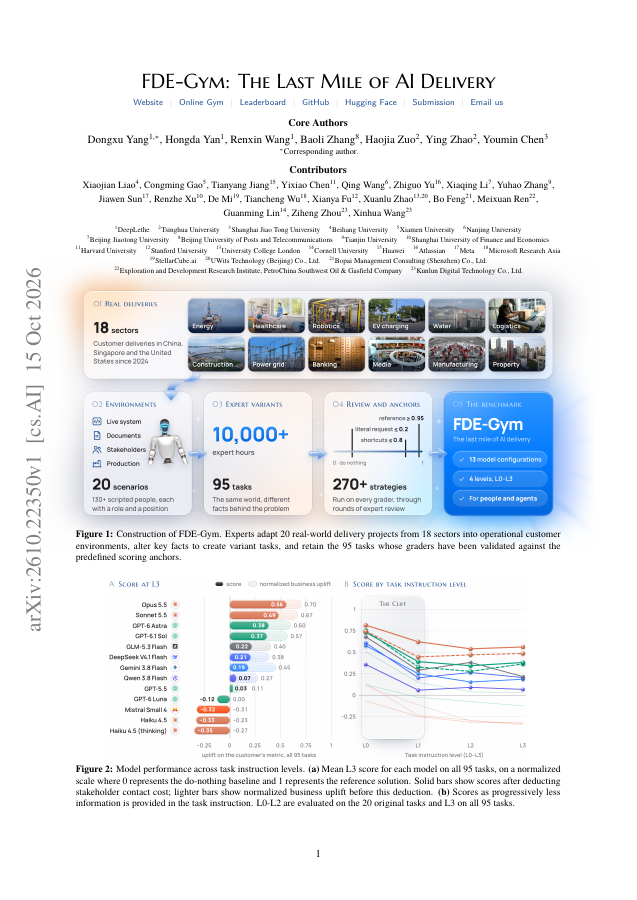
Existing agent benchmarks typically evaluate agents on well-specified tasks defined by issue reports, specifications, or task tickets. Real-world customer delivery is different: forward-deployed engineers (FDEs) must clarify ambiguous requirements, work in live systems, and…
19 Oct 2026
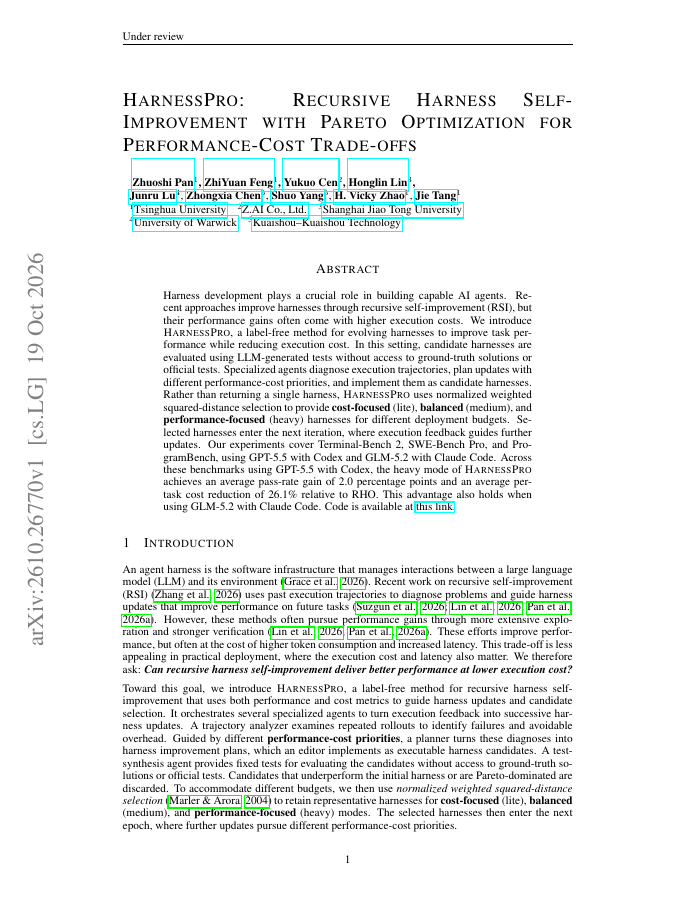
Harness development plays a crucial role in building capable AI agents. Recent approaches improve harnesses through recursive self-improvement (RSI), but their performance gains often come with higher execution costs.
20 Oct 2026
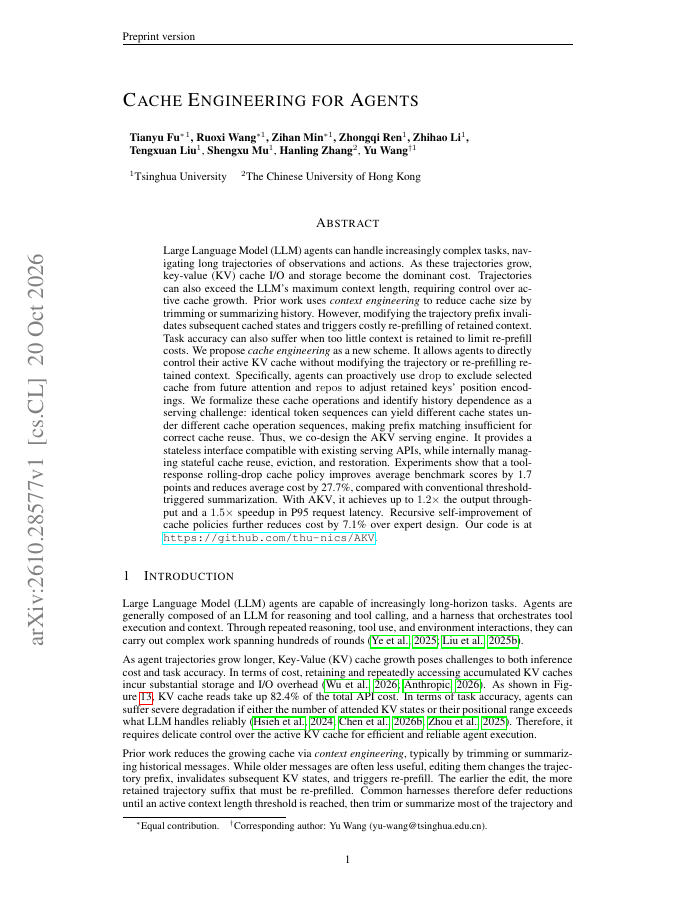
Large Language Model (LLM) agents can handle increasingly complex tasks, navigating long trajectories of observations and actions. As these trajectories grow, key-value (KV) cache I/O and storage become the dominant cost.
19 Oct 2026
Medical workflows often require multiple interdependent analyses, but existing specialist and generalist AI models are not designed to coordinate them. We introduce MMedAgent-Plus, a multimodal medical tool-use agent that combines a vision-language planner with 18 leading…