9 Oct 2026
LLM agents' capabilities depend not only on their underlying models but also on their execution harnesses. Recursive self-improvement (RSI) offers a promising approach to automatically evolve these harnesses.
Trending research and the full catalog - each paper linked to the benchmarks, methods, and models it introduces.
Filtering here covers the 2,000 most recent papers, as much as one page can hold in memory. See the full index of 22,663 papers.
9 Oct 2026
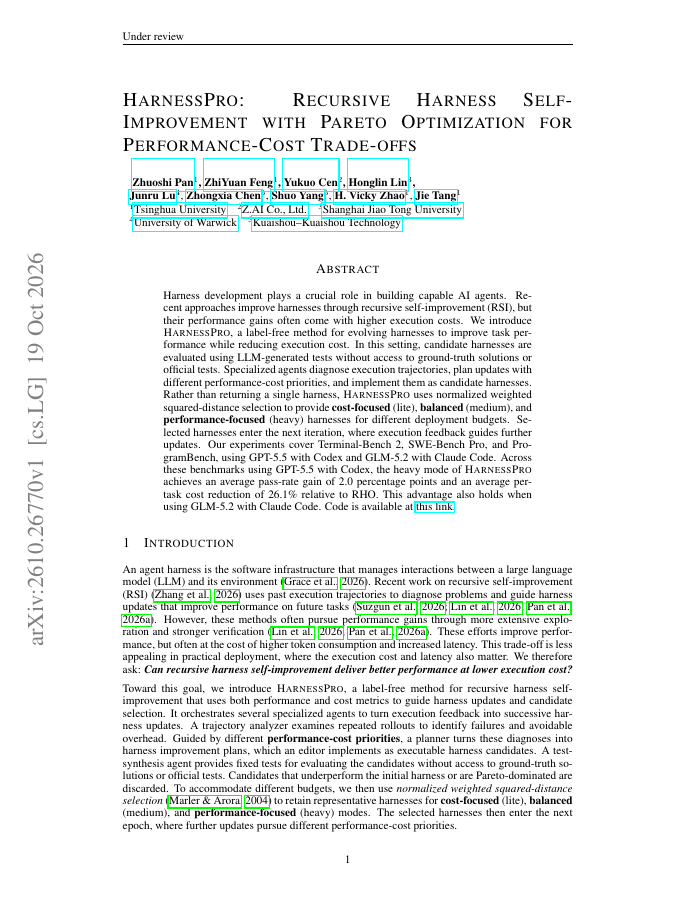
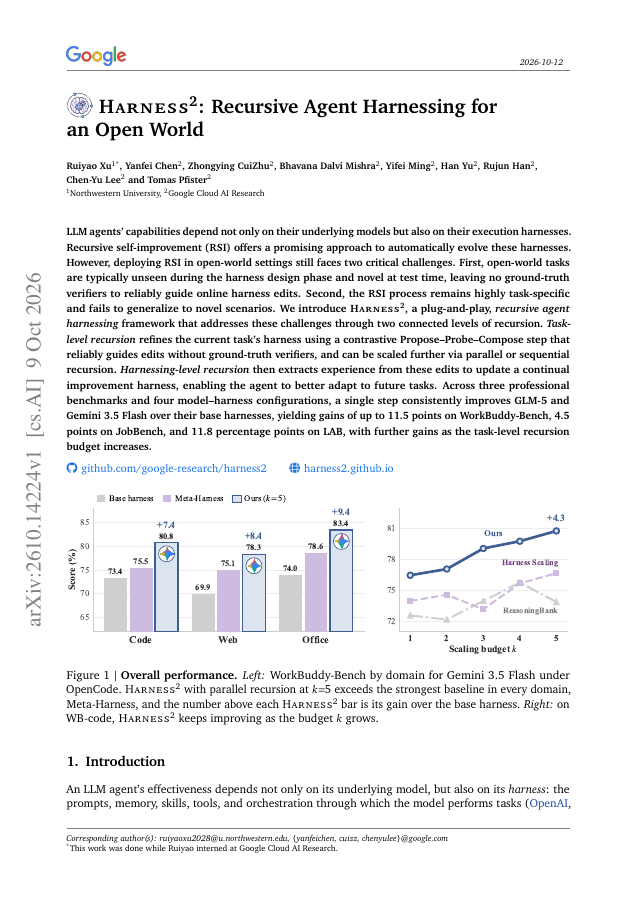
LLM agents' capabilities depend not only on their underlying models but also on their execution harnesses. Recursive self-improvement (RSI) offers a promising approach to automatically evolve these harnesses.
8 Oct 2026
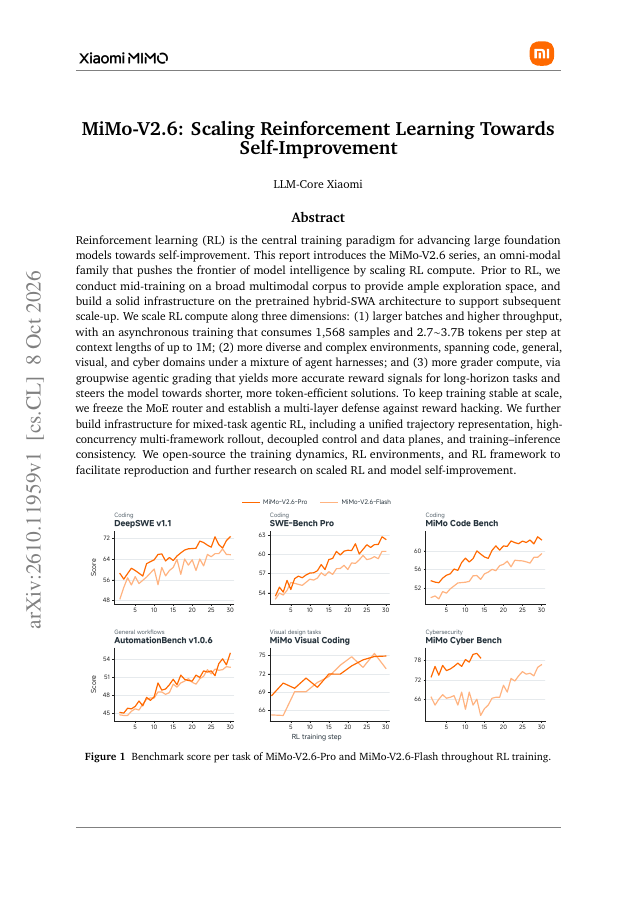
Reinforcement learning (RL) is the central training paradigm for advancing large foundation models towards self-improvement. This report introduces the MiMo-V2.6 series, an omni-modal family that pushes the frontier of model intelligence by scaling RL compute.
17 Sep 2026
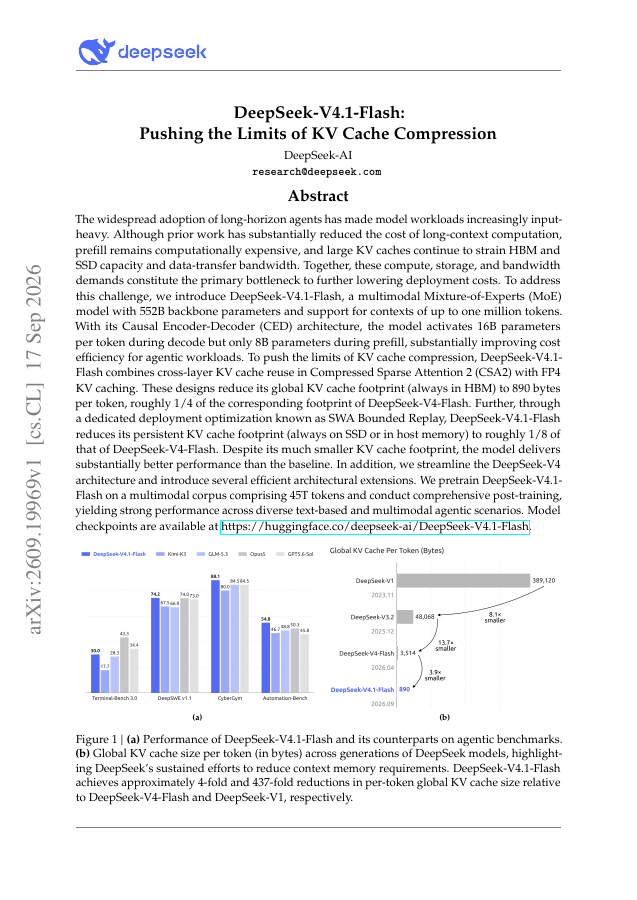
The widespread adoption of long-horizon agents has made model workloads increasingly input-heavy. Although prior work has substantially reduced the cost of long-context computation, prefill remains computationally expensive, and large KV caches continue to strain HBM and SSD…
6 Oct 2026
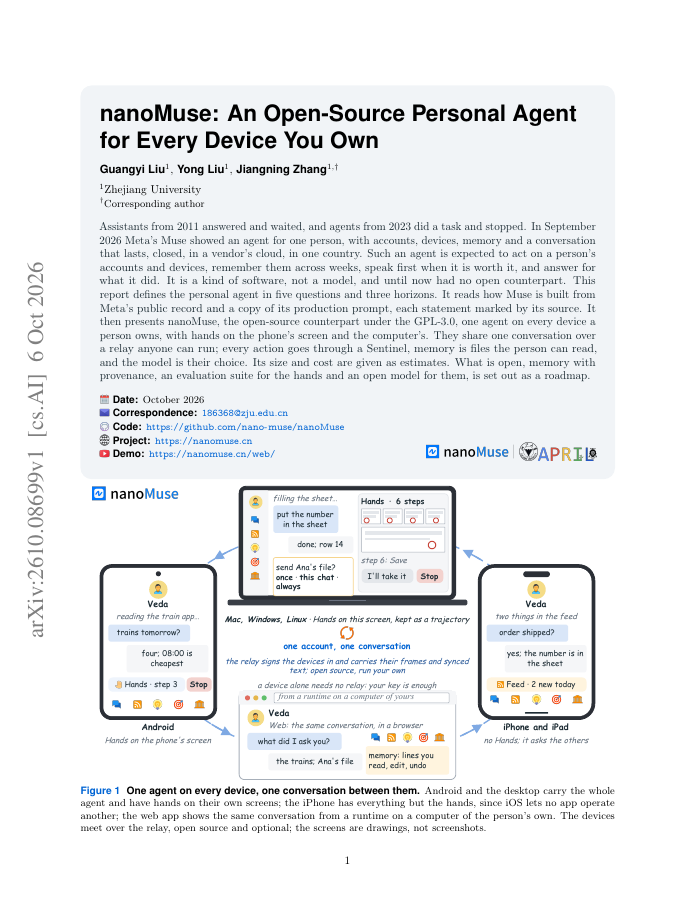
Assistants from 2011 answered and waited, and agents from 2023 did a task and stopped. In September 2026 Meta's Muse showed an agent for one person, with accounts, devices, memory and a conversation that lasts, closed, in a vendor's cloud, in one country.
4 Sep 2026
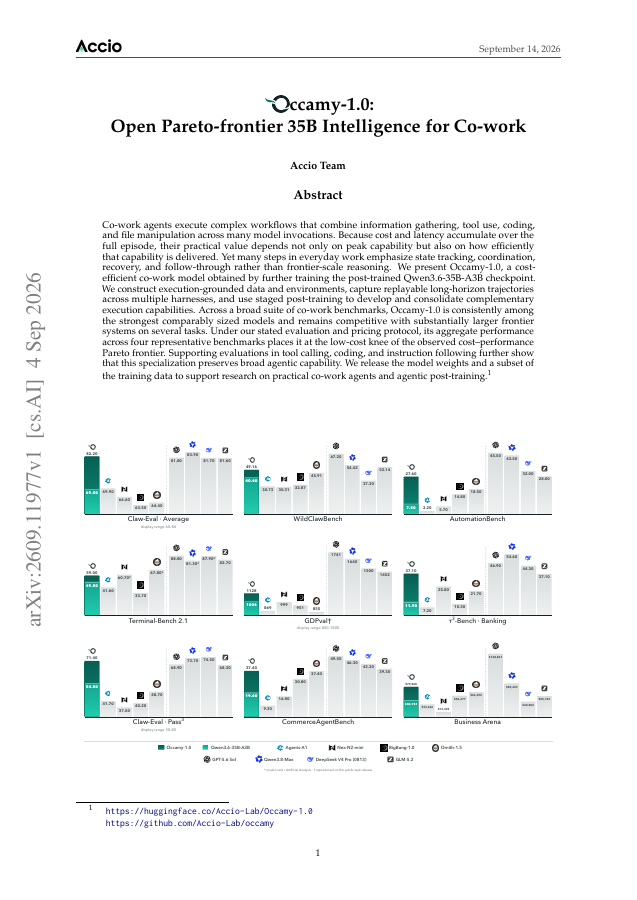
Co-work agents execute complex workflows that combine information gathering, tool use, coding, and file manipulation across many model invocations. Because cost and latency accumulate over the full episode, their practical value depends not only on peak capability but also on…
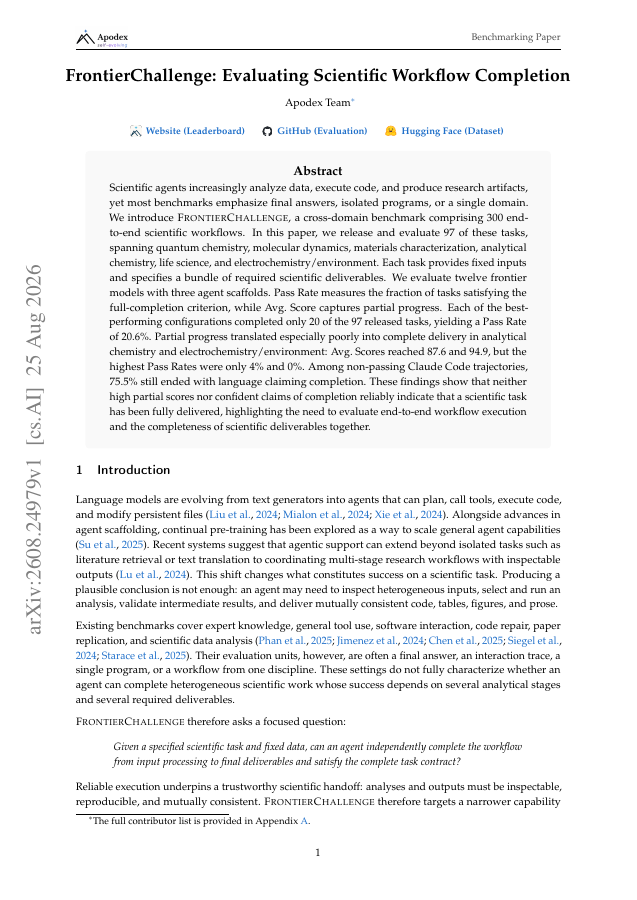
25 Aug 2026
Scientific agents increasingly analyze data, execute code, and produce research artifacts, yet most benchmarks emphasize final answers, isolated programs, or a single domain. We introduce FrontierChallenge, a cross-domain benchmark comprising 300 end-to-end scientific workflows.
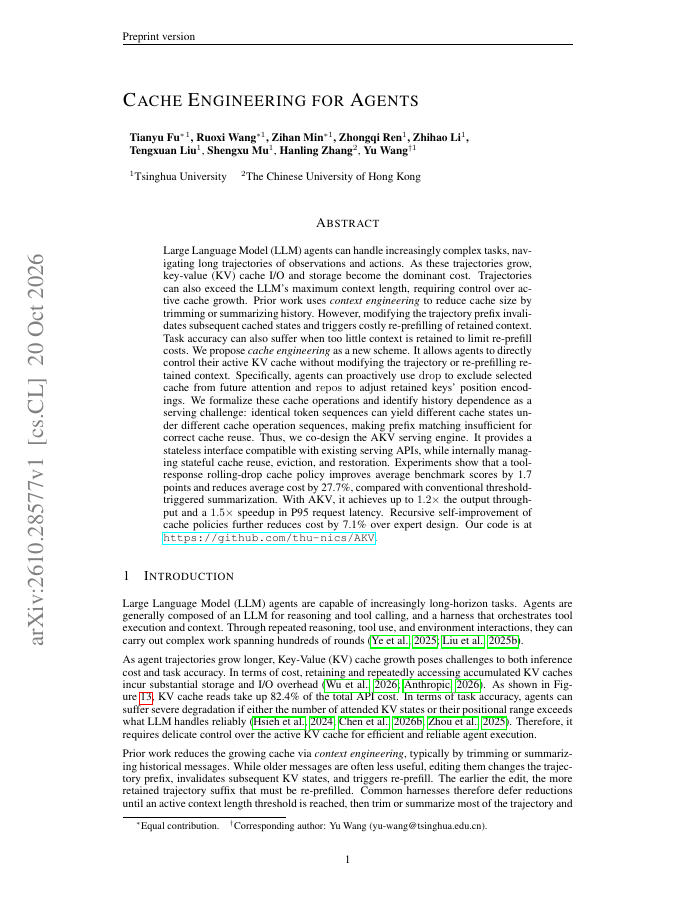
20 Oct 2026
Large Language Model (LLM) agents can handle increasingly complex tasks, navigating long trajectories of observations and actions. As these trajectories grow, key-value (KV) cache I/O and storage become the dominant cost.
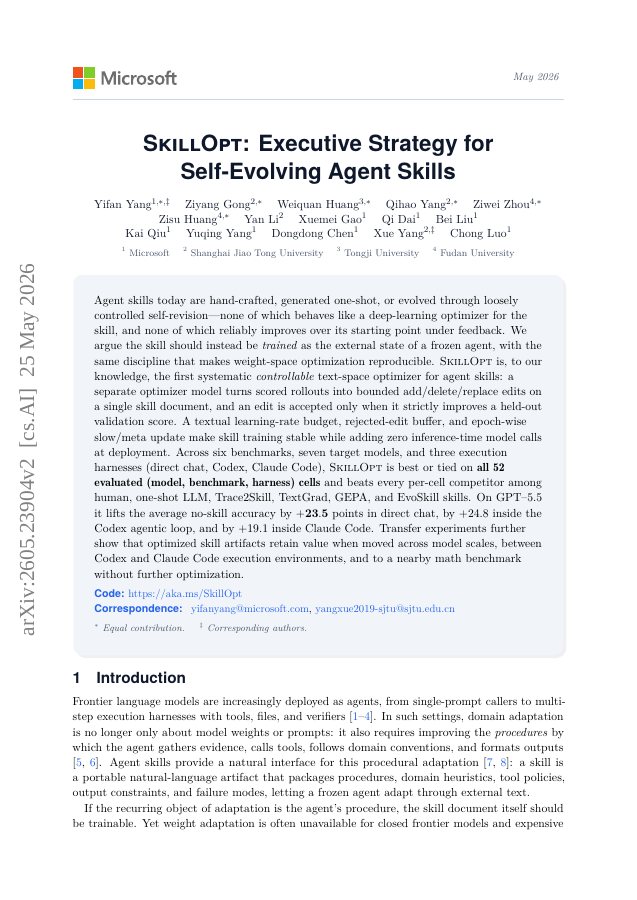
Yifan Yang, Ziyang Gong, Weiquan Huang et al. · 22 May 2026
Agent skills today are hand-crafted, generated one-shot, or evolved through loosely controlled self-revision, none of which behaves like a deep-learning optimizer for the skill, and none of which reliably improves over its starting point under feedback.
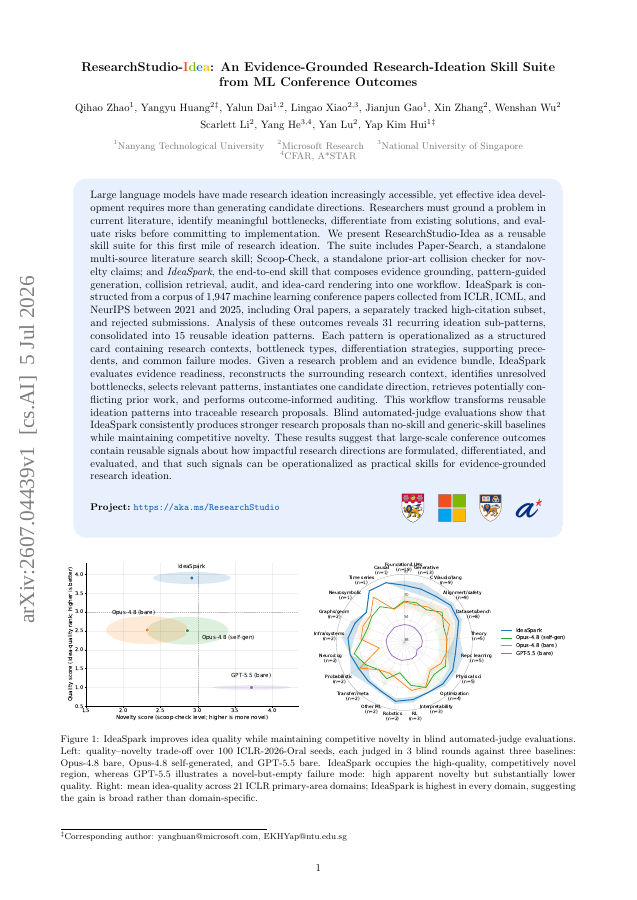
5 Jul 2026
Large language models have made research ideation increasingly accessible, yet effective idea development requires more than generating candidate directions. Researchers must ground a problem in current literature, identify meaningful bottlenecks, differentiate from existing…
19 Oct 2026
Harness development plays a crucial role in building capable AI agents. Recent approaches improve harnesses through recursive self-improvement (RSI), but their performance gains often come with higher execution costs.
15 Jun 2026
Personalized presentation generation requires more than conditioning on a current prompt or template: agents must preserve stable user preferences across tasks, retain newly introduced preferences and constraints during multi-turn revision, and carry out local edits reliably.
12 Jun 2026
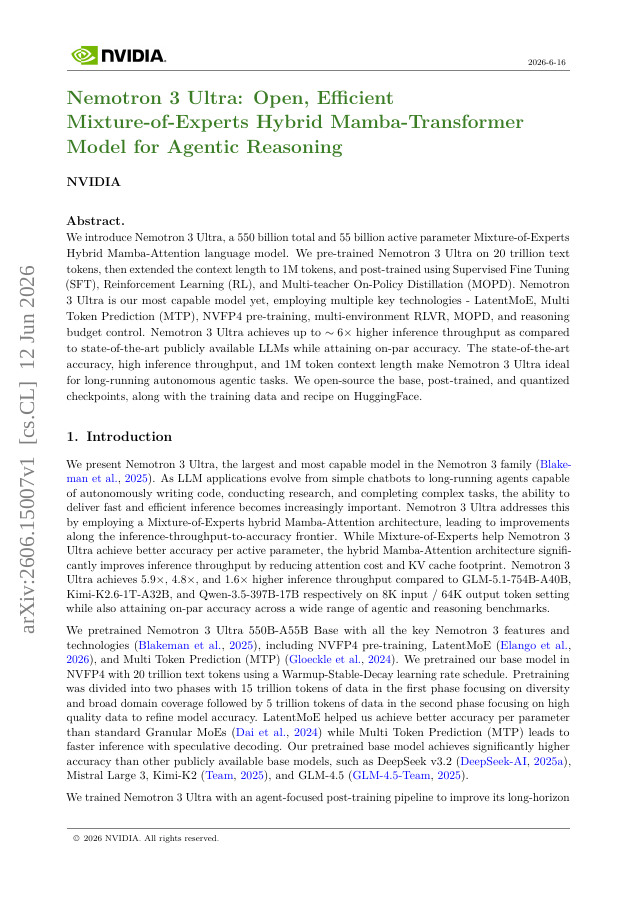
We introduce Nemotron 3 Ultra, a 550 billion total and 55 billion active parameter Mixture-of-Experts Hybrid Mamba-Attention language model. We pre-trained Nemotron 3 Ultra on 20 trillion text tokens, then extended the context length to 1M tokens, and post-trained using…
21 Sep 2026
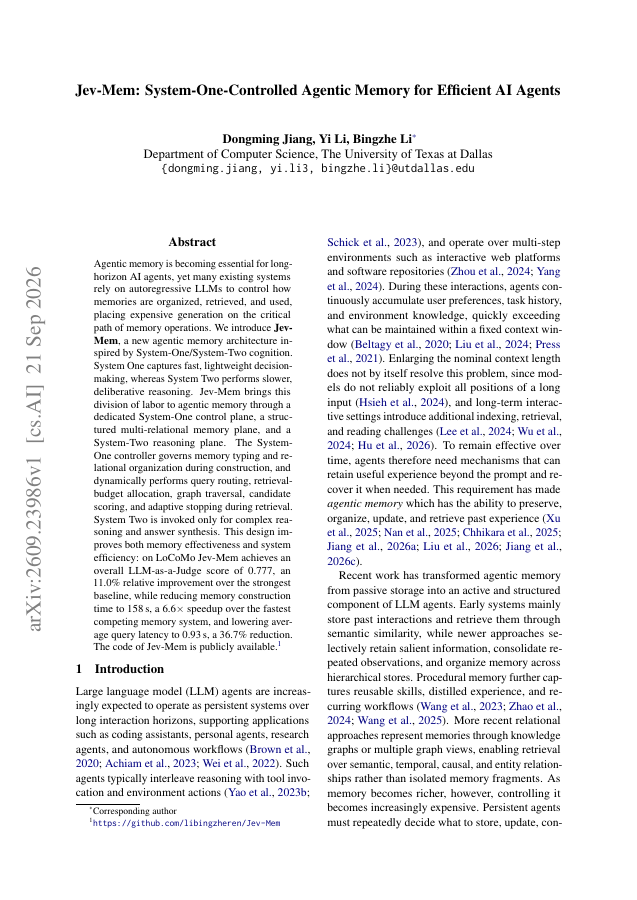
Agentic memory is becoming essential for long-horizon AI agents, yet many existing systems rely on autoregressive LLMs to control how memories are organized, retrieved, and used, placing expensive generation on the critical path of memory operations.
Caiming Xiong, Xiao Wang, Jiaqi Liu et al. · 19 May 2026
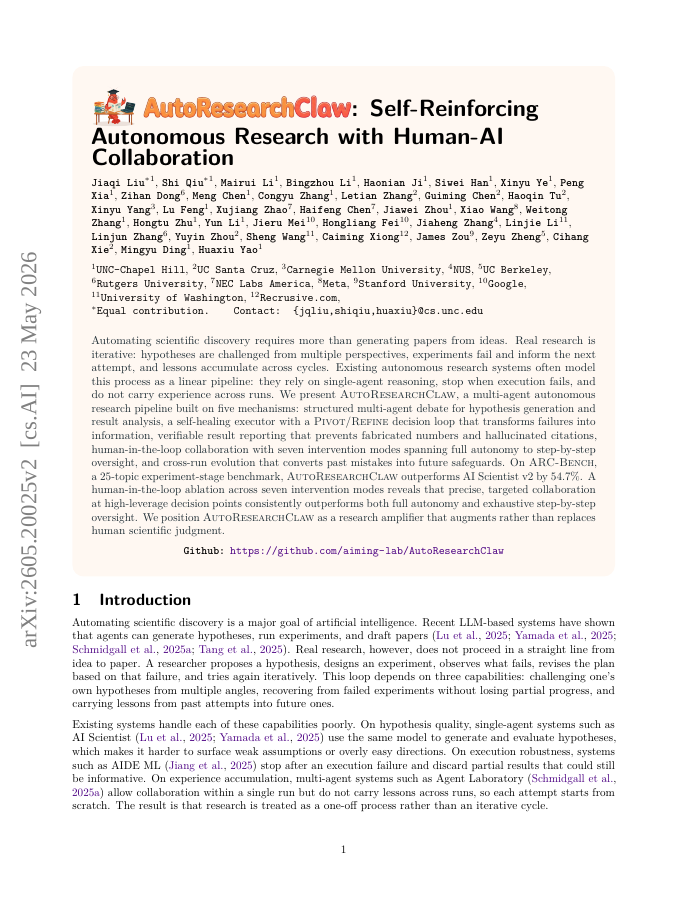
Automating scientific discovery requires more than generating papers from ideas.
Jiebo Luo, Ziyun Zeng, Zhenghong Zhou et al. · 18 May 2026
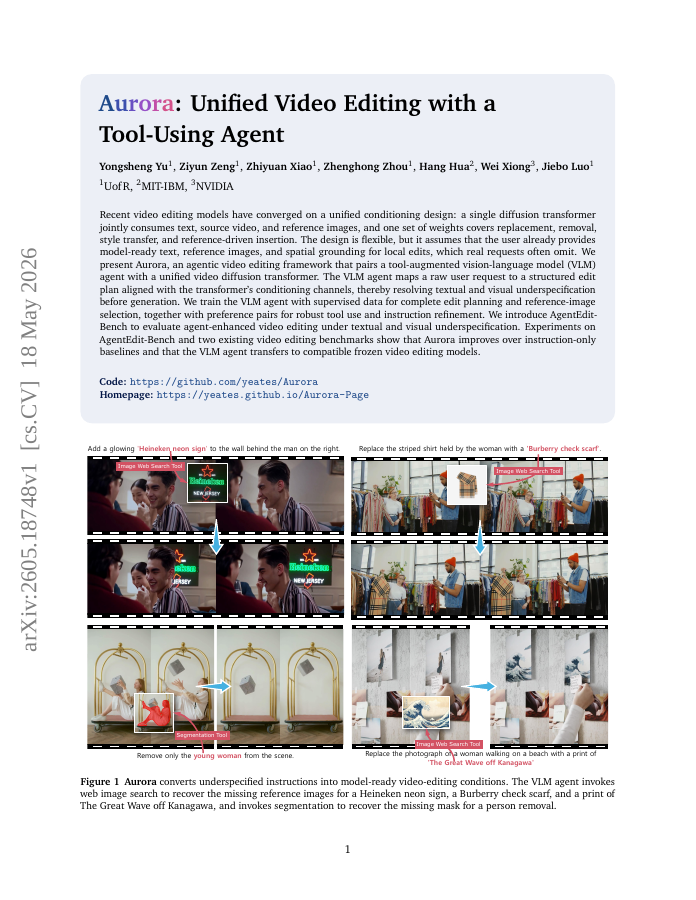
Aurora is an agentic video editing framework that combines a vision-language model agent with a diffusion transformer to handle textual and visual underspecification in video editing requests.
18 Jun 2026
Agent benchmarks are growing fast, but no single benchmark touches more than four or five of the dimensions that deployment exposes. This paper aggregates the largest coordinated deep-dive of one MCP-based industrial-agent benchmark to date: fourteen parallel implementation…
27 Sep 2026
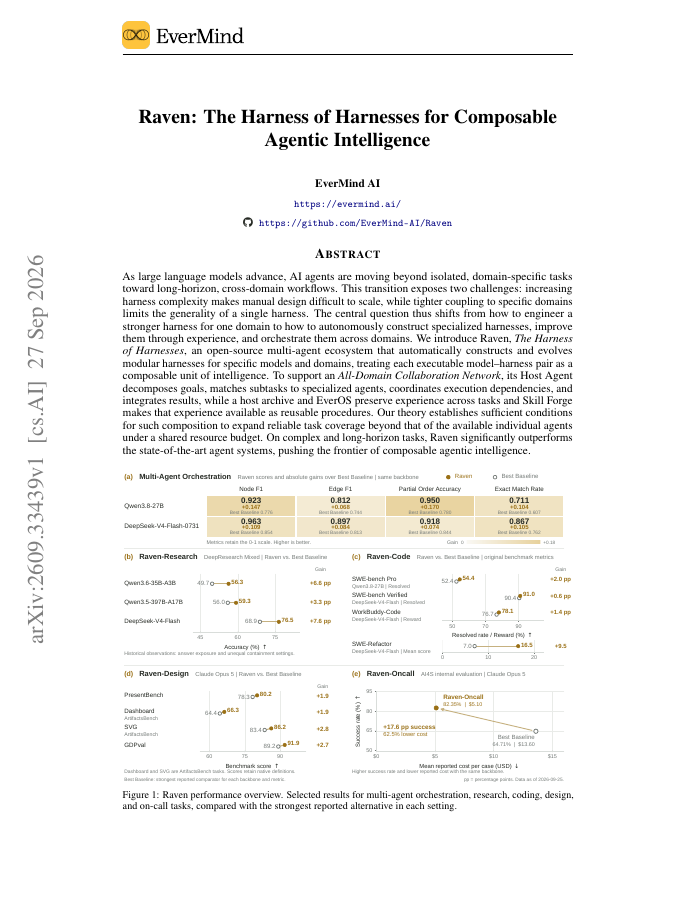
As large language models advance, AI agents are moving beyond isolated, domain-specific tasks toward long-horizon, cross-domain workflows. This transition exposes two challenges: increasing harness complexity makes manual design difficult to scale, while tighter coupling to…
19 Oct 2026
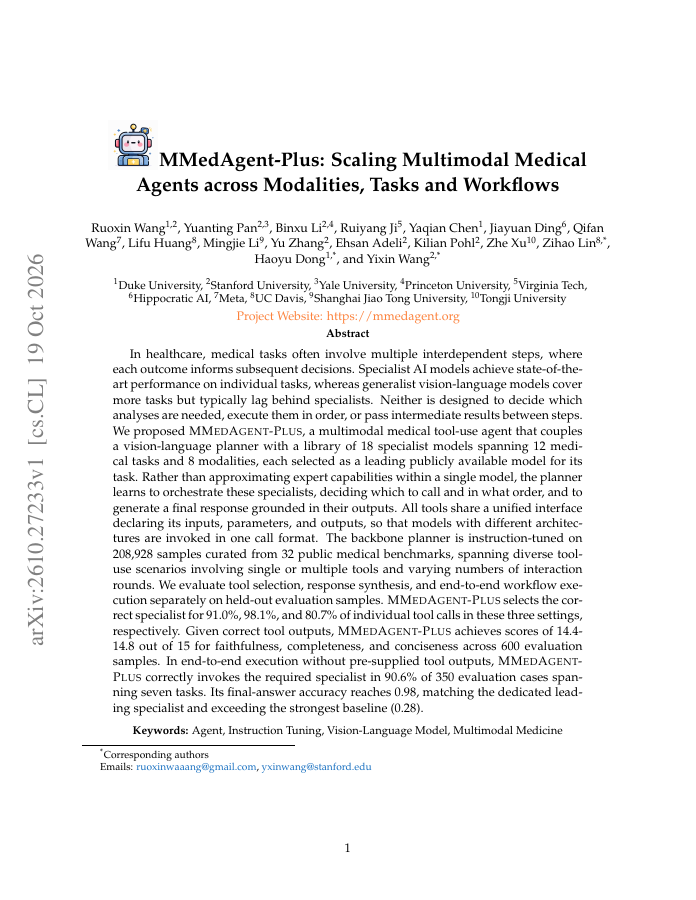
Medical workflows often require multiple interdependent analyses, but existing specialist and generalist AI models are not designed to coordinate them. We introduce MMedAgent-Plus, a multimodal medical tool-use agent that combines a vision-language planner with 18 leading…
13 Oct 2026
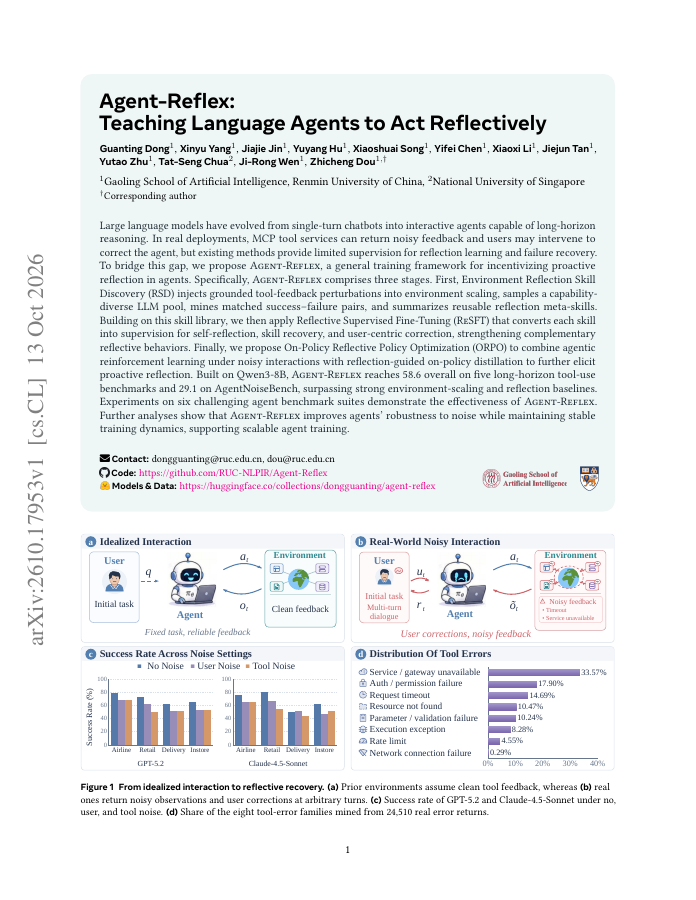
Large language models have evolved from single-turn chatbots into interactive agents capable of long-horizon reasoning. In real deployments, MCP tool services can return noisy feedback and users may intervene to correct the agent, but existing methods provide limited supervision…
19 Oct 2026
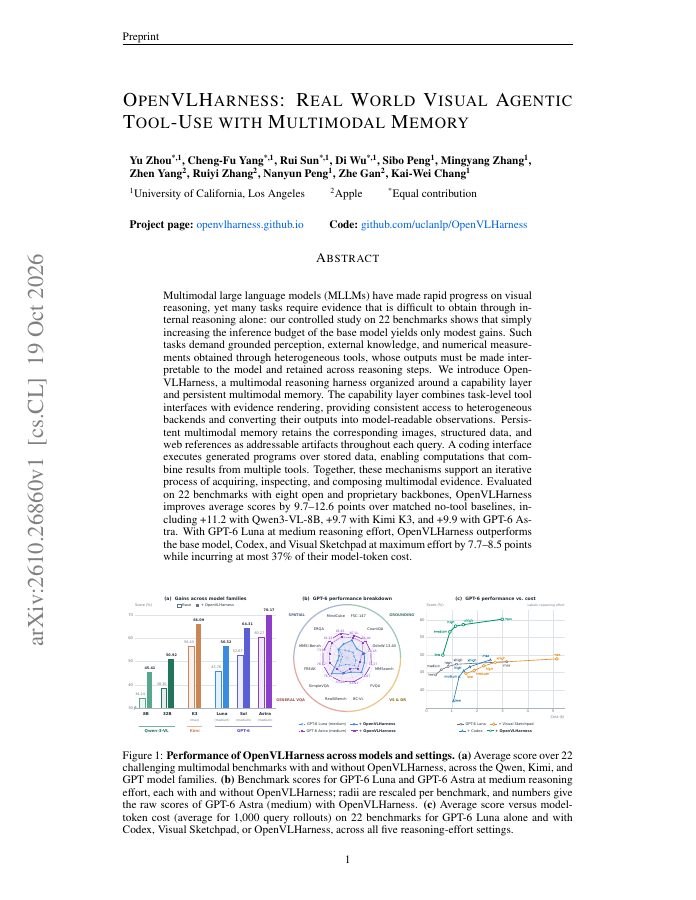
Multimodal large language models (MLLMs) have made rapid progress on visual reasoning, yet many tasks require evidence that is difficult to obtain through internal reasoning alone: our controlled study on 22 benchmarks shows that simply increasing the inference budget of the…
21 Oct 2026
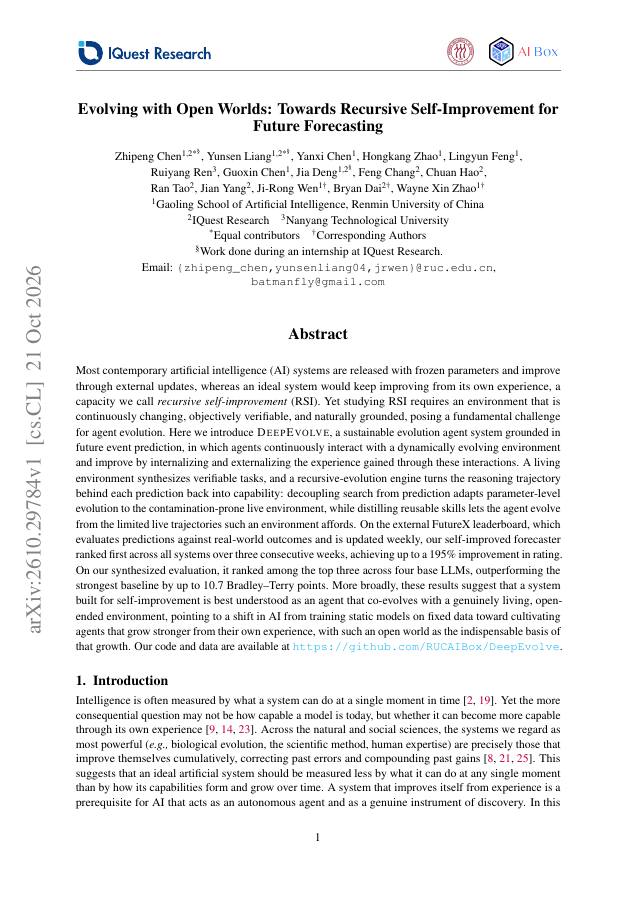
Most contemporary artificial intelligence (AI) systems are released with frozen parameters and improve through external updates, whereas an ideal system would keep improving from its own experience, a capacity we call recursive self-improvement (RSI).