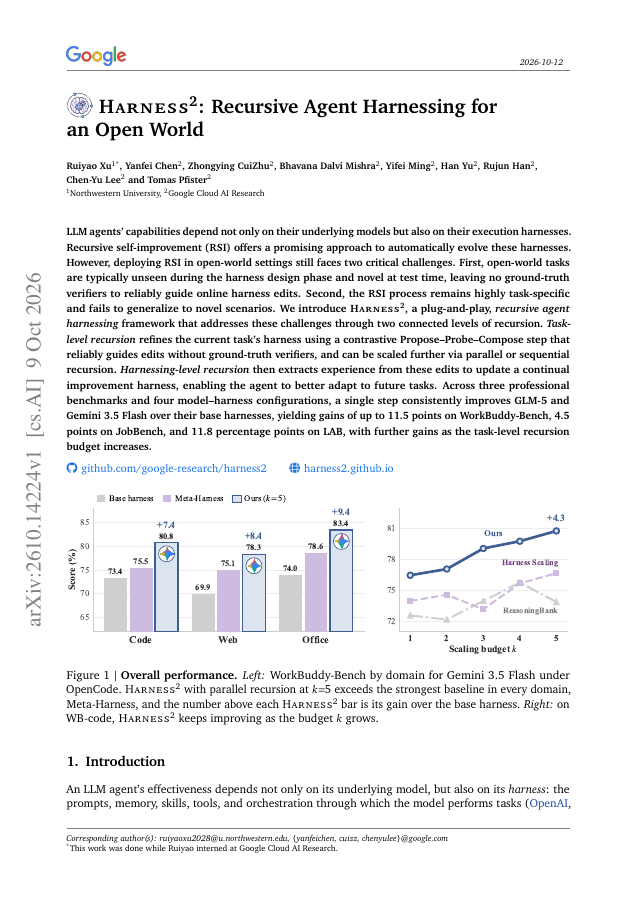
9 Oct 2026
LLM agents' capabilities depend not only on their underlying models but also on their execution harnesses. Recursive self-improvement (RSI) offers a promising approach to automatically evolve these harnesses.
Trending research and the full catalog - each paper linked to the benchmarks, methods, and models it introduces.
Filtering here covers the 2,000 most recent papers, as much as one page can hold in memory. See the full index of 22,712 papers.
9 Oct 2026
LLM agents' capabilities depend not only on their underlying models but also on their execution harnesses. Recursive self-improvement (RSI) offers a promising approach to automatically evolve these harnesses.
8 Oct 2026
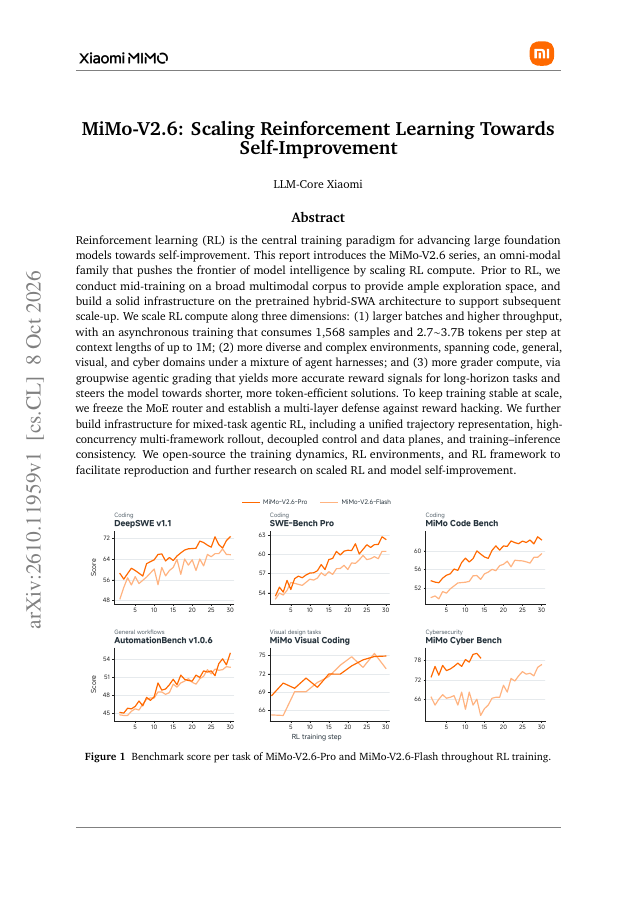
Reinforcement learning (RL) is the central training paradigm for advancing large foundation models towards self-improvement. This report introduces the MiMo-V2.6 series, an omni-modal family that pushes the frontier of model intelligence by scaling RL compute.
6 Oct 2026
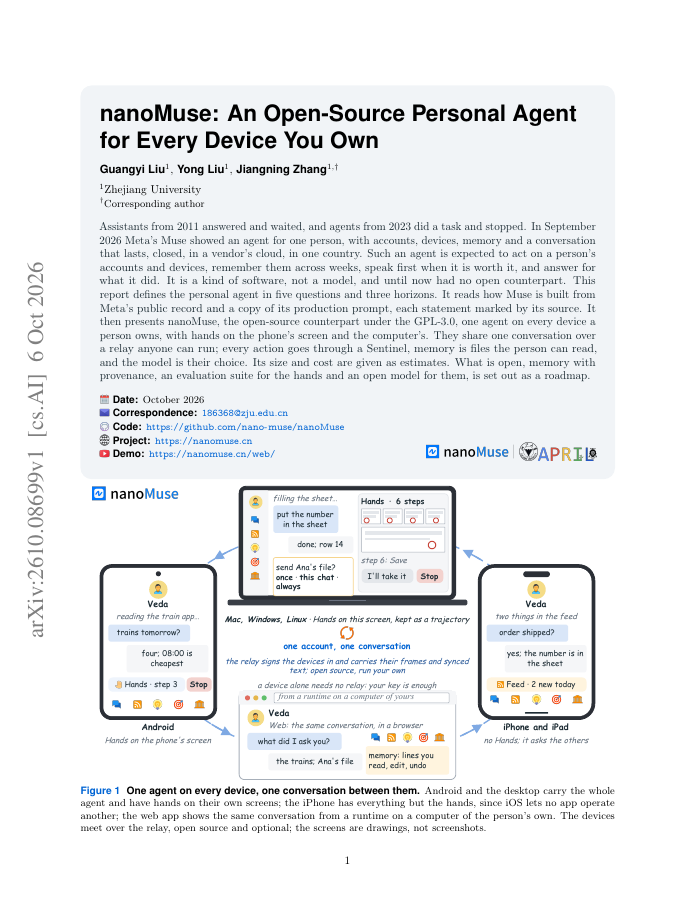
Assistants from 2011 answered and waited, and agents from 2023 did a task and stopped. In September 2026 Meta's Muse showed an agent for one person, with accounts, devices, memory and a conversation that lasts, closed, in a vendor's cloud, in one country.
19 Oct 2026
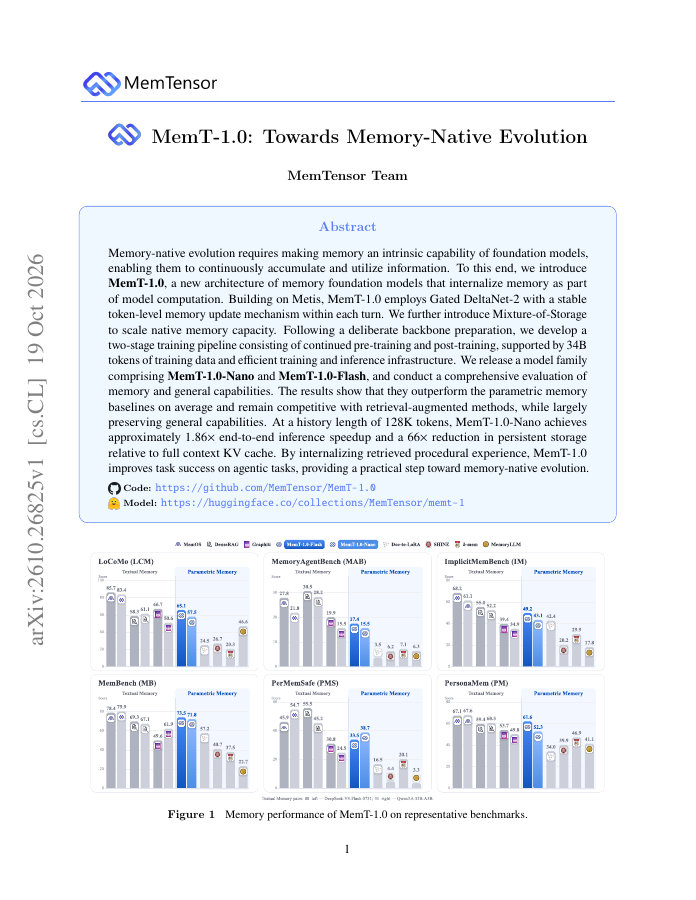
Memory-native evolution requires making memory an intrinsic capability of foundation models, enabling them to continuously accumulate and utilize information. To this end, we introduce MemT-1.0, a new architecture of memory foundation models that internalize memory as part of…
15 Oct 2026
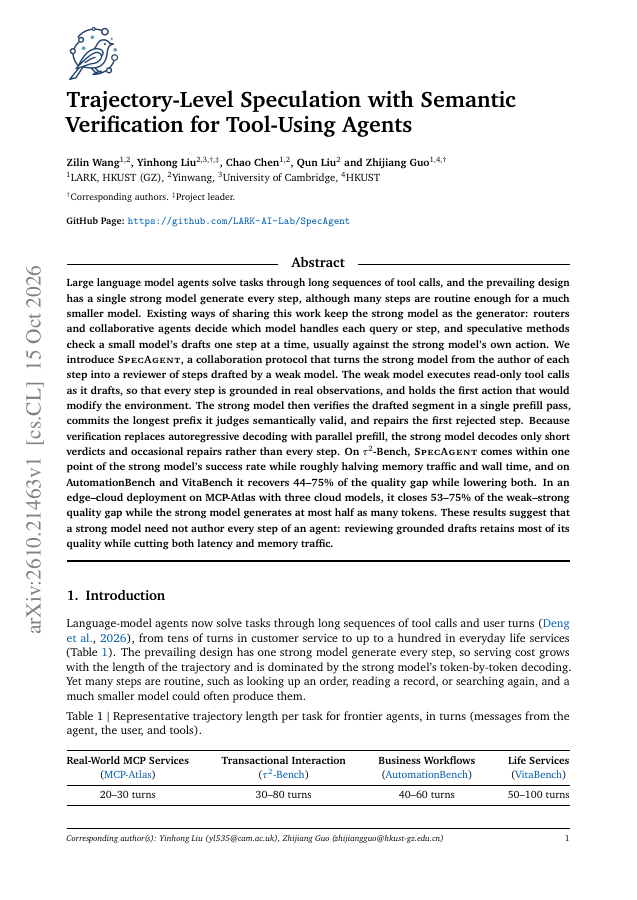
Large language model agents solve tasks through long sequences of tool calls, and the prevailing design has a single strong model generate every step, although many steps are routine enough for a much smaller model.
20 Oct 2026
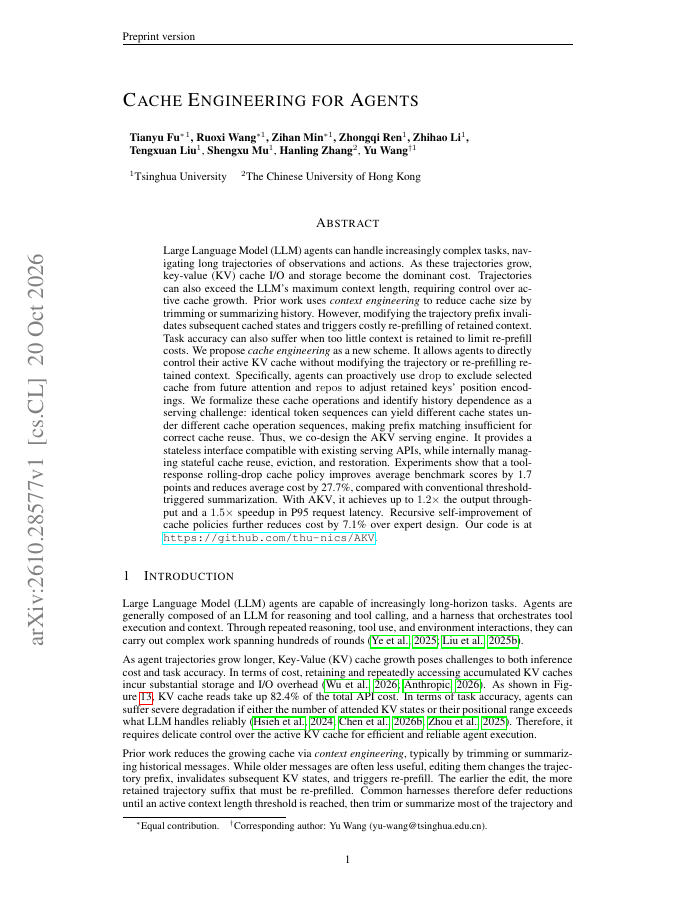
Large Language Model (LLM) agents can handle increasingly complex tasks, navigating long trajectories of observations and actions. As these trajectories grow, key-value (KV) cache I/O and storage become the dominant cost.
13 Oct 2026
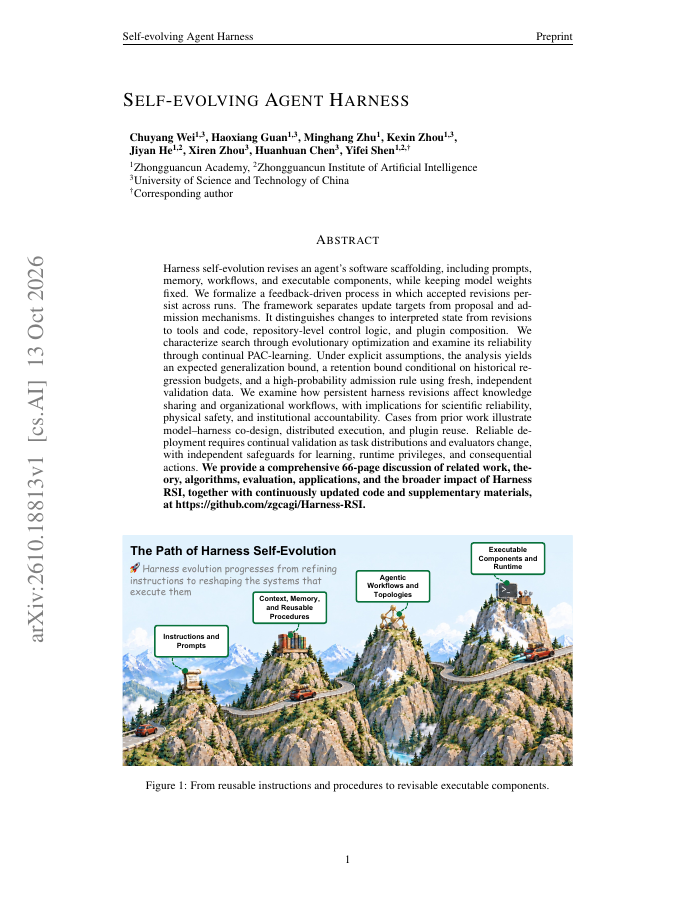
Harness self-evolution revises an agent's software scaffolding, including prompts, memory, workflows, and executable components, while keeping model weights fixed. We formalize a feedback-driven process in which accepted revisions persist across runs.
23 Oct 2026
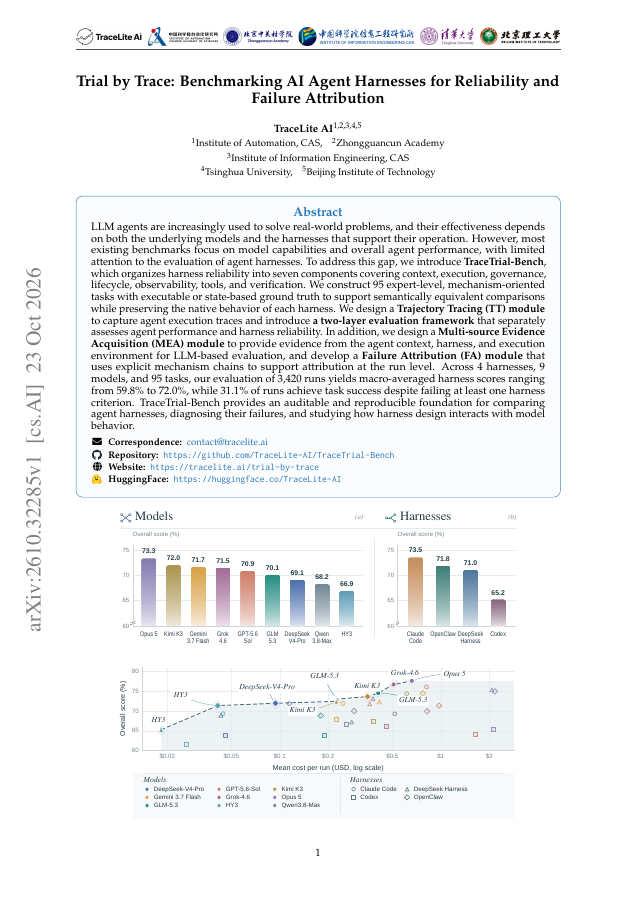
LLM agents are increasingly used to solve real-world problems, and their effectiveness depends on both the underlying models and the harnesses that support their operation.
21 Oct 2026
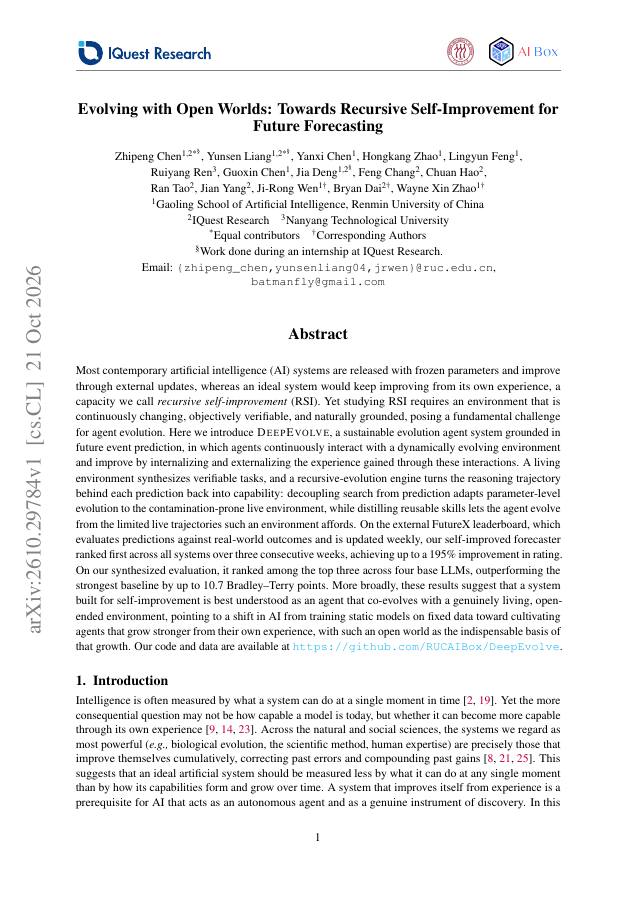
Most contemporary artificial intelligence (AI) systems are released with frozen parameters and improve through external updates, whereas an ideal system would keep improving from its own experience, a capacity we call recursive self-improvement (RSI).
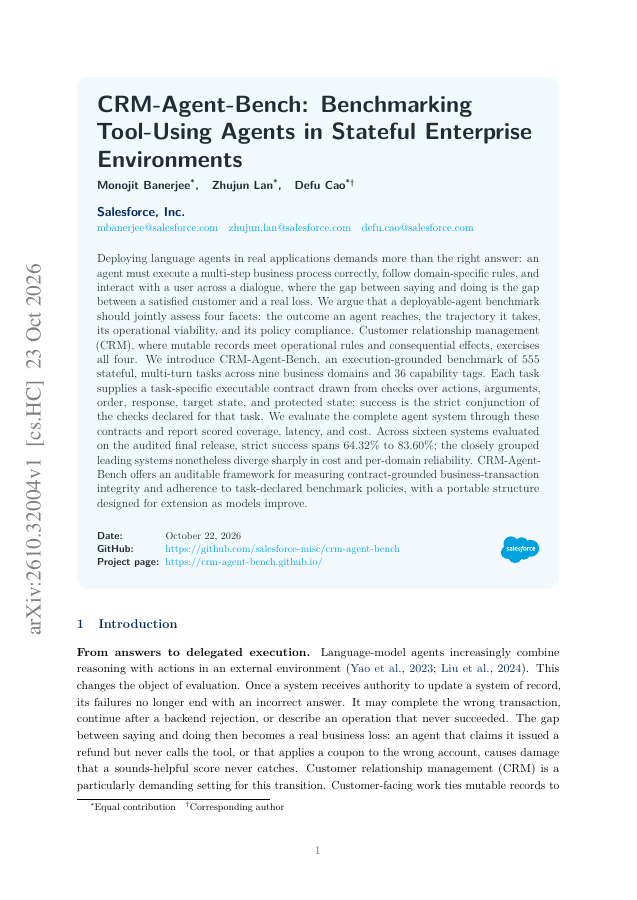
23 Oct 2026
Deploying language agents in real applications demands more than the right answer: an agent must execute a multi-step business process correctly, follow domain-specific rules, and interact with a user across a dialogue, where the gap between saying and doing is the gap between a…
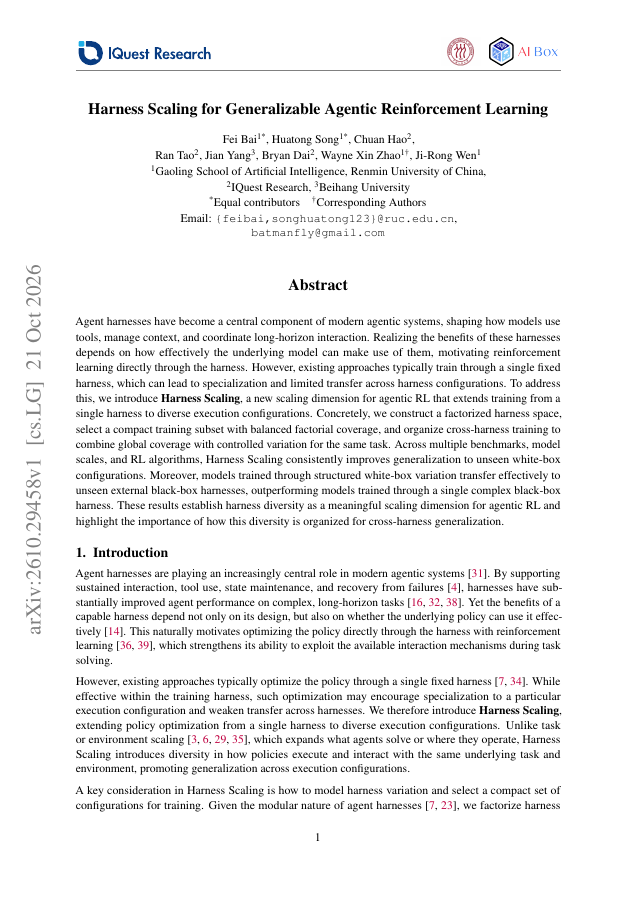
21 Oct 2026
Agent harnesses have become a central component of modern agentic systems, shaping how models use tools, manage context, and coordinate long-horizon interaction. Realizing the benefits of these harnesses depends on how effectively the underlying model can make use of them,…
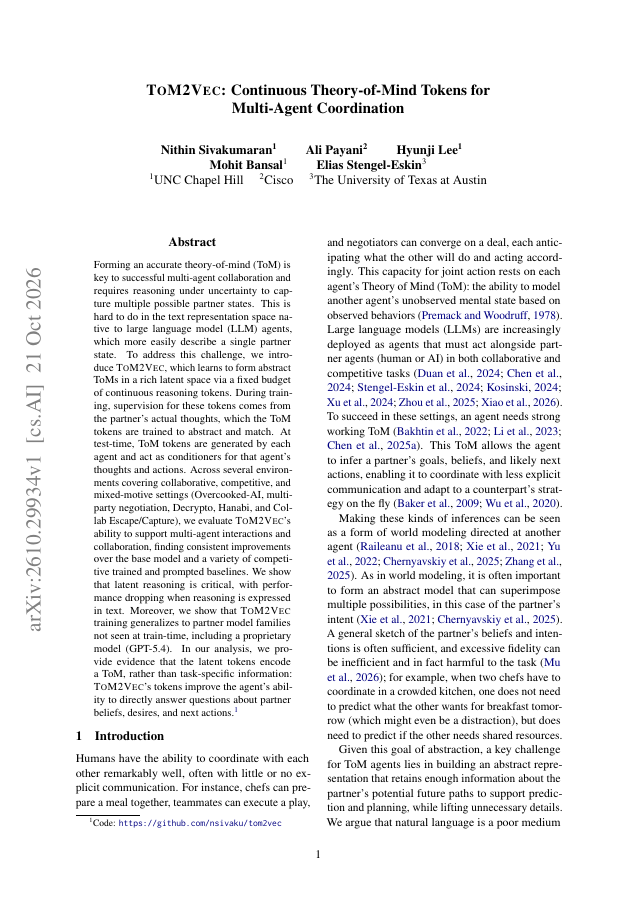
21 Oct 2026
Forming an accurate theory-of-mind (ToM) is key to successful multi-agent collaboration and requires reasoning under uncertainty to capture multiple possible partner states.