9 Oct 2026
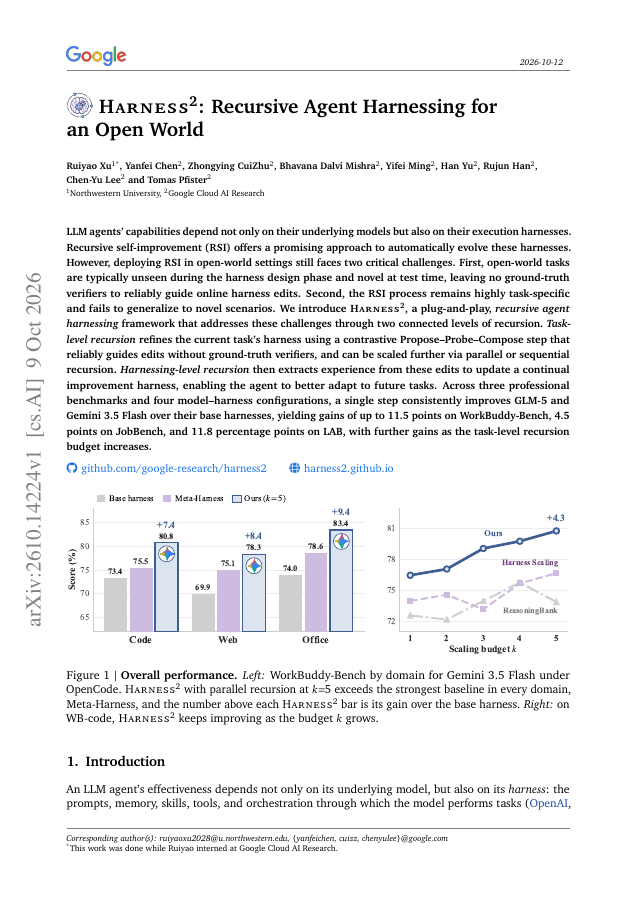
LLM agents' capabilities depend not only on their underlying models but also on their execution harnesses. Recursive self-improvement (RSI) offers a promising approach to automatically evolve these harnesses.
Trending research and the full catalog - each paper linked to the benchmarks, methods, and models it introduces.
Filtering here covers the 2,000 most recent papers, as much as one page can hold in memory. See the full index of 22,688 papers.
9 Oct 2026
LLM agents' capabilities depend not only on their underlying models but also on their execution harnesses. Recursive self-improvement (RSI) offers a promising approach to automatically evolve these harnesses.
8 Oct 2026
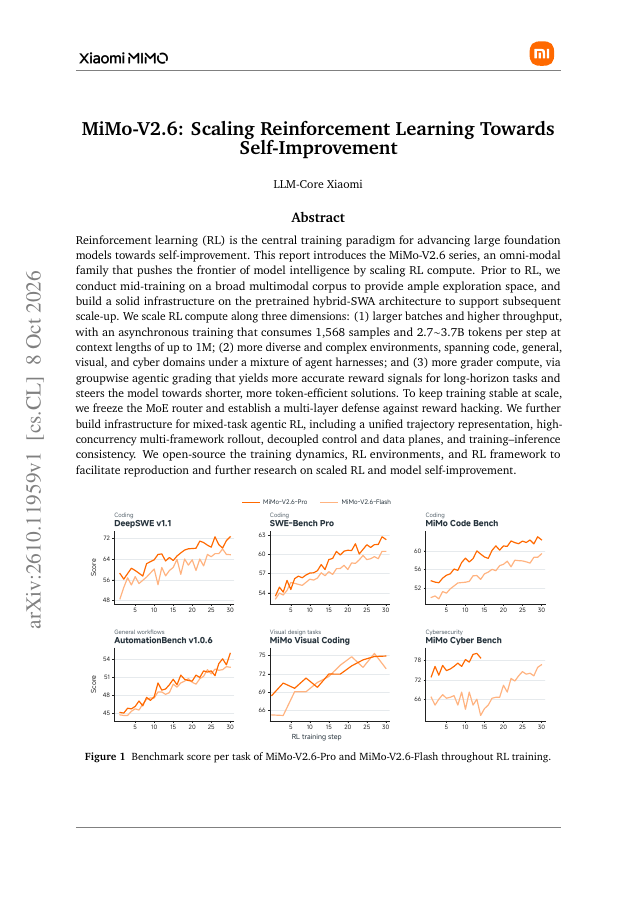
Reinforcement learning (RL) is the central training paradigm for advancing large foundation models towards self-improvement. This report introduces the MiMo-V2.6 series, an omni-modal family that pushes the frontier of model intelligence by scaling RL compute.
20 Oct 2026
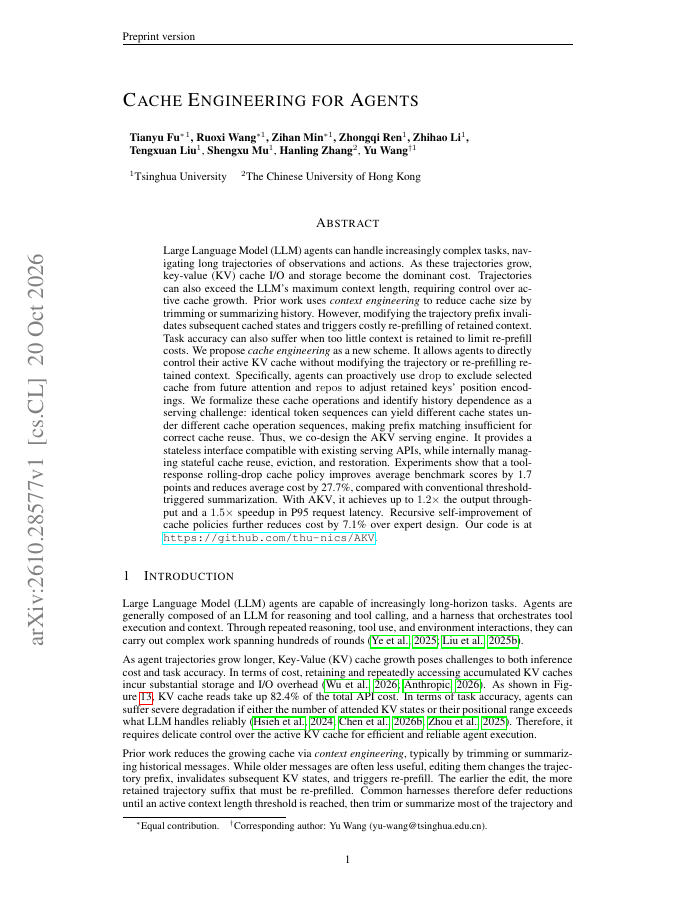
Large Language Model (LLM) agents can handle increasingly complex tasks, navigating long trajectories of observations and actions. As these trajectories grow, key-value (KV) cache I/O and storage become the dominant cost.
19 Oct 2026
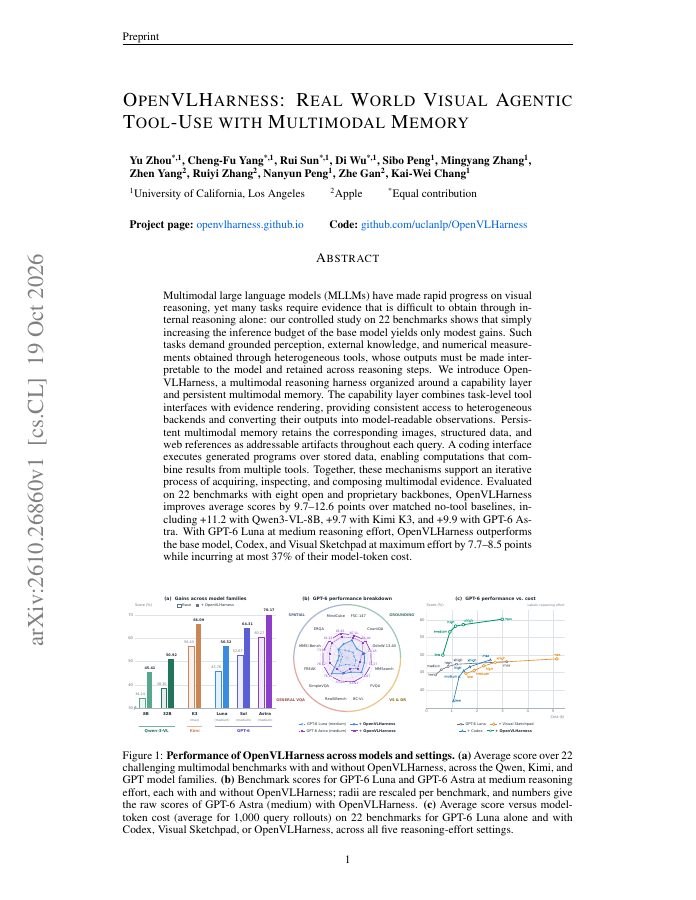
Multimodal large language models (MLLMs) have made rapid progress on visual reasoning, yet many tasks require evidence that is difficult to obtain through internal reasoning alone: our controlled study on 22 benchmarks shows that simply increasing the inference budget of the…
19 Oct 2026
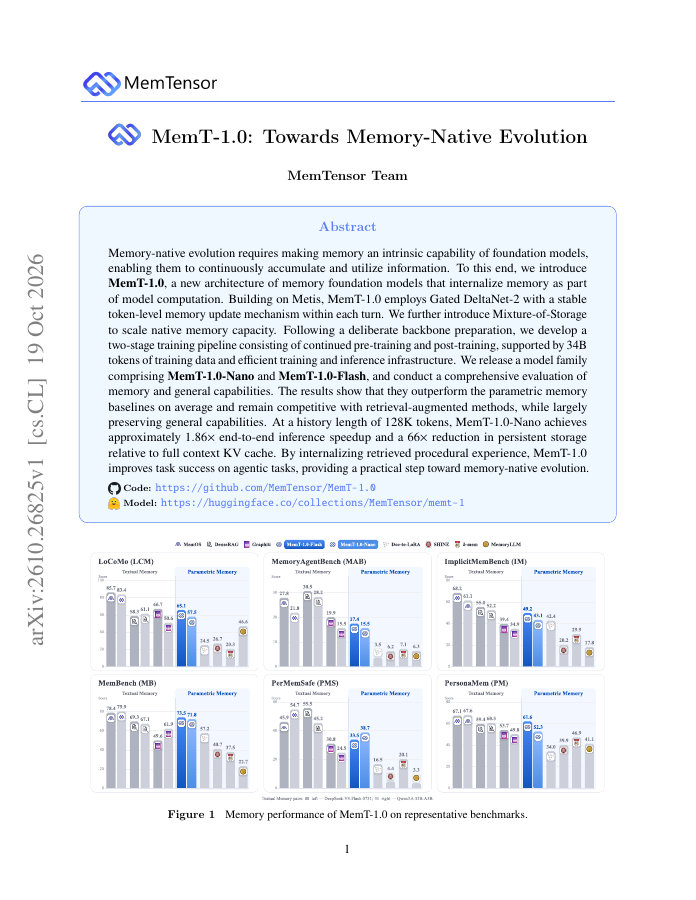
Memory-native evolution requires making memory an intrinsic capability of foundation models, enabling them to continuously accumulate and utilize information. To this end, we introduce MemT-1.0, a new architecture of memory foundation models that internalize memory as part of…
6 Oct 2026
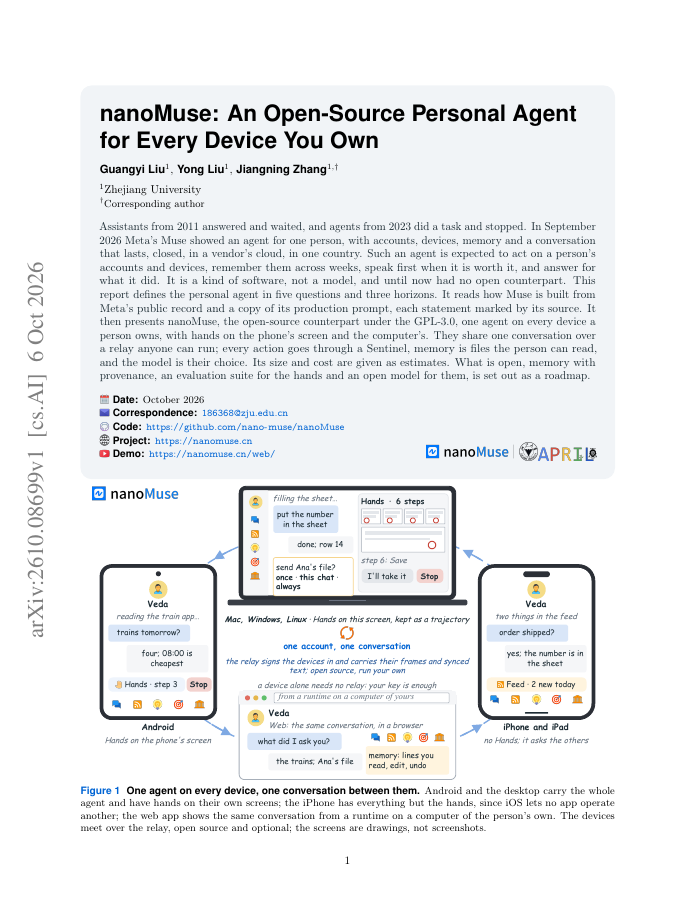
Assistants from 2011 answered and waited, and agents from 2023 did a task and stopped. In September 2026 Meta's Muse showed an agent for one person, with accounts, devices, memory and a conversation that lasts, closed, in a vendor's cloud, in one country.
15 Oct 2026
Training language agents is bottlenecked by the high cost of long-horizon rollouts, yet standard agentic reinforcement learning (RL) learns only from a terminal scalar reward, leaving the supervision in intermediate steps largely unused.
20 Oct 2026
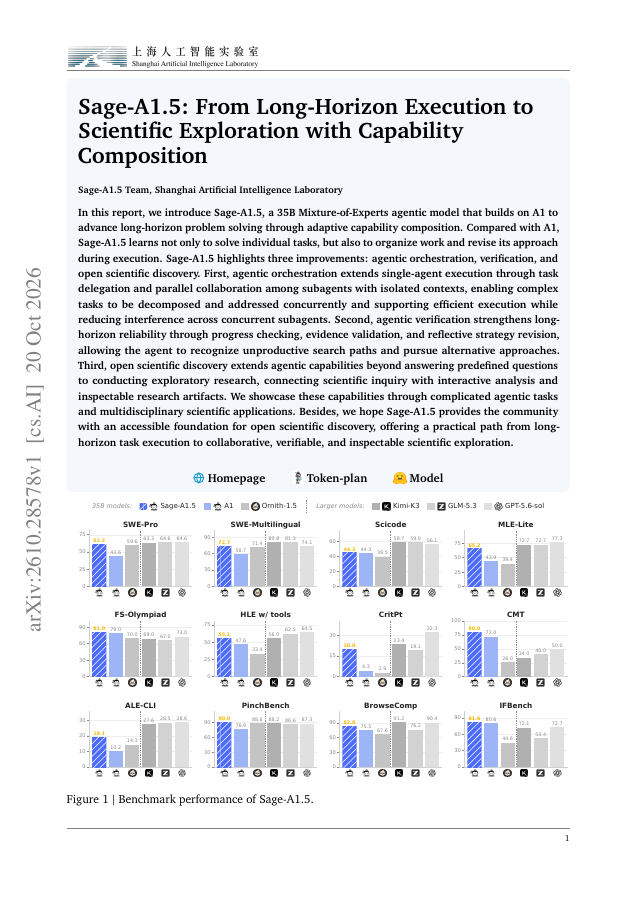
In this report, we introduce Sage-A1.5, a 35B Mixture-of-Experts agentic model that builds on A1 to advance long-horizon problem solving through adaptive capability composition.
19 Oct 2026
Harness development plays a crucial role in building capable AI agents. Recent approaches improve harnesses through recursive self-improvement (RSI), but their performance gains often come with higher execution costs.
15 Oct 2026
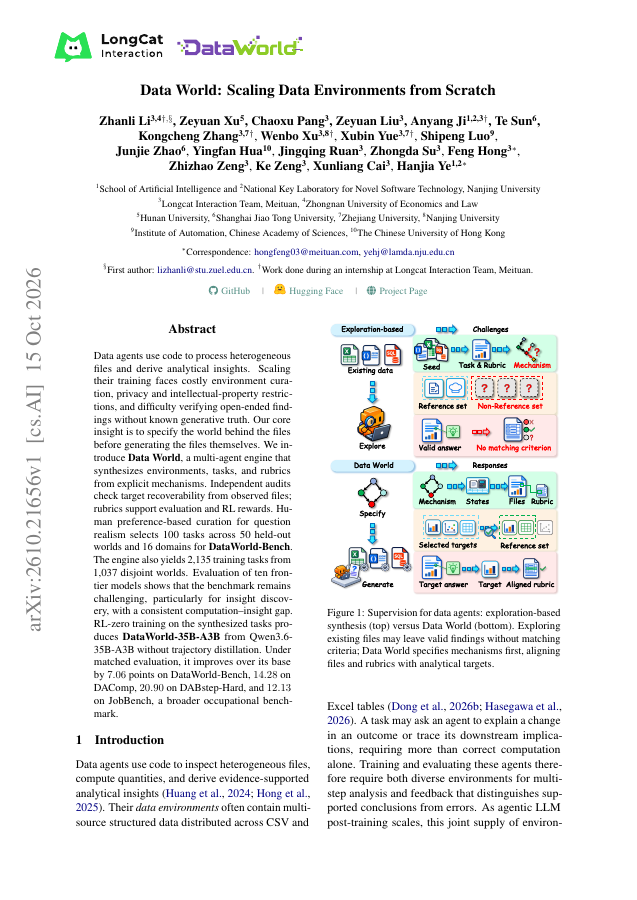
Data agents use code to process heterogeneous files and derive analytical insights. Scaling their training faces costly environment curation, privacy and intellectual-property restrictions, and difficulty verifying open-ended findings without known generative truth.
20 Oct 2026
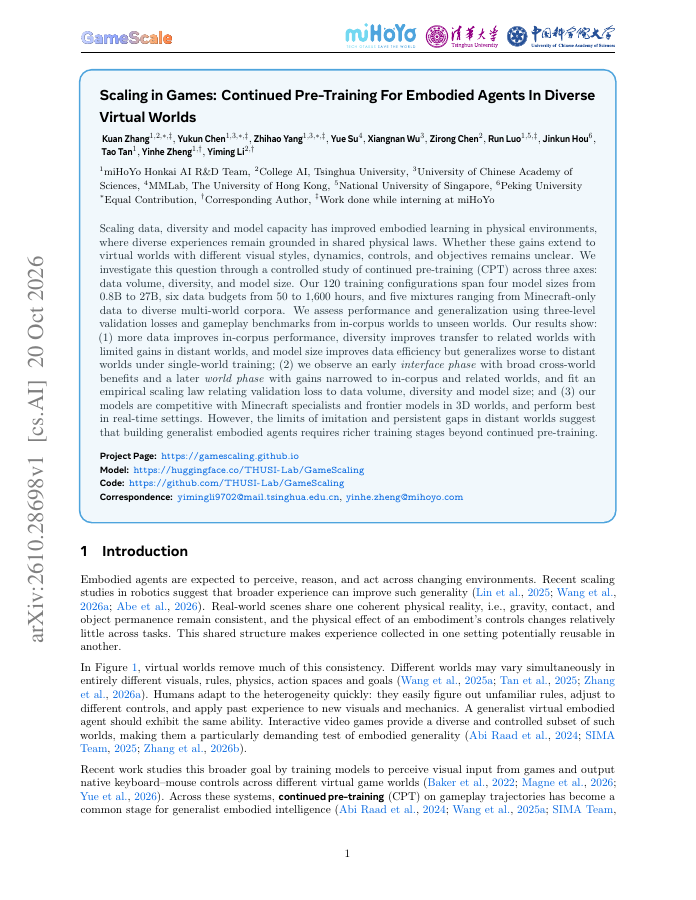
Scaling data, diversity and model capacity has improved embodied learning in physical environments, where diverse experiences remain grounded in shared physical laws. Whether these gains extend to virtual worlds with different visual styles, dynamics, controls, and objectives…
21 Oct 2026
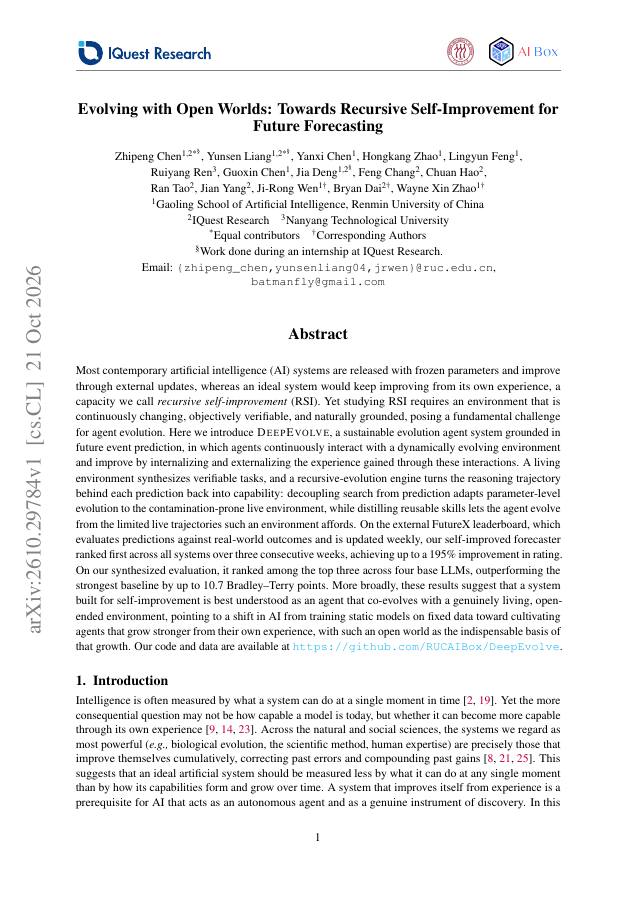
Most contemporary artificial intelligence (AI) systems are released with frozen parameters and improve through external updates, whereas an ideal system would keep improving from its own experience, a capacity we call recursive self-improvement (RSI).
21 Oct 2026
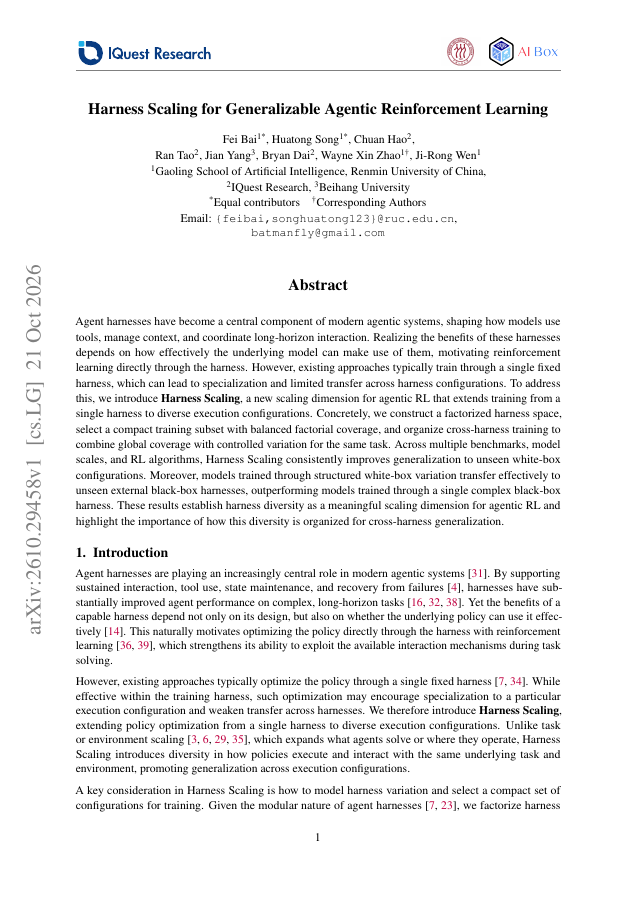
Agent harnesses have become a central component of modern agentic systems, shaping how models use tools, manage context, and coordinate long-horizon interaction. Realizing the benefits of these harnesses depends on how effectively the underlying model can make use of them,…
21 Oct 2026
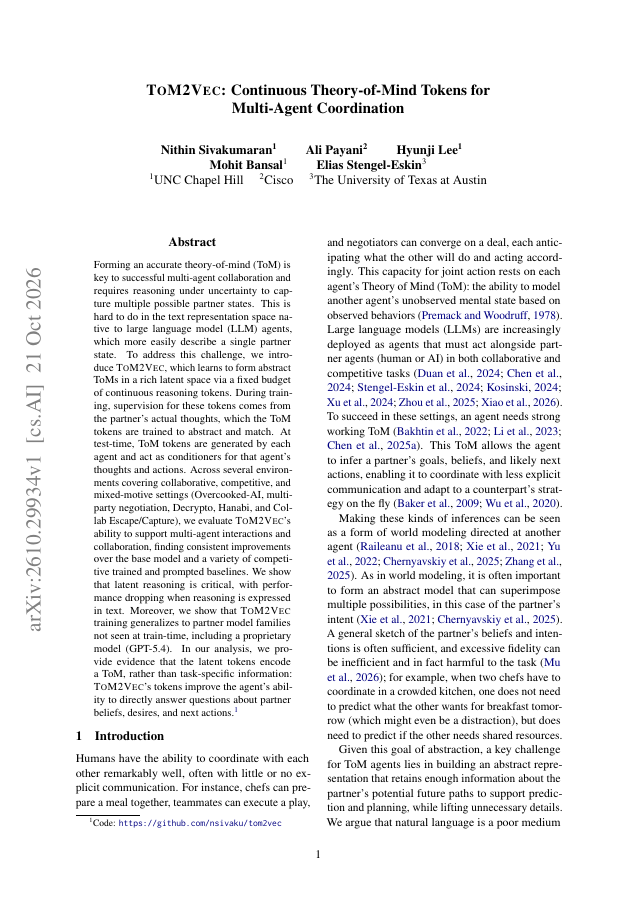
Forming an accurate theory-of-mind (ToM) is key to successful multi-agent collaboration and requires reasoning under uncertainty to capture multiple possible partner states.