16 Jun 2026
We develop a mathematically explicit link between shock-wave theory and the symmetry-quotiented learning dynamics of stochastic gradient descent, drawing on differential geometry, Lie group theory, and fluid mechanics.
Trending research and the full catalog - each paper linked to the benchmarks, methods, and models it introduces.
Filtering here covers the 2,000 most recent papers, as much as one page can hold in memory. See the full index of 22,712 papers.
16 Jun 2026
We develop a mathematically explicit link between shock-wave theory and the symmetry-quotiented learning dynamics of stochastic gradient descent, drawing on differential geometry, Lie group theory, and fluid mechanics.
16 Jun 2026
Traditional comorbidity scores (e.g., Charlson and Elixhauser) are widely used for risk adjustment and patient stratification, but they have two key limitations: (i) they are largely mortality-centric and do not align well with other clinical outcomes, and (ii) their linear,…
16 Jun 2026
Reasoning about what agents can achieve through strategic interaction is a core challenge in Multi-Agent Systems (MAS). Logics for strategic ability, such as ATL, provide rigorous methods, but their adoption is often hindered by the computational cost of strategy synthesis.
16 Jun 2026
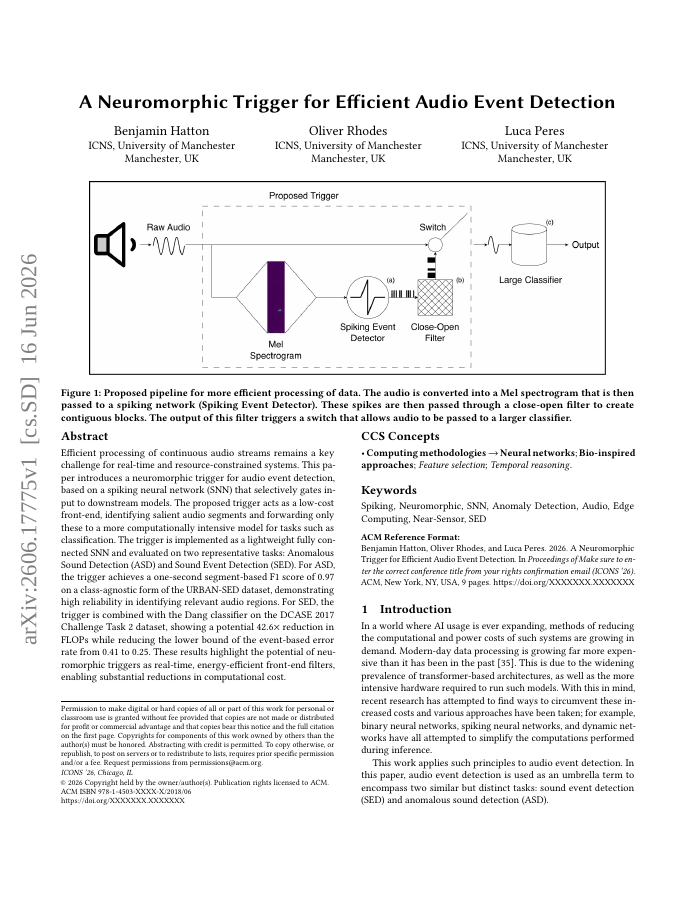
Efficient processing of continuous audio streams remains a key challenge for real-time and resource-constrained systems. This paper introduces a neuromorphic trigger for audio event detection, based on a spiking neural network (SNN) that selectively gates input to downstream…
16 Jun 2026
Despite increasing adoption of multimodal approaches in Alzheimer's Disease (AD) research -- aimed at integrating molecular, structural, clinical, and genetic biomarkers to enhance disease characterization -- the relationships among these modalities remain poorly understood.
16 Jun 2026
We evaluate the adversarial robustness of three frontier large language models (LLMs) developed by Anthropic, Opus 4.8, Fable 5 and its successor Fable 5.1, against four families of automated jailbreak attack across 7,826 harmful intents spanning a ten-category harm taxonomy.
16 Jun 2026
Yun, Sra, and Jadbabaie (COLT 2021, open question) conjectured the SS--RS--GD inequalities: for well-conditioned symmetric matrices $A_1,\dots,A_n$, the operators $W_{ss}$, $W_{rs}$, and $W_{gd}$ that encode the expected iterate of single-shuffle SGD, random-reshuffle SGD, and…
16 Jun 2026
The high cost of fine-tuning LLMs poses a significant economic barrier; pre-hoc performance prediction offers a critical solution to substantially reduce this expense. However, the theoretical limits of pre-hoc performance prediction remain unexplored.
16 Jun 2026
Soil Moisture (SM) modelling constitutes a complex spatiotemporal learning problem characterised by nonlinear environmental interactions, heterogeneous data sources, and limited ground observations.
16 Jun 2026
Optical networks need intent-driven, closed-loop agentic management, a key enabler for higher autonomy levels. We present the first T-API-compliant reasoning and act (ReAct) loop.
16 Jun 2026
Retrieval-Augmented Generation (RAG) has emerged as a paradigm for enhancing large language models (LLMs) with external knowledge, yet existing graph-based methods face a fundamental limitation: entity-centric and chunk-centric approaches operate on representations anchored to…
16 Jun 2026
This paper develops a variational framework for regulated language generation. Starting from autoregressive token sampling, we derive the induced distribution over complete messages and relate it to an entropy-regularized Gibbs law.
15 Jun 2026
World models that capture how actions induce physical change enable scalable robot learning without reliance on embodiment-specific action labels. Pixel-space video models provide broad visual priors but expend model capacity on dense appearance reconstruction, while direct…
15 Jun 2026
With the rapid development of cloud computing and Web services, Quality of Service (QoS) has become a key criterion for service selection and recommendation. Tensor latent feature analysis provides an effective way to model multidimensional QoS data, and most existing QoS…
15 Jun 2026
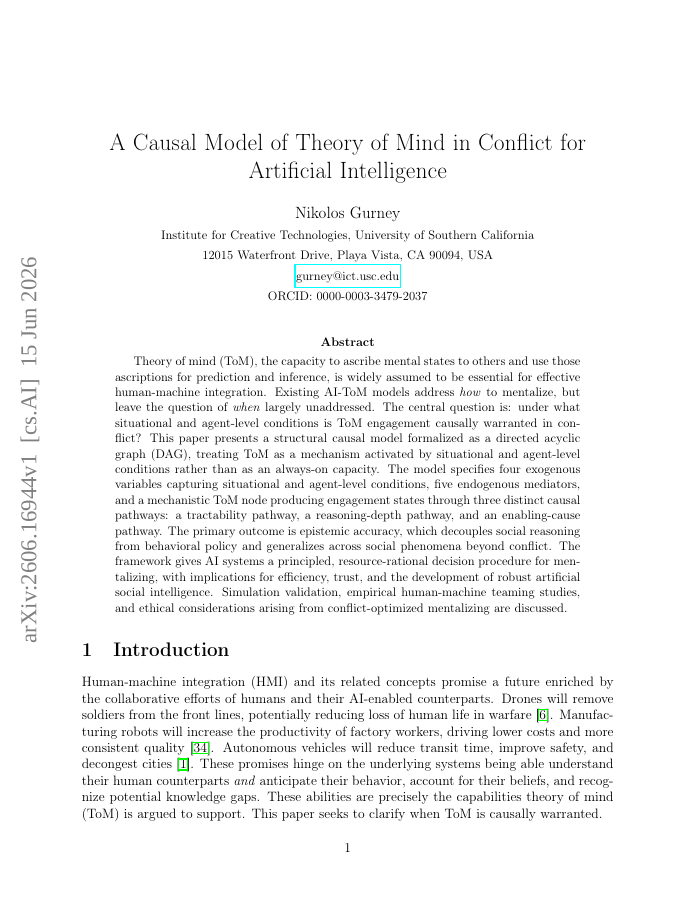
Theory of mind (ToM), the capacity to ascribe mental states to others and use those ascriptions for prediction and inference, is widely assumed to be essential for effective human-machine integration.
15 Jun 2026
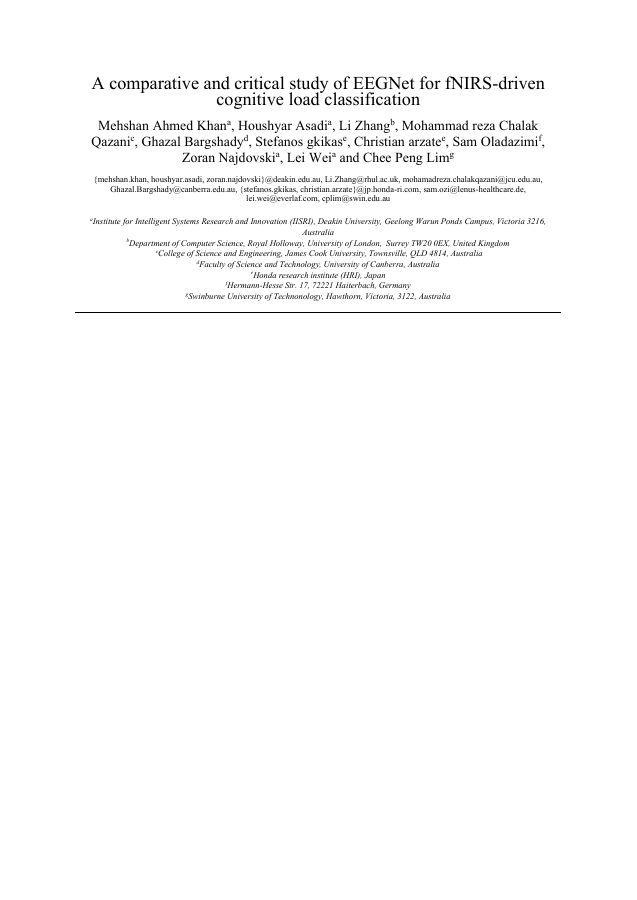
Accurately classifying cognitive load from functional near-infrared spectroscopy (fNIRS) signals remains a significant challenge due to temporal variability, inter-subject differences, and sensitivity to preprocessing choices.
15 Jun 2026
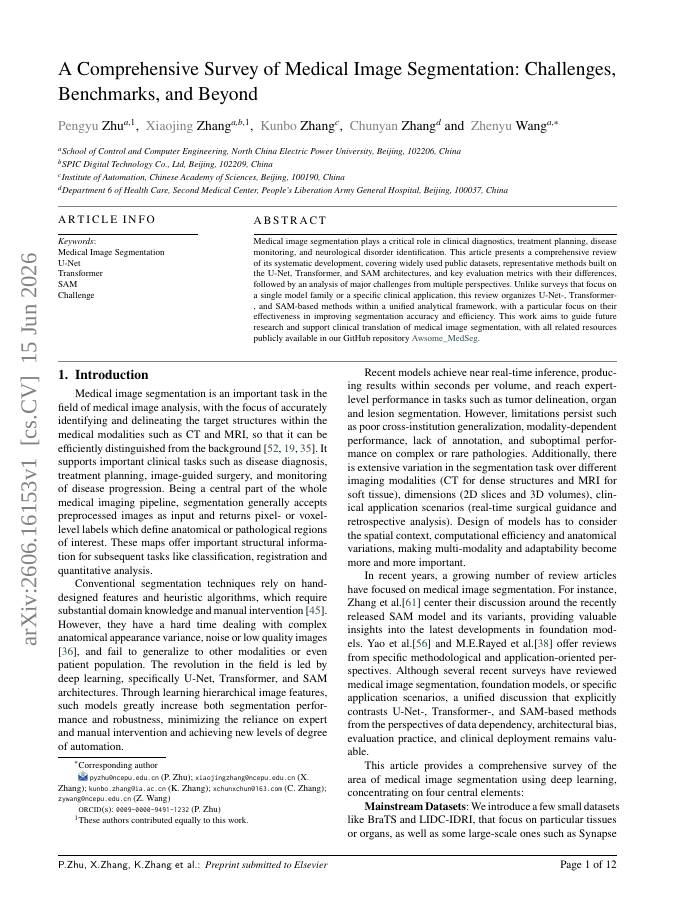
Medical image segmentation plays a critical role in clinical diagnostics, treatment planning, disease monitoring, and neurological disorder identification. This article presents a comprehensive review of its systematic development, covering widely used public datasets,…
15 Jun 2026
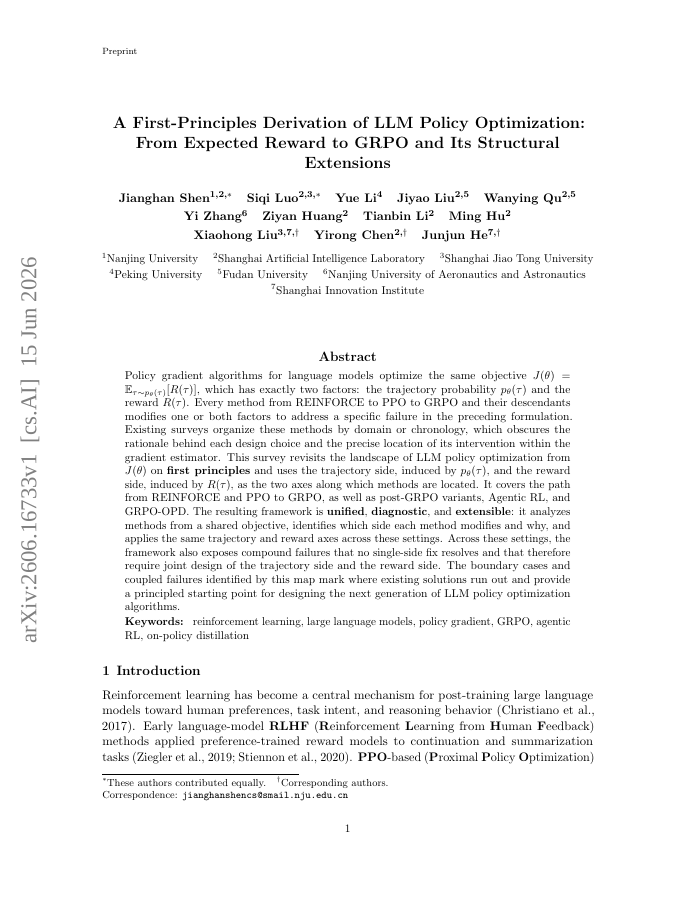
Policy gradient algorithms for language models optimize the same objective $J(θ) = \mathbb{E}*{τ\sim p*θ(τ)}[R(τ)]$, which has exactly two factors: the trajectory probability $p_θ(τ)$ and the reward $R(τ)$.
15 Jun 2026
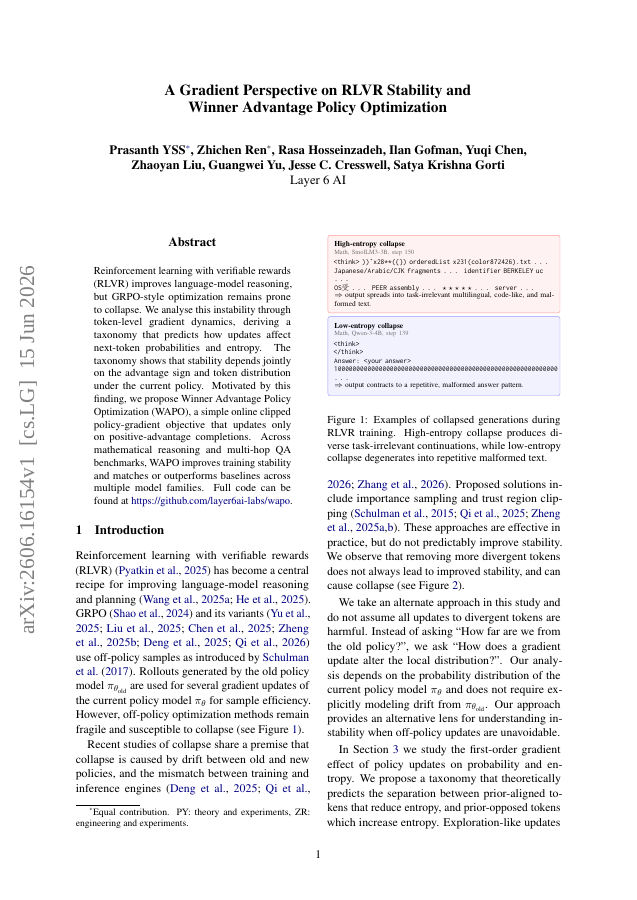
Reinforcement learning with verifiable rewards (RLVR) improves language-model reasoning, but GRPO-style optimization remains prone to collapse. We analyse this instability through token-level gradient dynamics, deriving a taxonomy that predicts how updates affect next-token…
15 Jun 2026
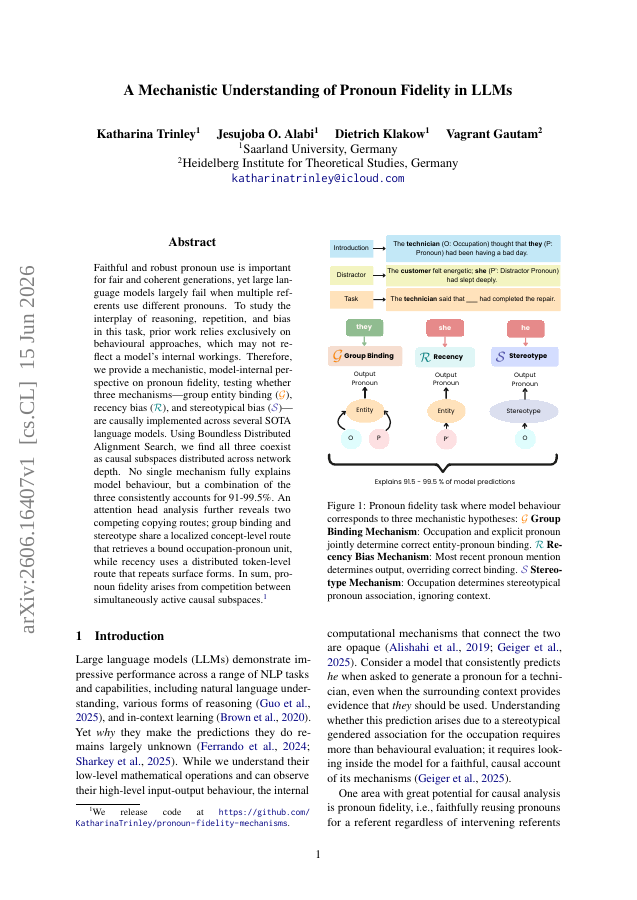
Faithful and robust pronoun use is important for fair and coherent generations, yet large language models largely fail when multiple referents use different pronouns. To study the interplay of reasoning, repetition, and bias in this task, prior work relies exclusively on…
15 Jun 2026
Multiphasic contrast-enhanced CT (CECT) is widely used for abdominal lesion characterization, yet it carries inherent risks of contrast-induced nephropathy, escalates acquisition burden, and heavily contributes to radiologist workload.
15 Jun 2026
Detecting distributional differences between two independent samples is a fundamental problem in statistics and machine learning. Nonparametric two-sample testing provides a principled framework for determining whether two samples are drawn from the same underlying distribution,…
15 Jun 2026
Driven by their remarkable success in computer vision and inverse problem solving, score-based models are increasingly applied to wireless communications, where they show promise across a range of physical-layer tasks.
15 Jun 2026
Adaptive optimizers combining preconditioning, momentum, and weight decay (Adam and AdamW) are, under Polyak-Ruppert averaging, candidate engines for one-pass inference.