24 May 2026
We introduce a user defined probabilistic polygonal representation for plane curves. Given a curve, we select vertices on the curve and connect consecutive vertices by line segments to obtain a polygonal approximation.
Trending research and the full catalog - each paper linked to the benchmarks, methods, and models it introduces.
Filtering here covers the 2,000 most recent papers, as much as one page can hold in memory. See the full index of 22,712 papers.
24 May 2026
We introduce a user defined probabilistic polygonal representation for plane curves. Given a curve, we select vertices on the curve and connect consecutive vertices by line segments to obtain a polygonal approximation.
23 May 2026
Ethical constraints on open-weight AI models are both a reflection of societal concerns and a foundation for AI governance policy. They are expected to propagate to downstream derivatives while implemented as voluntary metadata disclosures that must be restated at each…
23 May 2026
The rapid expansion of space activities has led to an unprecedented accumulation of technical documentation, operational guidelines, and scientific literature, creating challenges for timely decision-making in space operations.
22 May 2026
Lipid nanoparticles (LNPs) are efficient delivery systems for negatively charged nucleic acids. Their multi-component architecture yields a core-shell structure. Small-angle X-ray scattering (SAXS) is an important characterization technique for LNPs, but recovering internal…
22 May 2026
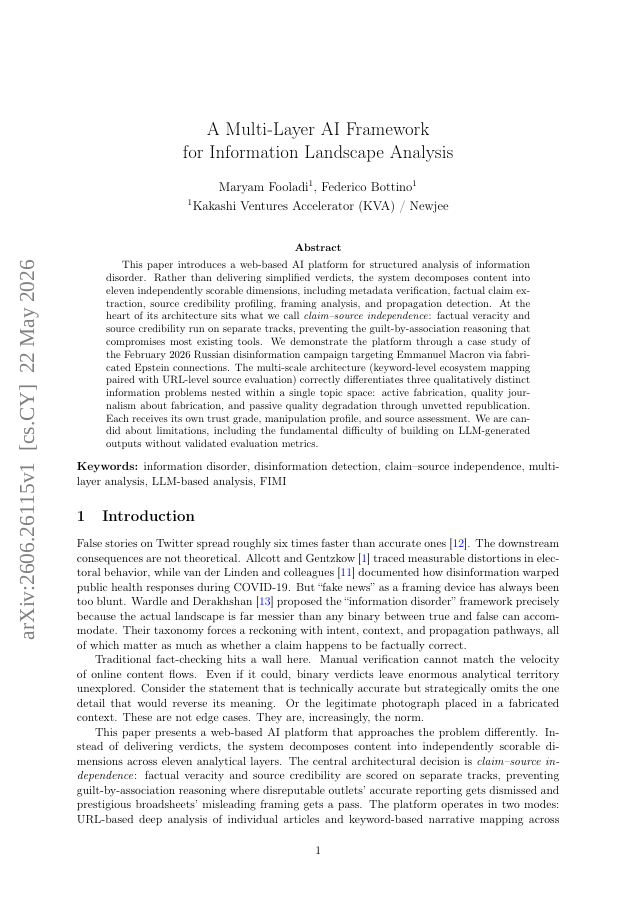
This paper proposes a multi-layer AI framework for information landscape analysis in the context of information disorder. Rather than treating misinformation detection as a binary fact-checking task, the framework analyzes political and media content across multiple dimensions,…
22 May 2026
Query understanding in large-scale industrial search systems is typically implemented as a cascade of disparate, task-specific components. While individually optimizable, this fragmented architecture incurs high maintenance overhead and results in inconsistent behaviors,…
21 May 2026
Edge deployments of generative inference increasingly face two practical realities: per-device per-model performance is often unknown at deployment time, and it is non-stationary due to user-driven semantic events, background load, and device churn.
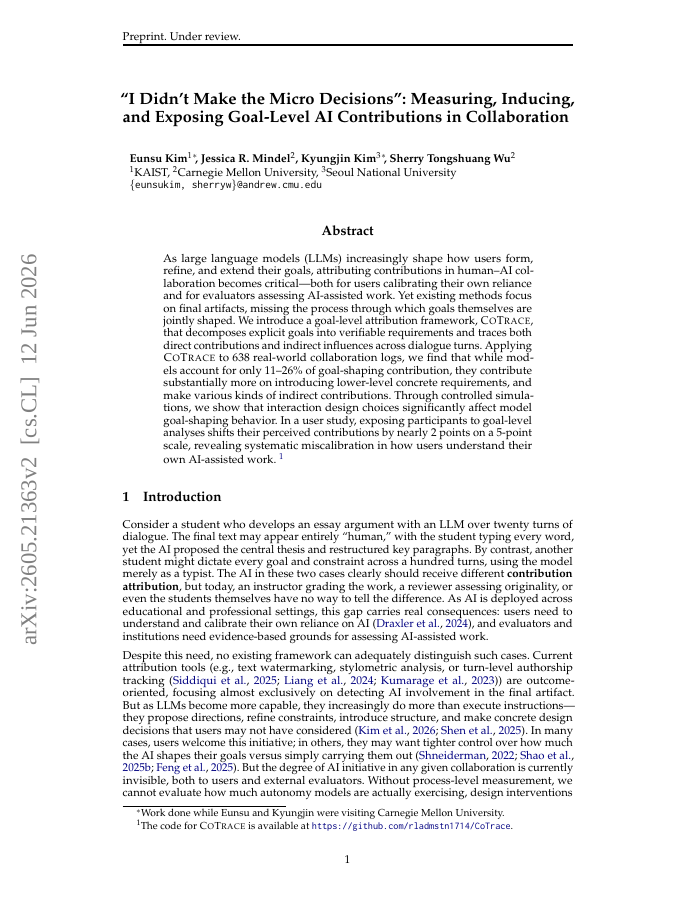
Eunsu Kim, Jessica R. Mindel, Kyungjin Kim · 20 May 2026
As large language models (LLMs) increasingly shape how users form, refine, and extend their goals, attributing contributions in human-AI collaboration becomes critical for users calibrating their own reliance and for evaluators assessing AI-assisted work.
19 May 2026
The growing adoption of AI in healthcare, particularly in preventive care, highlights the critical need for accessibility and precision in Medical Question Answering (MedQA).
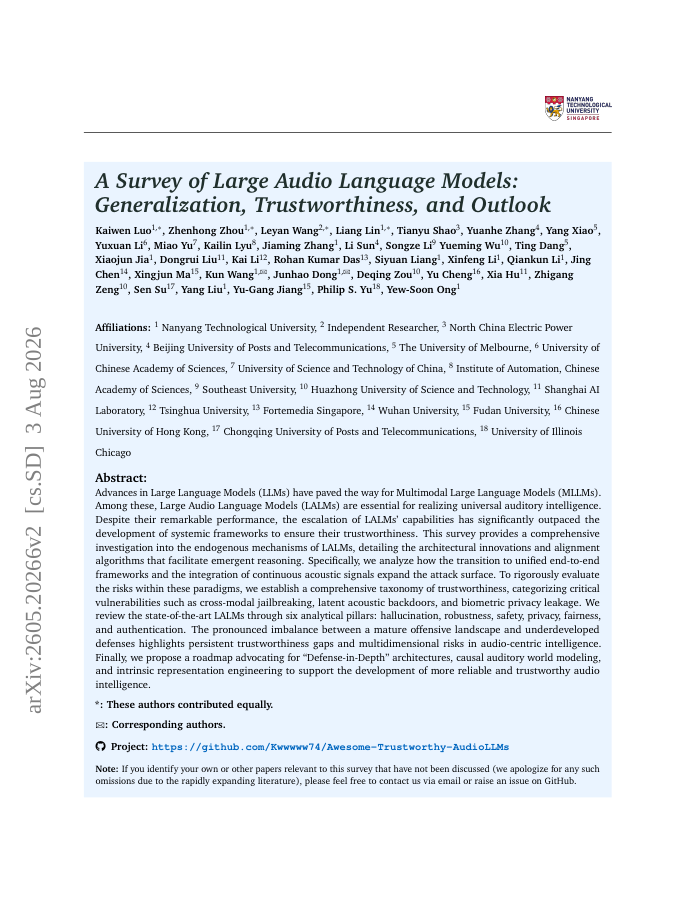
Yang Liu, Yu-Gang Jiang, YuXuan Li · 18 May 2026
Large Audio Language Models exhibit significant trustworthiness challenges despite performance advances, requiring comprehensive frameworks addressing security vulnerabilities and defensive strategies.
17 May 2026
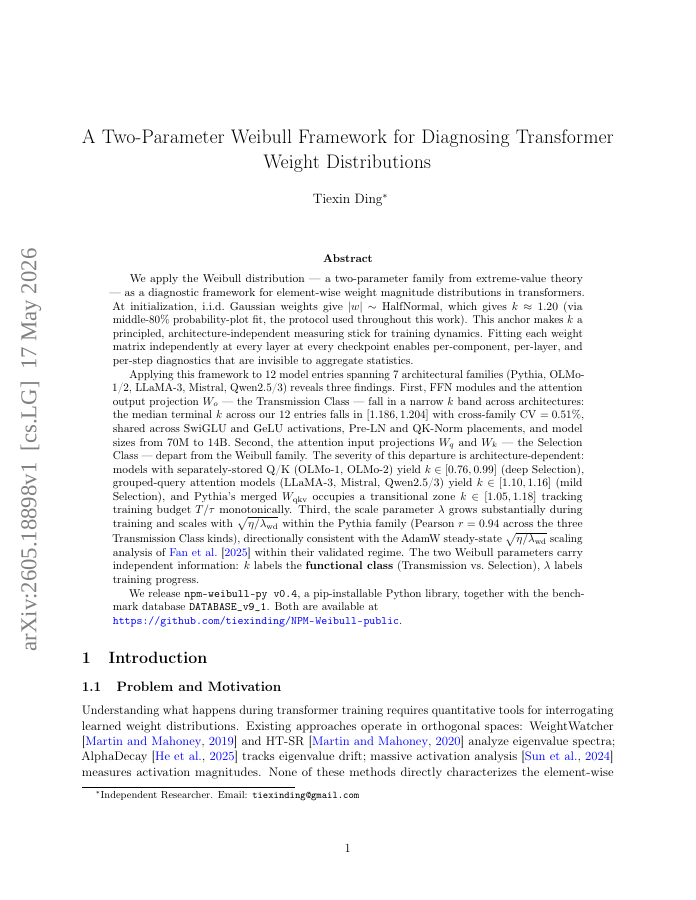
We apply the Weibull distribution -- a two-parameter family from extreme-value theory -- as a diagnostic framework for element-wise weight magnitude distributions in transformers. At initialization, i.i.d.
14 May 2026
In professional sports, a team has clinched the playoffs if they are guaranteed a postseason spot, regardless of the outcomes of any remaining games. As the season progresses, sports fans and other stakeholders are interested in precisely when, and under what conditions, their…
14 May 2026
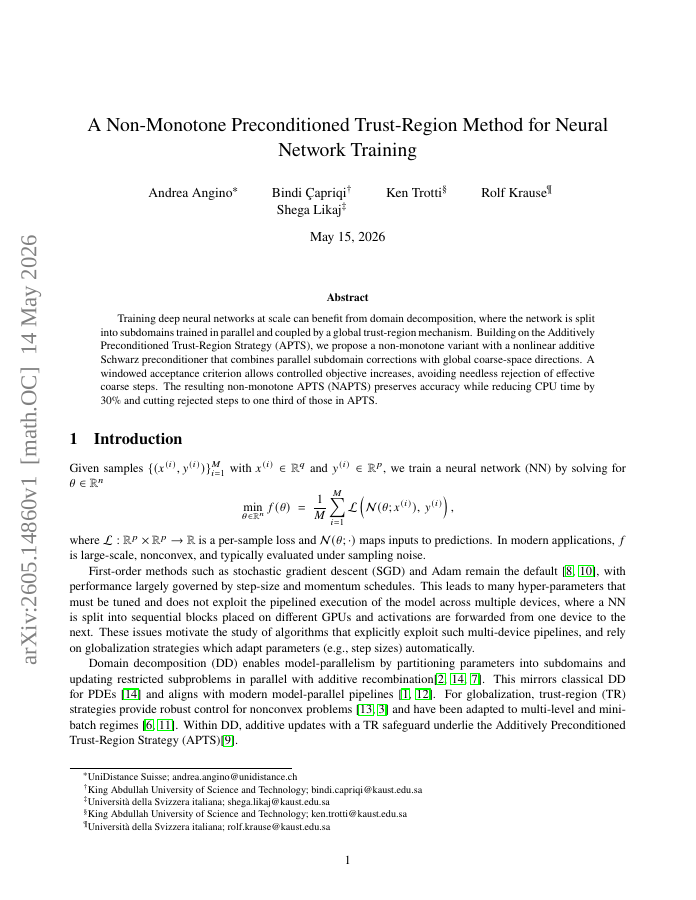
Training deep neural networks at scale can benefit from domain decomposition, where the network is split into subdomains trained in parallel and coupled by a global trust-region mechanism.
14 May 2026
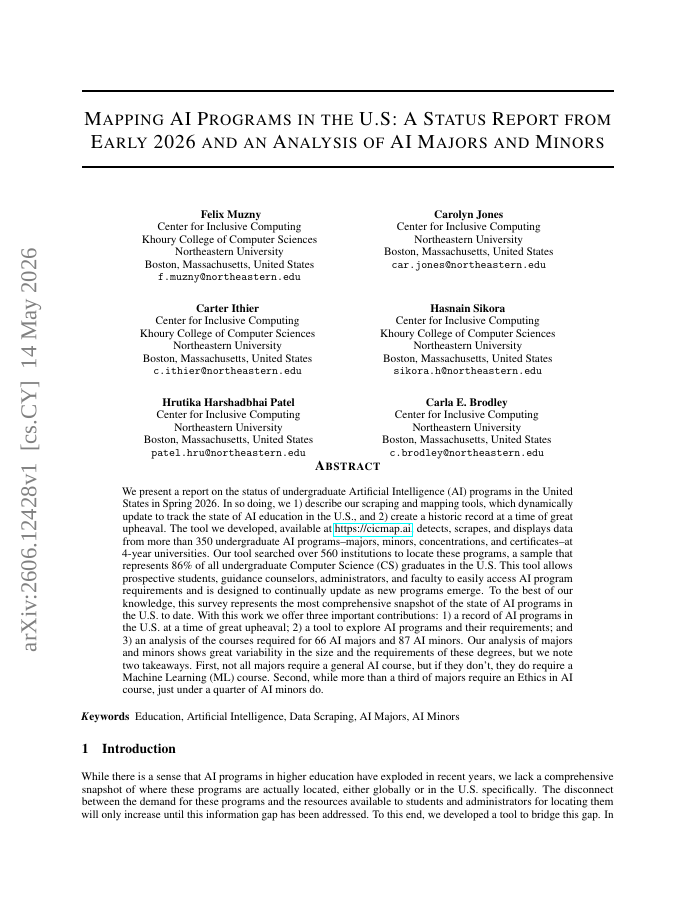
In this work, we locate and analyze existing undergraduate Artificial Intelligence (AI) programs in the United States in Spring 2026, creating a historic record at a time of great change in this area.
Di Zhang, Kaixuan Fan, Xiang Liu · 12 May 2026
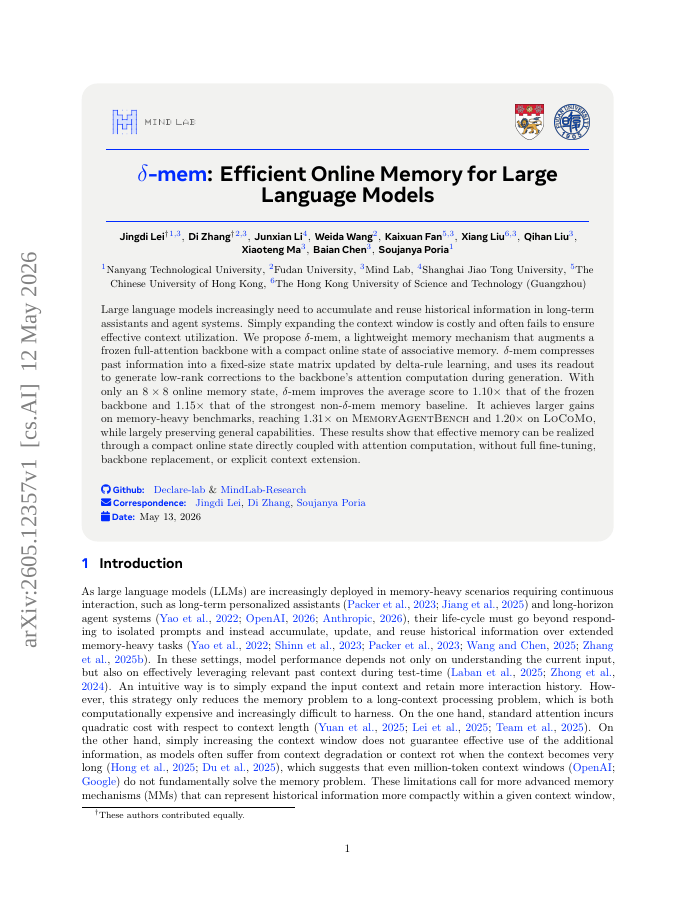
Large language models increasingly need to accumulate and reuse historical information in long-term assistants and agent systems. Simply expanding the context window is costly and often fails to ensure effective context utilization.
12 May 2026
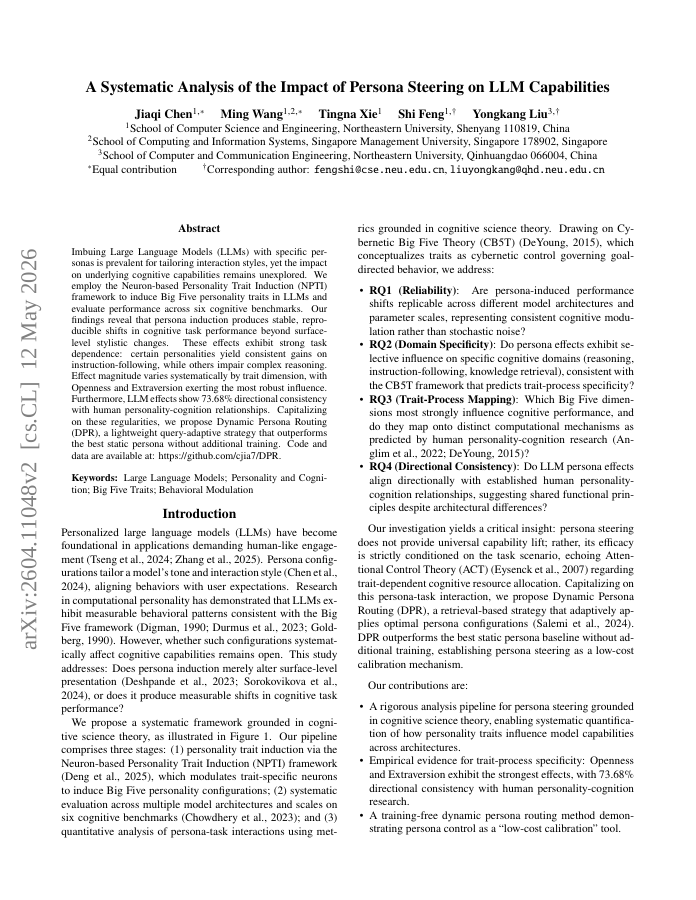
Imbuing Large Language Models (LLMs) with specific personas is prevalent for tailoring interaction styles, yet the impact on underlying cognitive capabilities remains unexplored.
11 May 2026
Automated coaching for oral presentations sits at the intersection of computer-assisted pronunciation training (CAPT), prosody modeling, and speech synthesis, yet no prior work has systematically surveyed and compared existing systems along these dimensions.
Xiaobin Hu, Xinlei Yu, Xiang An · 7 May 2026
4DThinker enables vision-language models to perform dynamic spatial reasoning through 4D latent mental imagery, using scalable data generation and novel fine-tuning methods that outperform existing approaches.
7 May 2026
Autonomous agents based on Large Language Models (LLMs) are increasingly being utilized in complex software systems. However, reliability remains a significant challenge due to unpredictable failures such as hallucinations, execution errors, and inconsistent reasoning.
7 May 2026
Structured state space models (SSMs) have recently emerged as a promising foundation for sequence modeling, with Mamba-based architectures demonstrating strong performance through input-dependent state transitions, albeit at considerable complexity.
6 May 2026
Recent research has revived and amplified interest in algorithms for undiscounted average reward reinforcement learning in infinite-horizon, non-episodic (continuing) tasks. Semi-Markov decision processes (SMDPs) are of particular interest.
Stefanos Pasios · 4 May 2026
A hybrid approach combining diffusion-based and image-to-image translation methods improves photorealism in synthetic datasets while maintaining semantic consistency.
1 May 2026
Recent advances in user modeling make it feasible to conduct open-ended inference over a person's everyday computer use. Despite longstanding visions of systems that deeply understand our actions and the purposes they serve in our lives, existing systems only capture what a…
1 May 2026
Scaling on-policy distillation (OPD) for large language models (LLMs) confronts a fundamental tension: asynchronous execution is necessary for system efficiency, but structurally deviates from the ideal on-policy objective.