13 Oct 2026
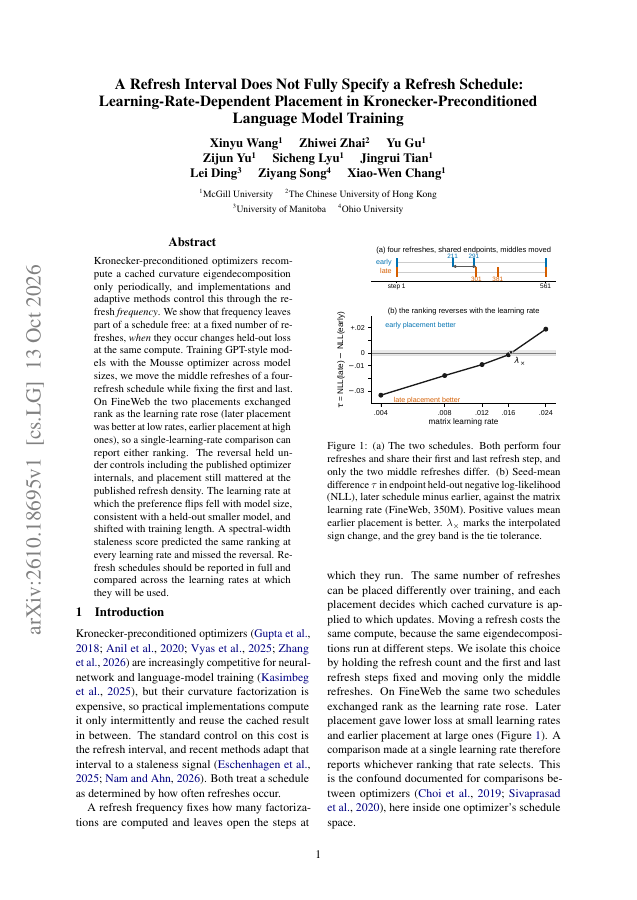
Kronecker-preconditioned optimizers recompute a cached curvature eigendecomposition only periodically, and implementations and adaptive methods control this through the refresh frequency.
Trending research and the full catalog - each paper linked to the benchmarks, methods, and models it introduces.
Filtering here covers the 2,000 most recent papers, as much as one page can hold in memory. See the full index of 22,570 papers.
13 Oct 2026
Kronecker-preconditioned optimizers recompute a cached curvature eigendecomposition only periodically, and implementations and adaptive methods control this through the refresh frequency.
13 Oct 2026
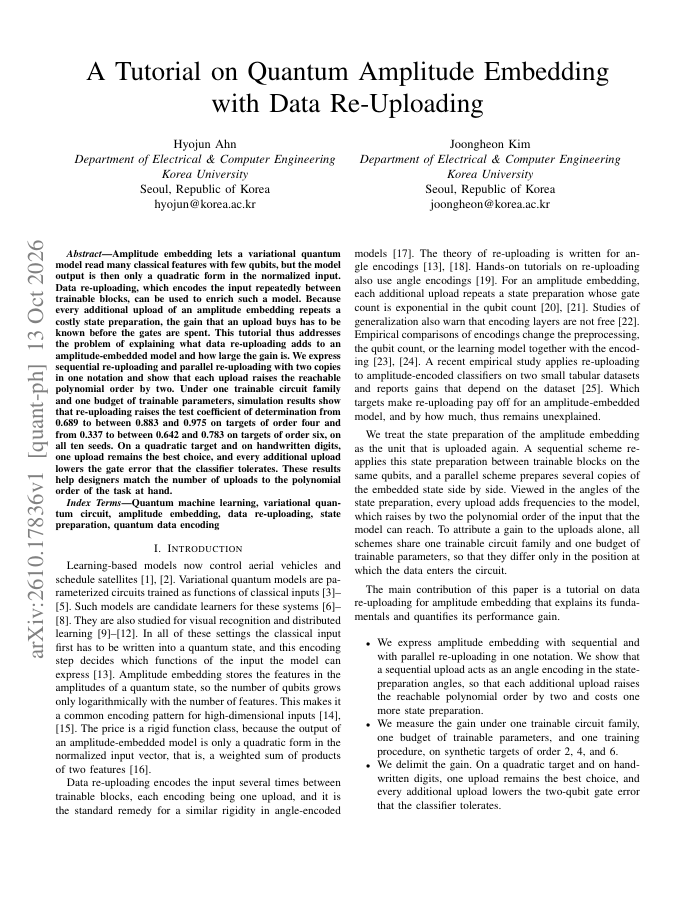
Data-driven machine learning (ML) techniques have become an essential tool in many domains of science. Their application to atomistic simulations of matter is particularly widespread and impactful.
13 Oct 2026
Amplitude embedding lets a variational quantum model read many classical features with few qubits, but the model output is then only a quadratic form in the normalized input.
13 Oct 2026
Reinforcement learning (RL) post-training improves robot foundation models (RFMs) beyond their demonstrations, but real-world deployment demands more: learning new tasks efficiently while retaining previously acquired behaviors.
12 Oct 2026
Accurately assessing the convergence of Monte Carlo Markov Chains is crucial for ensuring their validity in Bayesian inference problems. However, convergence assessment in high dimensions is known to be difficult, due to most convergence diagnostics becoming insensitive beyond a…
12 Oct 2026
DNA methylation is a critical epigenetic modification that regulates gene expression and genome stability, primarily catalyzed by the DNA methyltransferase 3 (DNMT3) family of enzymes.
12 Oct 2026
Parallel token proposals need a joint law, not merely accurate token marginals. We construct coordinate-Bethe-ansatz laws from the periodic XXZ chain and compare them with their maximum-entropy pairwise projections at identical one- and two-site moments.
12 Oct 2026
We develop a novel generalization of McDiarmid's concentration inequality and use it to obtain a uniform law of large numbers result and error bounds on stochastic optimization problems which simultaneously incorporate two key features: 1) They capture the benefit of training…
12 Oct 2026
This paper proposes a method for constructing a neural network that achieves perfect classification of all samples in a given training set, without taking regularization into account.
12 Oct 2026
We present a method for enforcing exactly Dirichlet, Neumann, and Robin conditions on general triangular domains with arbitrarily curved boundaries. The algorithmic constructions developed here complements those in a previous work for general quadrilateral domains.
12 Oct 2026
Constant-step stochastic gradient descent with momentum (SGDM) augments the parameter recursion with a momentum state that carries geometrically decaying memory of past stochastic gradients.
12 Oct 2026
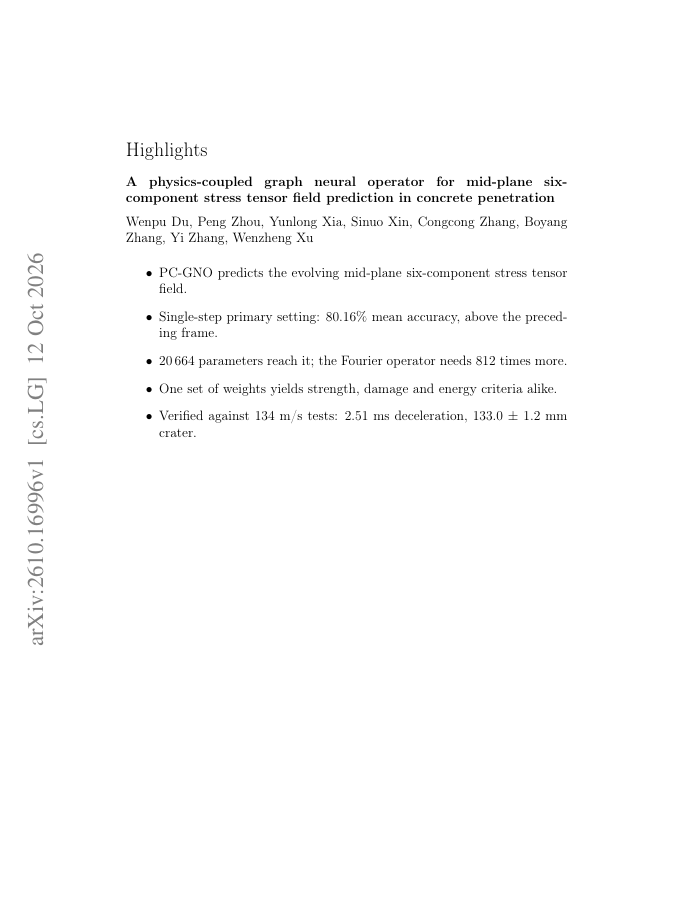
The penetration-resistant design of concrete structures requires the spatiotemporal evolution of the stress field within the target, whereas in design only the strength grade, the geometry and the projectile parameters are known, and the aggregate arrangement is not.
12 Oct 2026
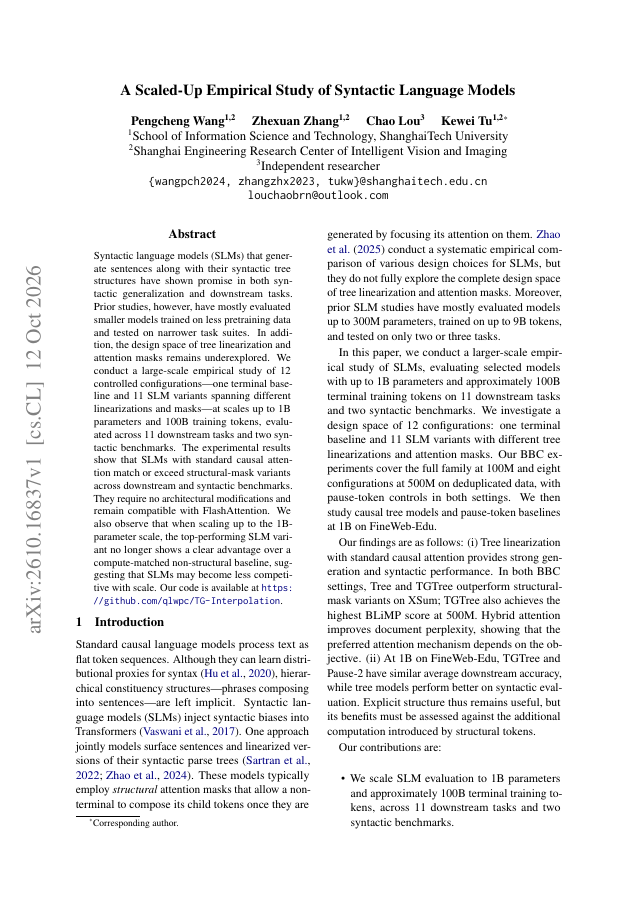
Syntactic language models (SLMs) that generate sentences along with their syntactic tree structures have shown promise in both syntactic generalization and downstream tasks.
12 Oct 2026
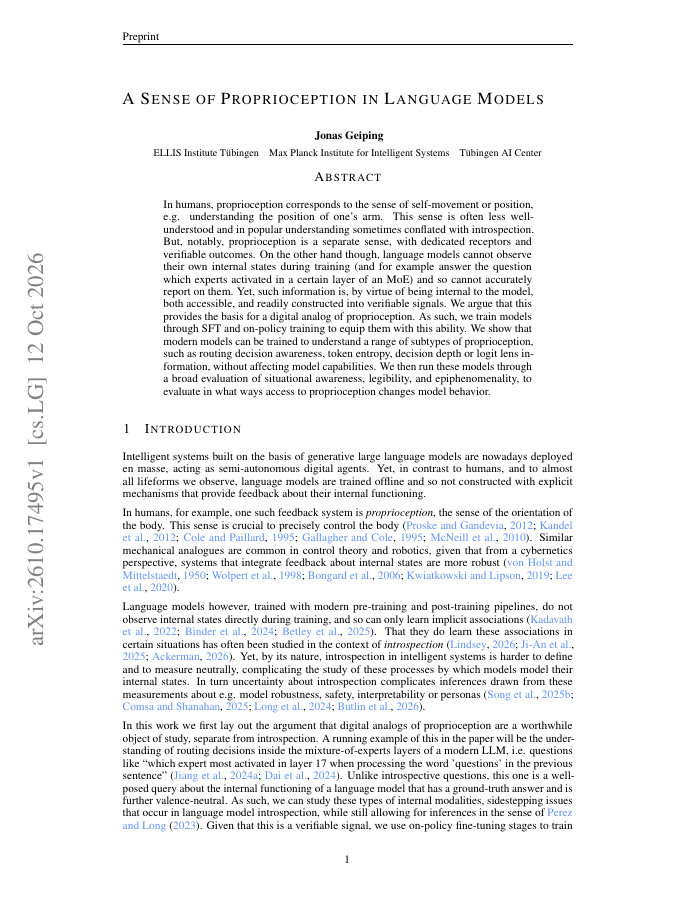
In humans, proprioception corresponds to the sense of self-movement or position, e.g. understanding the position of one's arm. This sense is often less well-understood and in popular understanding sometimes conflated with introspection.
12 Oct 2026
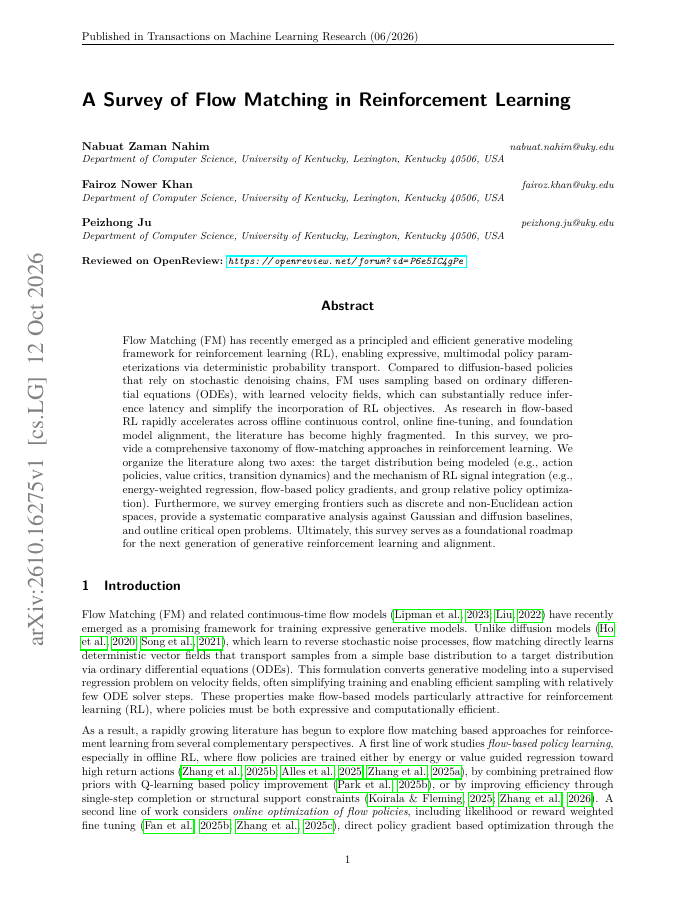
Flow Matching (FM) has recently emerged as a principled and efficient generative modeling framework for reinforcement learning (RL), enabling expressive, multimodal policy parameterizations via deterministic probability transport.
12 Oct 2026
Comparing temporal networks is a challenging problem in network analysis. Commonly adopted methods compare structural properties of temporal graphs and can be highly sensitive to the pre-selected features.
12 Oct 2026
Retrospective evaluation of early-warning models may not reflect information available when predictions are issued and outcomes become observable. We developed a time-synchronous prequential framework for online prediction of next-week student disengagement, operationalised as…
11 Oct 2026
Large language model agents are emerging as an important new class of users of desktop applications. However, existing desktop interfaces were designed for human end users or application developers, leaving agents to interpret visual controls or discover and compose low-level…
11 Oct 2026
Crowdsourced disaster imagery provides timely, ground-level observations when conventional disaster mapping is delayed or incomplete, yet its geographic value depends on where observations are produced, how they are interpreted, and whether they can be reliably located as…
11 Oct 2026
Temporal graph neural networks (TGNNs) achieve superior performance in many dynamic graph learning tasks. These models use node state vectors (i.e., memories) to capture and record graph changes (i.e., events), and then exploit these memories to assist prediction.
11 Oct 2026
Elastic buckling remains a critical concern in the design of deep spherical shell caps, given that experiments reveal a significant reduction of critical loads from those predicted by linearized eigen-buckling analysis.
11 Oct 2026
Converting natural-language instructions into executable action plans conditioned on a scene image is a core capability for embodied human-robot interaction, but existing benchmarks target English, simulated or video-grounded environments, and largely assume instructions are…
11 Oct 2026
Gnani-Evon-v3.3-30B-A3B is a long-context hybrid Mamba-Transformer mixture-of-experts model for reasoning, instruction following, and tool use in English and eight Indian languages.
11 Oct 2026
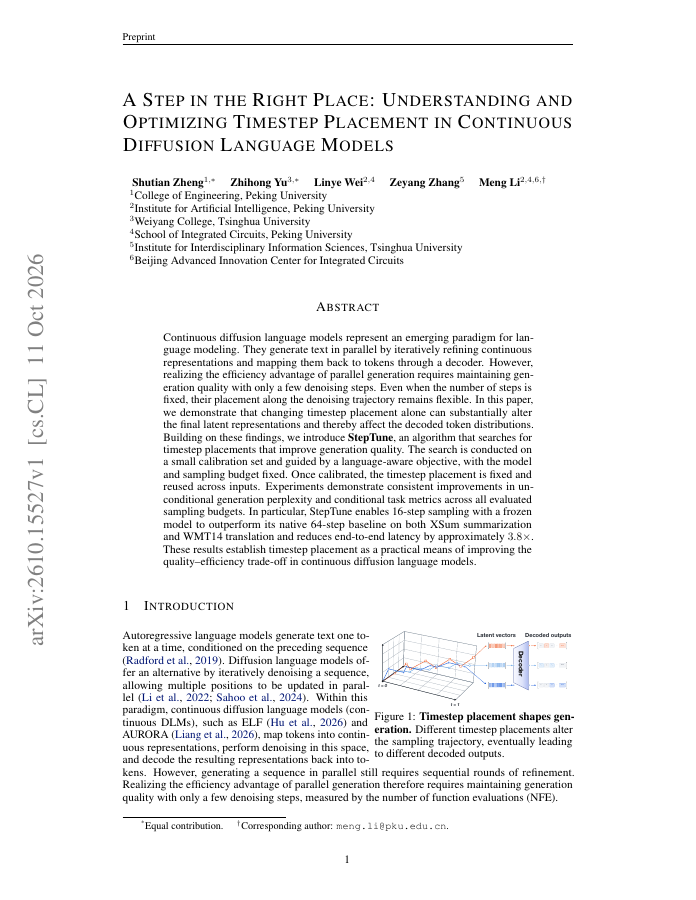
Continuous diffusion language models represent an emerging paradigm for language modeling. They generate text in parallel by iteratively refining continuous representations and mapping them back to tokens through a decoder.