11 Jun 2026
We investigate the belief revision problem in epistemic planning, i.e., what will be the beliefs of all agents in a multi-agent system after an agent gains the belief in some state property.
Trending research and the full catalog - each paper linked to the benchmarks, methods, and models it introduces.
Filtering here covers the 2,000 most recent papers, as much as one page can hold in memory. See the full index of 22,201 papers.
11 Jun 2026
We investigate the belief revision problem in epistemic planning, i.e., what will be the beliefs of all agents in a multi-agent system after an agent gains the belief in some state property.
11 Jun 2026
Scaling LLMs requires tremendous computational resources, and recent advances in AI have gone hand in hand with massive amounts of capital expenditure. While it is established that scaling up LLMs reliably increases model quality (quantified in terms of loss or downstream…
11 Jun 2026
Current discussions of AI in scientific discovery are often dominated by two visible capabilities: search over existing knowledge and execution through optimization, simulation, and automation.
11 Jun 2026
World modeling is emerging as a central principle for building intelligent systems capable of prediction, reasoning, and decision making. A central distinction can be drawn between explicit world models, which learn structured dynamics for rollout-based reasoning and planning,…
11 Jun 2026
This paper examines trade-offs between AI safety and well-being relative to (i) one of the most promising methods for finetuning super-capable AIs, 'Constitutional AI', and (ii) one of the most influential approaches to understanding complex ethical decision making and the…
11 Jun 2026
Discrete diffusion models offer a simple and stable likelihood-based framework for sequence generation, recently extended to any-length settings via token insertion. Principled reward-guided fine-tuning for any-length discrete diffusion, however, remains largely unexplored.
11 Jun 2026
Despite advances in information extraction driven by deep learning and large language models, performance gaps remain in highly specialized biomedical fields, where domainspecific complexity poses challenges for generalist models.
11 Jun 2026
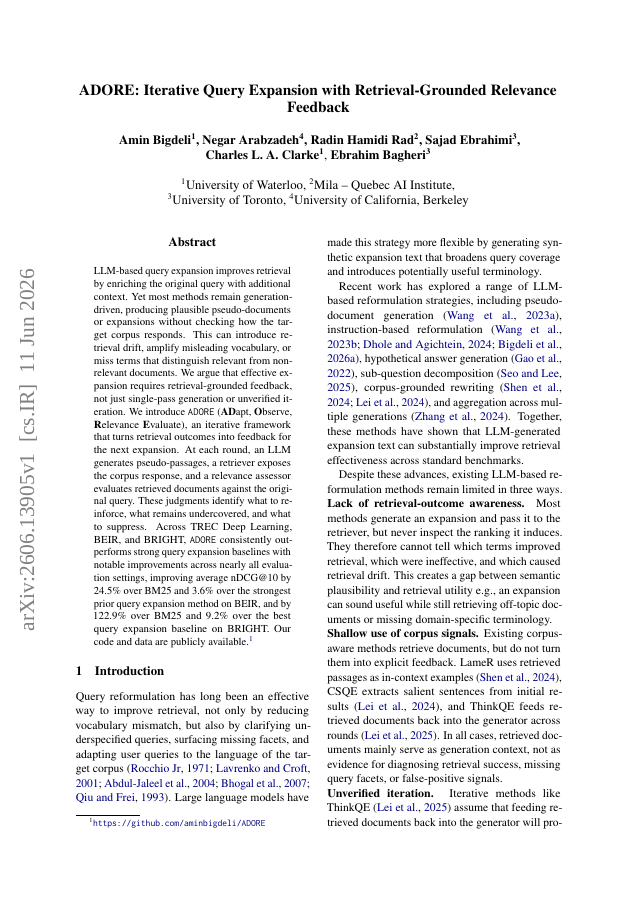
LLM-based query expansion improves retrieval by enriching the original query with additional context. Yet most methods remain generation-driven, producing plausible pseudo-documents or expansions without checking how the target corpus responds.
11 Jun 2026
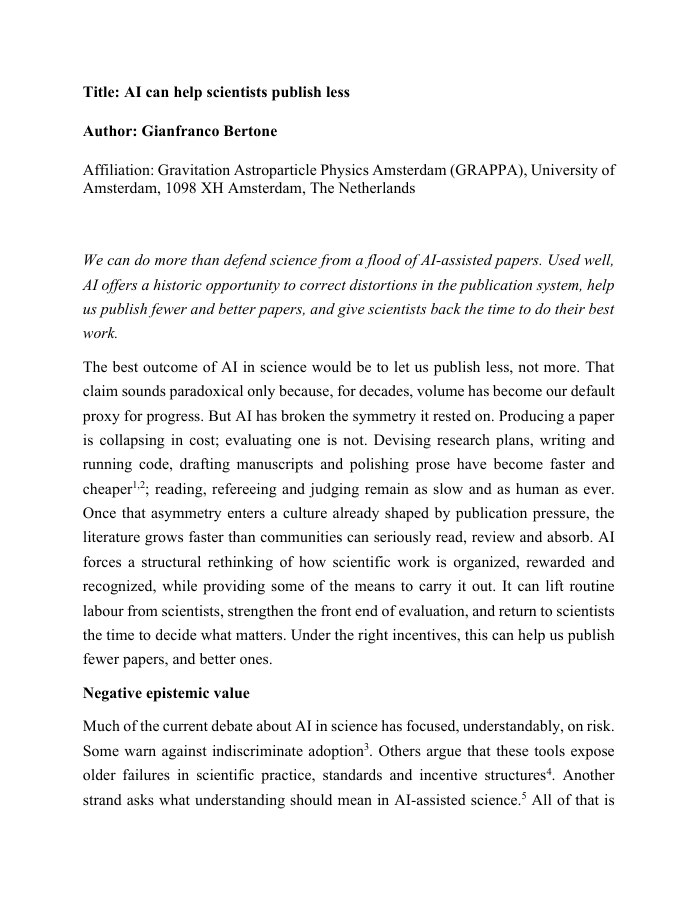
We can do more than defend science from a flood of AI-assisted papers. Used well, AI offers a historic opportunity to correct distortions in the publication system, help us publish fewer and better papers, and give scientists back the time to do their best work.
11 Jun 2026
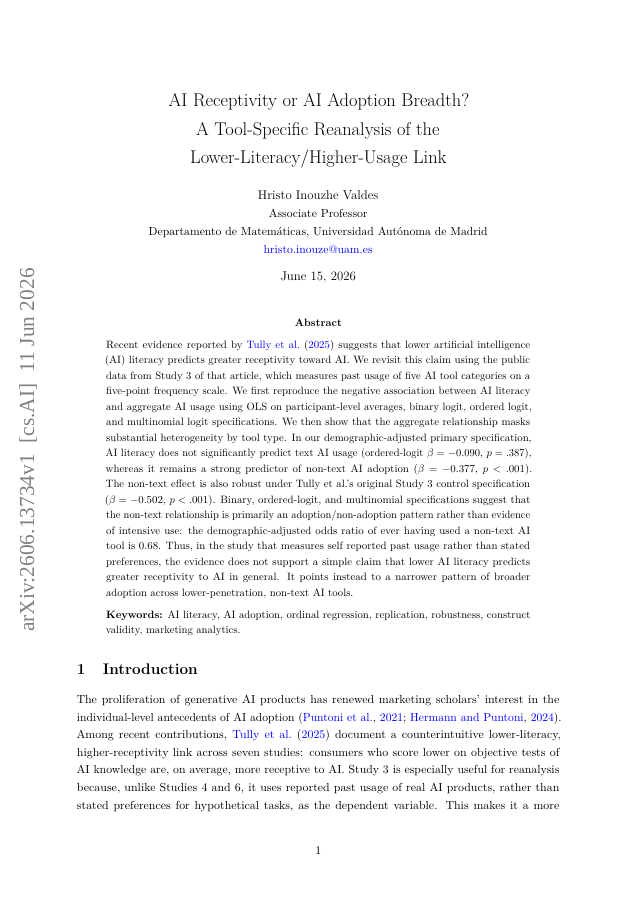
Recent evidence reported by Tully, Longoni, and Appel (2025) suggests that lower artificial intelligence (AI) literacy predicts greater receptivity toward AI. We revisit this claim using the public data from Study 3 of that article, which measures past usage of five AI tool…
10 Jun 2026
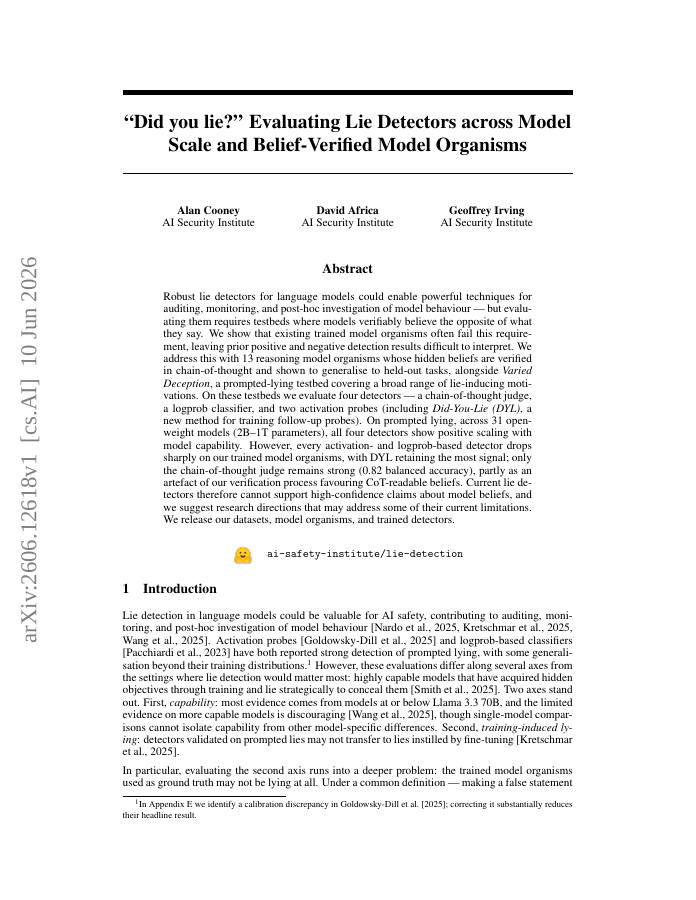
Robust lie detectors for language models could enable powerful techniques for auditing, monitoring, and post-hoc investigation of model behaviour, but evaluating them requires testbeds where models verifiably believe the opposite of what they say.
10 Jun 2026
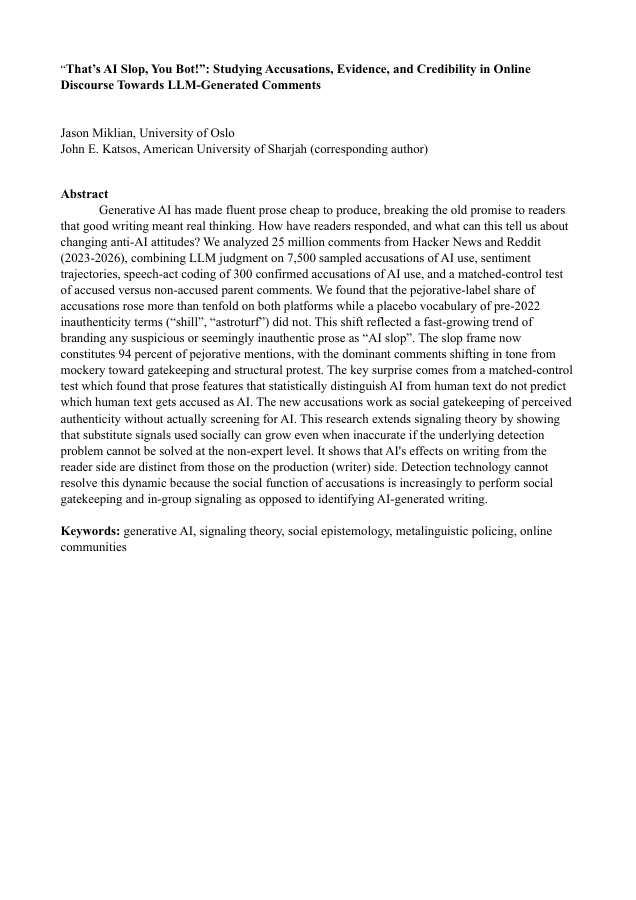
Generative AI has made fluent prose cheap to produce, breaking the old promise to readers that good writing meant real thinking. How have readers responded, and what can this tell us about changing anti-AI attitudes? We analyzed 25 million comments from Hacker News and Reddit…
10 Jun 2026
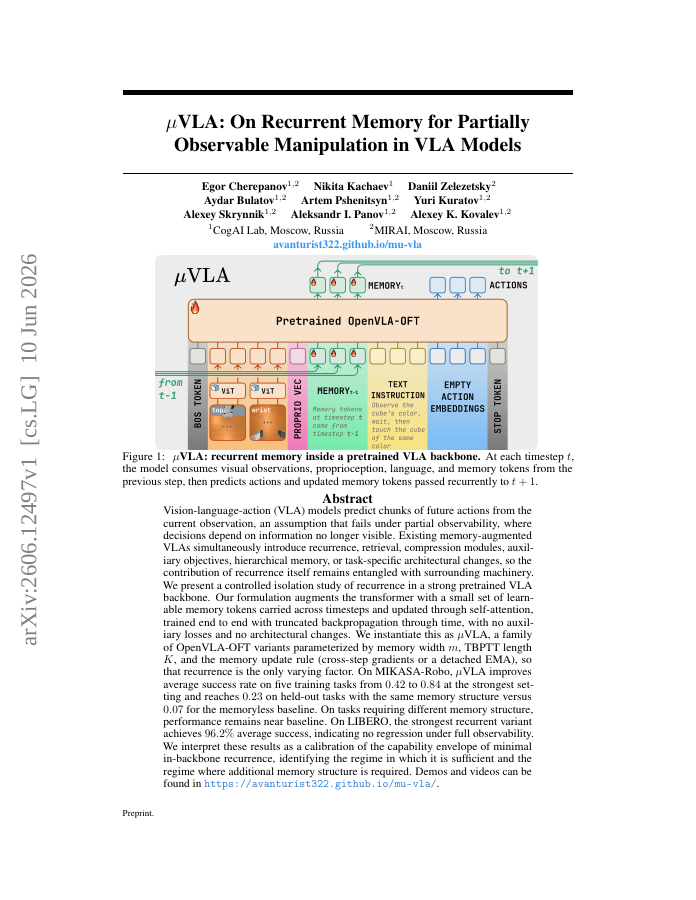
Vision-language-action (VLA) models predict chunks of future actions from the current observation, an assumption that fails under partial observability, where decisions depend on information no longer visible.
10 Jun 2026
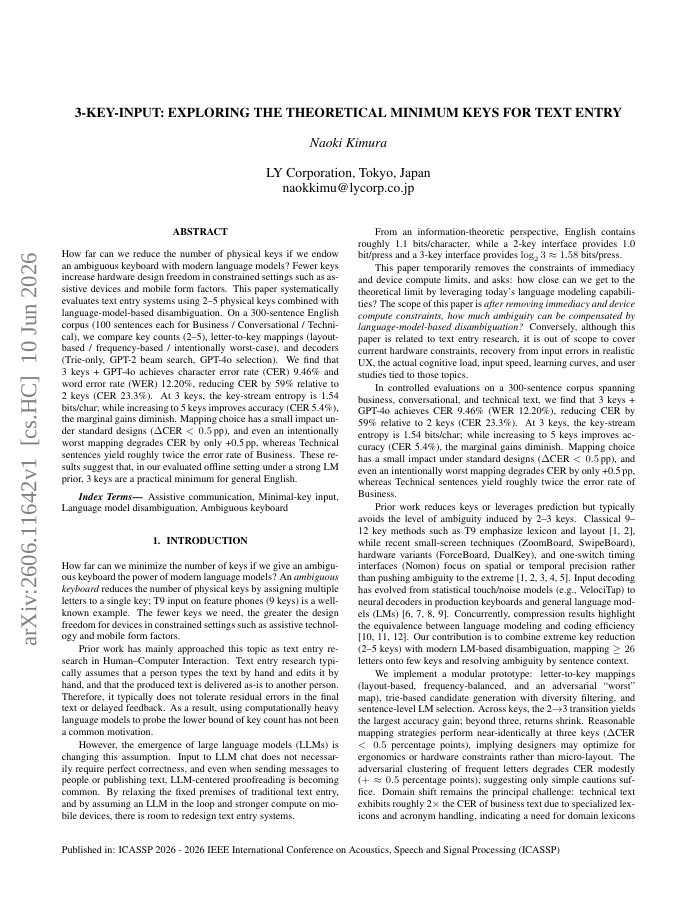
How far can we reduce the number of physical keys if we endow an ambiguous keyboard with modern language models? Fewer keys increase hardware design freedom in constrained settings such as assistive devices and mobile form factors.
10 Jun 2026
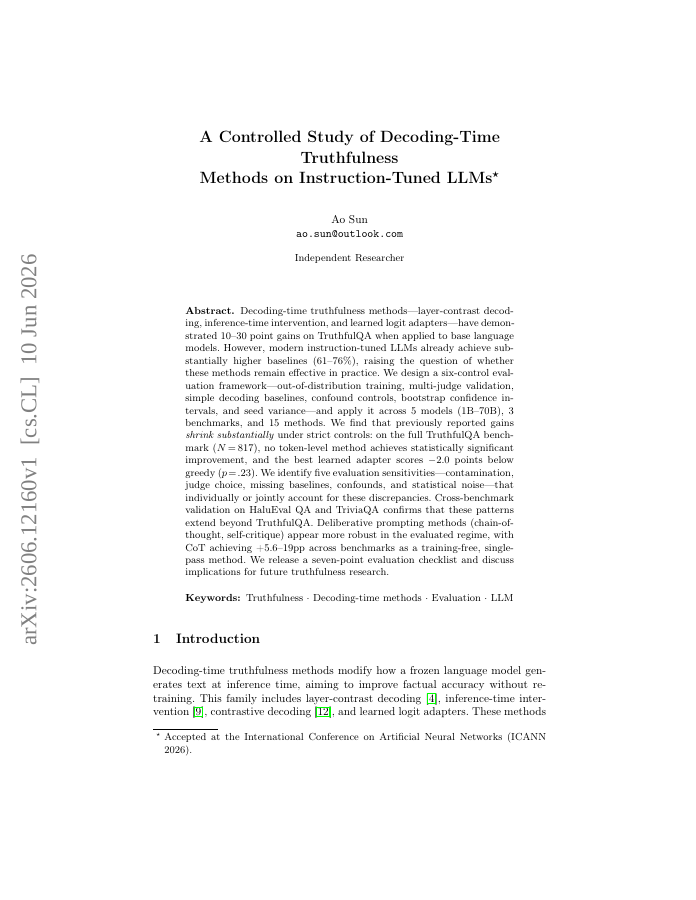
Decoding-time truthfulness methods -- layer-contrast decoding, inference-time intervention, and learned logit adapters -- have demonstrated 10-30 point gains on TruthfulQA when applied to base language models.
10 Jun 2026
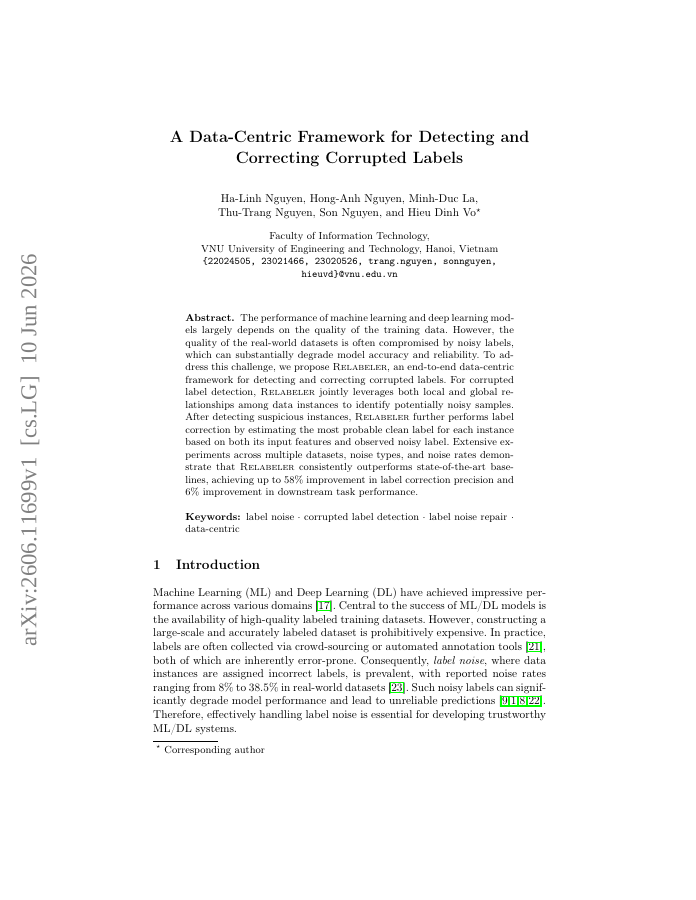
The performance of machine learning and deep learning models largely depends on the quality of the training data. However, the quality of the real-world datasets is often compromised by noisy labels, which can substantially degrade model accuracy and reliability.
10 Jun 2026
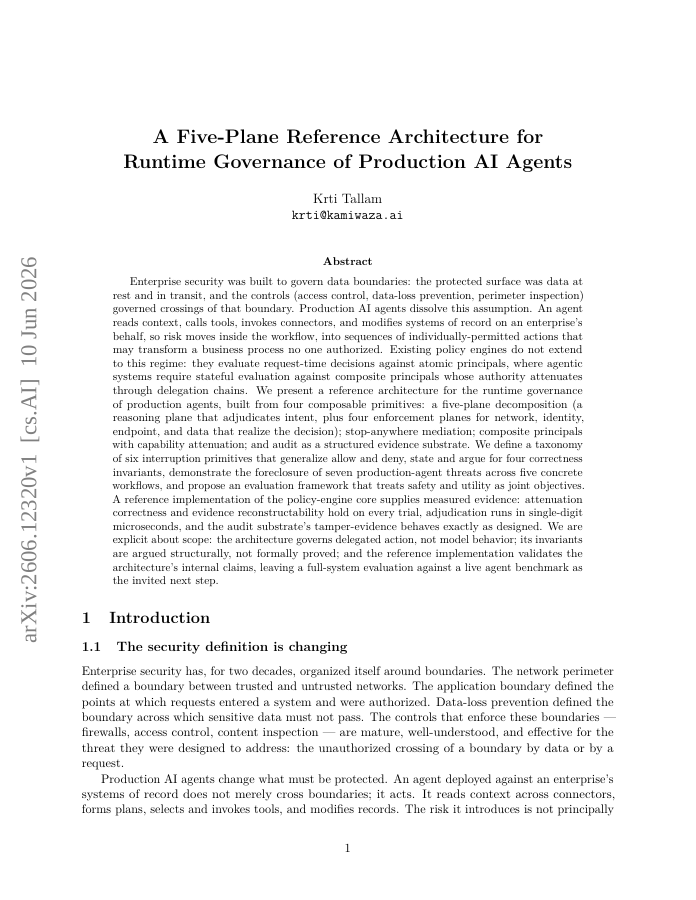
Enterprise security was built to govern data boundaries: the protected surface was data at rest and in transit, and the controls -- access control, data-loss prevention, perimeter inspection -- governed crossings of that boundary. Production AI agents dissolve this assumption.
10 Jun 2026
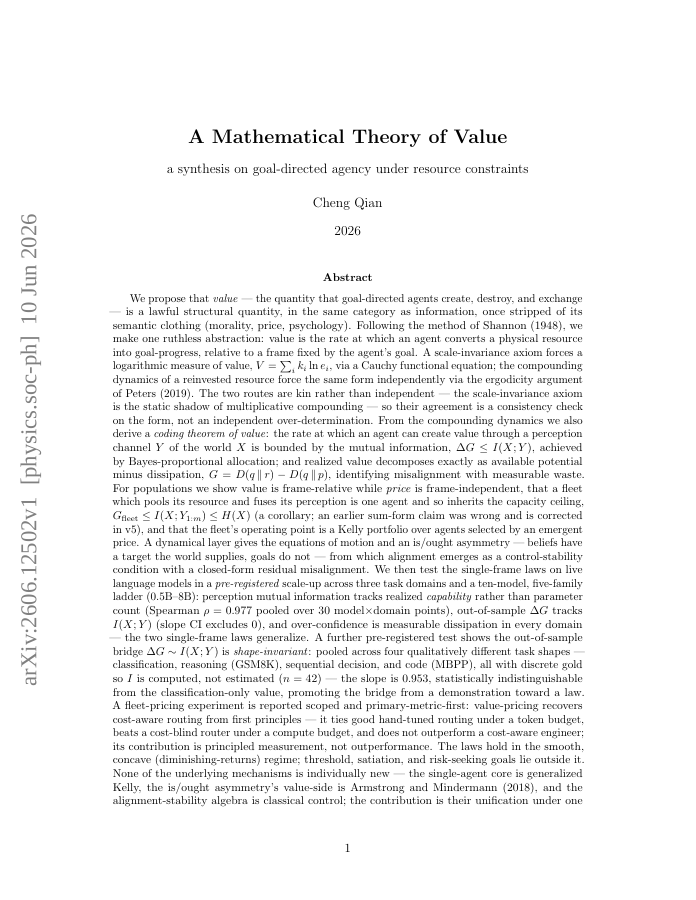
We propose that value -- the quantity goal-directed agents create, destroy, and exchange -- is a lawful structural quantity in the same category as information. Following Shannon's method, we make one ruthless abstraction: value is the rate at which an agent converts a resource…
10 Jun 2026
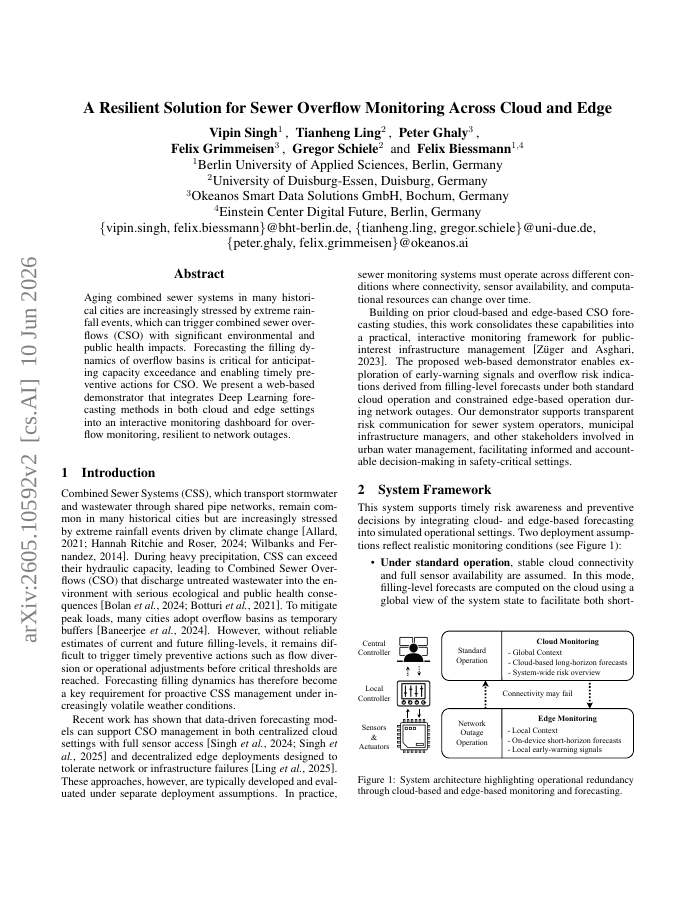
Aging combined sewer systems in many historical cities are increasingly stressed by extreme rainfall events, which can trigger combined sewer overflows (CSO) with significant environmental and public health impacts.
10 Jun 2026
Enthymemes, arguments with unstated premises or conclusions, are pervasive in persuasive discourse, yet their annotation remains notoriously subjective. We present a resource of 1,482 tweets from politically controversial discourse, annotated by five annotators for the presence…
10 Jun 2026
Low-rank optimal transport (OT) mitigates the quadratic scaling of classical solvers, yet existing approaches rely heavily on first-order mirror-descent updates that require careful hyperparameter tuning and ignore the optimization landscape's curvature.
10 Jun 2026
Diffusion models provide expressive data-driven priors for Bayesian inverse problems, but many diffusion posterior samplers rely on heuristic guidance approximations that can fail for nonlinear operators and multimodal posteriors.
10 Jun 2026
Learning compatible representations aims to learn feature representations that can be used interchangeably over time whenever a model undergoes updates. In this paper, we demonstrate that stationary representations learned by d-Simplex fixed classifiers imply compatibility as in…
10 Jun 2026
We give a simple, unified, and nearly tight bound for sampling arbitrary logconcave distributions from a warm start using the In-and-Out algorithm along with exponential lifting.