1 Jan 2026
Optimal control of obstacle problems arises in a wide range of applications and is computationally challenging due to its nonsmoothness, nonlinearity, and bilevel structure.
Trending research and the full catalog - each paper linked to the benchmarks, methods, and models it introduces.
Filtering here covers the 2,000 most recent papers, as much as one page can hold in memory. See the full index of 22,213 papers.
1 Jan 2026
Optimal control of obstacle problems arises in a wide range of applications and is computationally challenging due to its nonsmoothness, nonlinearity, and bilevel structure.
1 Jan 2026
The sequential acquisition of languages inevitably leads to Crosslinguistic Influence (CLI), where the syntactic properties of a first language (L1) impact the processing of a second language (L2).
1 Jan 2026
Large Language Models (LLMs) have emerged as powerful tools for generating data across various modalities. By transforming data from a scarce resource into a controllable asset, LLMs mitigate the bottlenecks imposed by the acquisition costs of real-world data for model training,…
1 Jan 2026
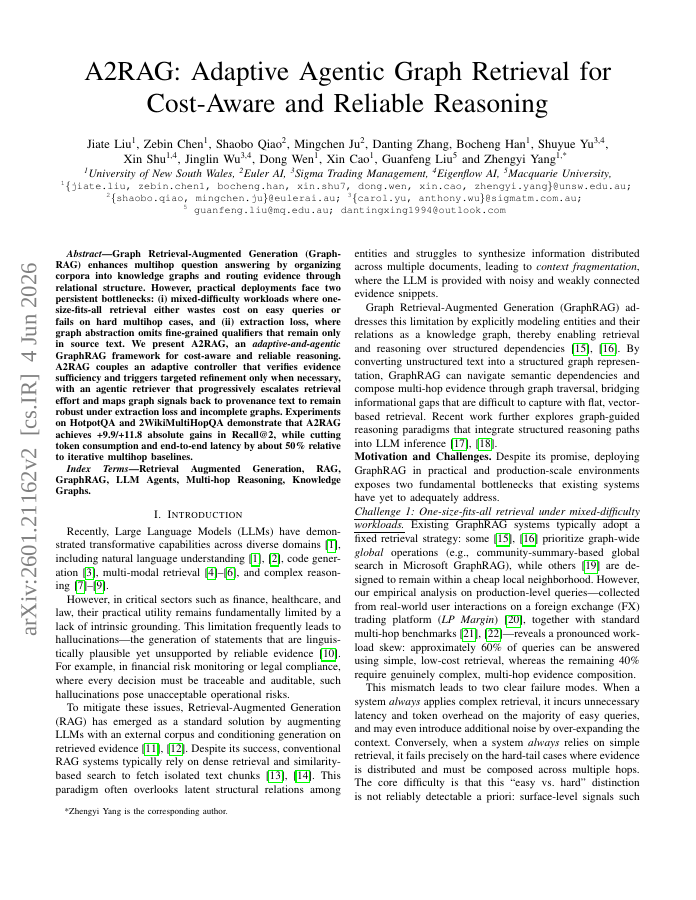
Graph Retrieval-Augmented Generation (Graph-RAG) enhances multihop question answering by organizing corpora into knowledge graphs and routing evidence through relational structure.
1 Jan 2026
Despite the significant advancements of Large Language Models (LLMs), their factuality remains a critical challenge, creating a growing need for more nuanced factuality verification.
1 Jan 2026
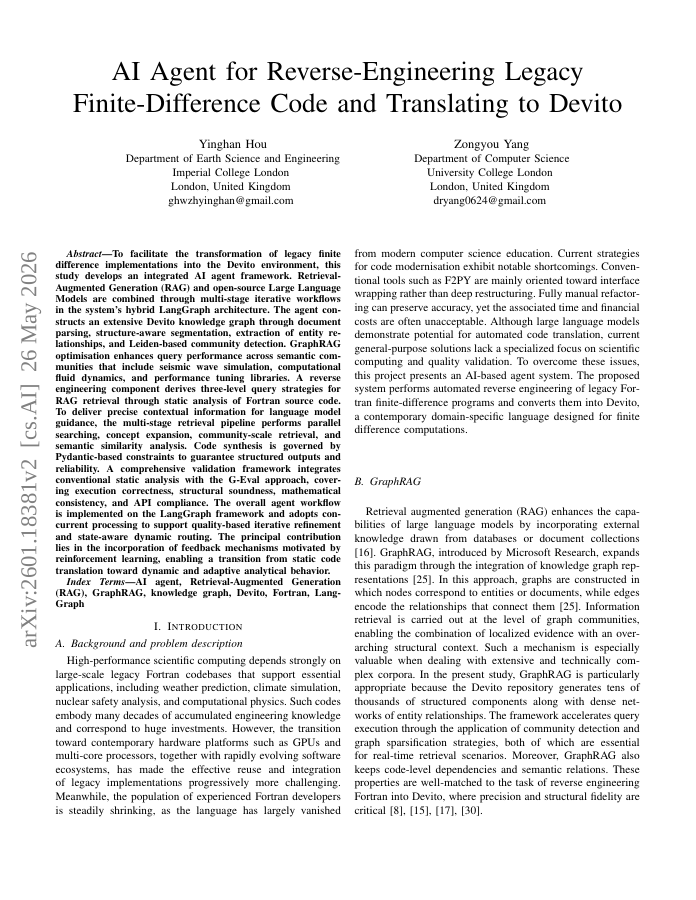
To facilitate the transformation of legacy finite difference implementations into the Devito environment, this study develops an integrated AI agent framework. Retrieval-Augmented Generation (RAG) and open-source Large Language Models are combined through multi-stage iterative…
1 Jan 2026
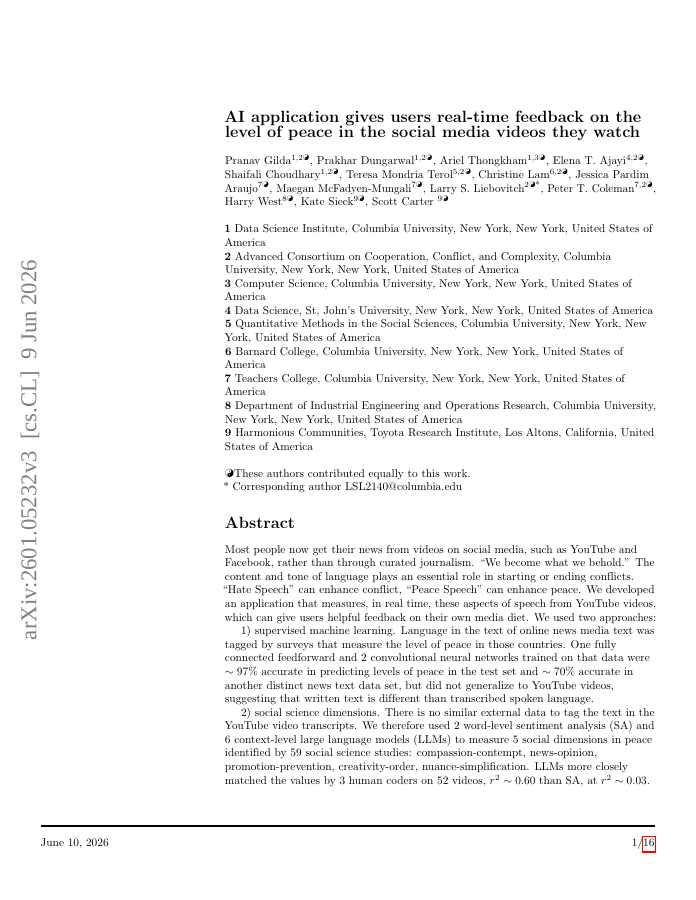
Most people now get their news from videos on social media, such as YouTube and Facebook, rather than through curated journalism. "We become what we behold." The content and tone of language plays an essential role in starting or ending conflicts.
1 Jan 2026
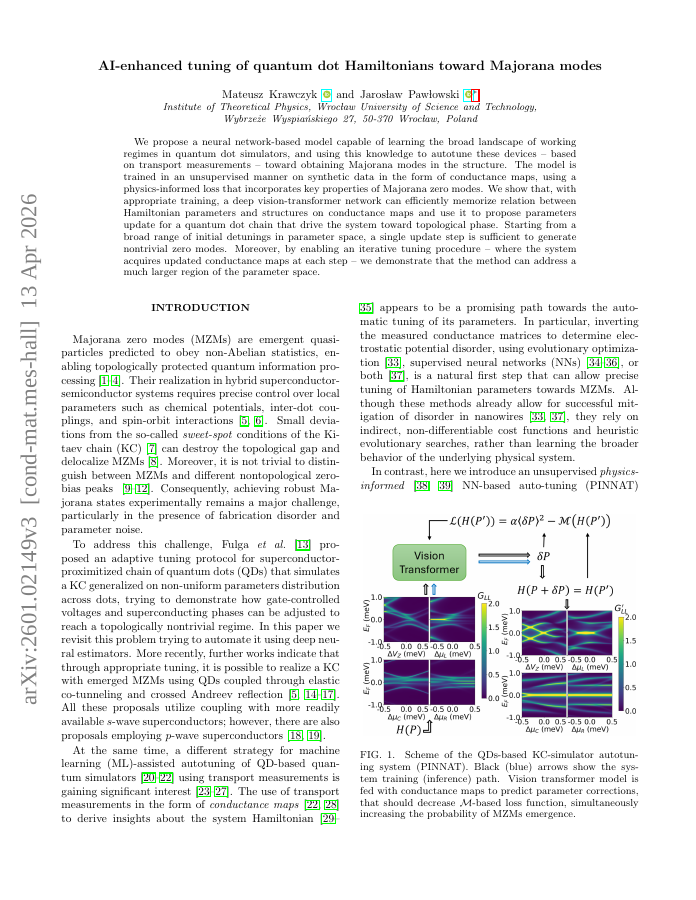
We propose a neural network-based model capable of learning the broad landscape of working regimes in quantum dot simulators, and using this knowledge to autotune these devices - based on transport measurements - toward obtaining Majorana modes in the structure.