19 Sep 2026
Can simple learning rules keep their regret bounded in self-play? Recent work achieves constant regret bounds through modified regularization and higher-order prediction.
Trending research and the full catalog - each paper linked to the benchmarks, methods, and models it introduces.
Filtering here covers the 2,000 most recent papers, as much as one page can hold in memory. See the full index of 22,552 papers.
19 Sep 2026
Can simple learning rules keep their regret bounded in self-play? Recent work achieves constant regret bounds through modified regularization and higher-order prediction.
19 Sep 2026
In this paper, we investigate the Minimum Obstacle Displacement Planning problem from a robot motion planning perspective. The problem involves determining a feasible path to a goal location by displacing movable obstacles when no collision-free path initially exists.
19 Sep 2026
Time series foundation models (TSFMs) have recently delivered impressive zero-shot performance across diverse forecasting tasks. However, real-world decision-making frequently relies on \emph{irregular multivariate time series} (IMTS), where inconsistent inter-observation…
19 Sep 2026
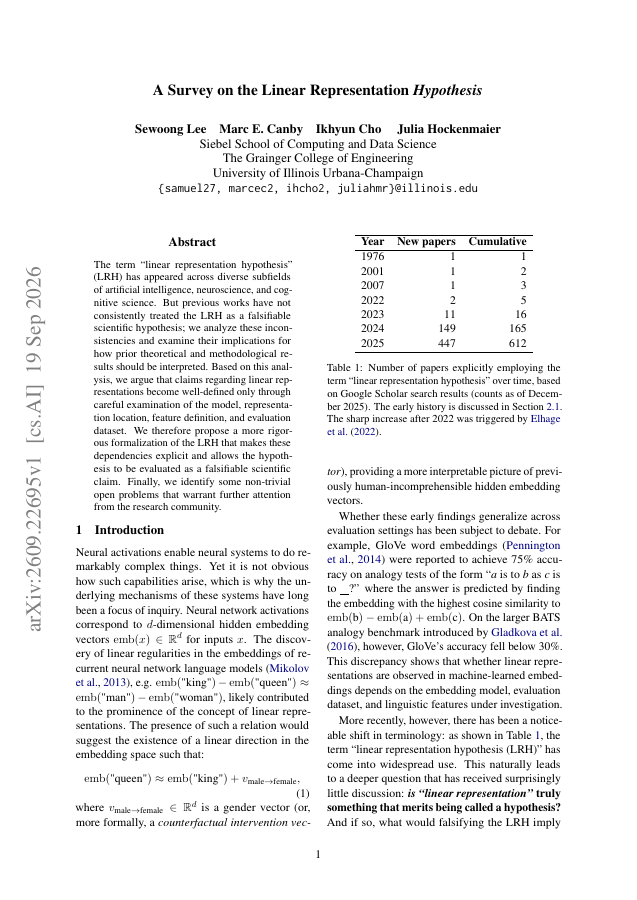
The term "linear representation hypothesis" (LRH) has appeared across diverse subfields of artificial intelligence, neuroscience, and cognitive science. But previous works have not consistently treated the LRH as a falsifiable scientific hypothesis; we analyze these…
18 Sep 2026
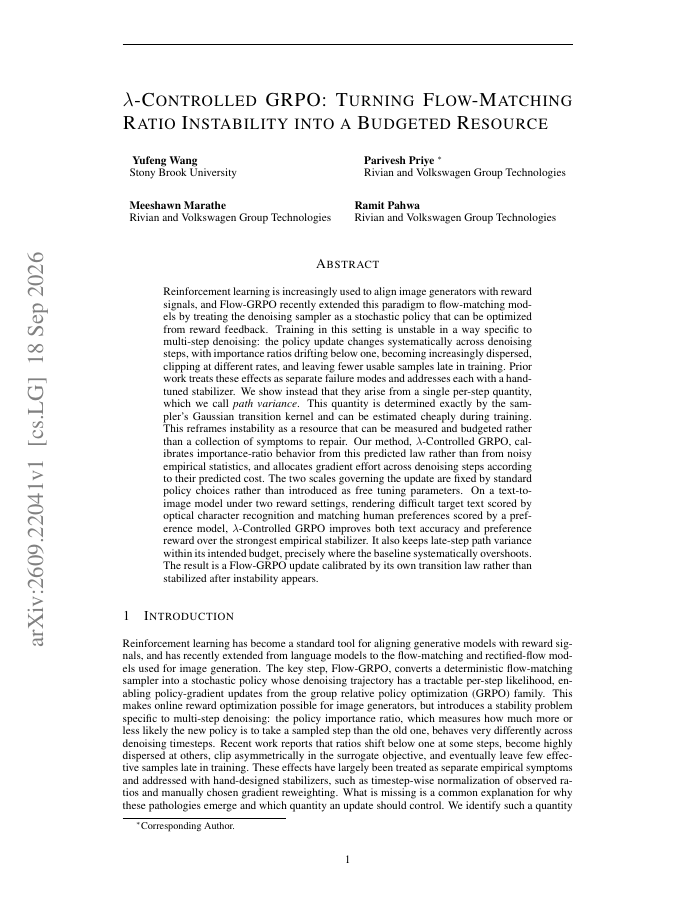
Reinforcement learning is increasingly used to align image generators with reward signals, and Flow-GRPO recently extended this paradigm to flow-matching models by treating the denoising sampler as a stochastic policy that can be optimized from reward feedback.
18 Sep 2026
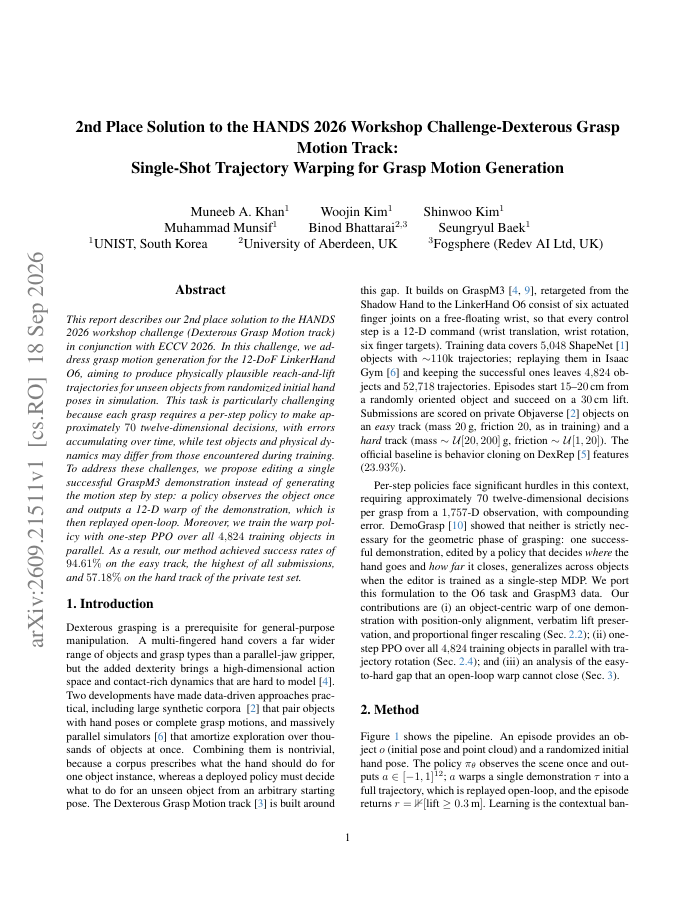
This report describes our 2nd place solution to the HANDS 2026 workshop challenge (Dexterous Grasp Motion track) in conjunction with ECCV 2026. In this challenge, we address grasp motion generation for the 12-DoF LinkerHand O6, aiming to produce physically plausible…
18 Sep 2026
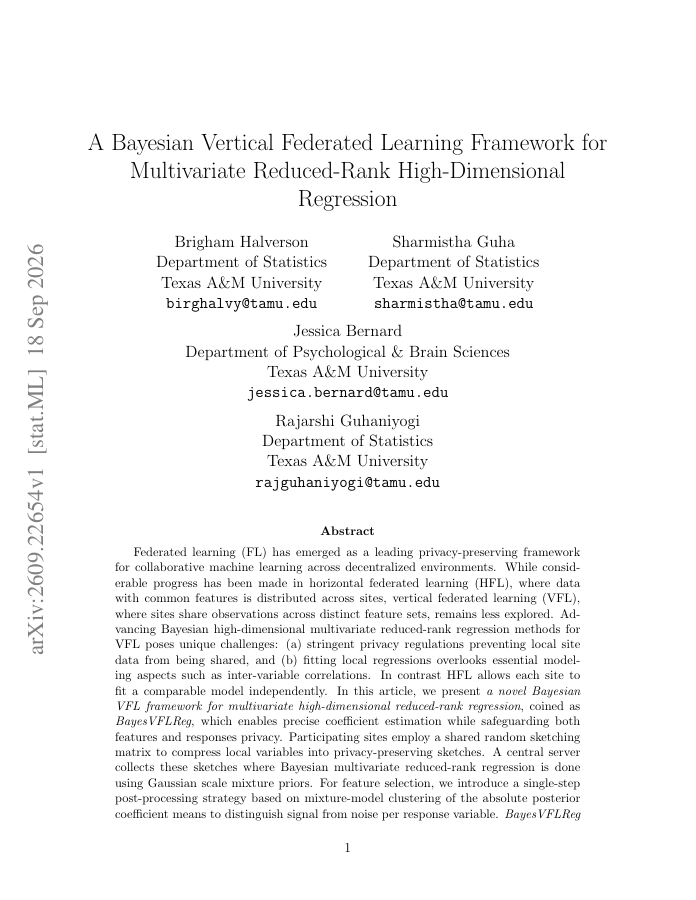
Federated learning (FL) has emerged as a leading privacy-preserving framework for collaborative machine learning across decentralized environments. While considerable progress has been made in horizontal federated learning (HFL), where data with common features is distributed…
18 Sep 2026
Perceptual planning tasks require two key capabilities: accurately perceiving uncertain scenes and planning valid action sequences following logical rules. Conventional methods convert perception into discrete symbolic facts and then plan, discarding perceptual uncertainty and…
18 Sep 2026
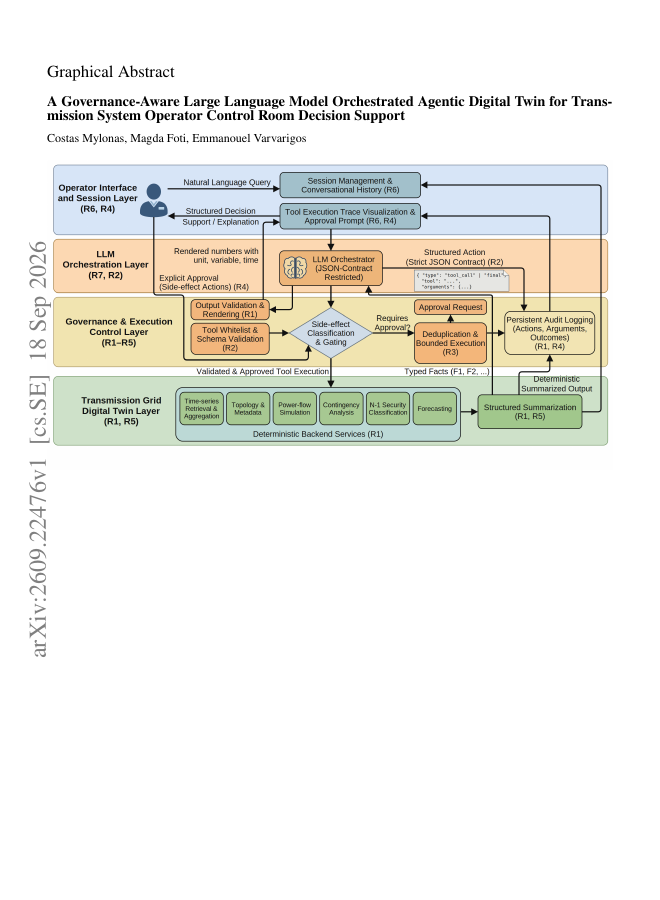
Transmission system operators face rising complexity from renewable integration, reduced inertia, and tighter security margins. Large language models offer natural-language decision support, but their hallucinations, uncontrolled tool use, and weak traceability conflict with…
18 Sep 2026
Large language models can hold knowledge they do not report. A model may sandbag on a capability evaluation, or answer against what it internally knows, and its outputs alone cannot tell whether it is hiding an answer or simply does not have one.
17 Sep 2026
Undesired information such as harmful content and private data propagates through Multilingual Large Language Models (LLMs) via direct training and indirect cross-linguistic spread.
17 Sep 2026
LLM-based GUI agents increasingly act on behalf of users in digital environments that were designed with human users in mind. These graphical user interfaces were designed to support, but also deliberately steer, the behaviour and decisions of users.
17 Sep 2026
Geographic applications need every object inside a radius that satisfies a semantic threshold, yet embedding indexes return approximate top-ranked lists and may omit qualifying records silently.
17 Sep 2026
Quantitative analysis of experimental powder X-ray diffraction data remains challenging when evaluating complex multiphase materials and noisy measurements. We introduce a hybrid quantum neural network framework designed to extract quantitative parameters, such as phase weight…
17 Sep 2026
Covariate-rich time-series forecasting requires deciding how external variables enter the target forecasting path. Existing Transformer-based forecasters usually build a covariate representation and pass it to the encoder without an explicit admission stage.
17 Sep 2026
This article presents a mathematical model of the Motivated Emotional Mind cognitive architecture developed for embodied intelligent systems. Such a system learns to maintain its homeostasis through a generalized form of reinforcement learning based on its internal motivations,…
17 Sep 2026
Artificial intelligence for plant disease analysis has advanced from task-specific classifiers to multi-modal models capable of jointly interpreting visual and textual information.
17 Sep 2026
This paper proposes a phonemically comprehensive, ASCII-only romanization scheme for Thai and Lao, treating the two closely related languages as a unified cross-lingual design problem.
17 Sep 2026
Croissant is the de facto machine-readable descriptor for ML datasets: JSON-LD over schema.org. Since version 1.1 it also carries data use conditions, recommending DUO and ODRL for them.
17 Sep 2026
The growing complexity of multi-domain operational environments (land, aerospace, naval, cyber, and electromagnetic spectrum) has increased the volume and velocity of data reaching command-and-control (C2) centers, straining the observe-orient-decide-act (OODA) decision cycle.
17 Sep 2026
Spatial reasoning abilities correlate strongly with performance in STEM fields. Games offer a compelling medium for training these critical skills in developing children who have a natural proclivity for play.
17 Sep 2026
The Internet of Agents is expected to enable large numbers of autonomous agents to discover, verify, and collaborate with each other across heterogeneous platforms. However, current agent protocols mainly address tool invocation and inter-agent communication, leaving scalable…
17 Sep 2026
Autonomous underwater vehicles (AUVs) operating beyond reliable communications must recover from failures without human intervention. We investigate an architecture in which conventional deterministic layered control autonomy manages normal operations, while an invokable large…
17 Sep 2026
We study data-driven early stopping for spectral regularisation methods in the classical non-parametric regression setting. Building on the discrepancy principle, we propose a multi-scale stopping rule that applies to general kernel estimators and show that, unlike previous…