8 Oct 2026
Predicting the structure and response of inhomogeneous polymer electrolytes requires a description of ion correlations that retains molecular-scale accuracy while remaining transferable across spatial scales and geometries.
Trending research and the full catalog - each paper linked to the benchmarks, methods, and models it introduces.
Filtering here covers the 2,000 most recent papers, as much as one page can hold in memory. See the full index of 22,552 papers.
8 Oct 2026
Predicting the structure and response of inhomogeneous polymer electrolytes requires a description of ion correlations that retains molecular-scale accuracy while remaining transferable across spatial scales and geometries.

8 Oct 2026
Reinforcement learning in safety-critical domains requires maximizing task performance while strictly adhering to safety constraints. Existing safe reinforcement learning paradigms typically force a trade-off: they either require a priori knowledge to provide strict safety…
7 Oct 2026
Despite its widespread use, Proximal Policy Optimization with clipping (PPO-Clip) remains difficult to tune, and the interactions among critic learning, clipping, and rollout reuse remain incompletely understood.
7 Oct 2026
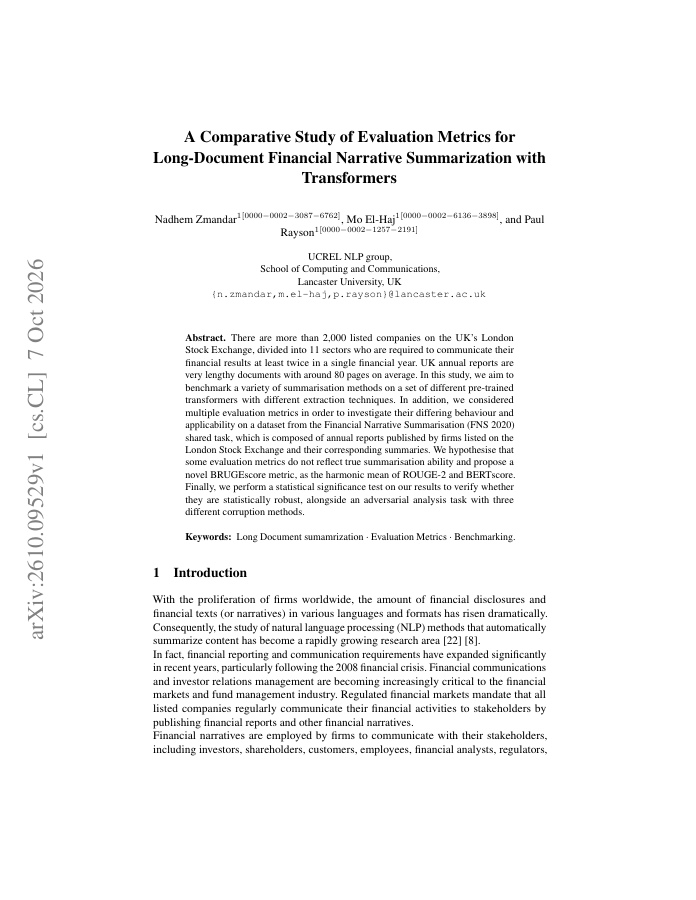
There are more than 2,000 listed companies on the UK's London Stock Exchange, divided into 11 sectors who are required to communicate their financial results at least twice in a single financial year. UK annual reports are very lengthy documents with around 80 pages on average.
7 Oct 2026
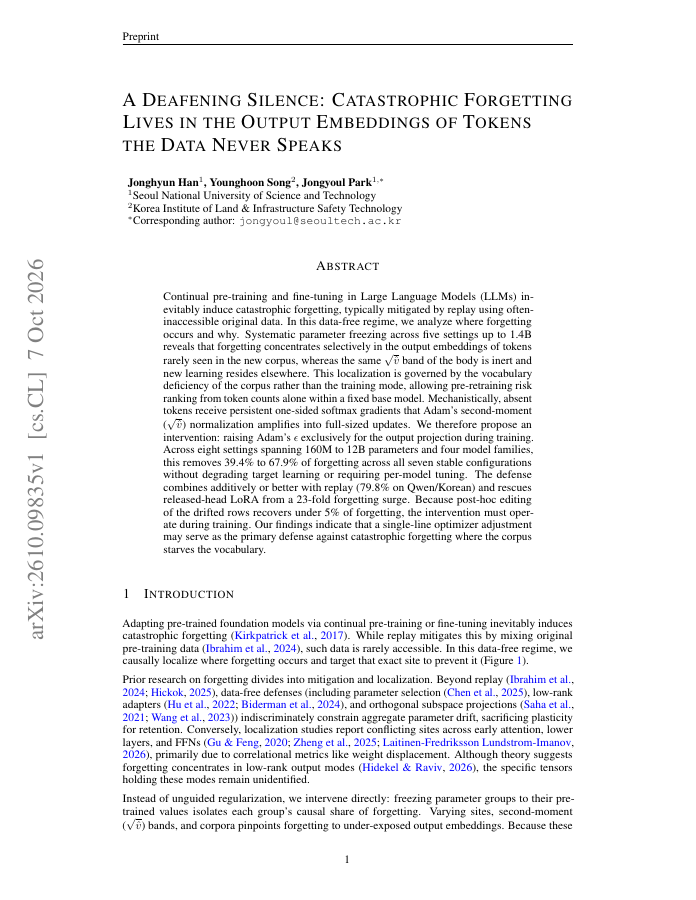
Continual pre-training and fine-tuning in Large Language Models (LLMs) inevitably induce catastrophic forgetting, typically mitigated by replay using often-inaccessible original data. In this data-free regime, we analyze where forgetting occurs and why.
7 Oct 2026
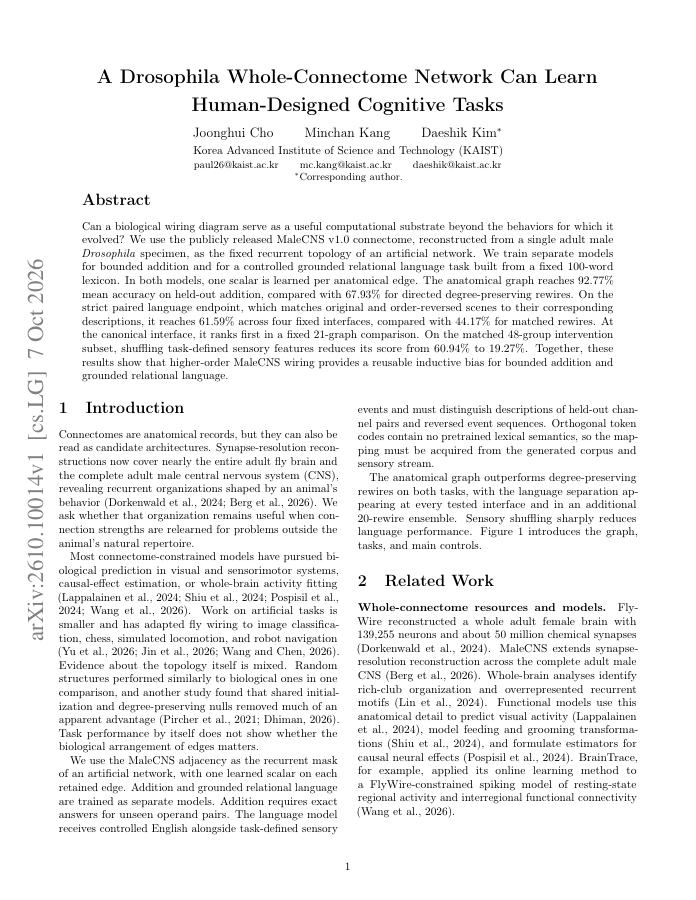
Can a biological wiring diagram serve as a useful computational substrate beyond the behaviors for which it evolved? We use the publicly released MaleCNS v1.0 connectome, reconstructed from a single adult male Drosophila specimen, as the fixed recurrent topology of an artificial…
7 Oct 2026
Background: Modern software systems increasingly rely on Machine Learning (ML) assets (i.e., pre-trained models, datasets, benchmarks) for building, evaluating, and integrating ML-based systems.
7 Oct 2026
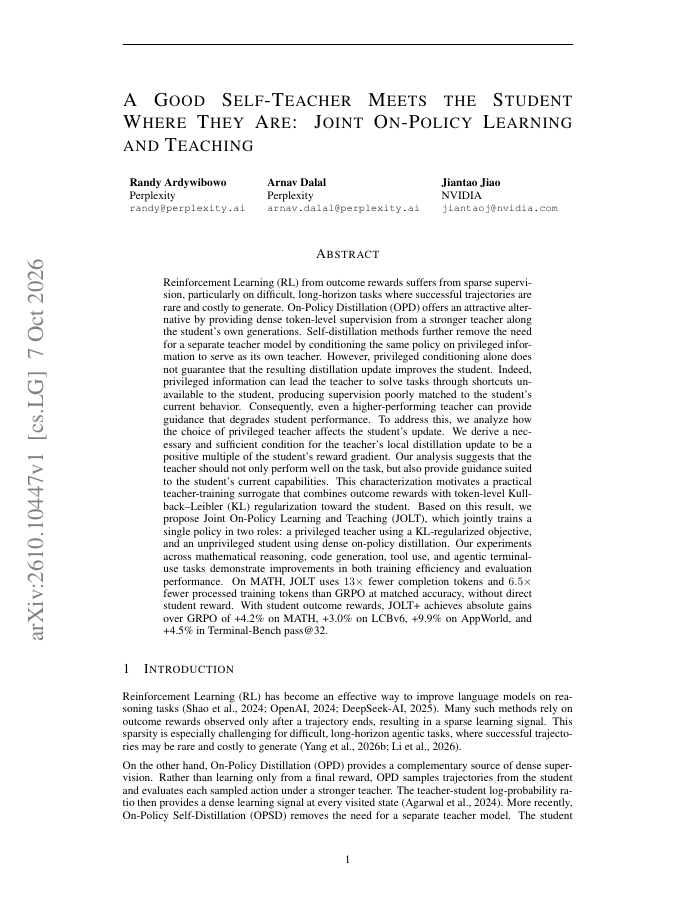
Reinforcement Learning (RL) from outcome rewards suffers from sparse supervision, particularly on difficult, long-horizon tasks where successful trajectories are rare and costly to generate.
7 Oct 2026
Modeling heterogeneous materials remains a challenge for physics-informed neural networks such as the deep energy method (DEM). The DEM and its variants, here collectively referred to as the neural energy method (NEM), offer a differentiable variational framework.
7 Oct 2026
Self-supervised anomaly detection is a promising paradigm for medical ultrasound, as normal images are often easier to obtain than exhaustive annotations of all possible pathologies.
7 Oct 2026
Electroencephalography (EEG) is highly susceptible to electromyographic (EMG) artifacts, whose temporal heterogeneity and spatial-spectral overlap with neural activity can leave mixed sources after blind source separation.
7 Oct 2026
Human-Robot Collaboration (HRC) can facilitate mass customisation in Industry 4.0, with Reinforcement Learning from Human Feedback (RLHF) representing a promising approach for developing safe AI-based robots.
7 Oct 2026
Deployments of research agents are moving to populations of thousands that share one pool of compute, while most current systems organize one project at a time or leave the population unorganized.
7 Oct 2026
When does distribution alignment help a frozen foundation-model embedding generalize across acoustic domains? For cross-domain mosquito-species classification we report a strength-monotonic law: the stronger an encoder is on the target task, the more its unseen-domain…
7 Oct 2026
The wide adoption of LLMs across broad NLG applications heightens the importance of providing users with the means to avert errors and hallucinations. Uncertainty quantification is poised to fill that gap; with low uncertainty (high confidence), as a proxy for correctness,…
7 Oct 2026
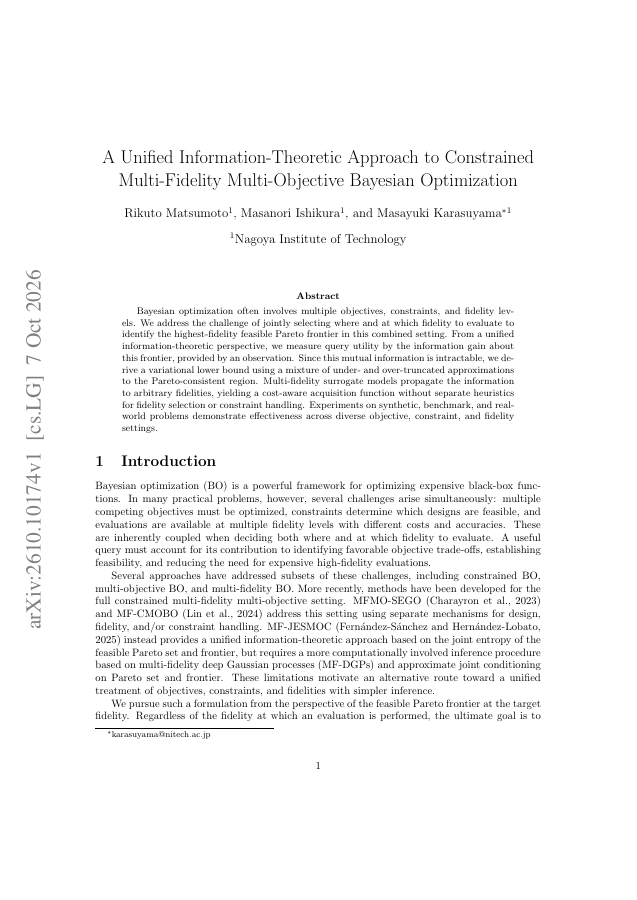
Bayesian optimization often involves multiple objectives, constraints, and fidelity levels. We address the challenge of jointly selecting where and at which fidelity to evaluate to identify the highest-fidelity feasible Pareto frontier in this combined setting.
6 Oct 2026
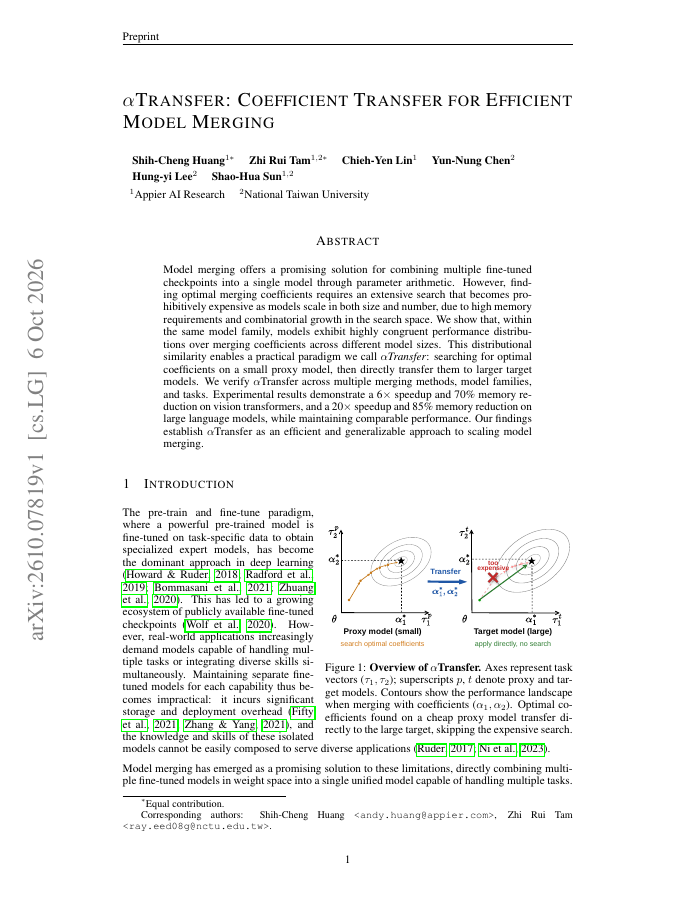
Model merging offers a promising solution for combining multiple fine-tuned checkpoints into a single model through parameter arithmetic. However, finding optimal merging coefficients requires an extensive search that becomes prohibitively expensive as models scale in both size…
6 Oct 2026
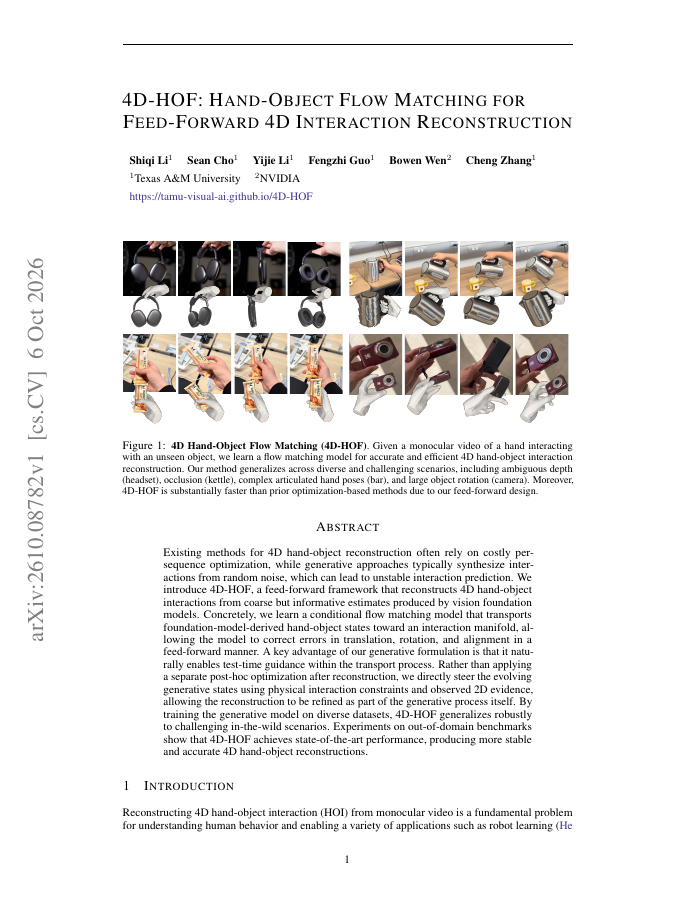
Existing methods for 4D hand-object reconstruction often rely on costly per-sequence optimization, while generative approaches typically synthesize interactions from random noise, which can lead to unstable interaction prediction.
6 Oct 2026
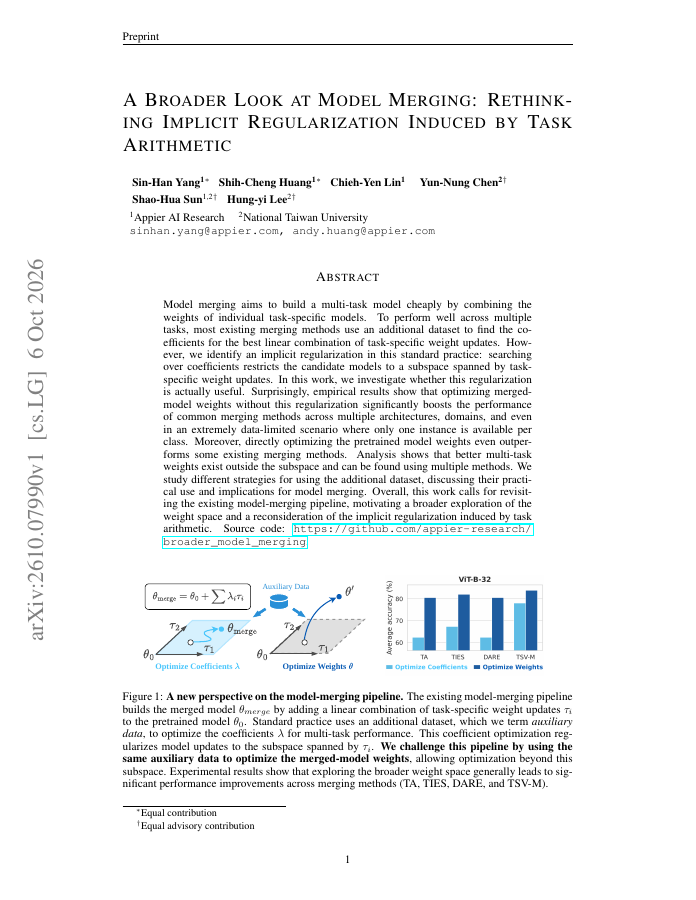
Model merging aims to build a multi-task model cheaply by combining the weights of individual task-specific models. To perform well across multiple tasks, most existing merging methods use an additional dataset to find the coefficients for the best linear combination of…
6 Oct 2026
Software-engineering agents can enable people without formal software training to build systems they could not otherwise implement and simultaneously can produce more code than even experts can meaningfully inspect.
6 Oct 2026
We present a hybrid quantum-classical framework that detects affinity and romance-investment fraud by modelling the cognitive biases in a manipulative conversation. In our proposed framework, cognitive biases central to this fraud class are carried by dedicated qubits in a…
6 Oct 2026
This study formulates individual route reproduction as a shortest-path problem over learned driver-specific latent link costs. The central idea is that, once such latent costs are inferred from contextual information, observed routes can be reproduced without enumerating…
6 Oct 2026
Autism spectrum disorder (ASD) is diagnosed through specialist observation of a child's social behavior, and access to that expertise is the bottleneck for early identification.
6 Oct 2026
We develop a geometry-based capacity theory for exact-key retrieval in compressed finite-feature Hebbian associative memory. For random or approximately isotropic values, retrieval interference separates into finite-feature noise, which decreases with feature dimension, and…