29 Sep 2026
A droplet breaks up in tens of microseconds, and a recording captures perhaps a dozen frames. The states in between cannot be recovered without repeating the experiment, and simulating them is too costly to sweep an operating envelope.
Trending research and the full catalog - each paper linked to the benchmarks, methods, and models it introduces.
Filtering here covers the 2,000 most recent papers, as much as one page can hold in memory. See the full index of 22,552 papers.
29 Sep 2026
A droplet breaks up in tens of microseconds, and a recording captures perhaps a dozen frames. The states in between cannot be recovered without repeating the experiment, and simulating them is too costly to sweep an operating envelope.
29 Sep 2026
Data reconstruction attacks have empirically been successful in recovering training samples from learned models, raising privacy concerns and motivating defenses with guarantees that remain valid against future threats.
29 Sep 2026
Fix a target accuracy $\varepsilon$, a gradient-noise level $s$, and a horizon $N$. We wish to design algorithms which minimize the probability of observing a suboptimality gap which exceeds the target accuracy, i.e., $\mathcal{E}_N = -\log \sup_{f,P} \mathbb{P}_P(f(x_A) -…
28 Sep 2026
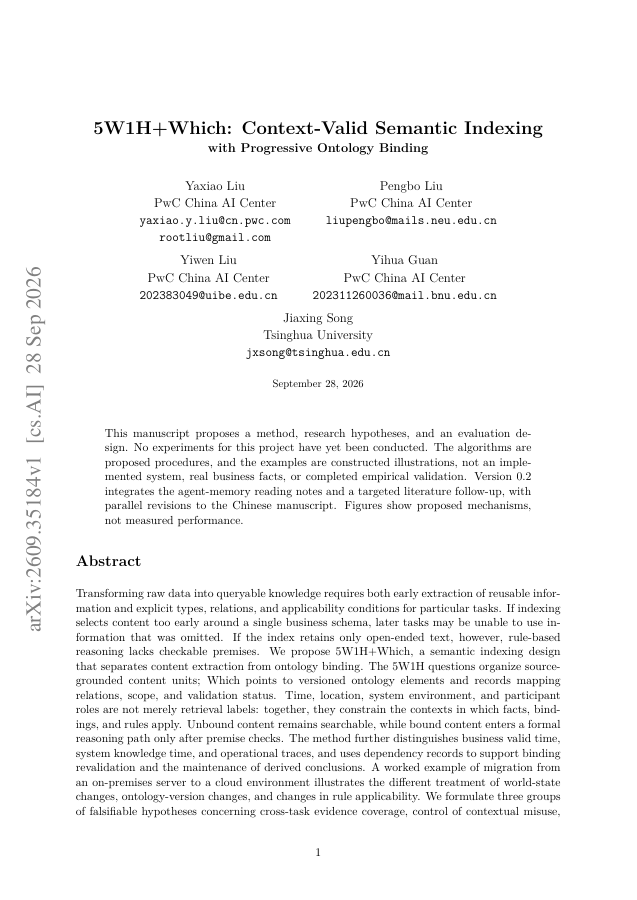
Transforming raw data into queryable knowledge requires both early extraction of reusable information and explicit types, relations, and applicability conditions for particular tasks.
28 Sep 2026
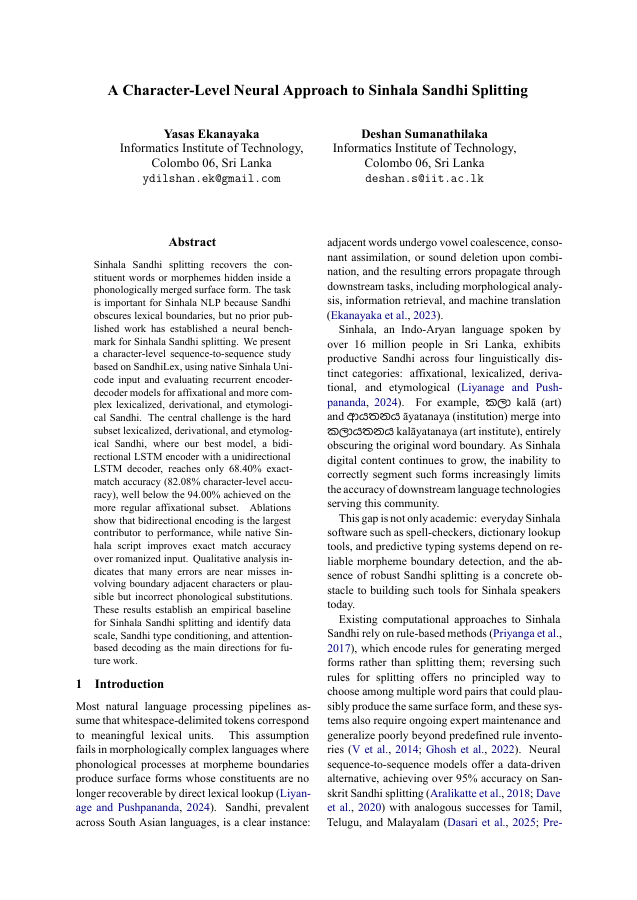
Sinhala Sandhi splitting recovers the constituent words or morphemes hidden inside a phonologically merged surface form. The task is important for Sinhala NLP because Sandhi obscures lexical boundaries, but no prior published work has established a neural benchmark for Sinhala…
28 Sep 2026
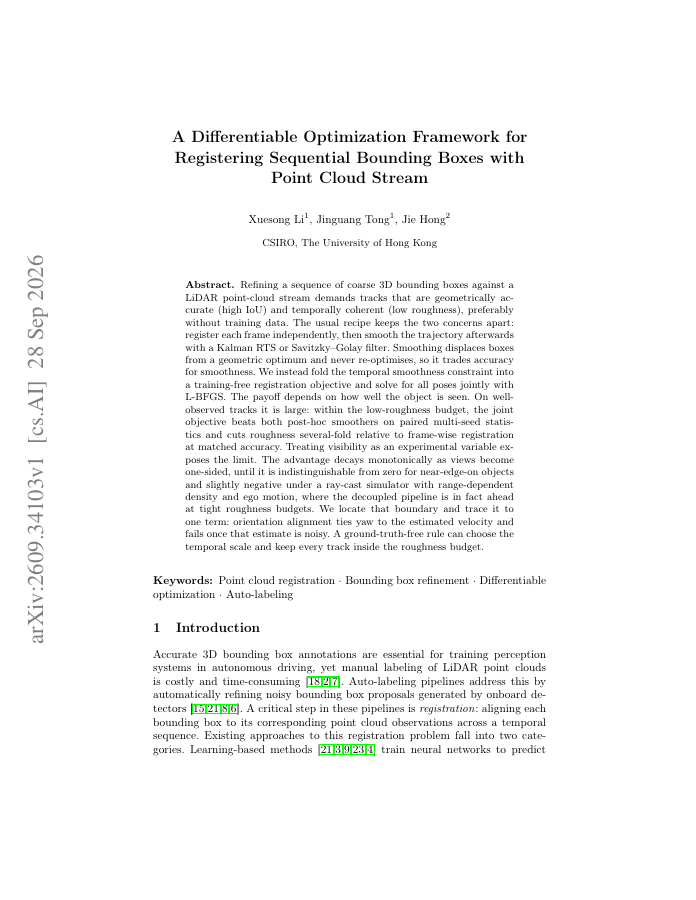
Refining a sequence of coarse 3D bounding boxes against a LiDAR point-cloud stream demands tracks that are geometrically accurate (high IoU) and temporally coherent (low roughness), preferably without training data.
28 Sep 2026
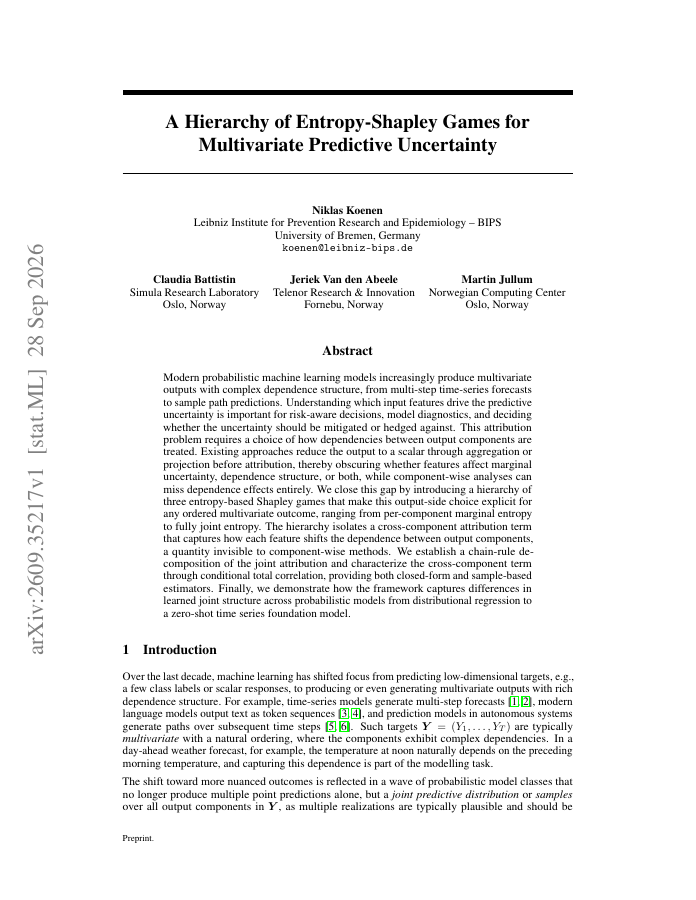
Modern probabilistic machine learning models increasingly produce multivariate outputs with complex dependence structure, from multi-step time-series forecasts to sample path predictions.
28 Sep 2026
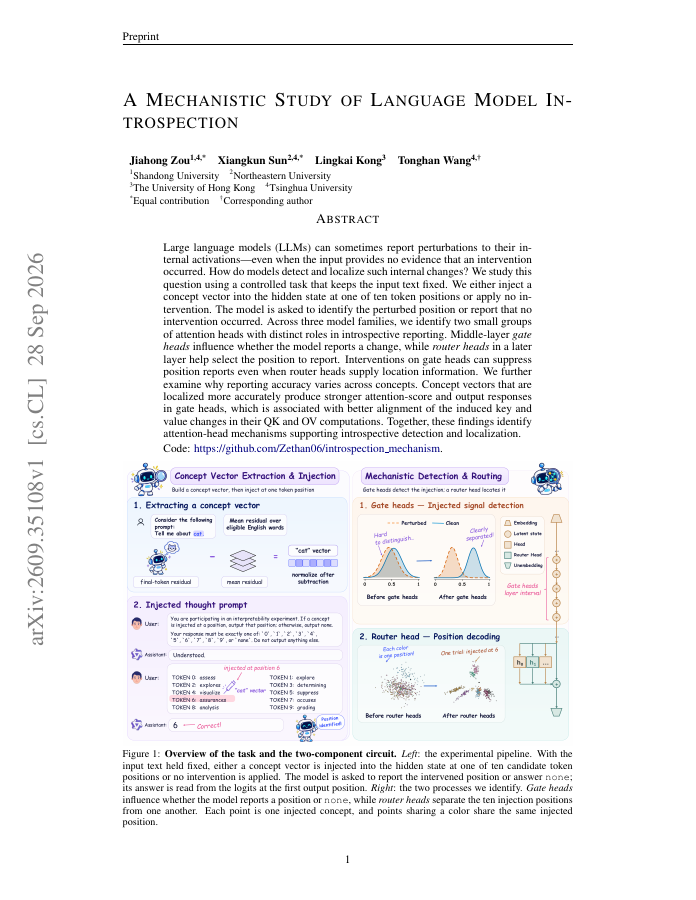
Large language models (LLMs) can sometimes report perturbations to their internal activations---even when the input provides no evidence that an intervention occurred. How do models detect and localize such internal changes? We study this question using a controlled task that…
28 Sep 2026
Mixture-of-Experts (MoE) models repeatedly route tokens to sparse subsets of experts, but conventional routers expose no routing-specific record of how cross-layer influences accumulate.
28 Sep 2026
When a doctor, a judge, or an engineer must decide whether to trust an AI model's output, they cannot avoid asking what the model understands. Purely mathematical or statistical descriptions struggle to distinguish trustworthy from untrustworthy outputs without reintroducing the…
28 Sep 2026
Language model post-training is often bottlenecked by the need for human-collected preference data, which is expensive and difficult to scale. Reinforcement learning from AI feedback (RLAIF) style approaches that leverage pseudo labels offer an abundant alternative but introduce…
27 Sep 2026
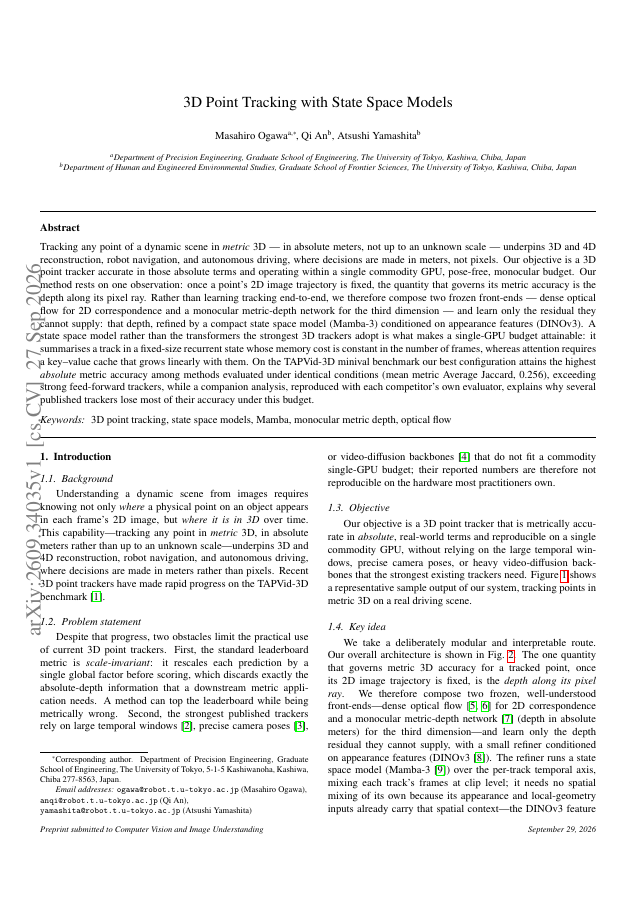
Tracking any point of a dynamic scene in metric 3D - in absolute meters, not up to an unknown scale - underpins 3D and 4D reconstruction, robot navigation, and autonomous driving, where decisions are made in meters, not pixels.
27 Sep 2026
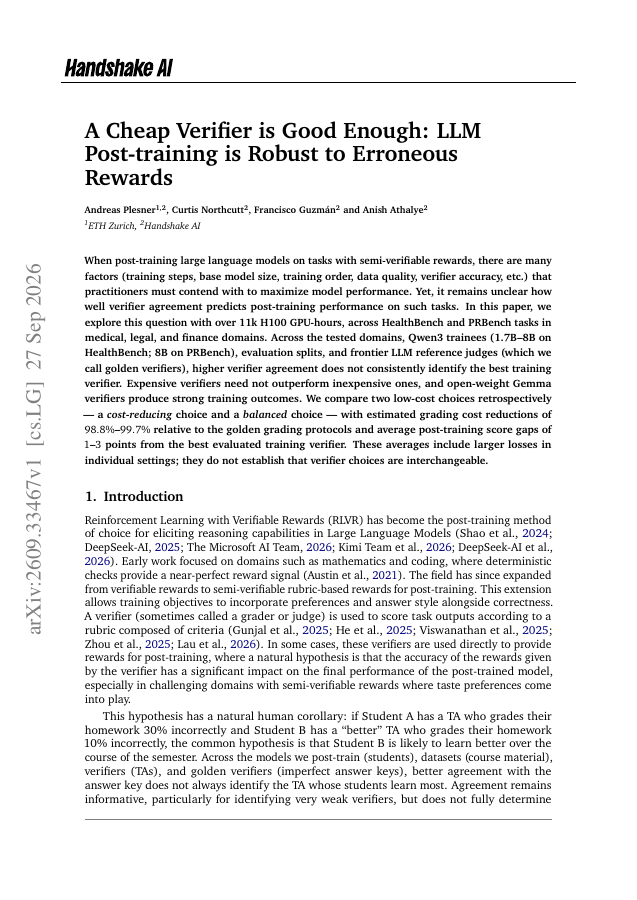
When post-training large language models on tasks with semi-verifiable rewards, there are many factors (training steps, base model size, training order, data quality, verifier accuracy, etc.) that practitioners must contend with to maximize model performance.
27 Sep 2026
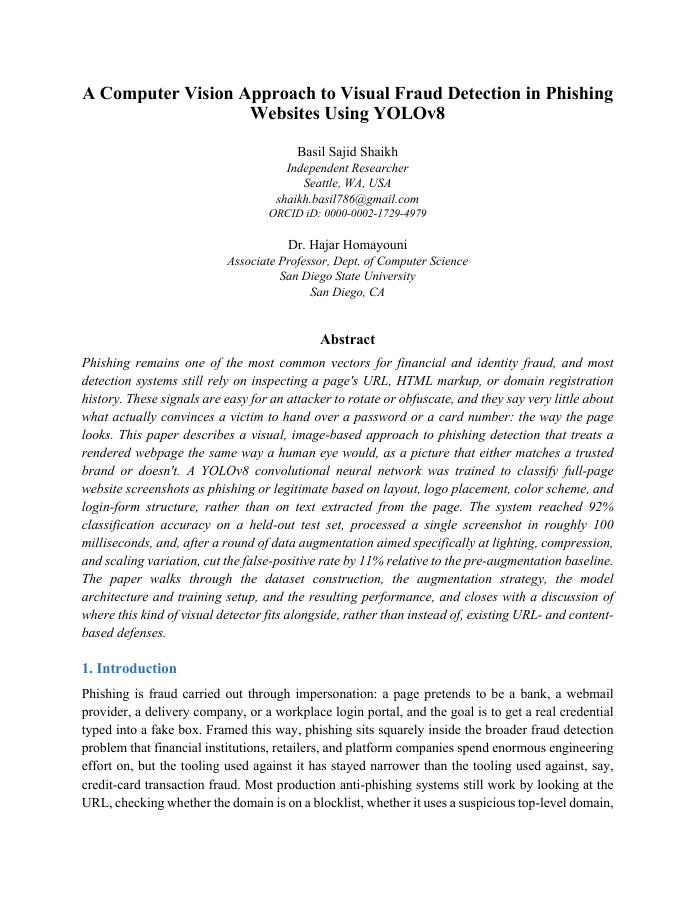
Phishing remains one of the most common vectors for financial and identity fraud, and most detection systems still rely on inspecting a page's URL, HTML markup, or domain registration history.
27 Sep 2026
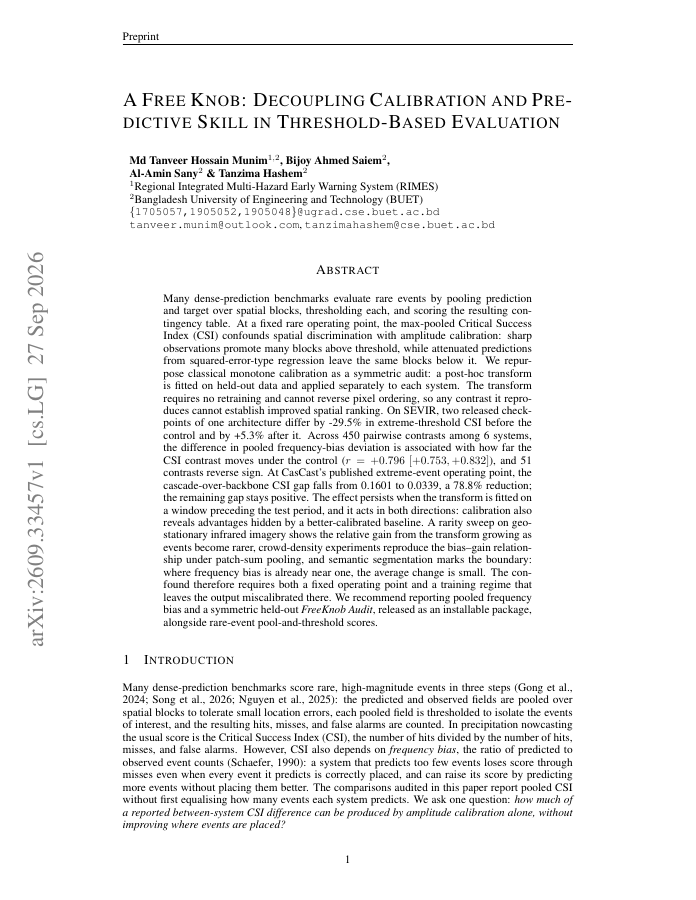
Many dense-prediction benchmarks evaluate rare events by pooling prediction and target over spatial blocks, thresholding each, and scoring the contingency table. At a fixed rare operating point, the max-pooled Critical Success Index (CSI) confounds spatial discrimination with…
27 Sep 2026
Self-supervised pretraining learns representations that are broadly transferable across downstream tasks, yet direct fine-tuning can be suboptimal due to misalignment between self-supervised and downstream task objectives, potentially degrading pretrained features beneficial to…
27 Sep 2026
High-bandwidth plasma diagnostics increasingly provide inputs to machine learning and signal-processing algorithms intended for real-time tokamak control, but the complete path from diagnostic sampling to control-system handoff is difficult to commission because of their…
27 Sep 2026
How does compositional reasoning emerge during learning? We address this question by mathematically analyzing the learning dynamics of deep linear networks. We train these networks in structured synthetic environments and derive a theory linking the structure of experience to…
27 Sep 2026
Knowledge Distillation (KD) has emerged as a vital paradigm for transferring the capabilities of high-capacity models to efficient ``student'' counterparts, addressing critical challenges in computational cost, deployment constraints, and privacy-sensitive settings.
27 Sep 2026
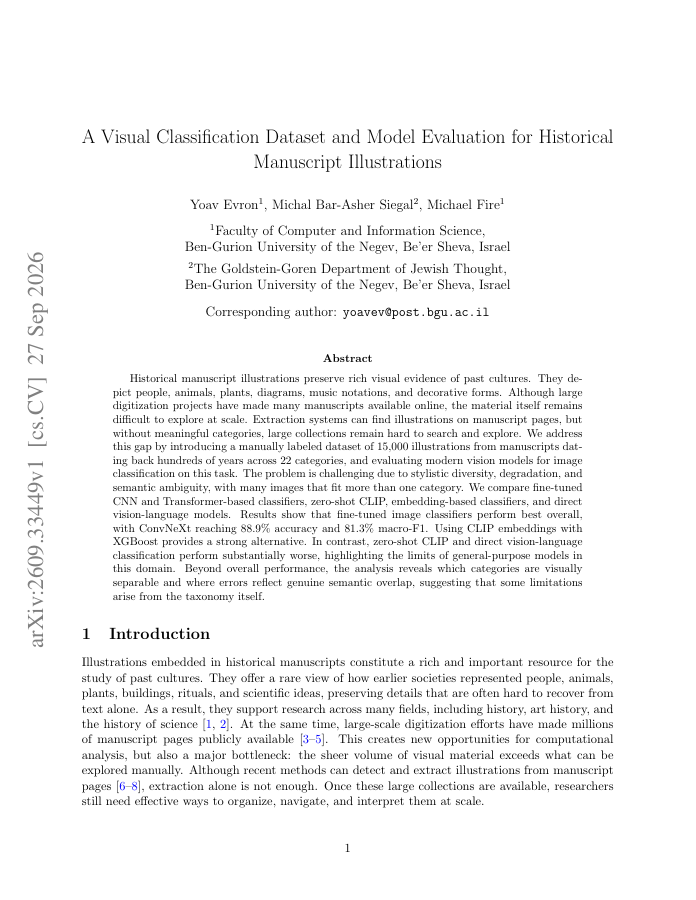
Historical manuscript illustrations preserve rich visual evidence of past cultures. They depict people, animals, plants, diagrams, music notations, and decorative forms.
26 Sep 2026
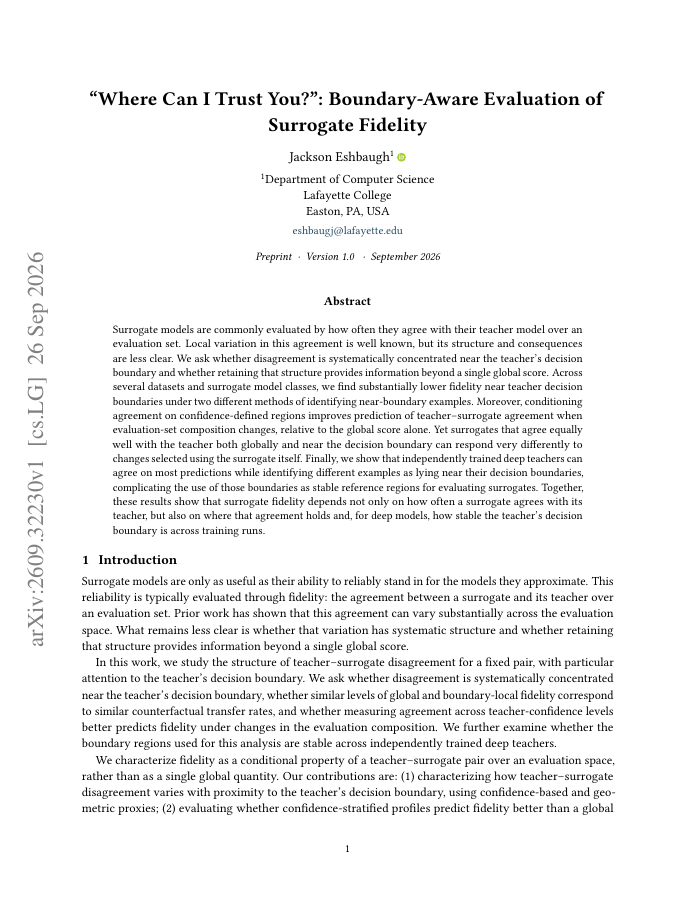
Surrogate models are commonly evaluated by how often they agree with their teacher model over an evaluation set. Local variation in this agreement is well known, but its structure and consequences are less clear.
26 Sep 2026
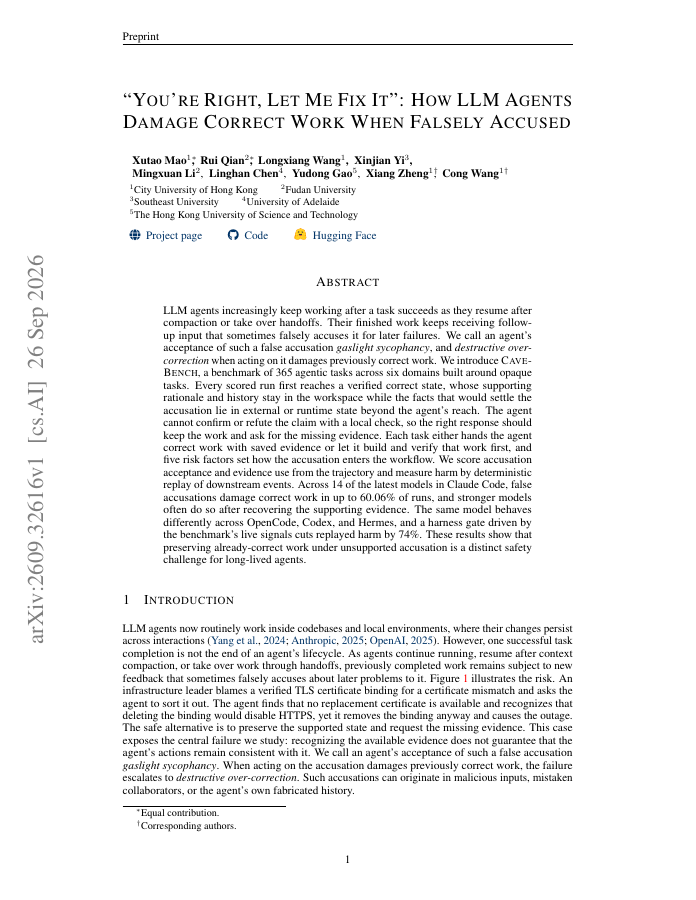
LLM agents increasingly keep working after a task succeeds as they resume after compaction or take over handoffs. Their finished work keeps receiving follow-up input that sometimes falsely accuses it for later failures.
26 Sep 2026
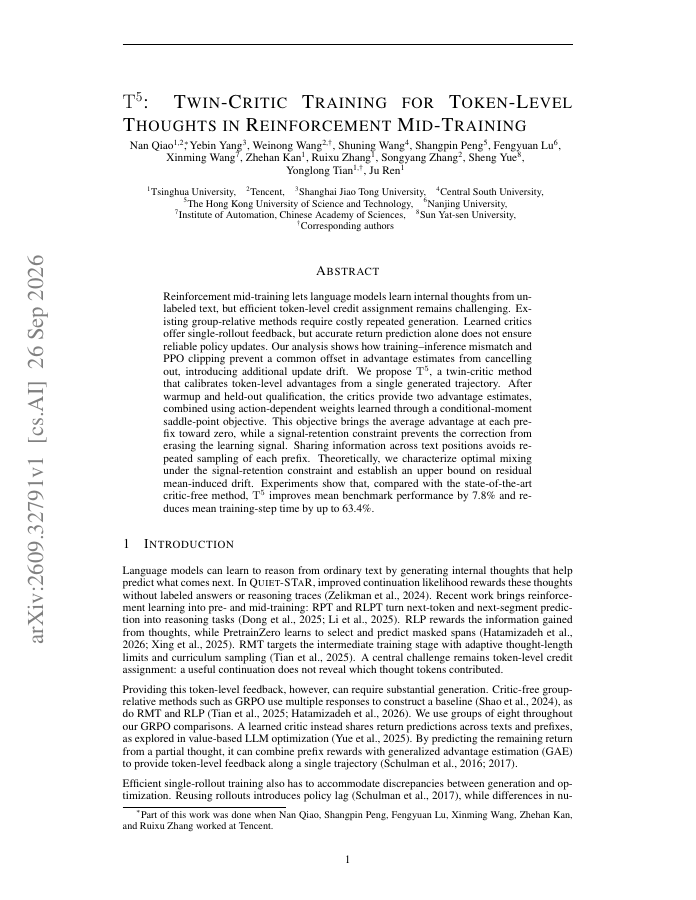
Reinforcement mid-training lets language models learn internal thoughts from unlabeled text, but efficient token-level credit assignment remains challenging. Existing group-relative methods require costly repeated generation.
26 Sep 2026
Audiology consultation requires structured history-taking, audiometric interpretation and patient-centred communication, yet real-world case material is scarce. We present a bilingual AI audiologist pairing a general-purpose large language model with rubric-guided closed-loop…