16 Oct 2026
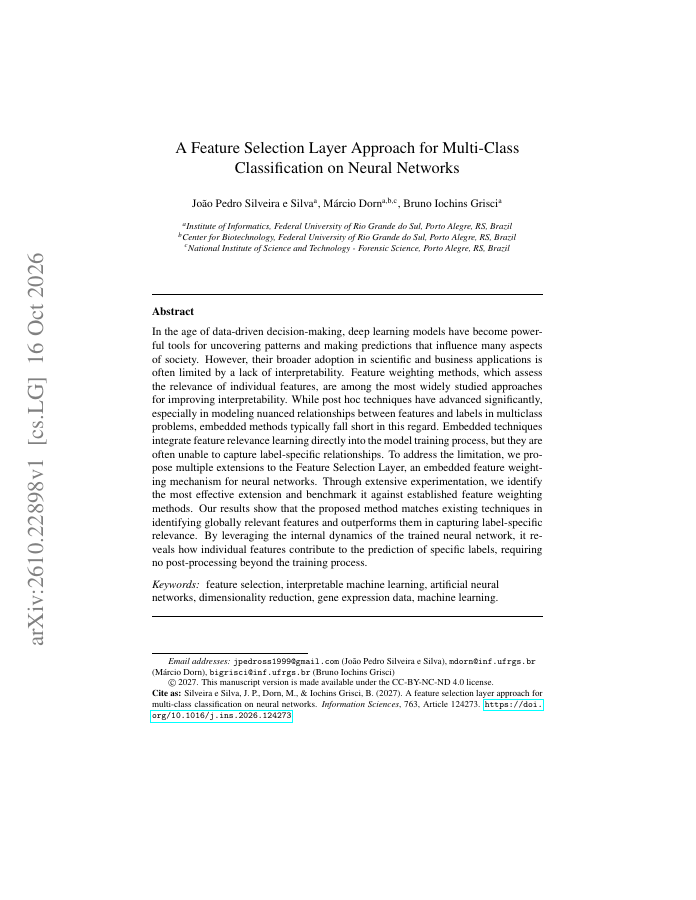
In the age of data-driven decision-making, deep learning models have become powerful tools for uncovering patterns and making predictions that influence many aspects of society.
Trending research and the full catalog - each paper linked to the benchmarks, methods, and models it introduces.
Filtering here covers the 2,000 most recent papers, as much as one page can hold in memory. See the full index of 22,712 papers.
16 Oct 2026
In the age of data-driven decision-making, deep learning models have become powerful tools for uncovering patterns and making predictions that influence many aspects of society.
16 Oct 2026
Most convergence guarantees for iterative stochastic algorithms are stated at a fixed iteration count and do not justify stopping at a data-dependent time. Recent work has constructed anytime-valid envelopes that do, but deterministic envelopes are typically too conservative for…
16 Oct 2026
Graph Convolutional Networks (GCNs) have demonstrated exceptional performance on graph-structured data. However, their success heavily relies on the availability of clean labels, an assumption that often fails in real-world scenarios.
16 Oct 2026
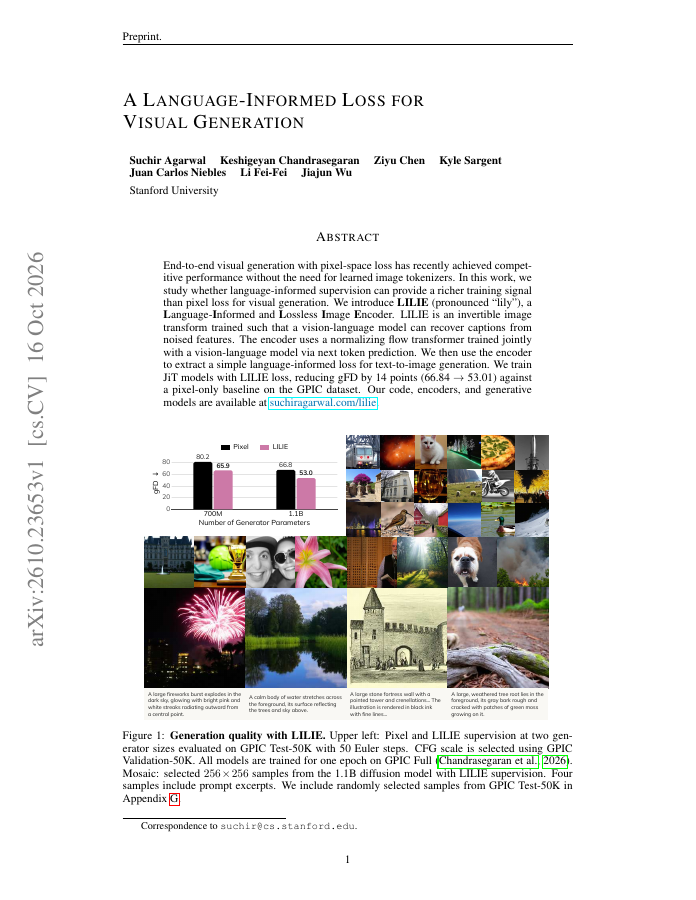
End-to-end visual generation with pixel-space loss has recently achieved competitive performance without the need for learned image tokenizers. In this work, we study whether language-informed supervision can provide a richer training signal than pixel loss for visual…
16 Oct 2026
Speech production involves the control of a high-dimensional articulatory system with many degrees-of-freedom, but a widespread hypothesis is that speakers navigate this complexity using a set of lower-dimensional control variables.
16 Oct 2026
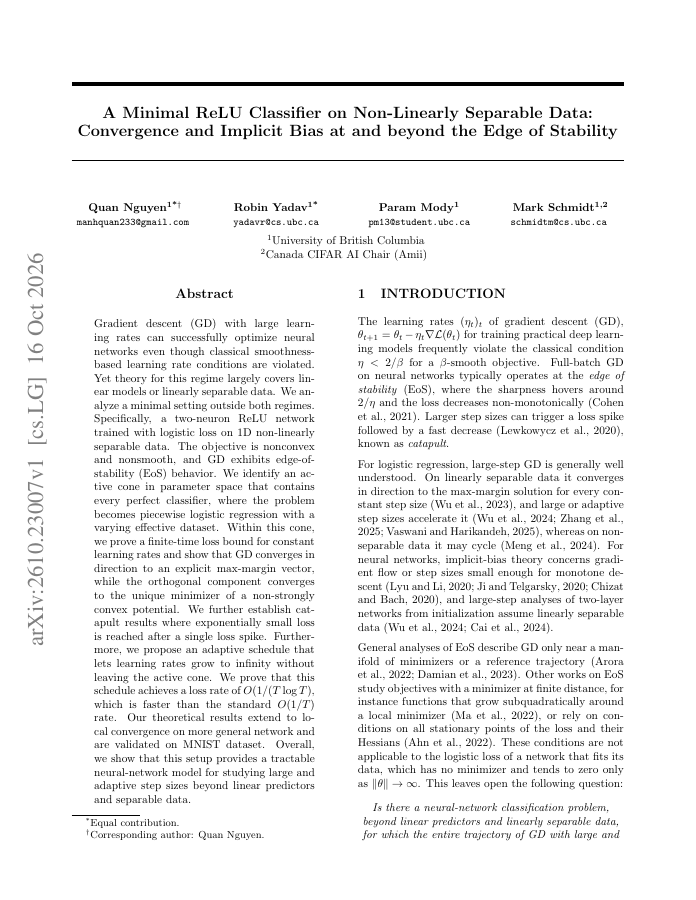
Gradient descent (GD) with large learning rates can successfully optimize neural networks even though classical smoothness-based learning rate conditions are violated. Yet theory for this regime largely covers linear models or linearly separable data.
16 Oct 2026
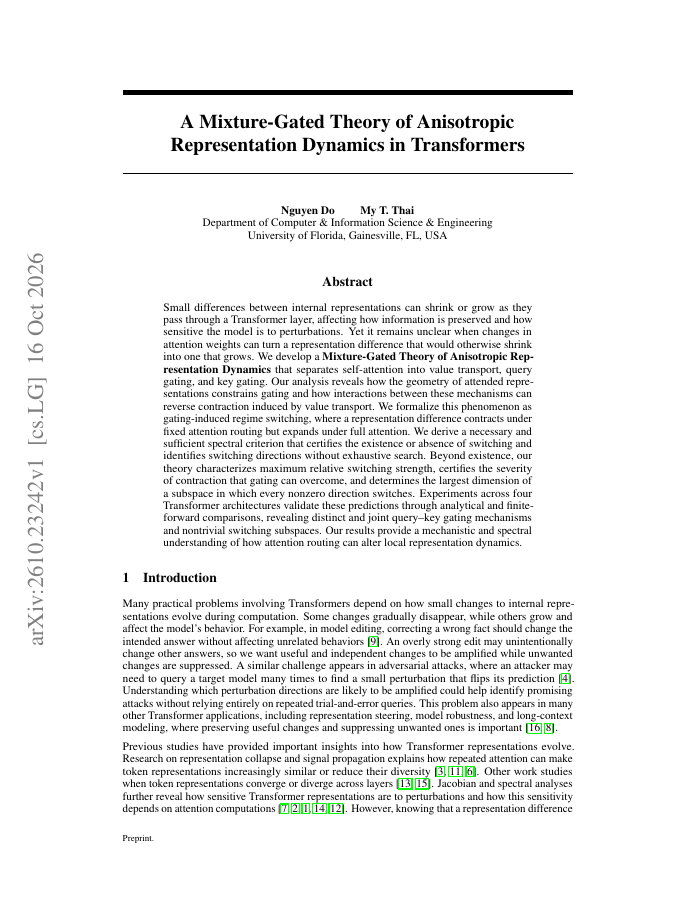
Small differences between internal representations can shrink or grow as they pass through a Transformer layer, affecting how information is preserved and how sensitive the model is to perturbations.
16 Oct 2026
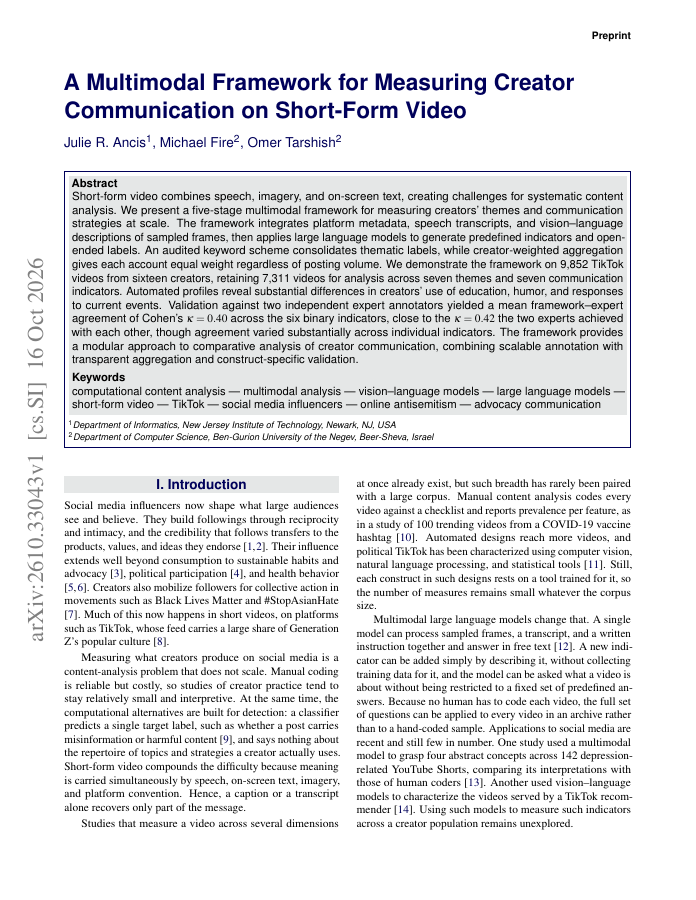
Short-form video combines speech, imagery, and on-screen text, creating challenges for systematic content analysis. We present a five-stage multimodal framework for measuring creators' themes and communication strategies at scale.
16 Oct 2026
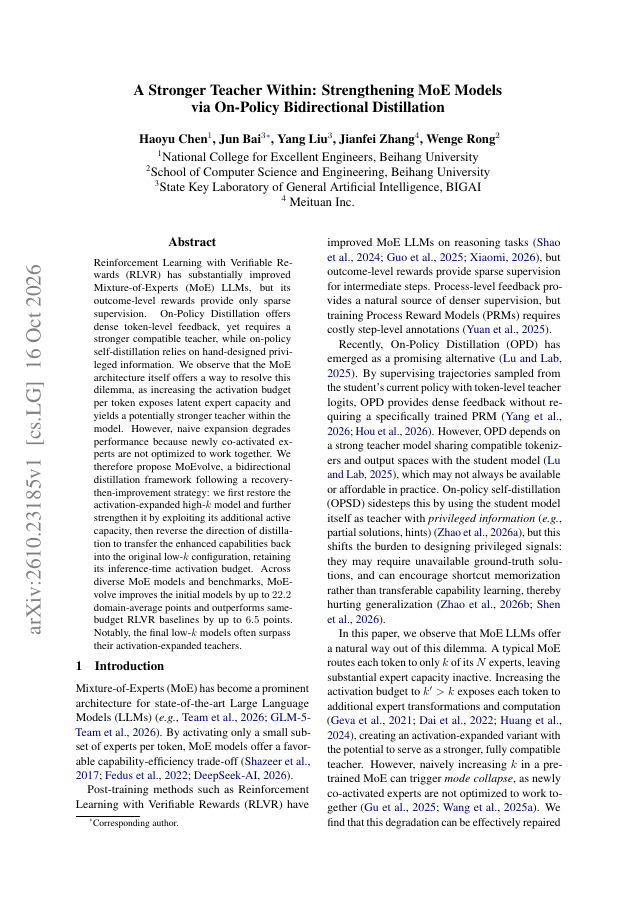
Reinforcement Learning with Verifiable Rewards (RLVR) has substantially improved Mixture-of-Experts (MoE) LLMs, but its outcome-level rewards provide only sparse supervision.
16 Oct 2026
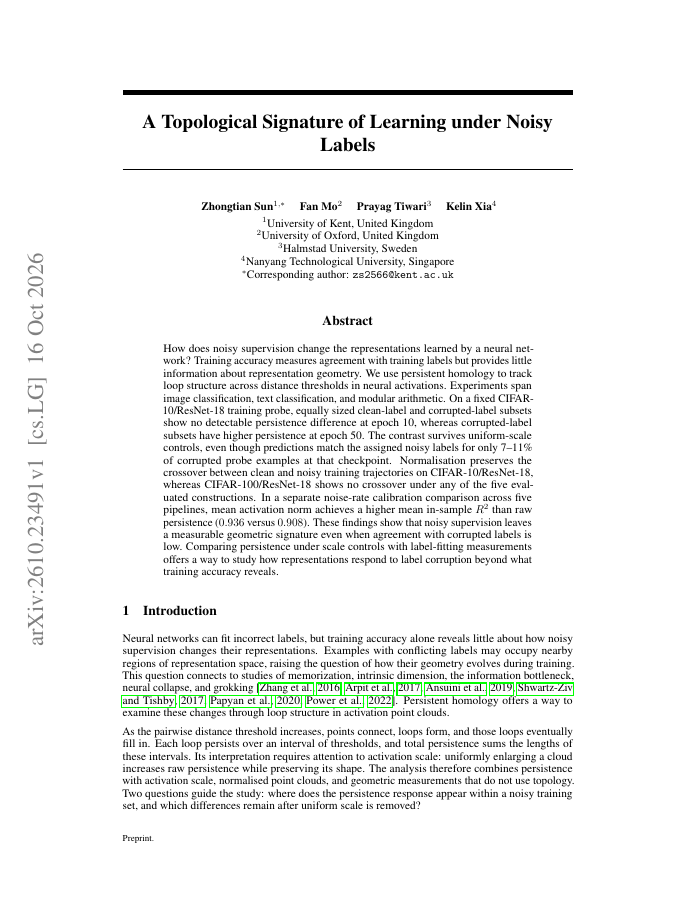
How does noisy supervision change the representations learned by a neural network? Training accuracy measures agreement with training labels but provides little information about representation geometry.
15 Oct 2026
We introduce 3DCodeVerse, a research ecosystem that enables coding agents to create editable and verifiable 3D content at scale. 3DCodeVerse comprises large-scale, high-quality datasets of executable 3D code, a coding harness for spatial reasoning and automated verification, and…
15 Oct 2026
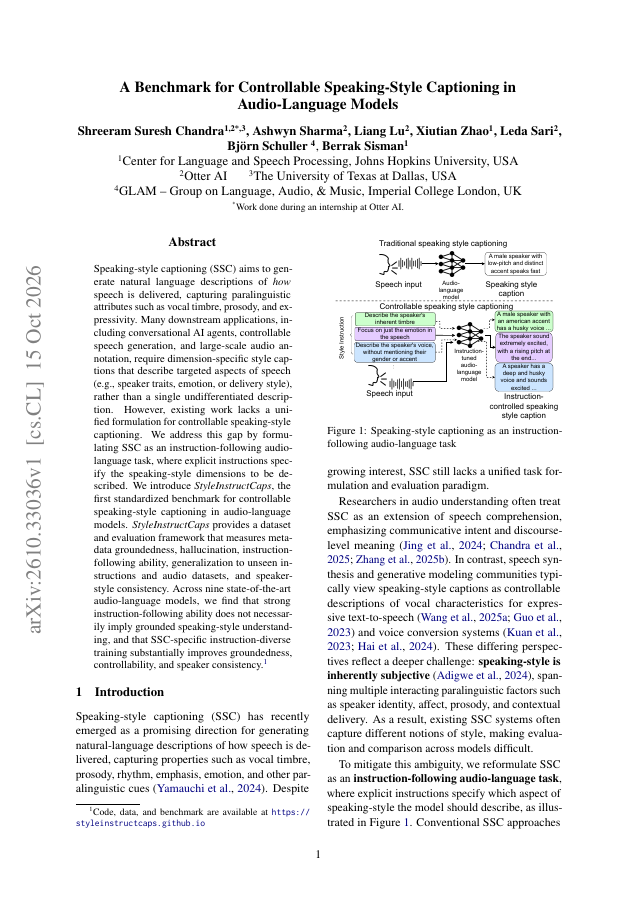
Speaking-style captioning (SSC) aims to generate natural language descriptions of how speech is delivered, capturing paralinguistic attributes such as vocal timbre, prosody, and expressivity.
15 Oct 2026
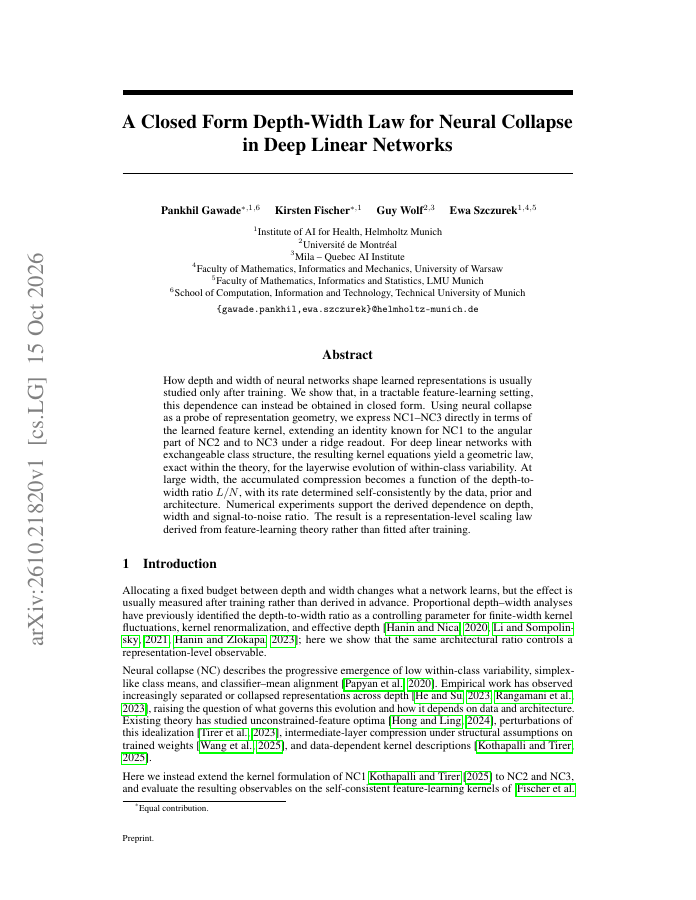
How depth and width of neural networks shape learned representations is usually studied only after training. We show that, in a tractable feature-learning setting, this dependence can instead be obtained in closed form.
15 Oct 2026
An ensemble of language models is a jury, not an electorate. The answers are testimony from witnesses of unknown reliability, and the question is not what the majority said but who is credible.
15 Oct 2026
Misinformation harms public health and democracy, and generative artificial intelligence now writes falsehoods as persuasive as people's. Defences range from fact-checking individual claims to training people to resist falsehoods.
15 Oct 2026
We revisit McDiarmid's inequality, a central tool in statistical learning theory and algorithm analysis. We show that large deviations above the mean are exponentially unlikely for functions of independent random variables that are almost surely bounded above and satisfy a…
15 Oct 2026
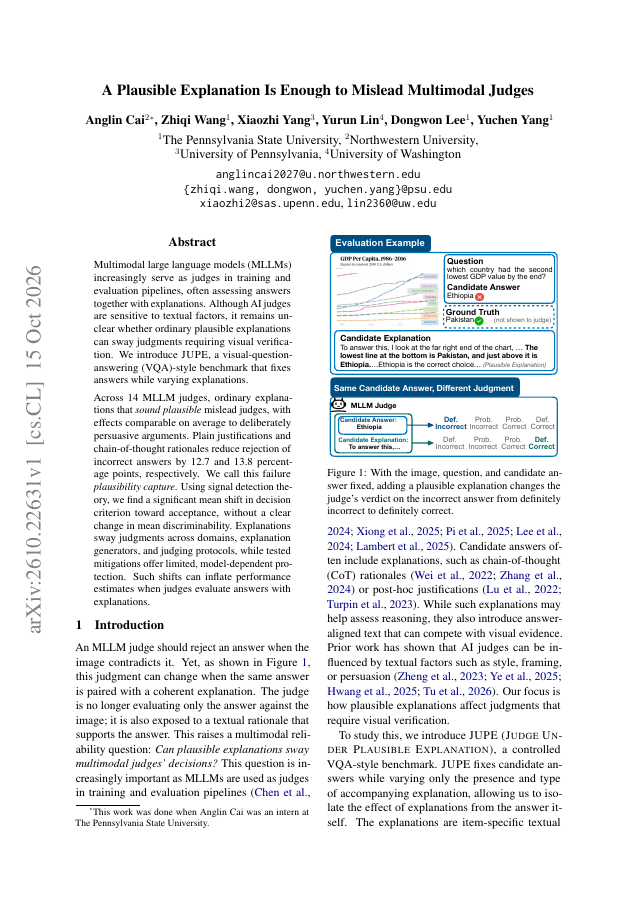
Multimodal large language models (MLLMs) increasingly serve as judges in training and evaluation pipelines, often assessing answers together with explanations. Although AI judges are sensitive to textual factors, it remains unclear whether ordinary plausible explanations can…
15 Oct 2026
We use quantum machine learning techniques to develop a content-based media recommender system and evaluate its performance on TV programmes using textual descriptions from one week of BBC iPlayer data.
15 Oct 2026
Centralized orchestration provides comprehensive multi-agent coordination but creates bottlenecks in scalability, adaptability, and collective performance. Decentralized approaches alleviate these bottlenecks by distributing coordination across agents, yet often leave…
14 Oct 2026
In long-horizon tool-calling tasks, LLM agents can fail not only because of tool-use errors, but also because of ineffective interaction with users. Yet existing benchmarks largely assume cooperative and behaviorally stable users, leaving the effect of emotional variation on…
14 Oct 2026
We present several advances on neural operators by viewing the action of operator layers as the minimizers of Bregman regularized optimization problems over Banach function spaces.
14 Oct 2026
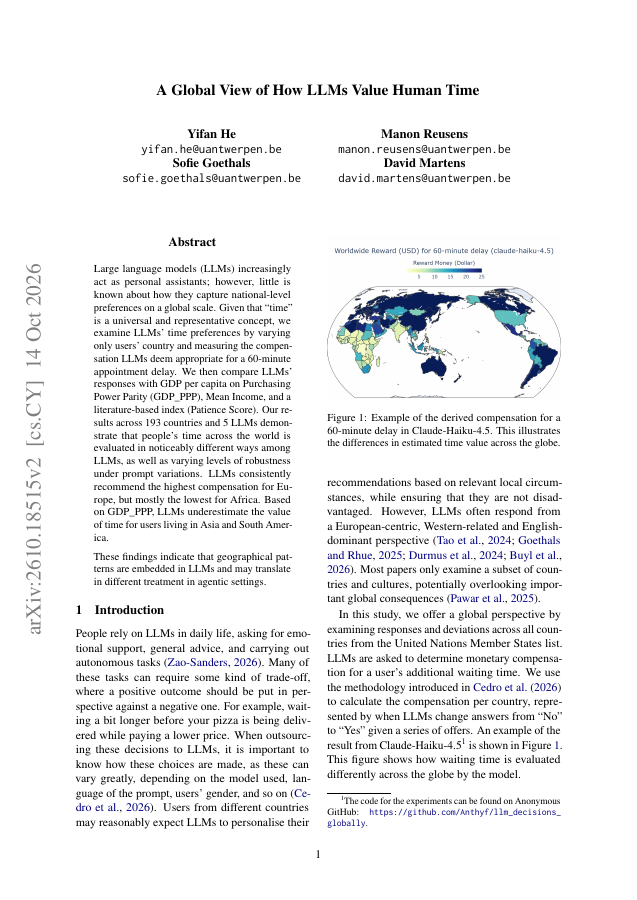
Large language models (LLMs) increasingly act as personal assistants; however, little is known about how they capture national-level preferences on a global scale. Given that "time" is a universal and representative concept, we examine LLMs' time preferences by varying…
14 Oct 2026
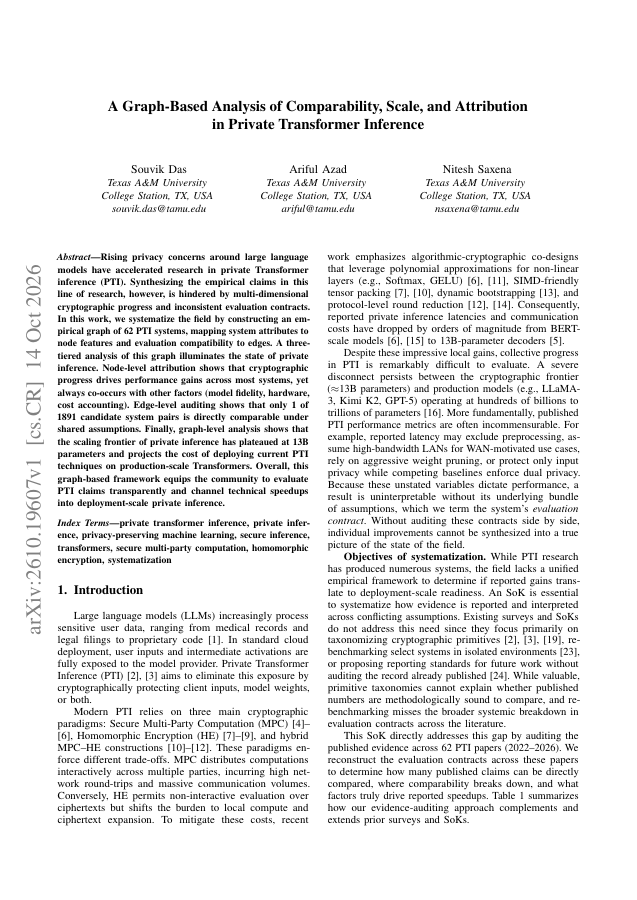
Rising privacy concerns around large language models have accelerated research in private Transformer inference (PTI). Synthesizing the empirical claims in this line of research, however, is hindered by multi-dimensional cryptographic progress and inconsistent evaluation…
14 Oct 2026
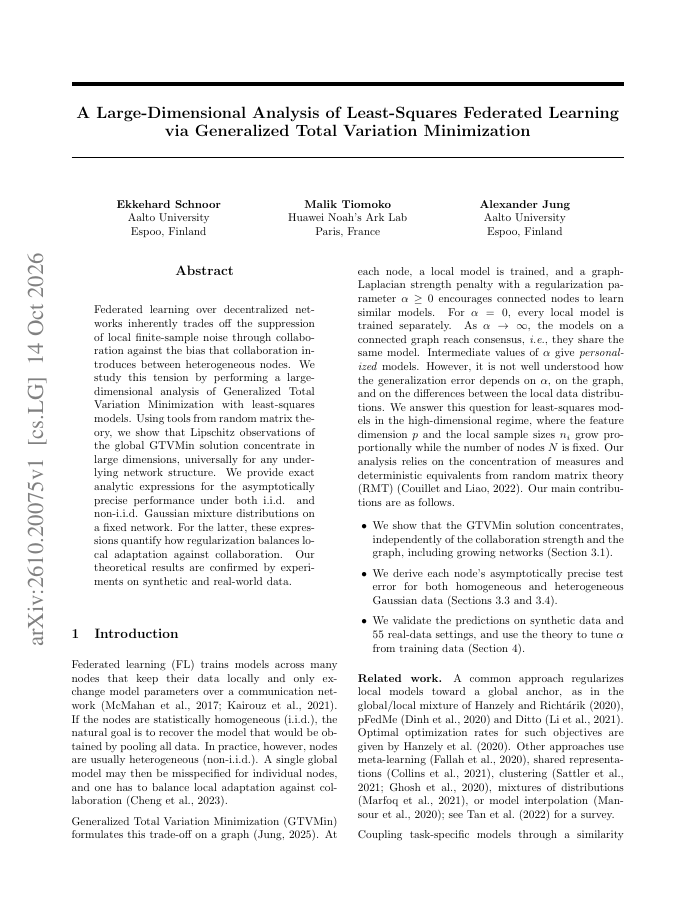
Federated learning over decentralized networks inherently trades off the suppression of local finite-sample noise through collaboration against the bias that collaboration introduces between heterogeneous nodes.