15 Jun 2026
Reinforcement learning (RL) systems often degrade when operating conditions differ from those previously encountered, reflecting distributional shifts in the underlying data-generating process.
Trending research and the full catalog - each paper linked to the benchmarks, methods, and models it introduces.
Filtering here covers the 2,000 most recent papers, as much as one page can hold in memory. See the full index of 22,712 papers.
15 Jun 2026
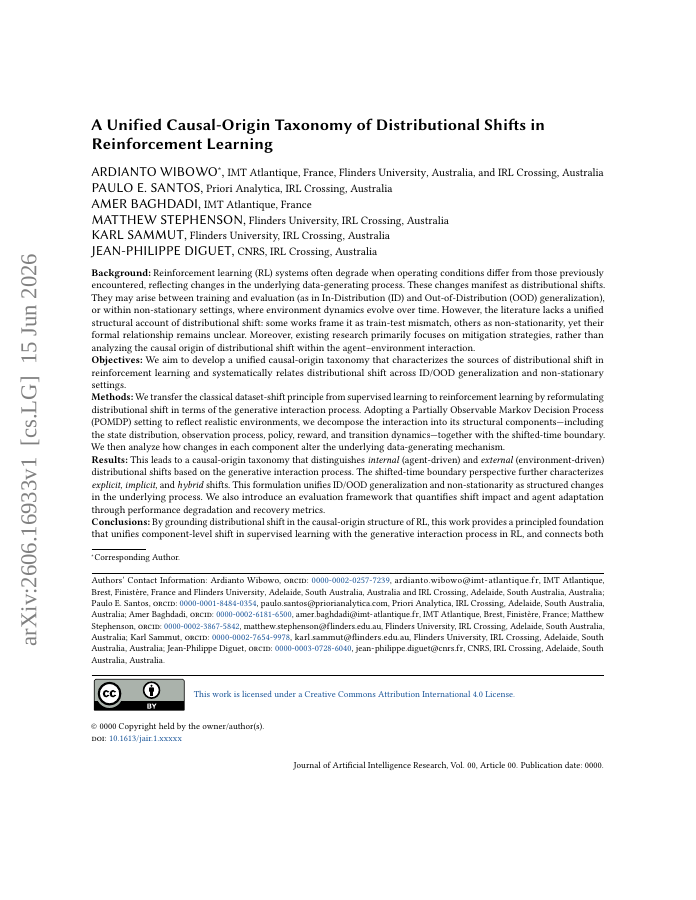
Reinforcement learning (RL) systems often degrade when operating conditions differ from those previously encountered, reflecting distributional shifts in the underlying data-generating process.
15 Jun 2026
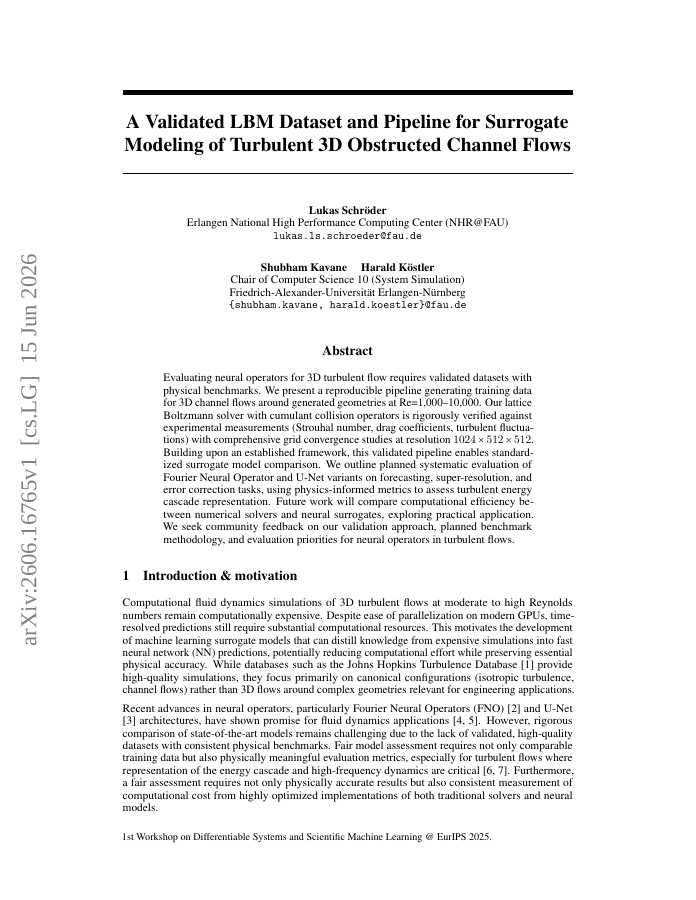
Evaluating neural operators for 3D turbulent flow requires validated datasets with physical benchmarks. We present a reproducible pipeline generating training data for 3D channel flows around generated geometries at Re=1,000-10,000.
14 Jun 2026
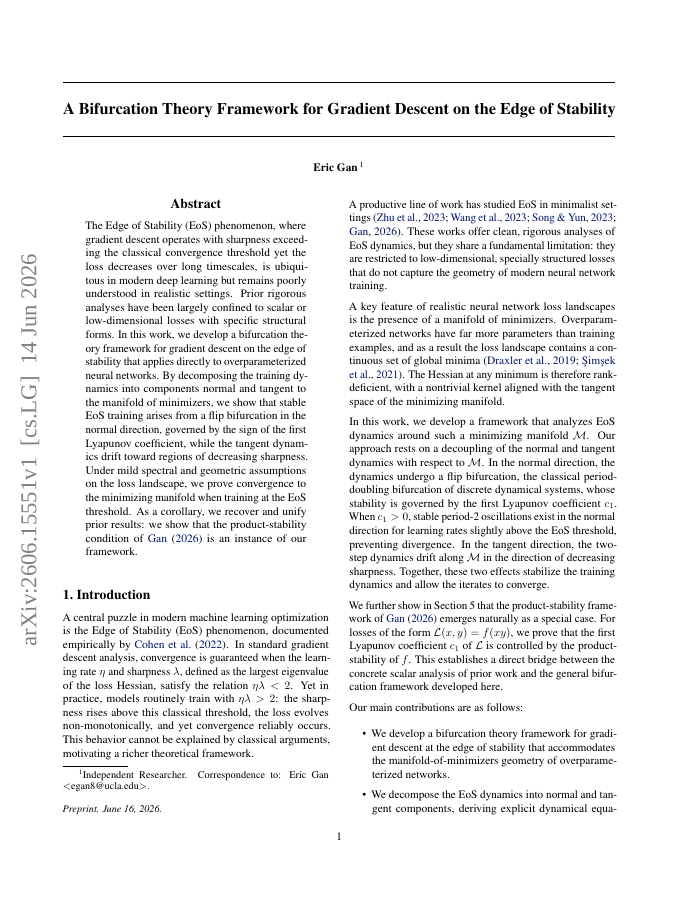
The Edge of Stability (EoS) phenomenon, where gradient descent operates with sharpness exceeding the classical convergence threshold yet the loss decreases over long timescales, is ubiquitous in modern deep learning but remains poorly understood in realistic settings.
14 Jun 2026
Test-time training (TTT) adapts a pretrained model to each prompt via parameter updates, improving accuracy under pretraining-to-test distribution shifts. Yet, its performance often suffers from instability and sensitivity to hyperparameters such as update steps and subspace.
14 Jun 2026
Despite the significant advancement of LLMs in conversation summarization, their evaluation remains limited by insufficient scenarios, input lengths, and sample sizes. Furthermore, existing benchmarks often omit frontier reasoning systems and efficient small models, or lack…
14 Jun 2026
Narrative question answering (NQA) is a challenging task in natural language processing that requires models to understand long textual contexts, capture relationships across events, and generate coherent responses.
13 Jun 2026
Open-ended intelligence is the capacity to adapt to novel problems and environments that are substantially different from those in training. A mathematics of open-ended intelligence requires two pillars: first, a minimal set of representational primitives (e.g., states, actions)…
13 Jun 2026
In this paper we show that the physical learning methods known as coupled learning (CL) and equilibrium propagation (EP) conserve a mass-like quantity in the trainable parameters in the continuous-time, small-nudging limit.
13 Jun 2026
Agentic AI opens new opportunities for automating Business Process (BP), enabling autonomous decision-making and dynamic adaptation. However, realising this potential requires BP entities and their interactions to be defined with formal precision.
13 Jun 2026
We propose a Koopman-enhanced physics-informed neural network (K--PINN) framework for parameter inference and forecasting in nonlinear epidemic models. This method combines Koopman operator theory and physics-informed learning.
13 Jun 2026
Simultaneous speech-to-speech translation (SimulS2ST) enables real-time cross-lingual communication, but existing evaluation has focused largely on short or pre-segmented speech rather than long-form, continuous input.
13 Jun 2026
Mixture-of-Experts (MoE) based large language models (LLMs), such as Qwen and DeepSeek, have recently emerged as an effective approach to improving model capacity without proportionally increasing computational cost.
13 Jun 2026
Slope hazards constitute a major safety threat to expressway infrastructure, and their evolution is typically manifested as slow surface deformation. Conventional manual inspection suffers from low efficiency and inadequate operational safety, especially on severely deteriorated…
12 Jun 2026
Classification and Regression Trees (CART) constitute one of the most influential paradigms in statistical learning. Although a variety of impurity measures have been proposed for different statistical models, these criteria are typically introduced on a case-by-case basis and…
12 Jun 2026
Wearable devices and smartphones generate rich behavioural time series that can support proactive health interventions, yet systematic comparisons of modern forecasting architectures for these data are lacking.
12 Jun 2026
Autonomous driving systems rely on precise trajectory prediction to plan safe and efficient movement. Graph Neural Networks (GNNs) have become a promising approach for modelling spatiotemporal interactions among road agents.
12 Jun 2026
We study a \emph{max-risk} objective for active learning in a multi-group mean estimation $d$-armed bandits: a learner adaptively allocates a budget of $T$ samples across $d$ groups to minimize the worst-case uncertainty index $\max_{k\in[d]}σ_k^2/n_k$, where $σ_k$ is the…
12 Jun 2026
Activation functions play a central role in neural networks by shaping internal representations. Recently, learning binary activation representations has attracted significant attention due to their advantages in computational and memory efficiency, as well as interpretability.
12 Jun 2026
Transformer-based clinical language models are increasingly integrated into high-stakes clinical decision support pipelines, yet the computational mechanisms through which demographic associations encoded in medical documentation propagate into model probability distributions…
12 Jun 2026
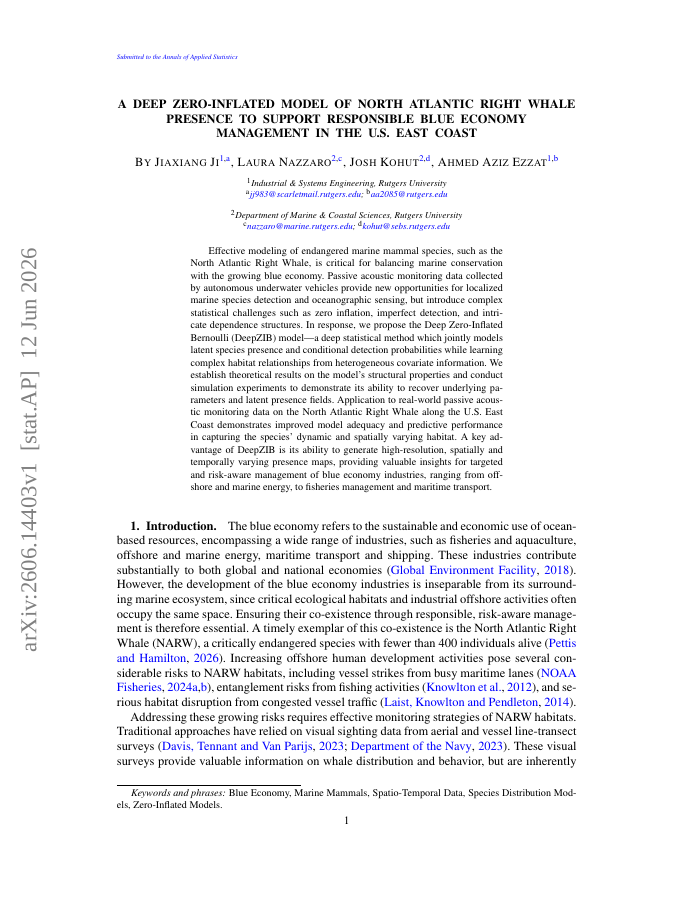
Effective modeling of endangered marine mammal species, such as the North Atlantic Right Whale, is critical for balancing marine conservation with the growing blue economy.
12 Jun 2026
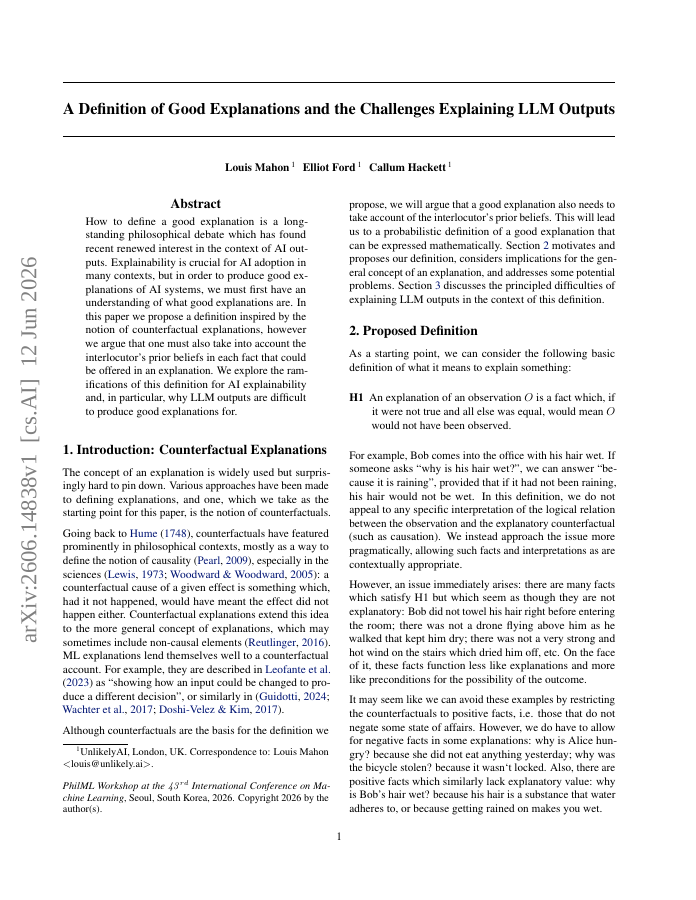
How to define a good explanation is a long-standing philosophical debate which has found recent renewed interest in the context of AI outputs. Explainability is crucial for AI adoption in many contexts, but in order to produce good explanations of AI systems, we must first have…
12 Jun 2026
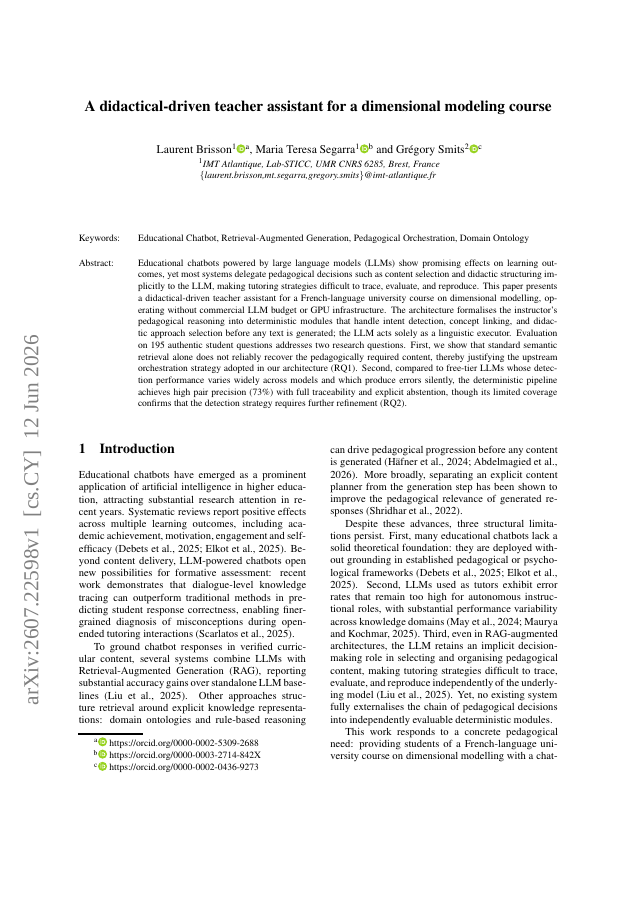
Educational chatbots powered by large language models (LLMs) show promising effects on learning outcomes, yet most systems delegate pedagogical decisions such as content selection and didactic structuring implicitly to the LLM, making tutoring strategies difficult to trace,…
12 Jun 2026
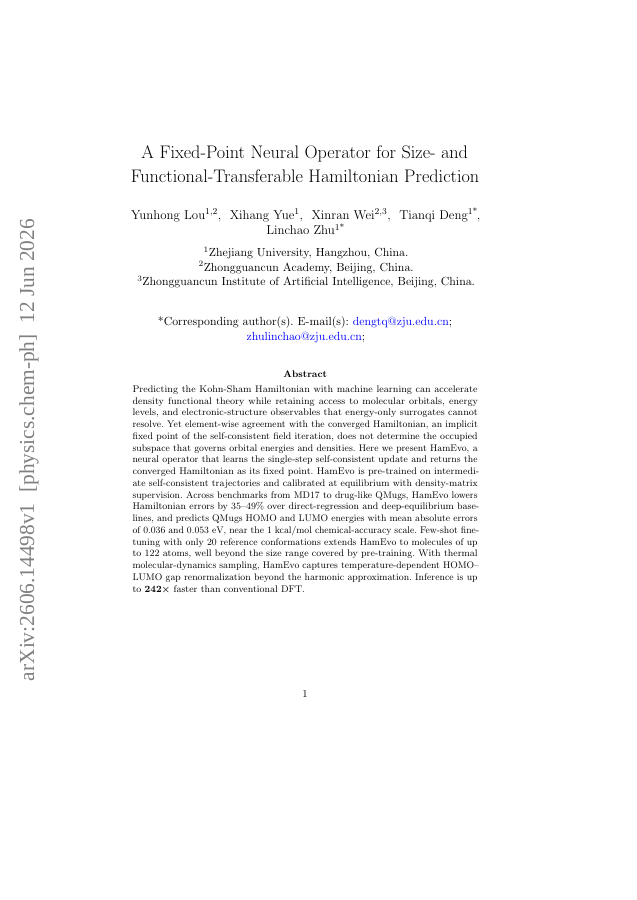
Predicting the Kohn-Sham Hamiltonian with machine learning can accelerate density functional theory while retaining access to molecular orbitals, energy levels, and electronic-structure observables that energy-only surrogates cannot resolve.
12 Jun 2026
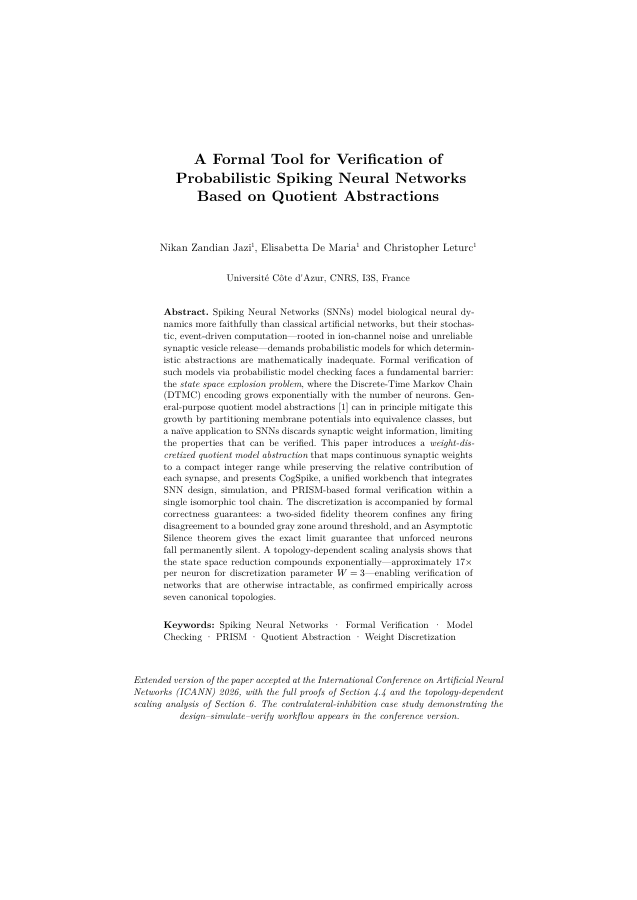
Spiking Neural Networks (SNNs) model biological neural dynamics more faithfully than classical artificial networks, but their stochastic, event-driven computation -- rooted in ion-channel noise and unreliable synaptic vesicle release -- demands probabilistic models for which…