26 Jun 2026
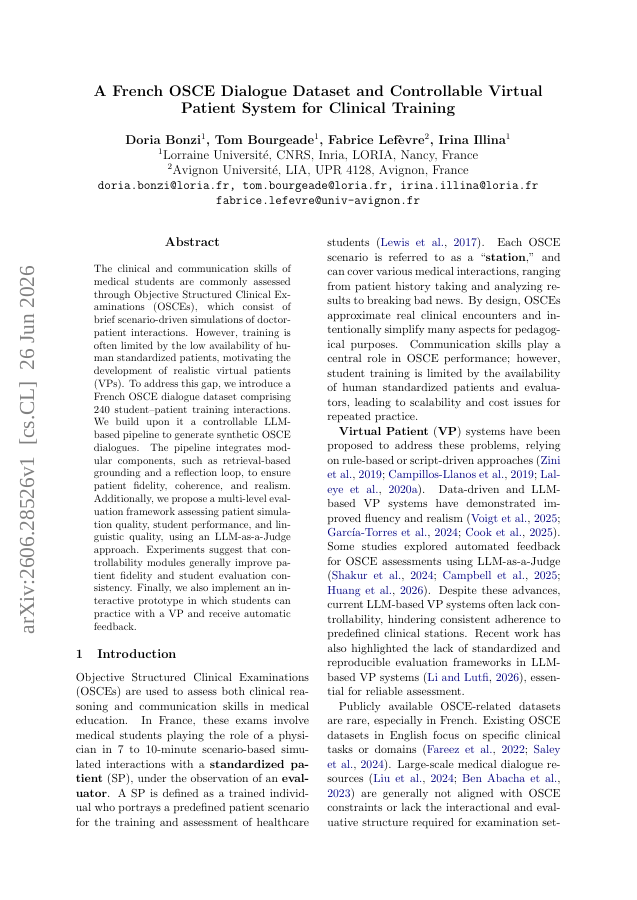
The clinical and communication skills of medical students are commonly assessed through Objective Structured Clinical Examinations (OSCEs), which consist of brief scenario-driven simulations of doctor-patient interactions.
Trending research and the full catalog - each paper linked to the benchmarks, methods, and models it introduces.
Filtering here covers the 2,000 most recent papers, as much as one page can hold in memory. See the full index of 22,824 papers.
26 Jun 2026
The clinical and communication skills of medical students are commonly assessed through Objective Structured Clinical Examinations (OSCEs), which consist of brief scenario-driven simulations of doctor-patient interactions.
26 Jun 2026
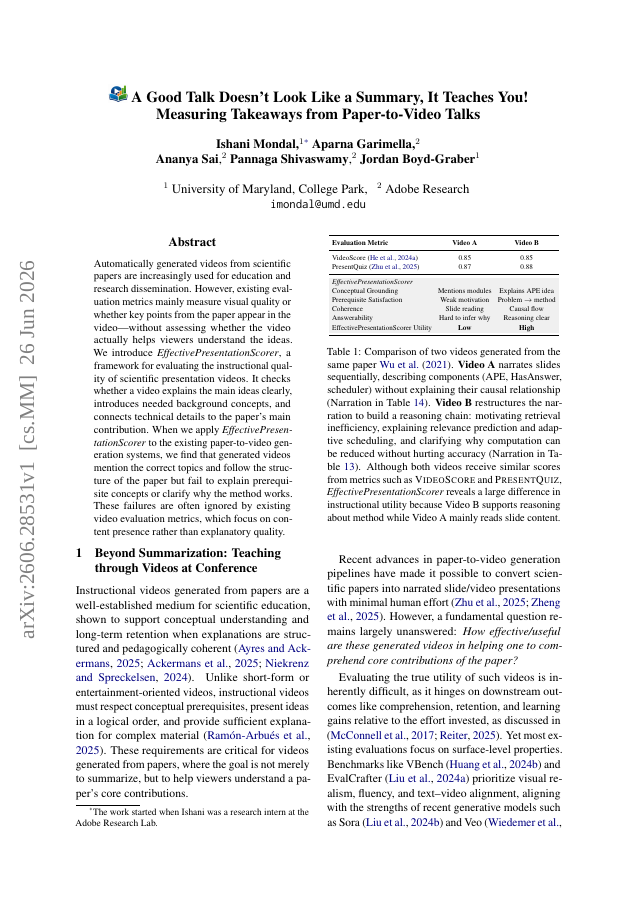
Automatically generated videos from scientific papers are increasingly used for education and research dissemination. However, existing evaluation metrics mainly measure visual quality or whether key points from the paper appear in the video without assessing whether the video…
26 Jun 2026
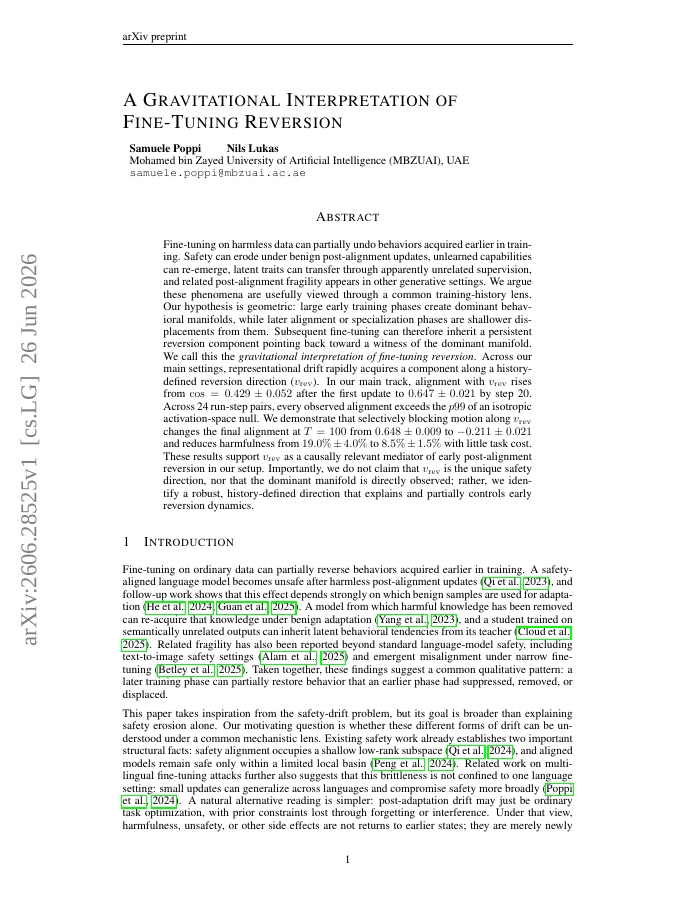
Safety alignment in large language models can degrade during post-training even when neither the data nor the objective is intentionally adversarial. Alignment rebound and reverse dynamics suggest that this degradation may reactivate behavior suppressed during safety alignment.
26 Jun 2026
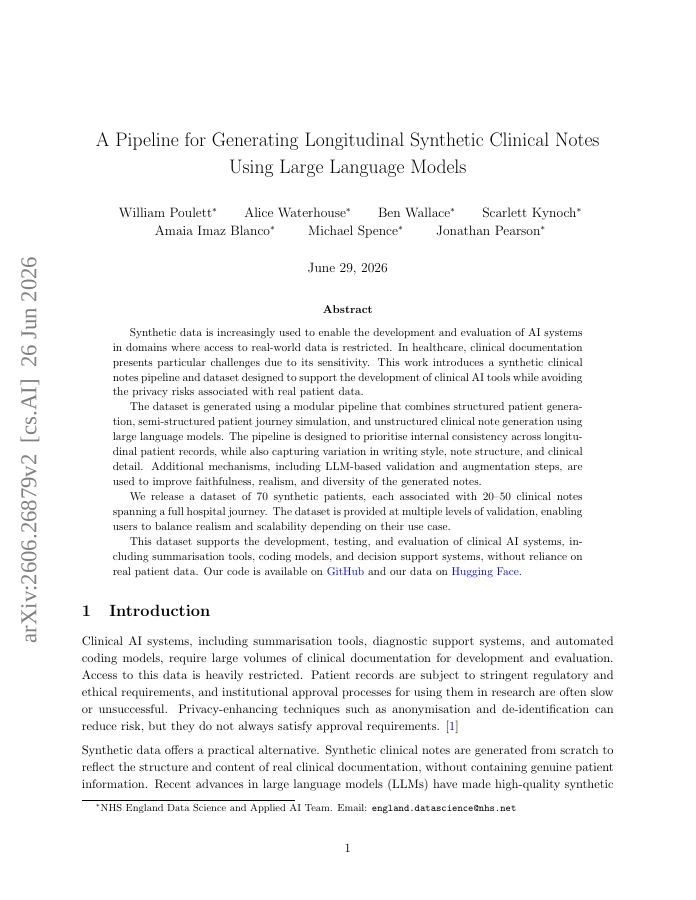
Synthetic data is increasingly used to enable the development and evaluation of AI systems in domains where access to real-world data is restricted. In healthcare, clinical documentation presents particular challenges due to its sensitivity.
26 Jun 2026
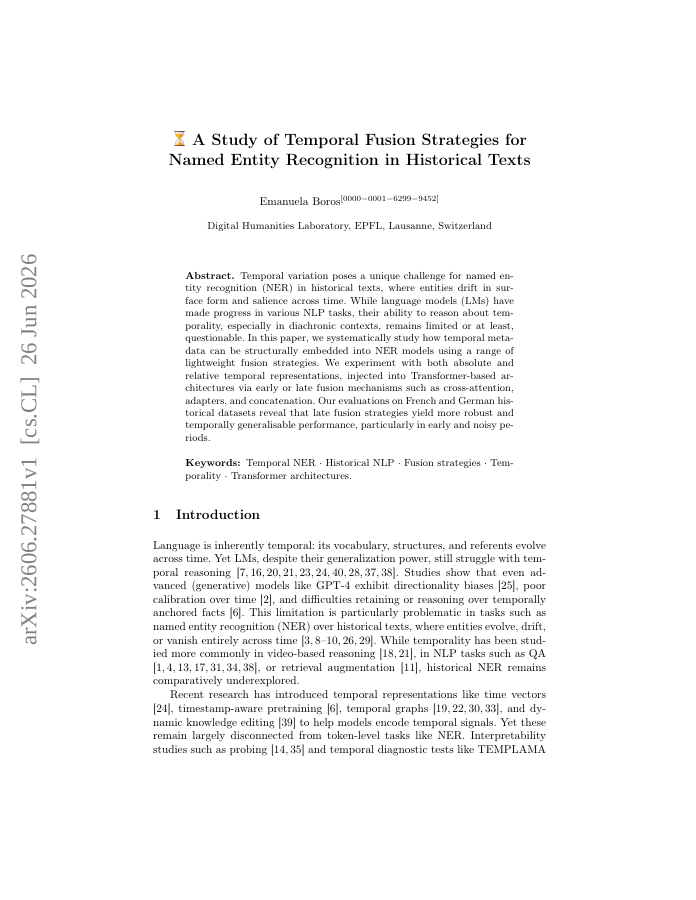
Temporal variation poses a unique challenge for named entity recognition (NER) in historical texts, where entities drift in surface form and salience across time. While language models (LMs) have made progress in various NLP tasks, their ability to reason about temporality,…
26 Jun 2026
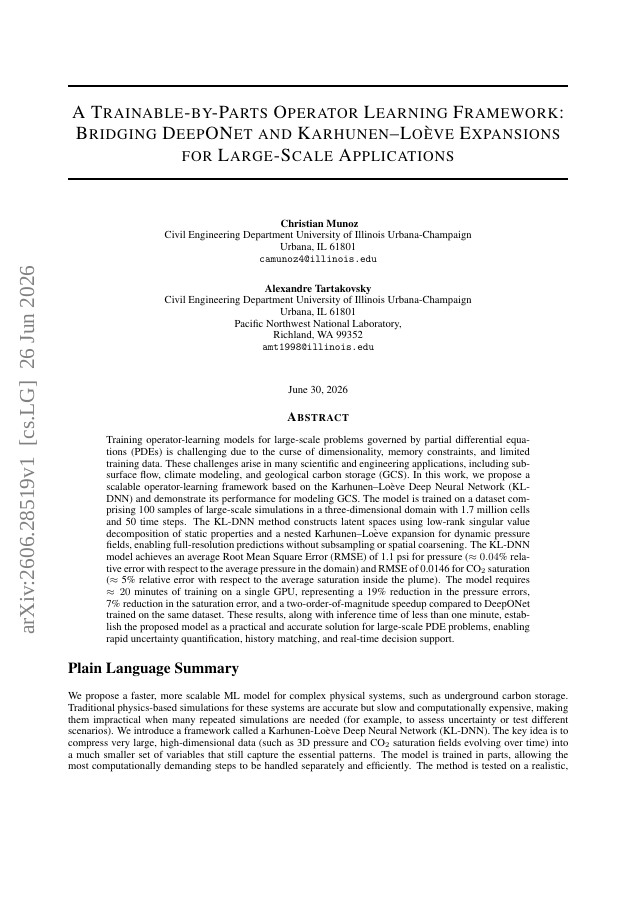
Training operator-learning models for large-scale problems governed by partial differential equations (PDEs) is challenging due to the curse of dimensionality, memory constraints, and limited training data.
26 Jun 2026
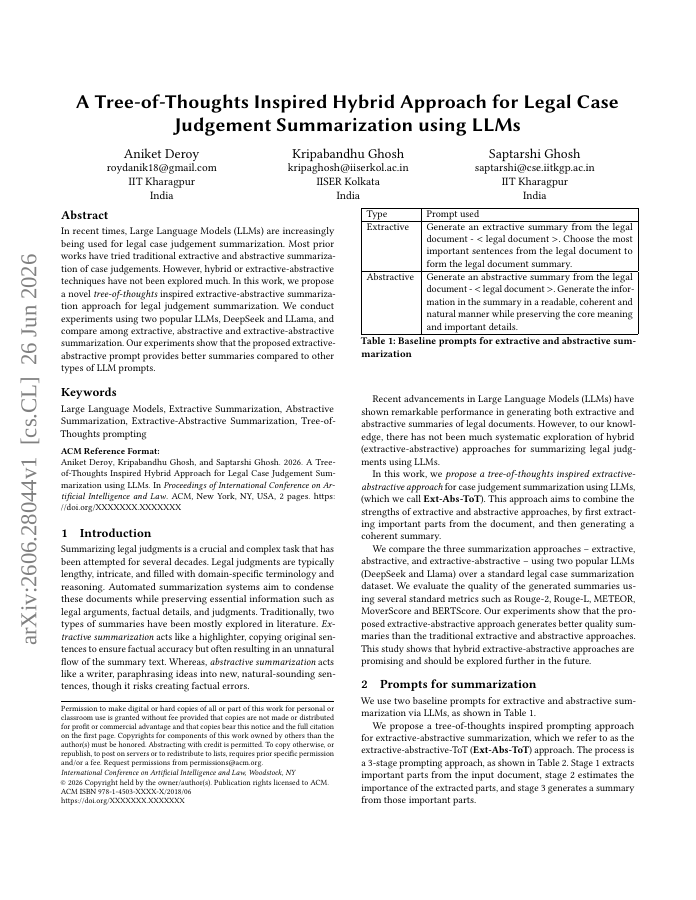
In recent times, Large Language Models (LLMs) are increasingly being used for legal case judgement summarization. Most prior works have tried traditional extractive and abstractive summarization of case judgements.
26 Jun 2026
Vision transformers have become a dominant architecture for visual recognition. However, standard models do not explicitly encode the planar symmetries that arise in many vision domains.
26 Jun 2026
Fluorescence microscopy images are degraded by noise and diffraction-induced blur, which compromise structural fidelity and limit quantitative analysis. Supervised deep learning methods achieve impressive restoration performance but require large-scale paired datasets that are…
25 Jun 2026
Polynomial Stein discrepancies (PSD) provide a scalable alternative to kernel Stein methods for measuring sample quality and goodness-of-fit testing, but their statistical properties remain poorly understood.
25 Jun 2026
Spatial pattern matching is the process of matching query entities and constraints with database entities and relations. It has many applications, including similar region search, housing market search, landmark search, and road network matching.
25 Jun 2026
We introduce TabPFN-CFM, a causal foundation model that can handle multiple causal problems. TabPFN-CFM predicts both causal structure and outcomes from observational data, supports queries on all three levels of Pearl's Causal Hierarchy and uses known graph structure when…
25 Jun 2026
LLM coding harnesses grant agents broad file and shell access, yet the configuration layer that steers them -- rules files, agent definitions, IDE-specific markdown -- is largely unmanaged.
25 Jun 2026
Joint Embedding Predictive Architectures (JEPAs) have recently emerged as a promising paradigm for world modeling by learning predictive dynamics in a latent space rather than generating future observations at the input level.
25 Jun 2026
Cardiac magnetic resonance imaging (CMR) captures rich spatiotemporal information about ventricular structure and motion, but conventional risk models use only a few image-derived indices from selected cardiac phases.
25 Jun 2026
Guided wave-based structural health monitoring (GWSHM) with onboard transducers offers significant potential for the early diagnosis of damage in engineering structures.
25 Jun 2026
With the gradual introduction of AI into telescope scheduling, AI-based decision-making has shown advantages in handling complex multi-constraint problems. However, its outputs often suffer from inconsistent data references, reasoning errors, and non-executable decisions,…
25 Jun 2026
We introduce the process harness, a new mechanism for uplifting legacy workflows into Agentic Business Process Management (Agentic BPM) without replacing the underlying workflow engine.
24 Jun 2026
A digital twin (DT) is a virtual model of a real-world system that can assist decision-making by simulating scenarios induced by different policies. However, typical machine learning-based DTs do not optimise for this use case.
24 Jun 2026
Existing texture datasets for tactile sensing primarily consist of sensor readings from a specific sensor interacting with available surfaces/objects rather than describing the textures themselves, limiting fair comparison between tactile sensors and hindering reproducible…
24 Jun 2026
Supervised deep learning has been widely used for weld penetration state classification; however, its performance often degrades significantly under domain shift, such as when transferring models between welding processes with distinct physical mechanisms:for instance, from…
24 Jun 2026
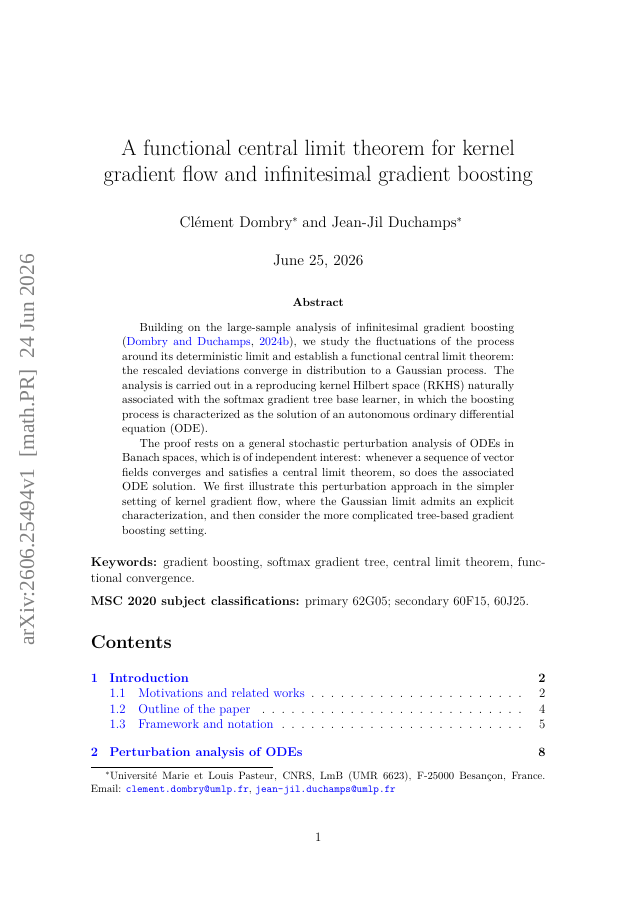
Building on the large-sample analysis of infinitesimal gradient boosting (Dombry and Duchamps, 2024), we study the fluctuations of the process around its deterministic limit and establish a functional central limit theorem: the rescaled deviations converge in distribution to a…
24 Jun 2026
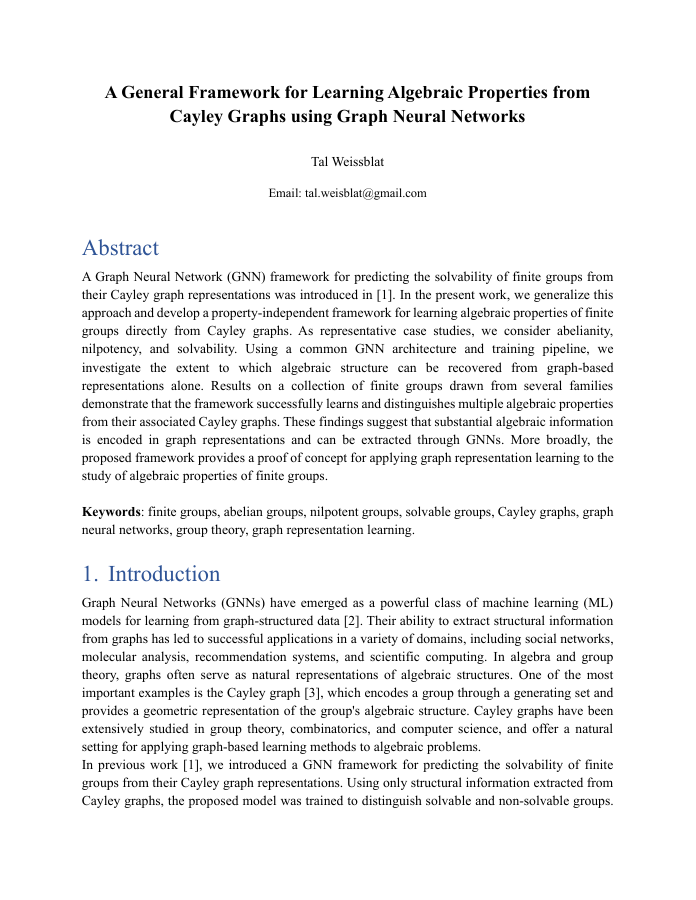
In this work, we present a general Graph Neural Network (GNN) framework for learning algebraic properties of finite groups from their Cayley graph representations. The framework provides a unified computational pipeline consisting of a common graph construction procedure,…
24 Jun 2026
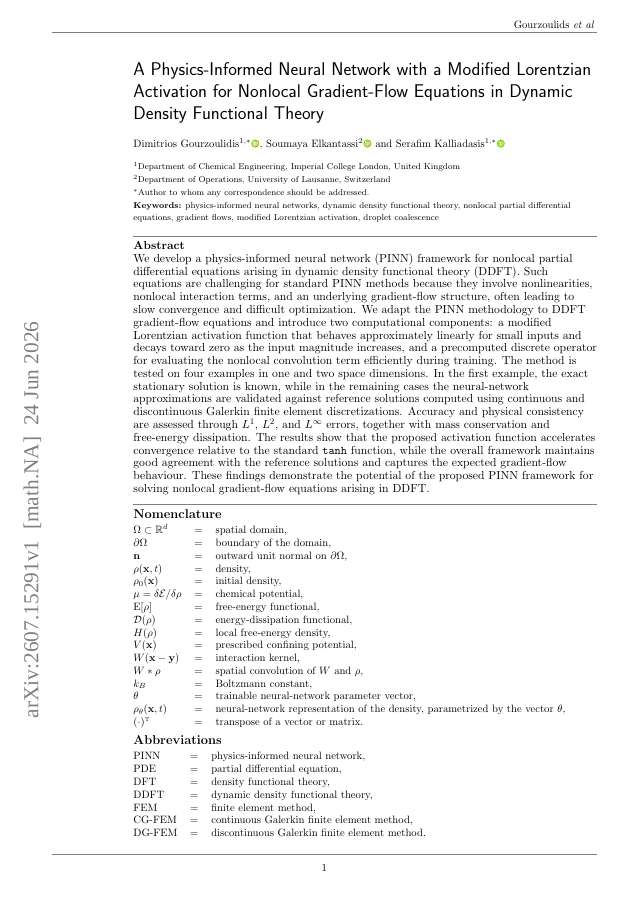
We develop a physics-informed neural network (PINN) framework for nonlocal partial differential equations arising in dynamic density functional theory (DDFT). Such equations are challenging for standard PINN methods because they involve nonlinearities, nonlocal interaction…