29 Oct 2026
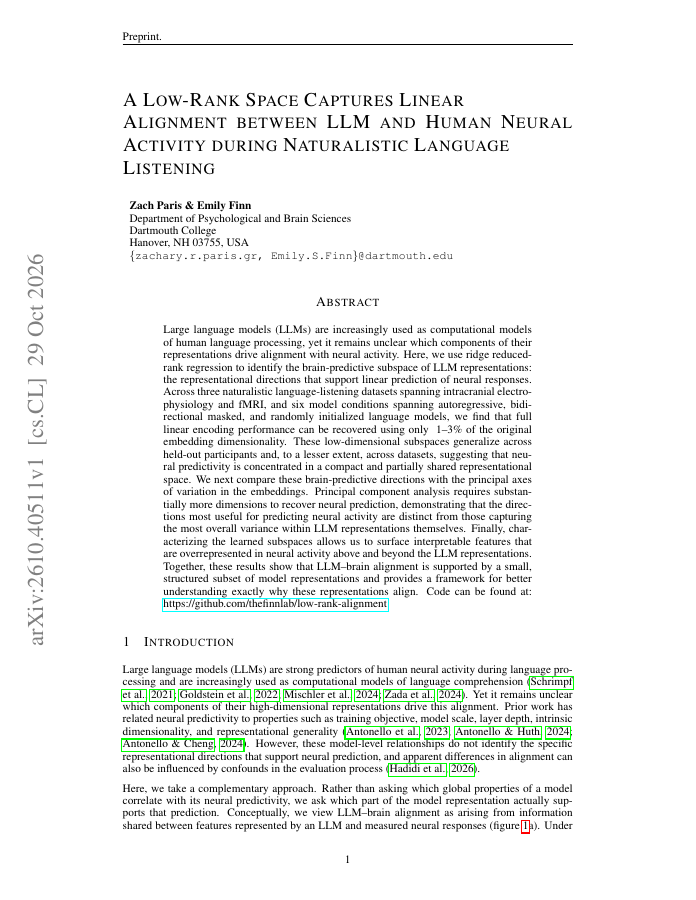
Large language models (LLMs) are increasingly used as computational models of human language processing, yet it remains unclear which components of their representations drive alignment with neural activity.
Trending research and the full catalog - each paper linked to the benchmarks, methods, and models it introduces.
Filtering here covers the 2,000 most recent papers, as much as one page can hold in memory. See the full index of 22,783 papers.
29 Oct 2026
Large language models (LLMs) are increasingly used as computational models of human language processing, yet it remains unclear which components of their representations drive alignment with neural activity.
29 Oct 2026
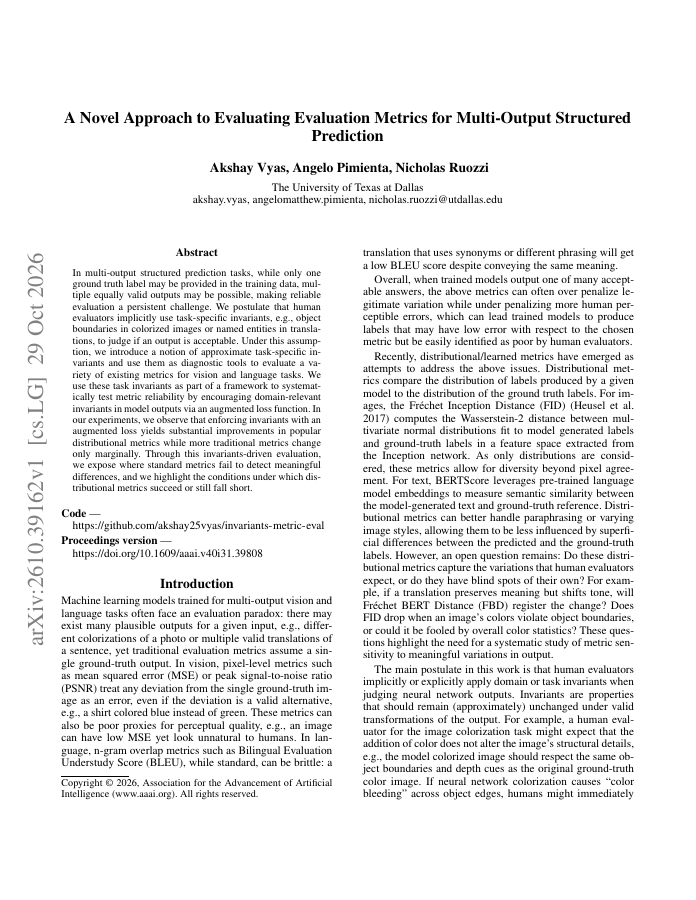
In multi-output structured prediction tasks, while only one ground truth label may be provided in the training data, multiple equally valid outputs may be possible, making reliable evaluation a persistent challenge.
28 Oct 2026
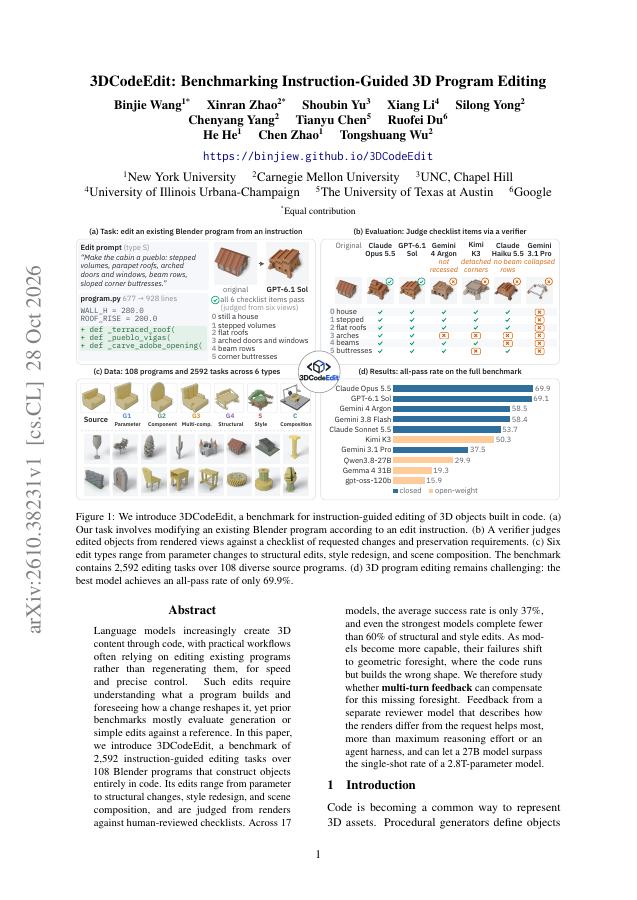
Language models increasingly create 3D content through code, with practical workflows often relying on editing existing programs rather than regenerating them, for speed and precise control.
28 Oct 2026
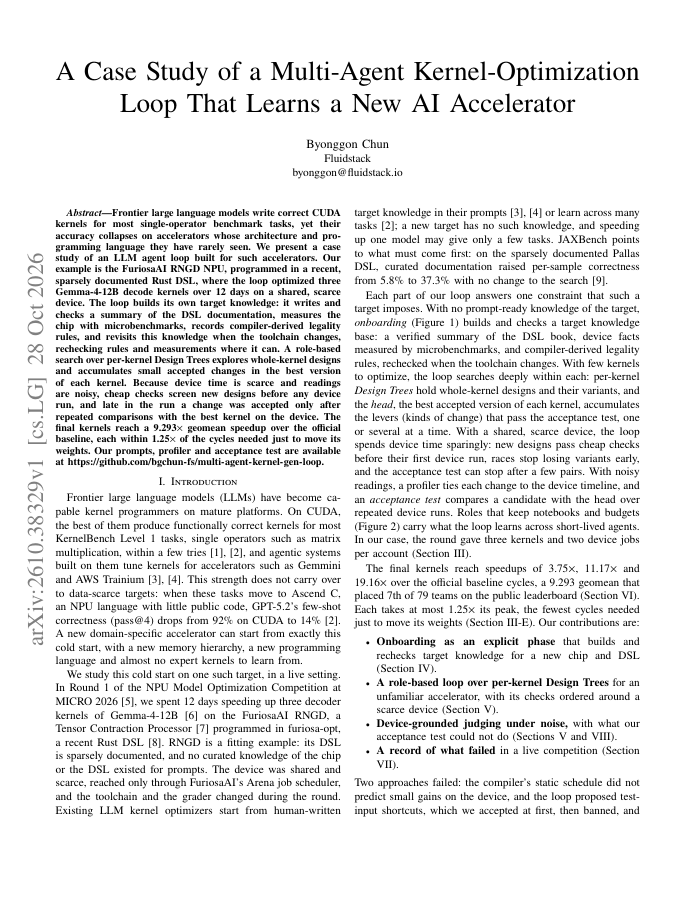
Frontier large language models write correct CUDA kernels for most single-operator benchmark tasks, yet their accuracy collapses on accelerators whose architecture and programming language they have rarely seen.
28 Oct 2026
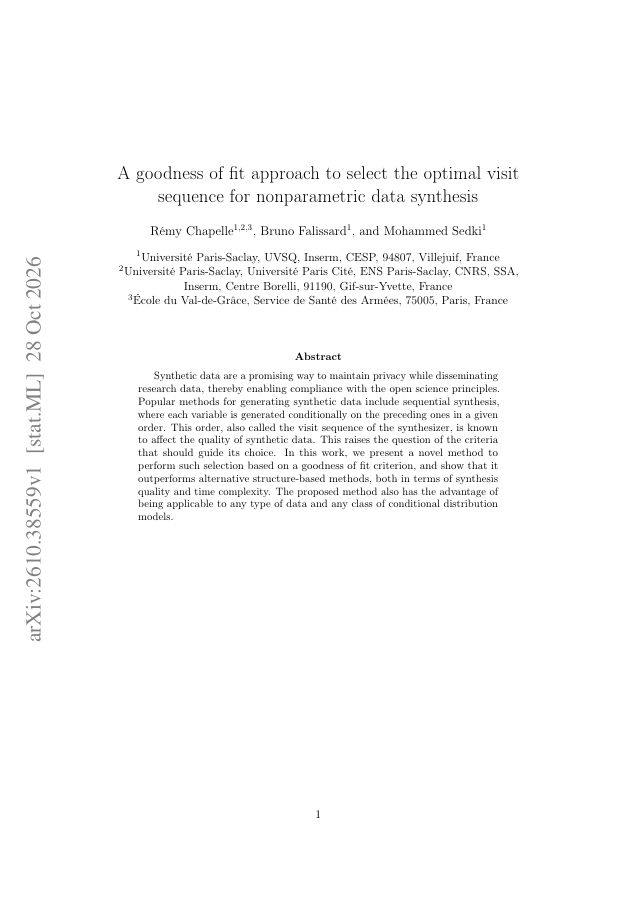
Synthetic data are a promising way to maintain privacy while disseminating research data, thereby enabling compliance with the open science principles. Popular methods for generating synthetic data include sequential synthesis, where each variable is generated conditionally on…
28 Oct 2026
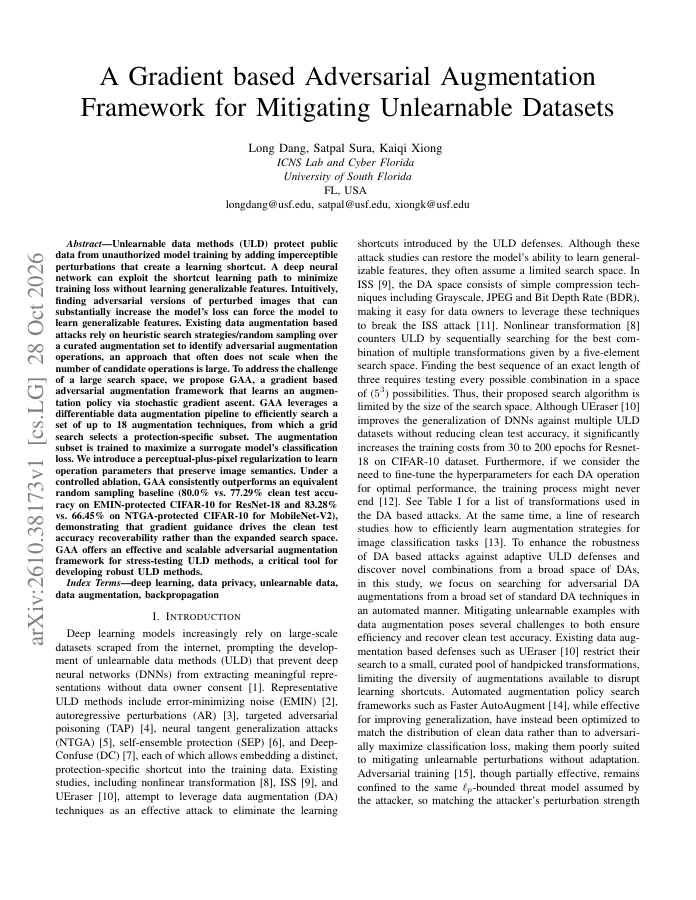
Unlearnable data methods (ULD) protect public data from unauthorized model training by adding imperceptible perturbations that create a learning shortcut. A deep neural network can exploit the shortcut learning path to minimize training loss without learning generalizable…
28 Oct 2026
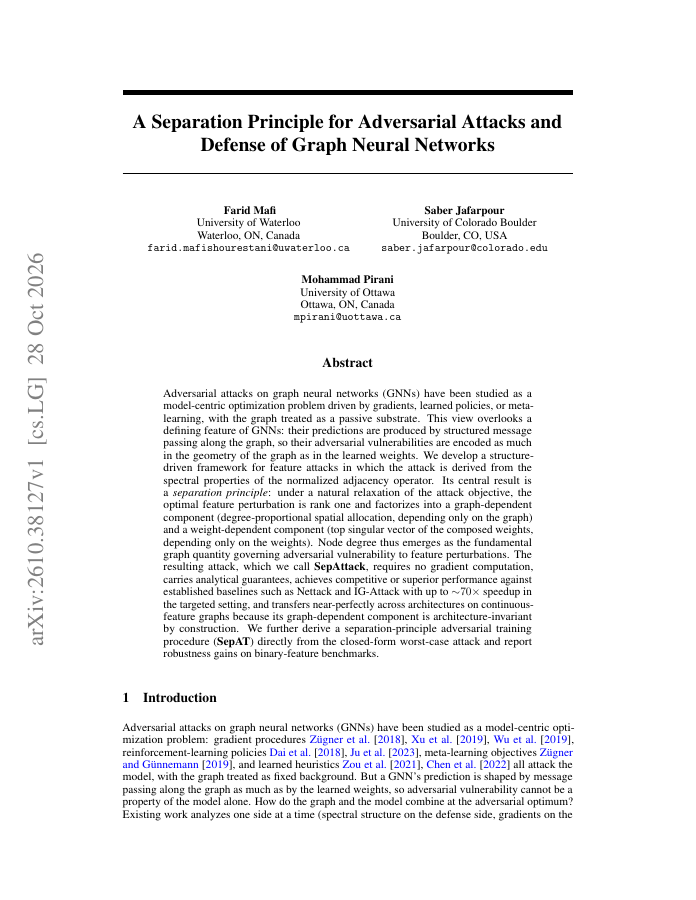
Adversarial attacks on graph neural networks (GNNs) have been studied as a model-centric optimization problem driven by gradients, learned policies, or meta-learning, with the graph treated as a passive substrate.
28 Oct 2026
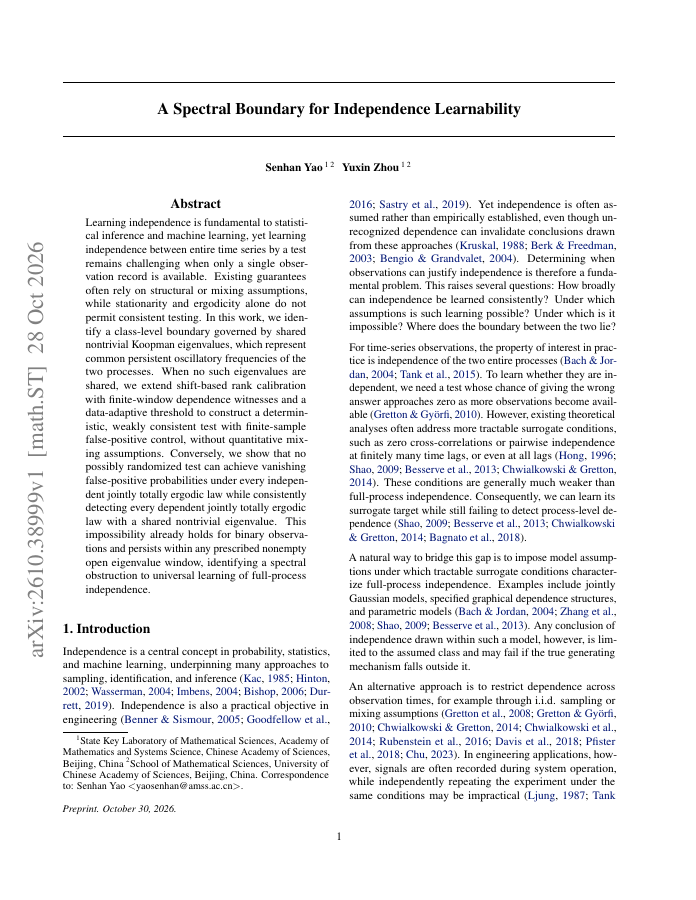
Learning independence is fundamental to statistical inference and machine learning, yet learning independence between entire time series by a test remains challenging when only a single observation record is available.
28 Oct 2026
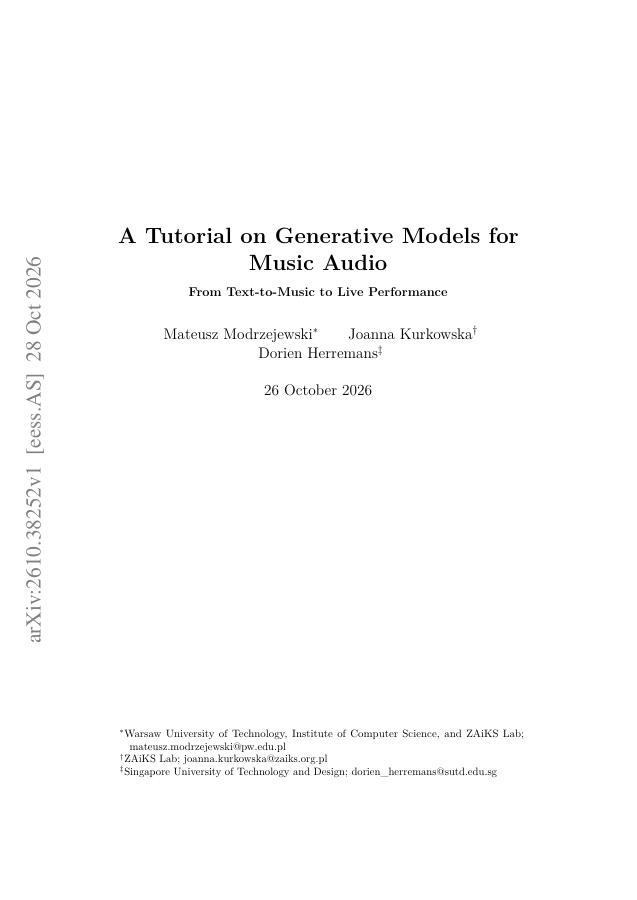
Music audio generation spans instrumental clips, full songs with vocals, edits of existing recordings, and systems that play alongside a musician in real time. This monograph explains the methods behind these systems for readers familiar with neural-network training who are new…
27 Oct 2026
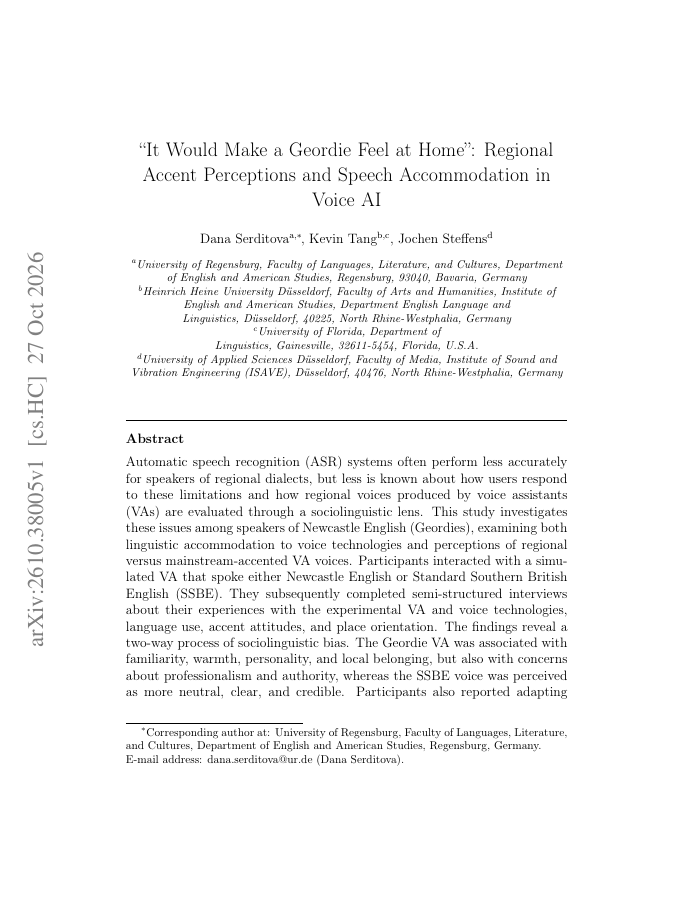
Automatic speech recognition (ASR) systems often perform less accurately for speakers of regional dialects, but less is known about how users respond to these limitations and how regional voices produced by voice assistants (VAs) are evaluated through a sociolinguistic lens.
27 Oct 2026
Distribution-matching distillation enables high-quality image generation in only a few denoising steps. However, distilled student models often map different initial noise samples to similar outputs under the same prompt.
27 Oct 2026
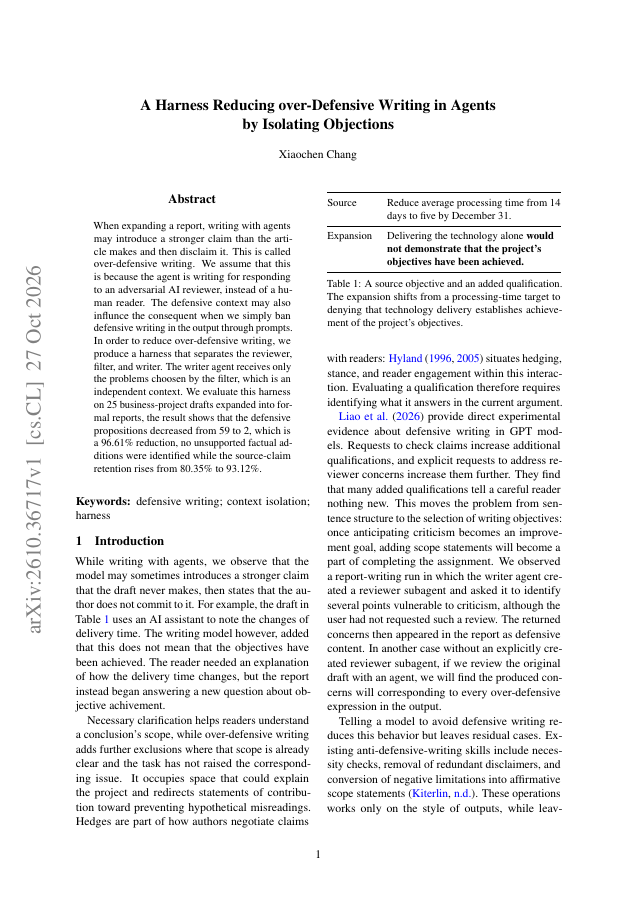
When expanding a report, writing with agents may introduce a stronger claim than the article makes and then disclaim it. This is called over-defensive writing. We assume that this is because the agent is writing for responding to an adversarial AI reviewer, instead of a human…
27 Oct 2026
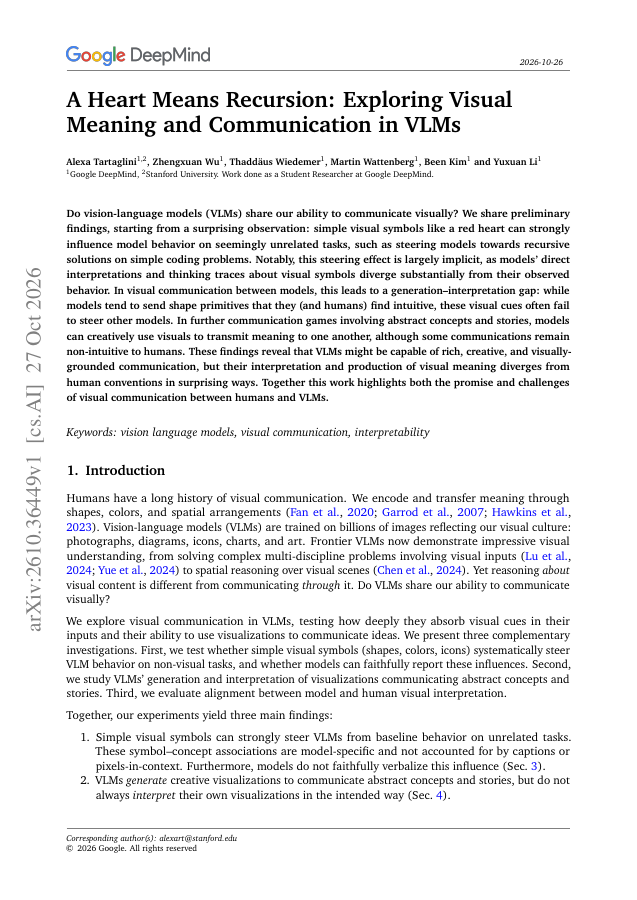
Do vision-language models (VLMs) share our ability to communicate visually? We share preliminary findings, starting from a surprising observation: simple visual symbols like a red heart can strongly influence model behavior on seemingly unrelated tasks, such as steering models…
27 Oct 2026
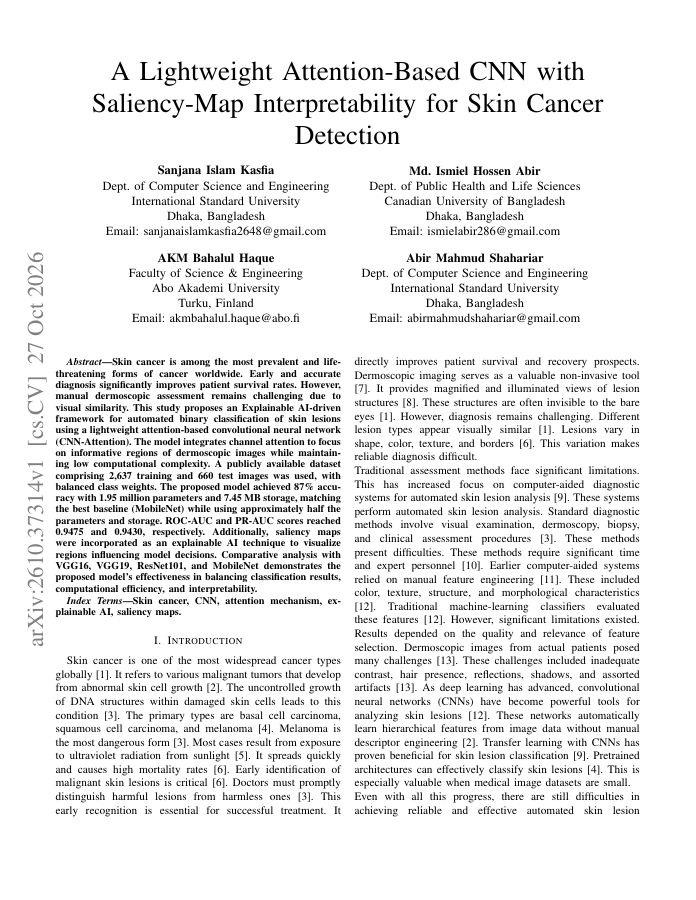
Skin cancer is among the most prevalent and life threatening forms of cancer worldwide. Early and accurate diagnosis significantly improves patient survival rates. However, manual dermoscopic assessment remains challenging due to visual similarity.
27 Oct 2026
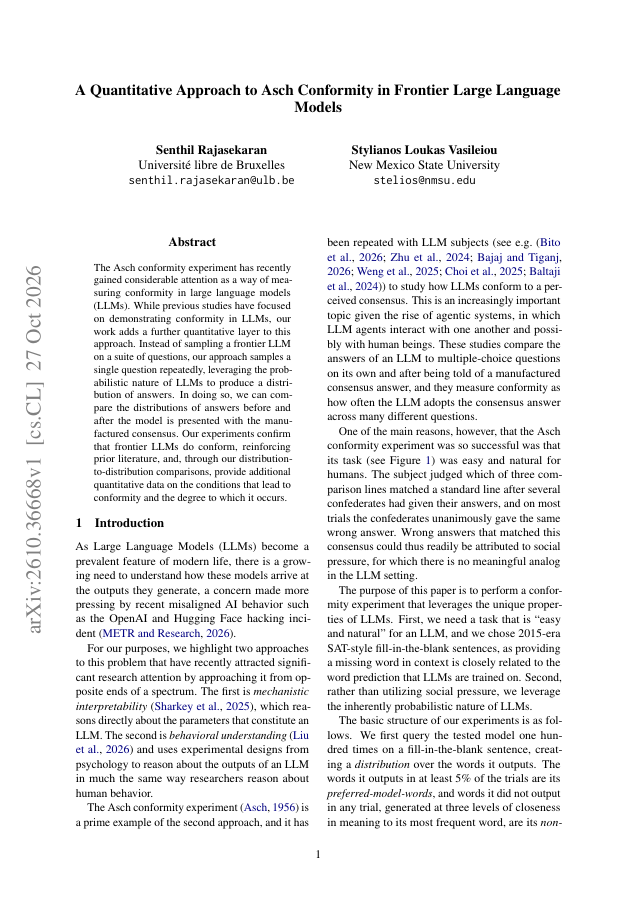
The Asch conformity experiment has recently gained considerable attention as a way of measuring conformity in large language models (LLMs). While previous studies have focused on demonstrating conformity in LLMs, our work adds a further quantitative layer to this approach.
27 Oct 2026
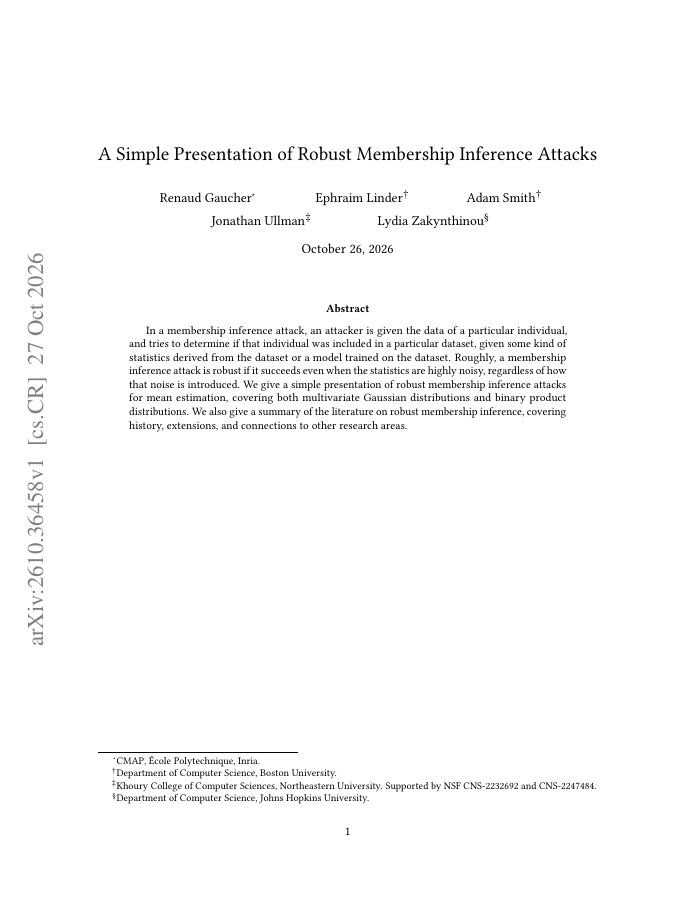
In a membership inference attack, an attacker is given the data of a particular individual, and tries to determine if that individual was included in a particular dataset, given some kind of statistics derived from the dataset or a model trained on the dataset.