Harikrishnan Unnikrishnan · 2 Mar 2026
A detection-gated pipeline combining a localizer and segmenter achieves state-of-the-art glottal segmentation with robust cross-dataset generalization and real-time processing capabilities.
Trending research and the full catalog - each paper linked to the benchmarks, methods, and models it introduces.
Filtering here covers the 2,000 most recent papers, as much as one page can hold in memory. See the full index of 22,736 papers.
Harikrishnan Unnikrishnan · 2 Mar 2026
A detection-gated pipeline combining a localizer and segmenter achieves state-of-the-art glottal segmentation with robust cross-dataset generalization and real-time processing capabilities.
1 Mar 2026
As large language models (LLMs) increasingly assist scientific writing, the limitations and token costs of generating TeX become increasingly visible. This paper analyzes TeX's architectural mismatch with LLM workflows, stemming from its lack of an explicit structural…
1 Mar 2026
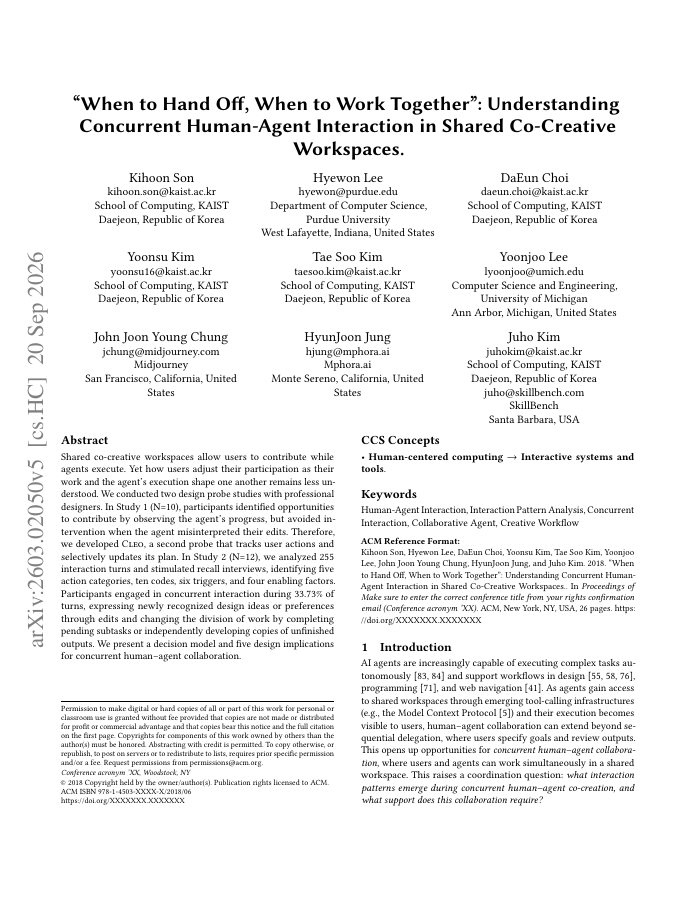
Shared co-creative workspaces allow users to contribute while agents execute. Yet how users adjust their participation as their work and the agent's execution shape one another remains less understood. We conducted two design probe studies with professional designers.
1 Mar 2026
Sparse plus Low-Rank $(\mathbf{S} + \mathbf{LR})$ decomposition of Large Language Models (LLMs) has emerged as a promising direction in model compression, aiming to decompose pre-trained model weights into a sum of sparse and low-rank matrices $(\mathbf{W} \approx \mathbf{S} +…
1 Mar 2026
Reinforcement Learning with Verifiable Rewards ( RLVR ) has emerged as a transformative paradigm for enhancing the reasoning capabilities of Large Language Models ( LLMs), yet its potential in 3D scene understanding remains under-explored.
1 Mar 2026
Global numerical weather prediction (NWP) and artificial intelligence (AI) models often underestimate tropical cyclone (TC) intensity, partly because coarse grids underresolve fine-scale three-dimensional inner-core structures that influence TC intensity evolution.
1 Mar 2026
Current Large Language Models have achieved Olympiad-level logic, yet Vision-Language Models paradoxically falter on elementary spatial tasks like block counting. This capability mismatch reveals a critical ``spatial intelligence gap,'' where models fail to construct coherent 3D…
1 Mar 2026
Drones are becoming popular as a complementary system for Emergency Medical Services (EMS). Although several pilot studies and flight trials have shown the feasibility of drone-assisted Automated External Defibrillator (AED) delivery, running a full-scale operational network…
1 Mar 2026
Autoregressive (AR) language models build representations incrementally via left-to-right prediction, while diffusion language models (dLLMs) are trained through full-sequence denoising.
1 Mar 2026
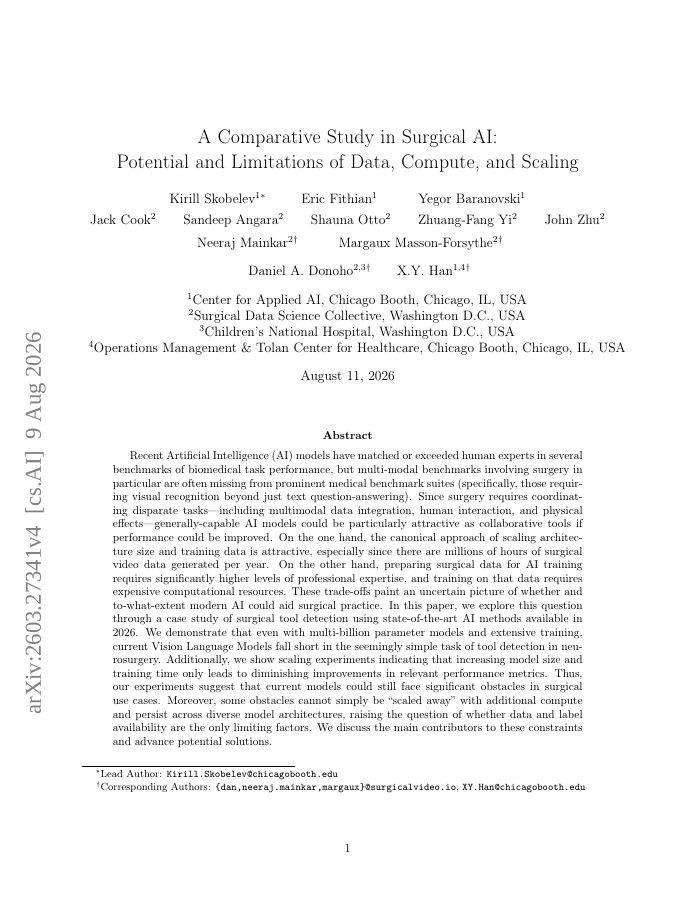
Recent Artificial Intelligence (AI) models have matched or exceeded human experts in several benchmarks of biomedical task performance, but surgical benchmarks in particular are often missing from prominent medical benchmark suites.
1 Mar 2026
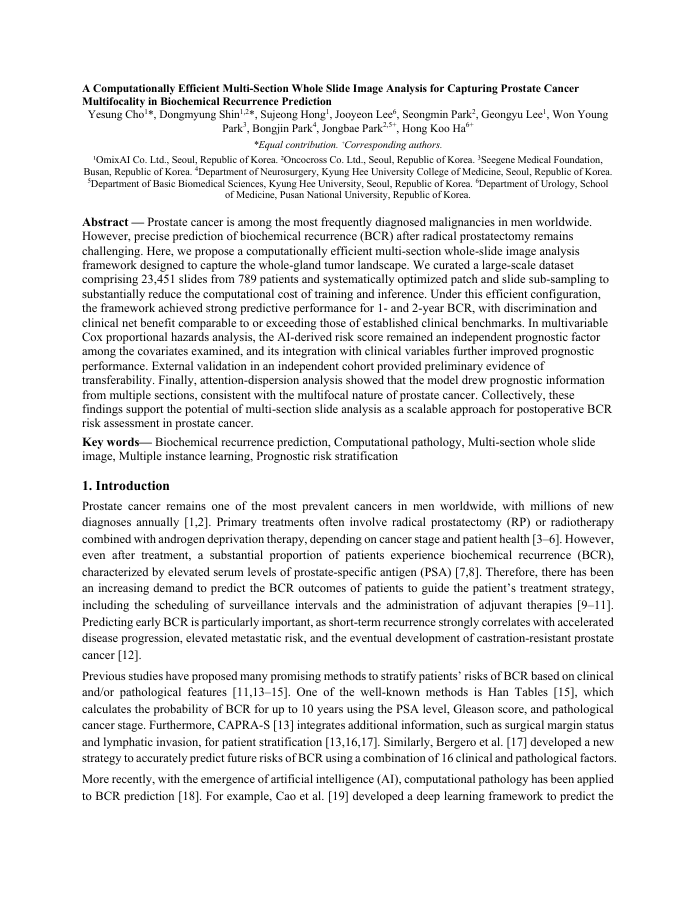
Prostate cancer is among the most frequently diagnosed malignancies in men worldwide. However, precise prediction of biochemical recurrence (BCR) after radical prostatectomy remains challenging.
1 Mar 2026
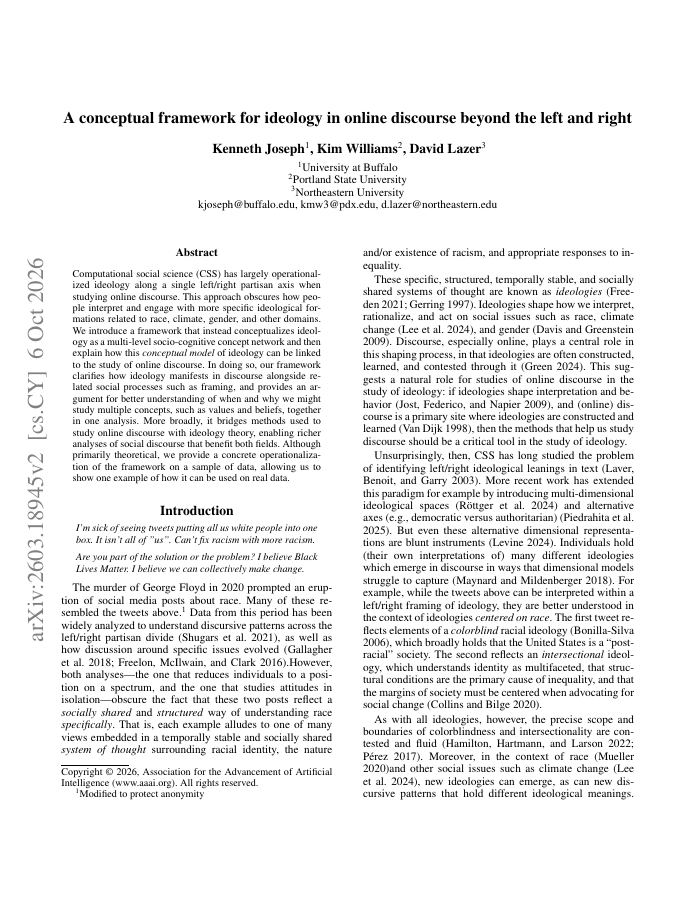
Computational social science (CSS) has largely operationalized ideology along a single left/right partisan axis when studying online discourse. This approach obscures how people interpret and engage with more specific ideological formations related to race, climate, gender, and…
1 Mar 2026
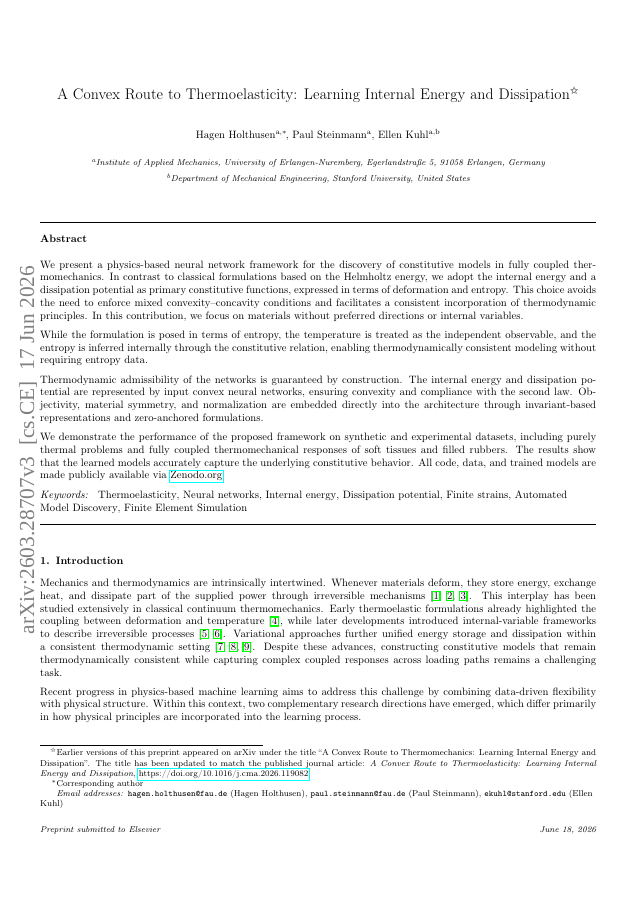
We present a physics-based neural network framework for the discovery of constitutive models in fully coupled thermomechanics. In contrast to classical formulations based on the Helmholtz energy, we adopt the internal energy and a dissipation potential as primary constitutive…
1 Mar 2026
A novel convolutional autoencoder and neural ODE (CAE-NODE) framework is proposed for a reduced-order model (ROM) applied to transient 2D counterflow flames, as an extension of AE-NODE methods in homogeneous reactive systems to spatially resolved flows.
1 Mar 2026
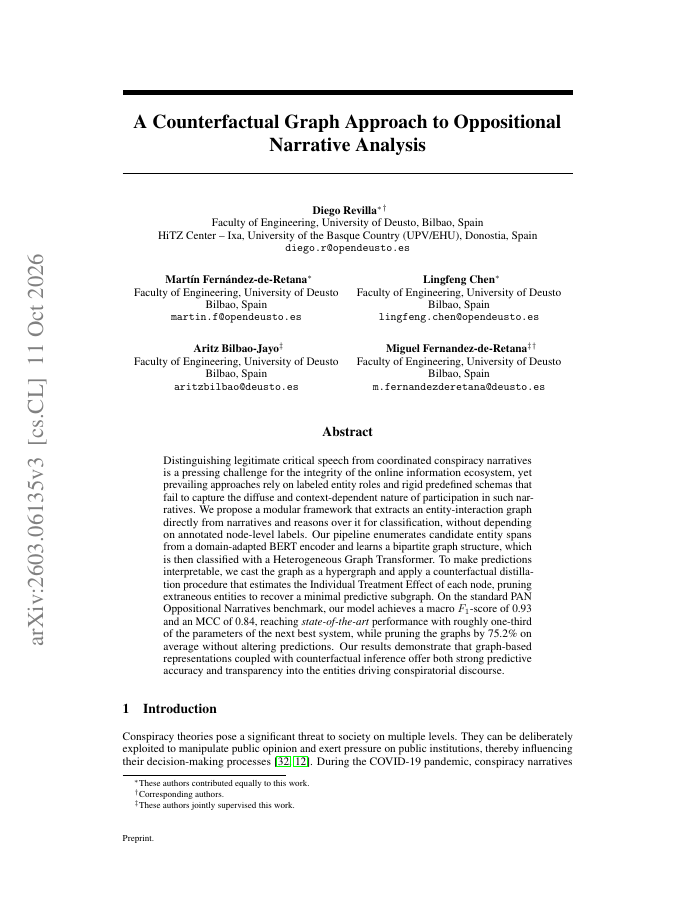
Distinguishing legitimate critical speech from coordinated conspiracy narratives is a pressing challenge for the integrity of the online information ecosystem, yet prevailing approaches rely on labeled entity roles and rigid predefined schemas that fail to capture the diffuse…
1 Mar 2026
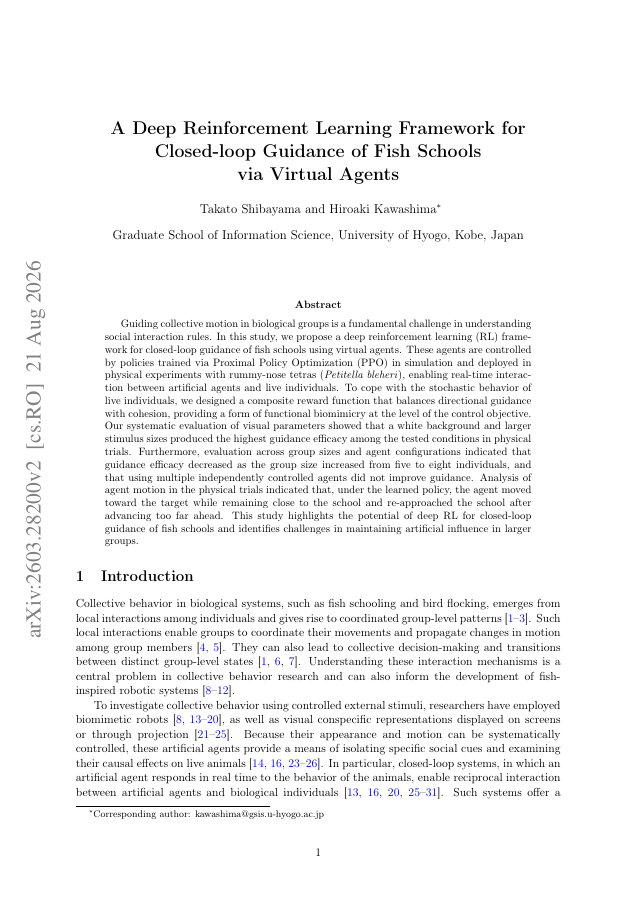
Guiding collective motion in biological groups is a fundamental challenge in understanding social interaction rules. In this study, we propose a deep reinforcement learning (RL) framework for closed-loop guidance of fish schools using virtual agents.
1 Mar 2026
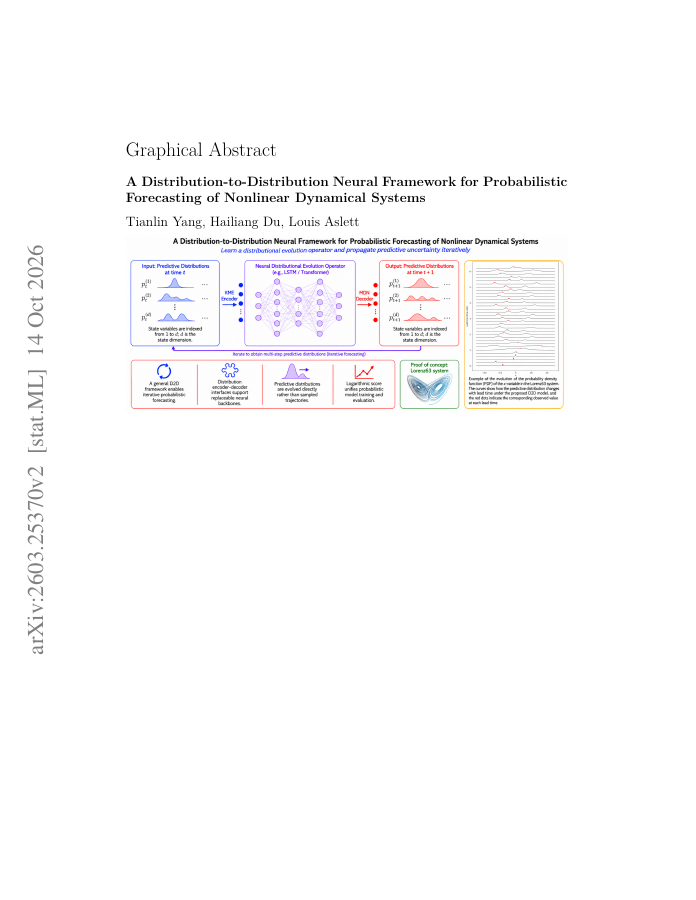
Probabilistic forecasts provide a principled representation of forecast uncertainty through predictive distributions. Directly propagating predictive distributions with conventional physical models requires solving distributional evolution equations, a task well-known to be…
1 Mar 2026
WebGIS development requires consistency, yet agentic AI often fails due to LLM context constraints, forgetting, stochasticity, instruction failure, and adaptation rigidity.
1 Mar 2026
The extraction of structured information from raw text is a fundamental component of many NLP applications, including document retrieval, ranking, and relevance estimation.
1 Mar 2026
In-context learning (ICL) enables task adaptation at inference time by conditioning on demonstrations rather than updating model parameters. Although recent time-series foundation models incorporate contextual conditioning, retrieval, or example-based prompting, they typically…
1 Mar 2026
The proliferation of data across the system lifecycle presents both a significant opportunity and a challenge for Engineering Design and Systems Engineering (EDSE). While this "digital thread" has the potential to drive innovation, the fragmented and inaccessible nature…
1 Mar 2026
While deep learning (DL)-based methods have achieved remarkable success in continuous wireless resource allocation, efficient solutions for problems involving discrete variables remain challenging.
1 Mar 2026
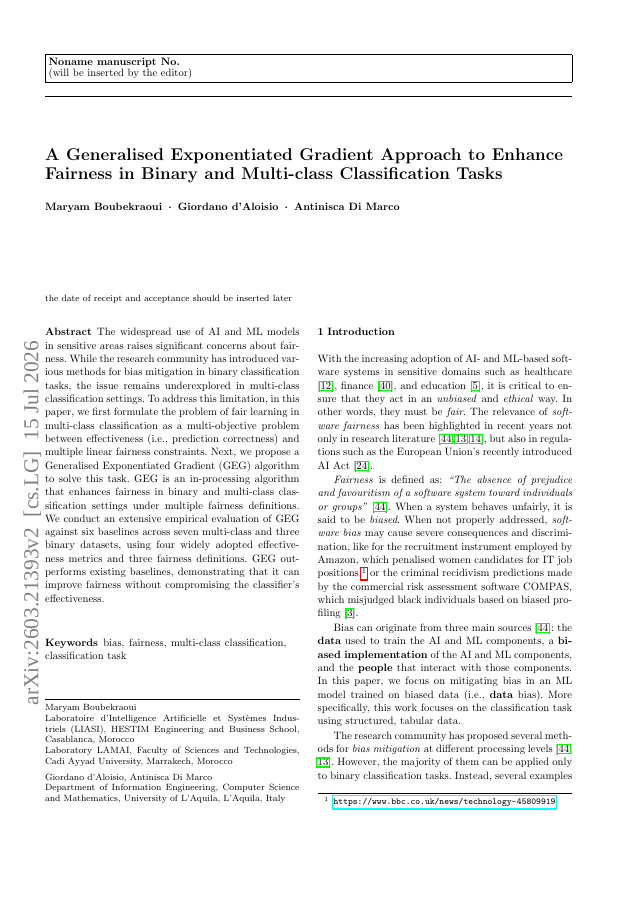
The widespread use of AI and ML models in sensitive areas raises significant concerns about fairness. While the research community has introduced various methods for bias mitigation in binary classification tasks, the issue remains under-explored in multi-class classification…
1 Mar 2026
Bock's 1971 algorithm is an exact primal--dual method for the minimum-cost arborescence problem, but its Algol presentation obscures the interaction of its maintained arrays and label-directed control flow.