9 Nov 2026
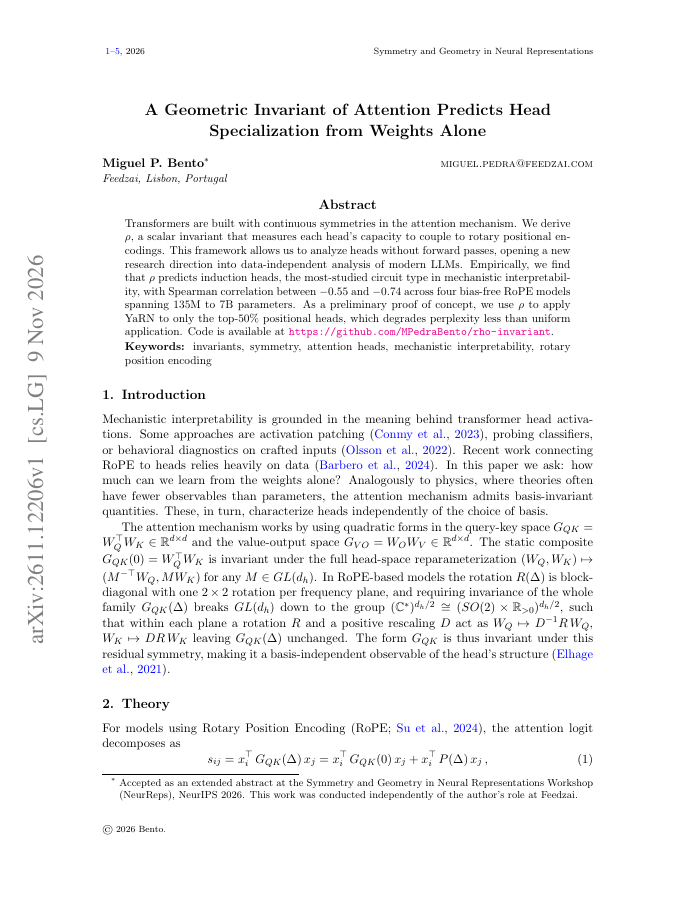
Transformers are built with continuous symmetries in the attention mechanism. We derive $ρ$, a scalar invariant that measures each head's capacity to couple to rotary positional encodings.
Trending research and the full catalog - each paper linked to the benchmarks, methods, and models it introduces.
Filtering here covers the 2,000 most recent papers, as much as one page can hold in memory. See the full index of 23,103 papers.
9 Nov 2026
Transformers are built with continuous symmetries in the attention mechanism. We derive $ρ$, a scalar invariant that measures each head's capacity to couple to rotary positional encodings.
9 Nov 2026
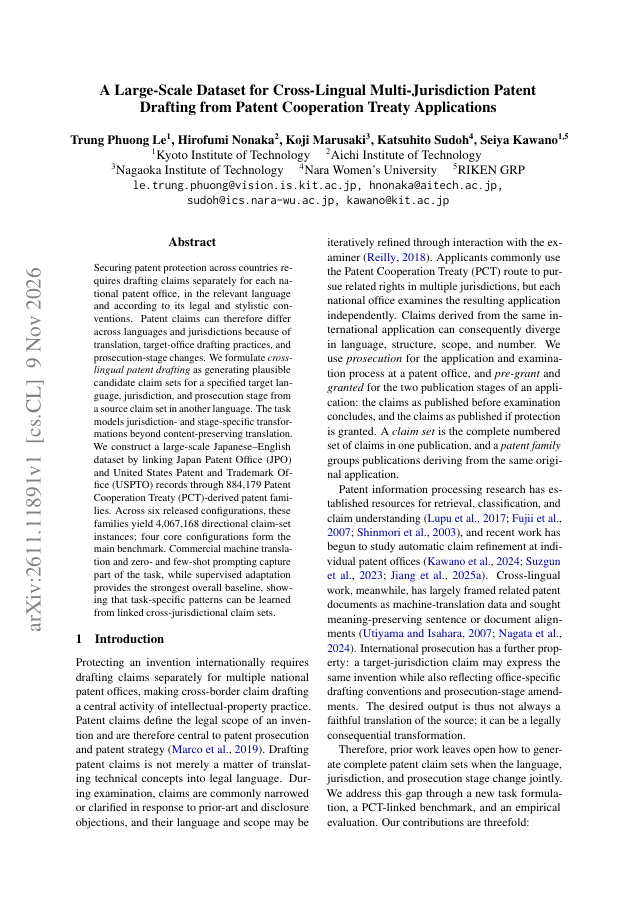
Securing patent protection across countries requires drafting claims separately for each national patent office, in the relevant language and according to its legal and stylistic conventions.
9 Nov 2026
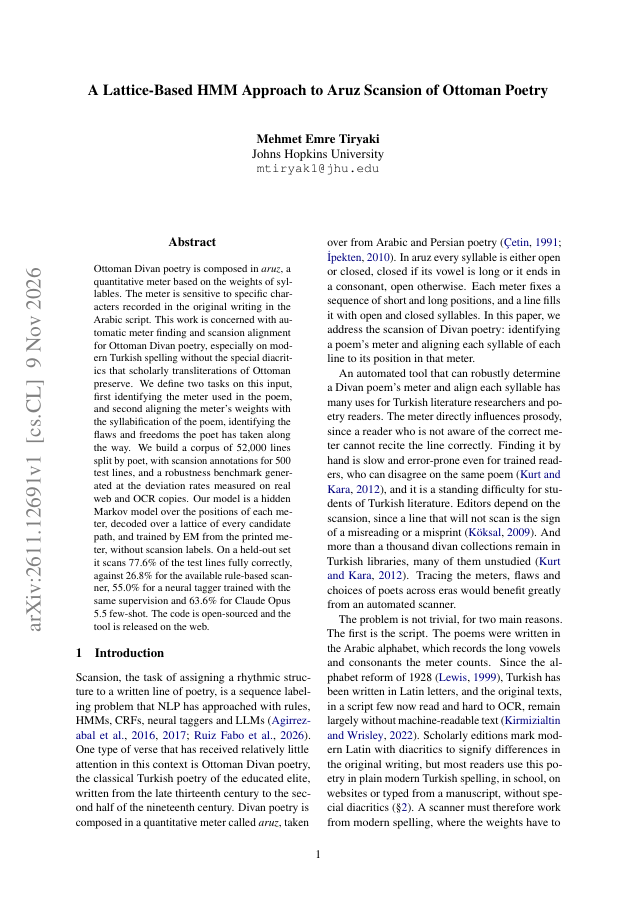
Ottoman Divan poetry is composed in aruz, a quantitative meter based on the weights of syllables. The meter is sensitive to specific characters recorded in the original writing in the Arabic script.
9 Nov 2026
The growing complexity of Multi-Agent Reinforcement Learning (MARL) has fragmented the literature, obscuring underlying architectural choices behind diverse implementations.
9 Nov 2026
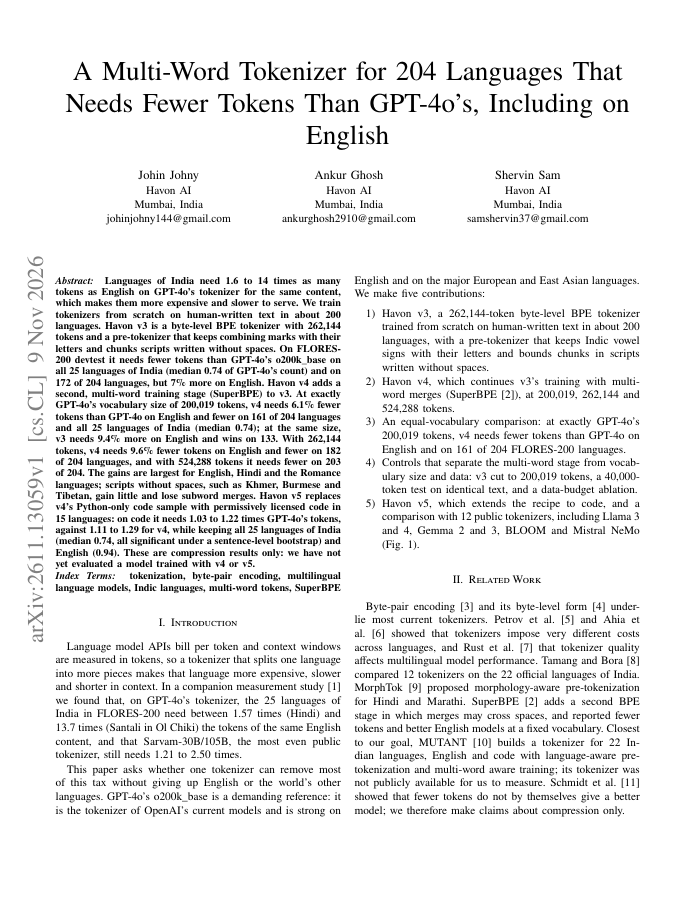
Languages of India need 1.6 to 14 times as many tokens as English on GPT-4o's tokenizer for the same content, which makes them more expensive and slower to serve. We train tokenizers from scratch on human-written text in about 200 languages.
9 Nov 2026
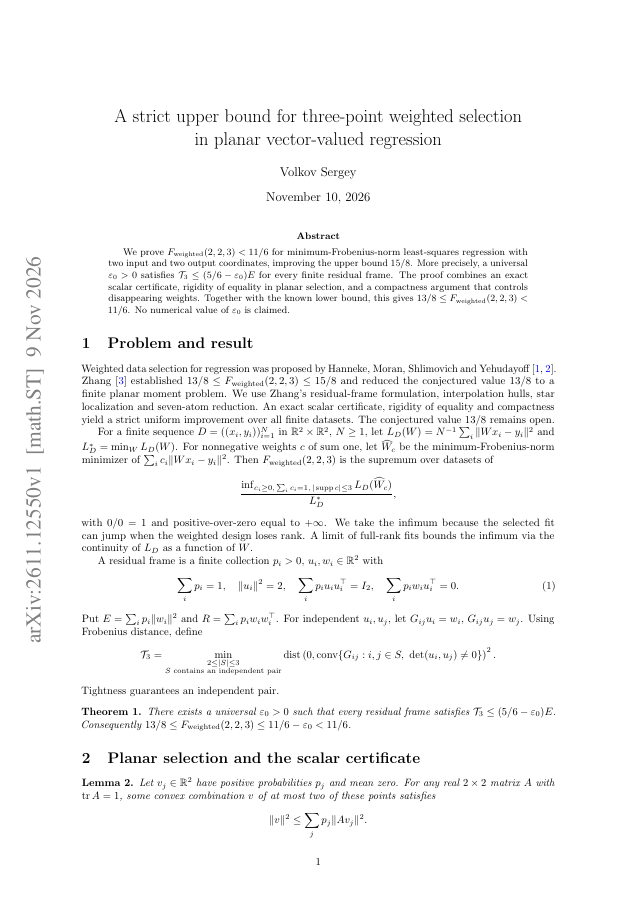
We prove $F_{\mathrm{weighted}}(2,2,3)<11/6$ for minimum-Frobenius-norm least-squares regression with two input and two output coordinates, improving the upper bound $15/8$.
9 Nov 2026
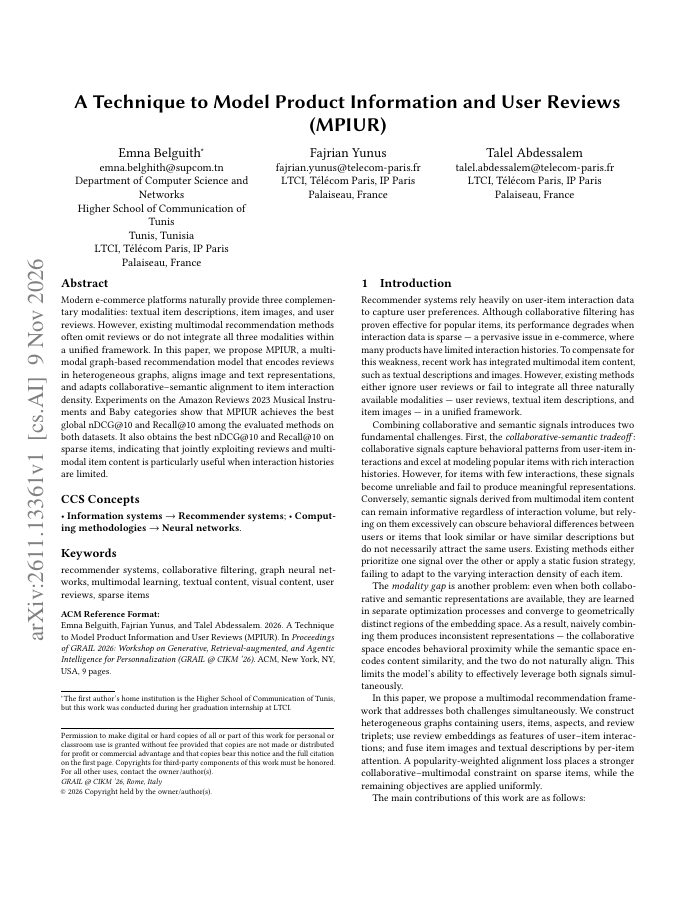
Modern e-commerce platforms naturally provide three complementary modalities: textual item descriptions, item images, and user reviews. However, existing multimodal recommendation methods often omit reviews or do not integrate all three modalities within a unified framework.
8 Nov 2026
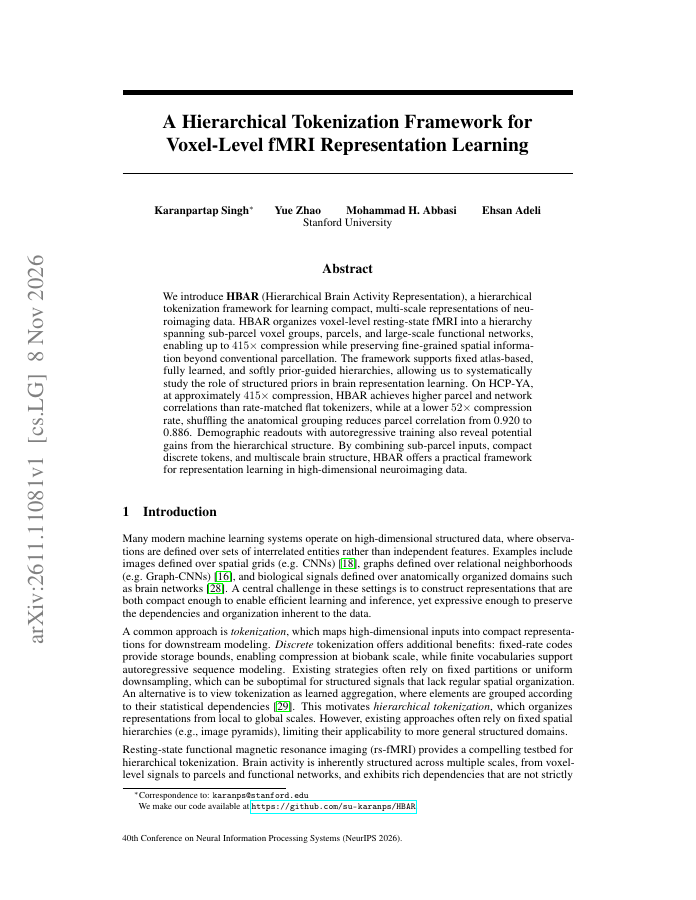
We introduce HBAR (Hierarchical Brain Activity Representation), a hierarchical tokenization framework for learning compact, multi-scale representations of neuroimaging data.
8 Nov 2026
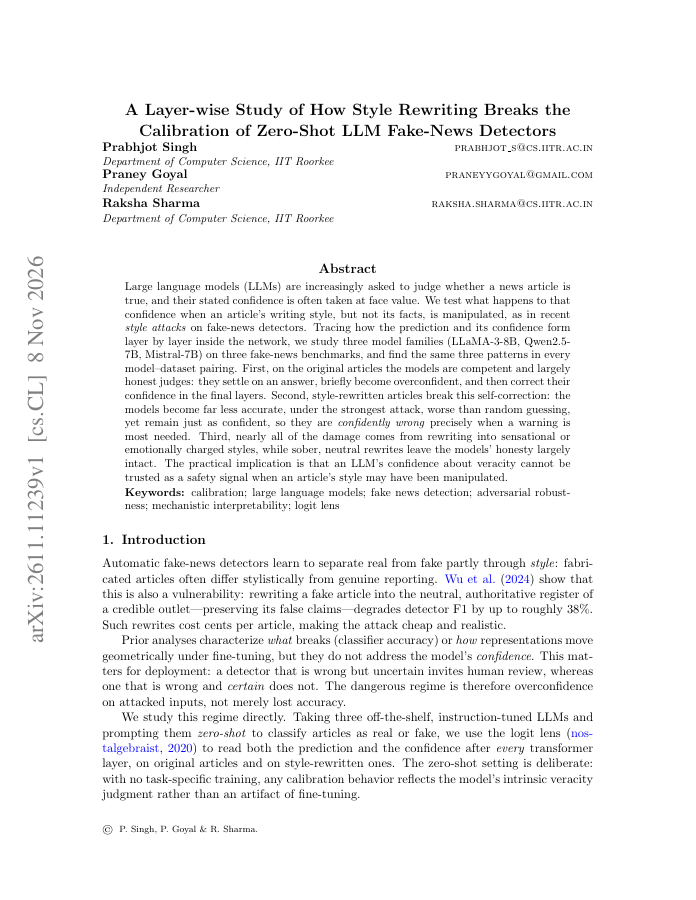
Large language models (LLMs) are increasingly asked to judge whether a news article is true, and their stated confidence is often taken at face value. We test what happens to that confidence when an article's writing style, but not its facts, is manipulated, as in recent…
8 Nov 2026
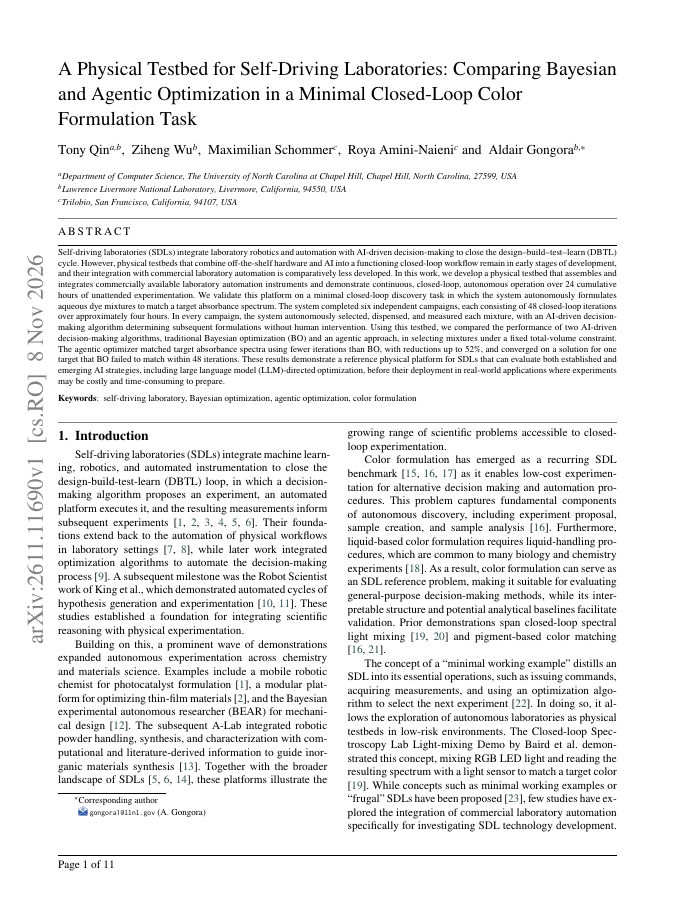
Self-driving laboratories (SDLs) integrate laboratory robotics and automation with AI-driven decision-making to close the design-build-test-learn (DBTL) cycle. However, physical testbeds that combine off-the-shelf hardware and AI into a functioning closed-loop workflow remain in…
8 Nov 2026
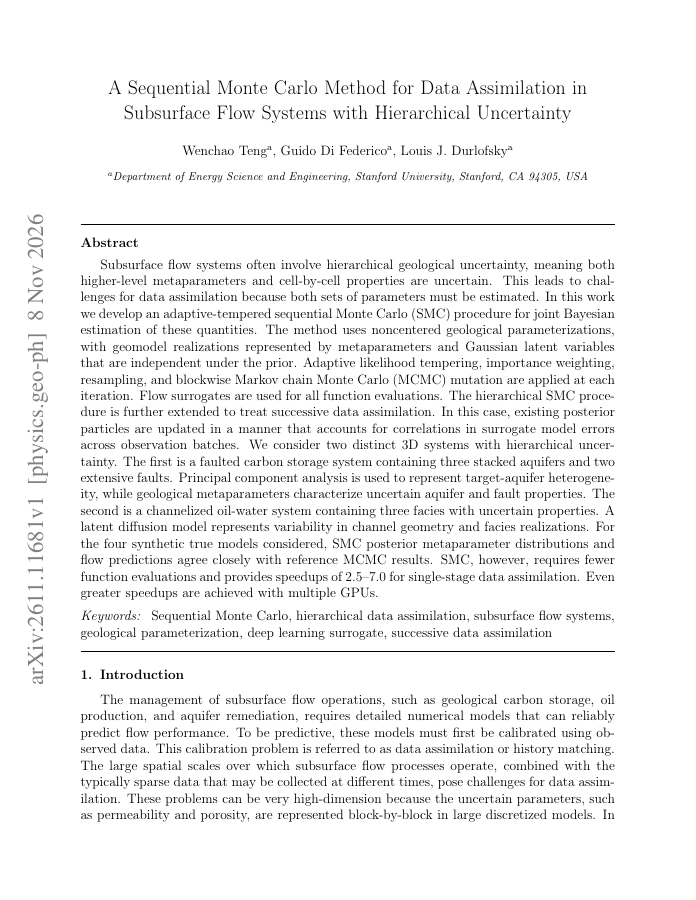
Subsurface flow systems often involve hierarchical geological uncertainty, meaning both higher-level metaparameters and cell-by-cell properties are uncertain. This leads to challenges for data assimilation because both sets of parameters must be estimated.
8 Nov 2026
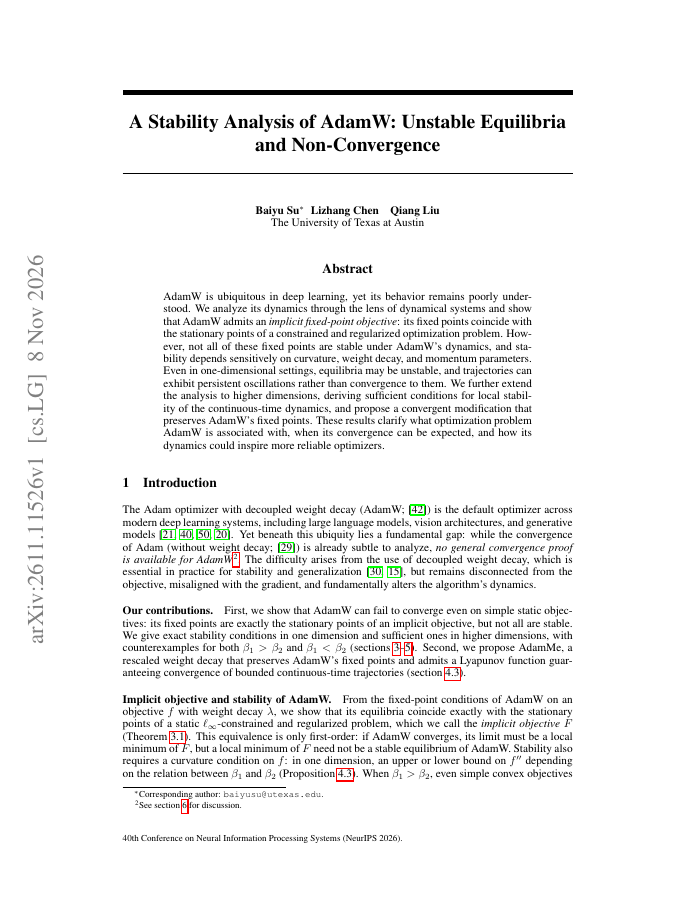
AdamW is ubiquitous in deep learning, yet its behavior remains poorly understood. We analyze its dynamics through the lens of dynamical systems and show that AdamW admits an implicit fixed-point objective: its fixed points coincide with the stationary points of a constrained and…
8 Nov 2026
We study reconstruction attacks, which recover training data from a learned model. In our adversarial model, the adversary designs a hard instance, drawn from a parameterized family of data distributions, and is given the parameter used to generate it.
7 Nov 2026
When disasters strike, they not only damage infrastructure, buildings, and the economy, but also affect the mental health of affected populations. Research on the mental health effects of disasters has expanded rapidly and has become an important, well-funded area of psychology,…
7 Nov 2026
Conflicting stakeholder objectives make it difficult to coordinate investments in urban resilience. We model conflict-driven urban design as a non-zero-sum digital board game in which stakeholder agents allocate scarce resources and balance individual payoffs against shared…
7 Nov 2026
We develop a variational and geometric theory based on statistical physics for the joint evolution of Transformer attention and token representations at fixed model parameters.
7 Nov 2026
Rapid, high-fidelity analysis of four-dimensional scanning transmission electron microscopy (4D-STEM) datasets from heterogeneous materials remains challenging because coexisting phases, orientation variants, local strain gradients, and intrinsic TEM thin-foil effects produce…
7 Nov 2026
Most temporal graph learning methods reduce future prediction to discriminative inference over past interactions, focusing on edges or node labels for a largely persistent set of nodes.
6 Nov 2026
While multimodal large language models (MLLMs) have improved automated radiology report generation, they remain prone to hallucinations, necessitating clinically meaningful risk-control methods.
6 Nov 2026
Agentic robotics asks coding agents to implement and iteratively improve robot policies from simulated and real-world physical interactions. We study the self-learning loop of agentic robotics through a controlled simulation study spanning nine manipulation tasks, 631 different…
6 Nov 2026
A central challenge in AI is specifying objectives that align with human preferences. While existing theoretical results elucidate how misspecification impacts performance, they typically do not distinguish between merely suboptimal and catastrophic outcomes.
6 Nov 2026
Generalized Bayes product partition models provide a probabilistic counterpart to loss-based clustering. They update a prior over partitions through an exponentiated clustering loss rather than a likelihood, so allocation uncertainty can be quantified without a full generative…
6 Nov 2026
Returned products in circular engineering often have heterogeneous degradation histories, making remaining function difficult to assess. For bolted joints, corrosion alters surface morphology, contact, friction, preload retention, and mechanical response.
6 Nov 2026
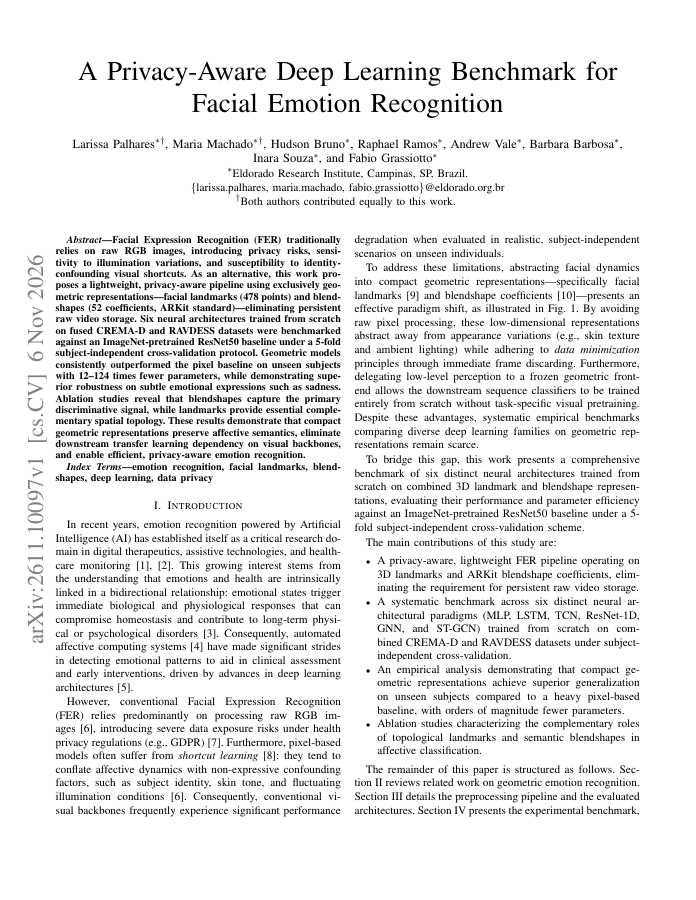
Facial Expression Recognition (FER) traditionally relies on raw RGB images, introducing privacy risks, sensitivity to illumination variations, and susceptibility to identity-confounding visual shortcuts.