1 Apr 2026
Understanding how complex systems respond to perturbations, such as whether they will remain stable or what their most sensitive patterns are, is a fundamental challenge across science and engineering.
Trending research and the full catalog - each paper linked to the benchmarks, methods, and models it introduces.
Filtering here covers the 2,000 most recent papers, as much as one page can hold in memory. See the full index of 22,502 papers.
1 Apr 2026
Understanding how complex systems respond to perturbations, such as whether they will remain stable or what their most sensitive patterns are, is a fundamental challenge across science and engineering.
1 Apr 2026
We introduce the penalised Saito functional $\mathfrak S_{λ,β}(\mathcal{A};d_1,d_2)$ for a reduced arrangement $\mathcal{A}$ of $n$ lines and a prescribed pair $d_1+d_2=n-1$.
1 Apr 2026
Vision-Language Models (VLMs) have made significant strides in static image understanding but continue to face critical hurdles in spatiotemporal reasoning. A major bottleneck is "multi-image reasoning hallucination", where a large performance drop between forward and…
1 Apr 2026
The Internet of Medical Things (IoMT) enables intelligent healthcare services but faces challenges such as dynamic topology, energy constraints, and diverse QoS requirements. This paper proposes QQMR, a Q-learning-based QoS-aware multipath routing method for WBANs.
1 Apr 2026
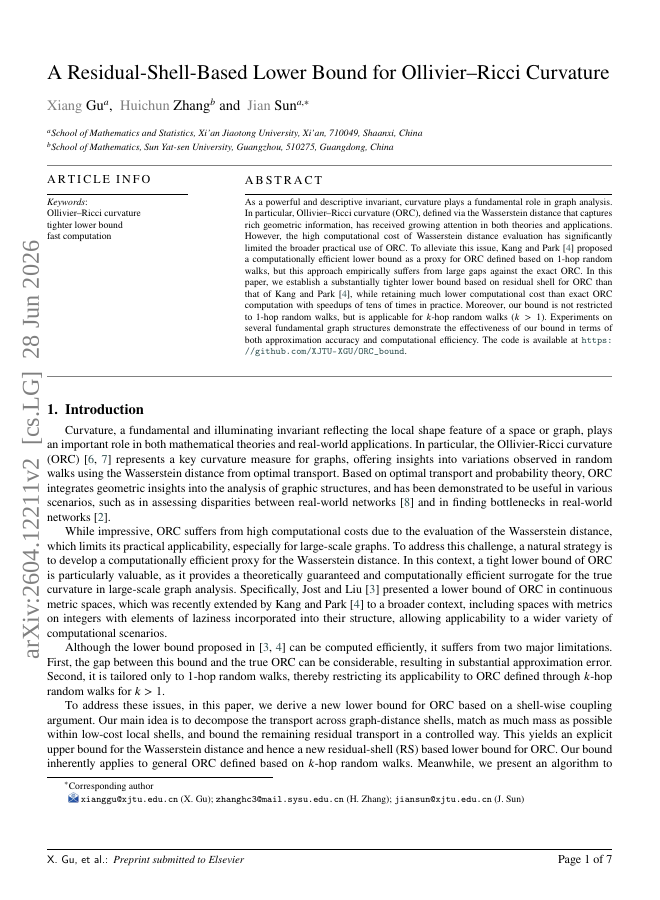
Ollivier-Ricci curvature (ORC), defined via the Wasserstein distance that captures rich geometric information, has received growing attention in both theory and applications.
1 Apr 2026
Recent work has shown that the hidden states of large language models contain signals useful for uncertainty estimation, motivating a growing interest in efficient probe-based approaches.
1 Apr 2026
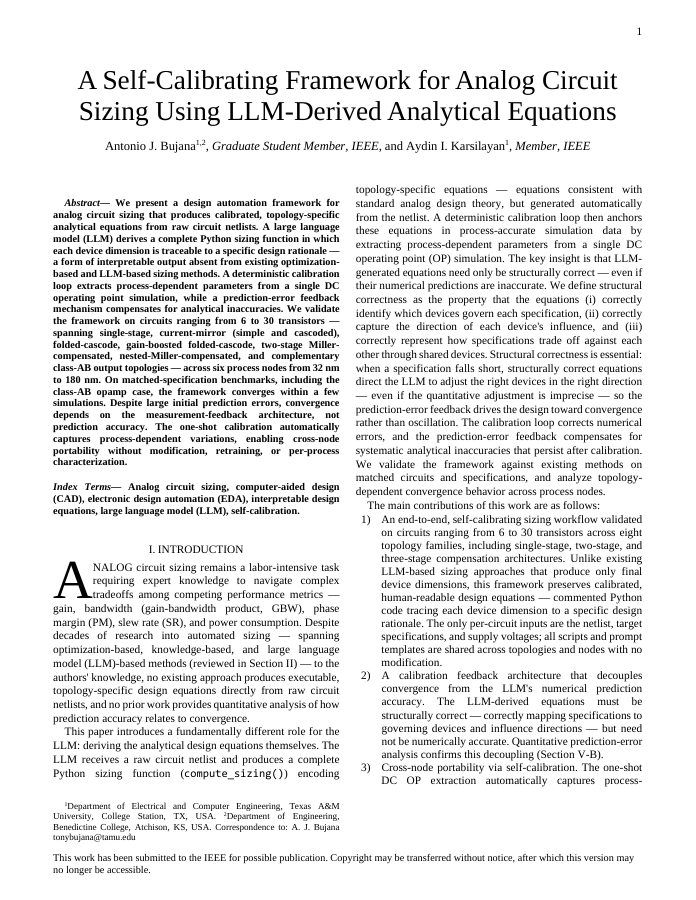
We present a design automation framework for analog circuit sizing that produces calibrated, topology-specific analytical equations from raw circuit netlists. A large language model (LLM) derives a complete Python sizing function in which each device dimension is traceable to a…
1 Apr 2026
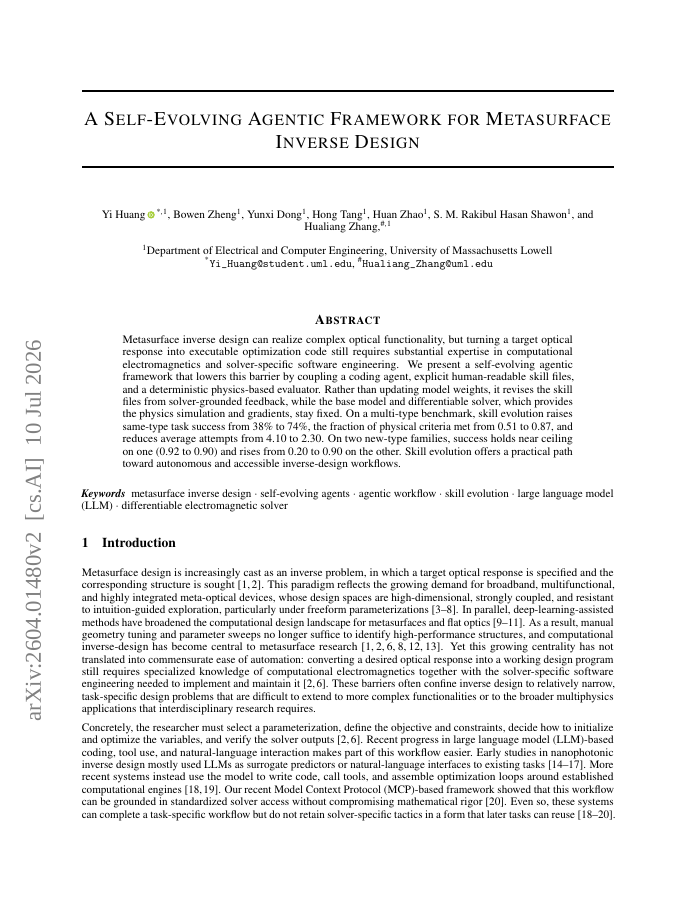
Metasurface inverse design can realize complex optical functionality, but turning a target optical response into executable optimization code still requires substantial expertise in computational electromagnetics and solver-specific software engineering.
1 Apr 2026
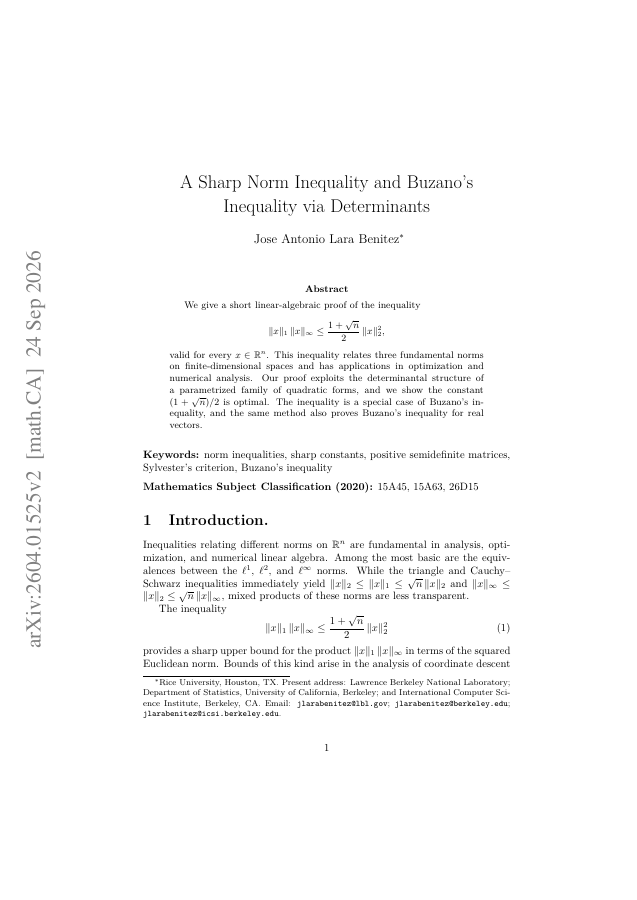
We give a short linear-algebraic proof of the inequality $$ \|x\|_1\,\|x\|_\infty \le \frac{1+\sqrt{n}}{2}\,\|x\|_2^2, $$ valid for every $x\in\mathbb{R}^n$. This inequality relates three fundamental norms on finite-dimensional spaces and has applications in optimization and…
1 Apr 2026
Dimensionality reduction (DR) involves two longstanding trade-offs. First, preserving local neighborhoods can come at the cost of global structure. Neighbor embedding methods such as t-SNE and UMAP prioritize local similarity preservation but do not explicitly constrain global…
1 Apr 2026
The rapid growth of the large language model (LLM) ecosystem raises a critical question: are seemingly diverse models truly independent? Shared pretraining data, distillation, and alignment pipelines can induce hidden behavioral dependencies, or latent entanglement, that…
1 Apr 2026
Media narratives wield tremendous power in shaping public opinion, yet computational approaches struggle to capture the nuanced storytelling structures that communication theory emphasizes as central to how meaning is constructed.
1 Apr 2026
As Large Language Models continue to grow in both capability and cost, transferring frontier capabilities into smaller, deployable students has become an important engineering problem, and knowledge distillation remains a common technique for this transfer.
1 Apr 2026
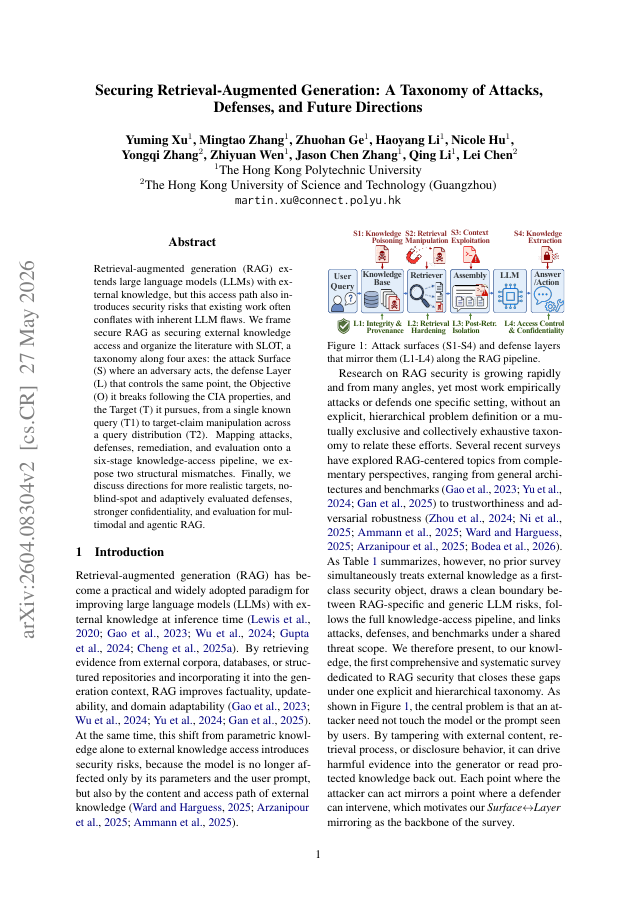
Retrieval-augmented generation (RAG) improves large language models (LLMs) with external knowledge, but this access path creates security risks distinct from inherent prompt-only or parametric-model flaws. We frame secure RAG as securing external knowledge access.
1 Apr 2026
The emergence of writable, cross-session persistent memory in LLM agents introduces a qualitatively different threat landscape from conventional input-centric security concerns, characterized by three properties: persistence, statefulness, and propagation.
1 Apr 2026
The fundamental limit of natural signal compression has traditionally been characterized by classical rate-distortion (RD) theory through the tradeoff between coding rate and reconstruction distortion, while the rate-distortion-perception (RDP) framework introduces a…
1 Apr 2026
The integration of Model Predictive Control (MPC) and Reinforcement Learning (RL) has emerged as a promising paradigm for constrained decision-making and adaptive control.
1 Apr 2026
Much work has been done on designing fast and accurate sampling for diffusion language models (dLLMs). However, these efforts have largely focused on the tradeoff between speed and quality of individual samples; how to additionally ensure diversity across samples remains less…
1 Apr 2026
The world's 7,000+ languages vary widely in the availability of resources for NLP, motivating efforts to systematically categorize them by their degree of resourcefulness (Joshi et al., 2020).
1 Apr 2026
Statistical evaluation aims to estimate the generalization performance of a model using held-out i.i.d. test data sampled from the ground-truth distribution. In supervised learning settings such as classification, performance metrics such as error rate are well-defined, and test…
1 Apr 2026
The accurate quantification of brain age from MRI has emerged as an important biomarker of brain health. However, existing approaches are often restricted to narrow age ranges and single-modality MRI data, limiting their capacity to capture the coordinated macro- and…
1 Apr 2026
Text-driven motion editing and intra-structural retargeting, where skeletons share topology but may differ in bone lengths and rest pose, are traditionally handled by fragmented pipelines with incompatible inputs and representations: editing relies on specialized generative…
1 Apr 2026
A unified framework for first-order optimization algorithms fornonconvex unconstrained optimization is proposed that uses adaptivelypreconditioned gradients and includes popular methods such as full anddiagonal AdaGrad, AdaNorm, as well as an adpative variant of Muon.
1 Apr 2026
We propose a unified fractional regularization framework for sparse signal recovery based on the $\ell_1/\ell_p^q$ model. This model generalizes several widely used sparsity-promoting regularizers and provides additional flexibility through the parameters $p$ and $q$.