1 Apr 2026
Student dropout is a persistent concern in Learning Analytics, yet comparative studies frequently evaluate predictive models under heterogeneous protocols, prioritizing discrimination over temporal interpretability and calibration.
Trending research and the full catalog - each paper linked to the benchmarks, methods, and models it introduces.
Filtering here covers the 2,000 most recent papers, as much as one page can hold in memory. See the full index of 22,502 papers.
1 Apr 2026
Student dropout is a persistent concern in Learning Analytics, yet comparative studies frequently evaluate predictive models under heterogeneous protocols, prioritizing discrimination over temporal interpretability and calibration.
1 Apr 2026
In the last decades, energy-based models (EBMs) have become an important class of probabilistic models in which a component of the likelihood is intractable and therefore cannot be evaluated explicitly.
1 Apr 2026
The IC3 algorithm represents the state-of-the-art (SOTA) hardware model checking technique, owing to its robust performance and scalability. A significant body of research has focused on enhancing the solving efficiency of the IC3 algorithm, with particular attention to the…
1 Apr 2026
Generating continuous-time, continuous-space stochastic processes (e.g., videos, weather forecasts) conditioned on partial observations (e.g., first and last frames) is a fundamental challenge.
1 Apr 2026
Selecting LLM-generated code candidates using LLM-generated tests is challenging because the tests themselves may be incorrect. Existing methods either treat all tests equally or rely on ad-hoc heuristics to filter unreliable tests.
26 Mar 2026
Multimodal Large Language Models (MLLMs) have shown impressive abilities in understanding and reasoning over conventional images. However, their perception of 360° images remains largely underexplored.
Vasily Ilin, Jingwei Hu · 26 Mar 2026
Score-based transport modeling replaces traditional blob methods in plasma simulations, offering improved accuracy and efficiency for solving the Vlasov-Maxwell-Landau system.
Mu Xu, Feng Xiong, Shuang Zeng · 24 Mar 2026
ABot-PhysWorld is a 14B Diffusion Transformer model that generates physically plausible videos through physics-aware training and evaluation on a new benchmark.
Eunbyung Park, Jihyeon Park, Hyun-kyu Ko · 19 Mar 2026
Creating dynamic, view-consistent videos of customized subjects is highly sought after for a wide range of emerging applications, including immersive VR/AR, virtual production, and next-generation e-commerce.
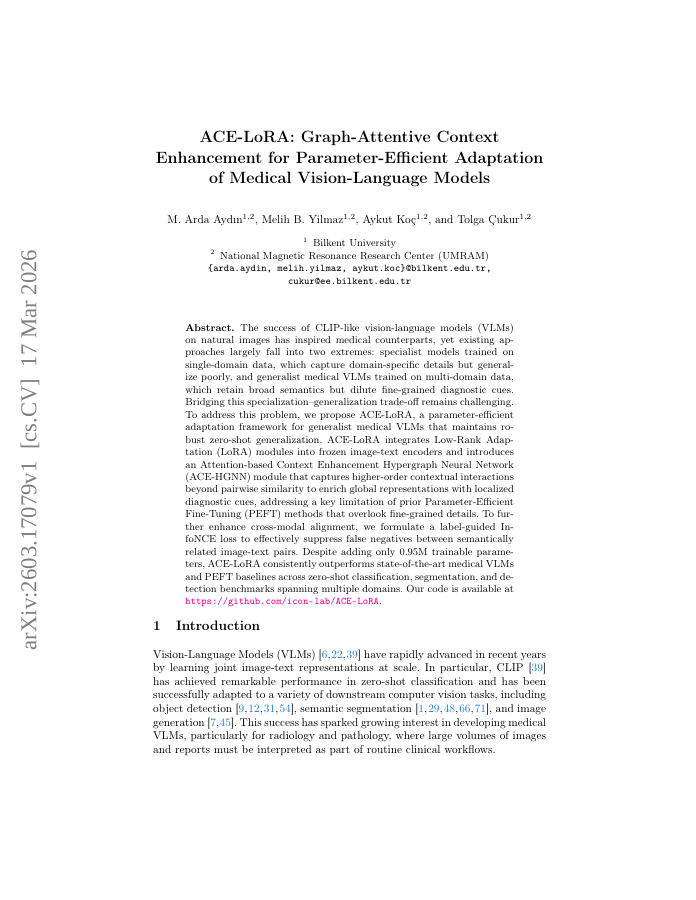
M. Arda Aydın, Melih B. Yilmaz, Aykut Koç · 17 Mar 2026
ACE-LoRA is a parameter-efficient adaptation framework for medical vision-language models that enhances zero-shot generalization through LoRA modules and attention-based context enhancement.
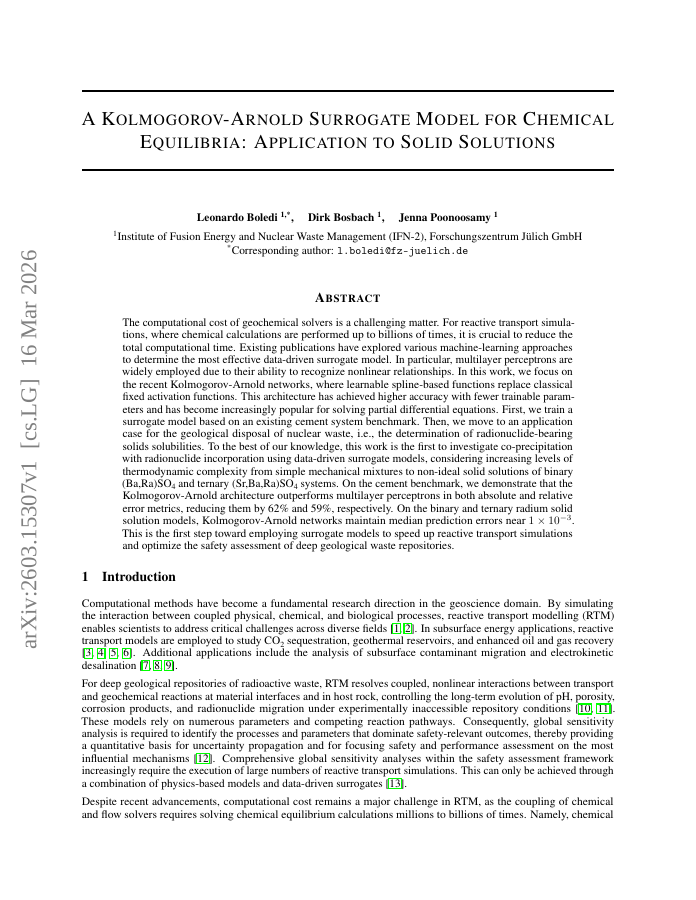
16 Mar 2026
The computational cost of geochemical solvers is a challenging matter. For reactive transport simulations, where chemical calculations are performed up to billions of times, it is crucial to reduce the total computational time.
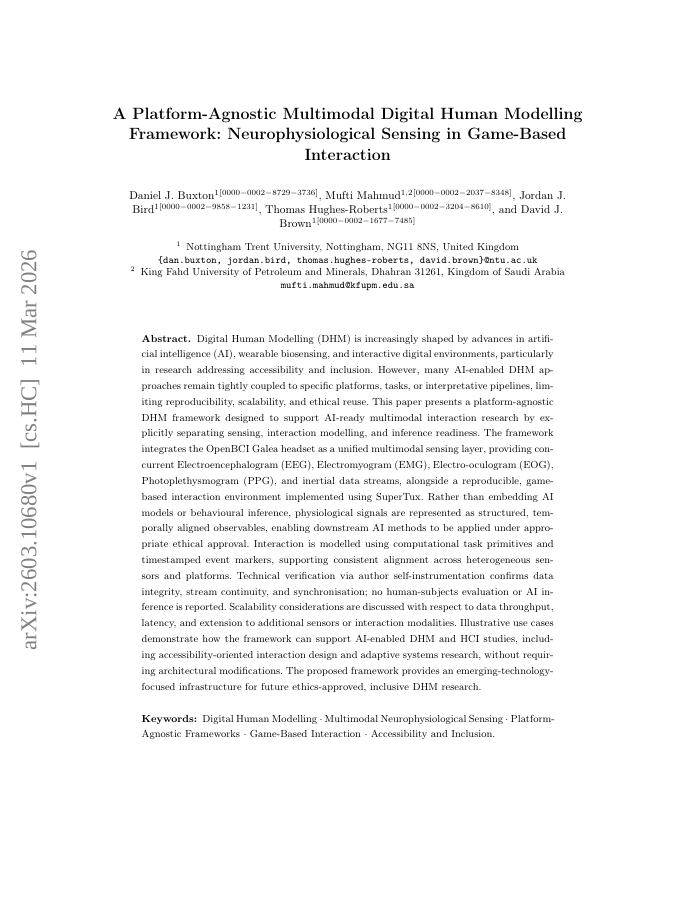
11 Mar 2026
Digital Human Modelling (DHM) is increasingly shaped by advances in AI, wearable biosensing, and interactive digital environments, particularly in research addressing accessibility and inclusion.
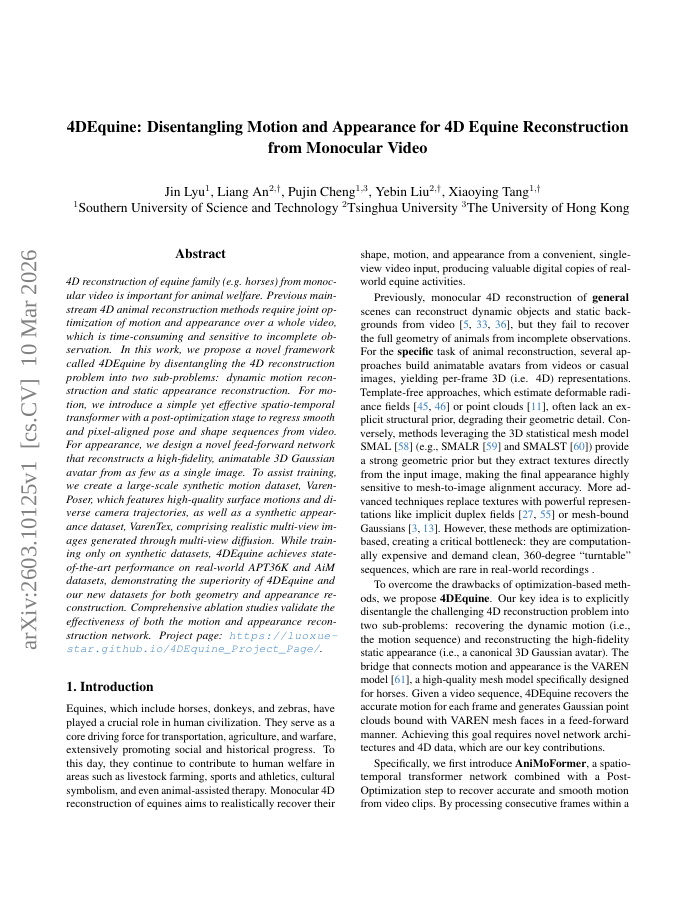
Yebin Liu, Xiaoying Tang, Jin Lyu · 10 Mar 2026
4D reconstruction of equine family (e.g.
10 Mar 2026
In the design of engineered components, rigorous vibration testing is essential for performance validation and identification of resonant frequencies and amplitudes encountered during operation.
Zachary W. Ulissi, Brandon M. Wood, Aditi S. Krishnapriyan · 6 Mar 2026
AllScAIP is an attention-based machine-learning interatomic potential model that scales efficiently to large systems through data-driven all-to-all node attention while maintaining energy conservation and achieving state-of-the-art accuracy in molecular dynamics simulations.
Harikrishnan Unnikrishnan · 2 Mar 2026
A detection-gated pipeline combining a localizer and segmenter achieves state-of-the-art glottal segmentation with robust cross-dataset generalization and real-time processing capabilities.
1 Mar 2026
As large language models (LLMs) increasingly assist scientific writing, the limitations and token costs of generating TeX become increasingly visible. This paper analyzes TeX's architectural mismatch with LLM workflows, stemming from its lack of an explicit structural…
1 Mar 2026
Shared co-creative workspaces allow users to contribute while agents execute. Yet how users adjust their participation as their work and the agent's execution shape one another remains less understood. We conducted two design probe studies with professional designers.
1 Mar 2026
Hard-negative source selection for dense retrieval is usually decided only after fine-tuning and downstream evaluation. We propose ECIsem, a validity-weighted diagnostic that ranks candidate hard-negative sources using frozen target-encoder embeddings.
1 Mar 2026
Sparse plus Low-Rank $(\mathbf{S} + \mathbf{LR})$ decomposition of Large Language Models (LLMs) has emerged as a promising direction in model compression, aiming to decompose pre-trained model weights into a sum of sparse and low-rank matrices $(\mathbf{W} \approx \mathbf{S} +…
1 Mar 2026
Reinforcement Learning with Verifiable Rewards ( RLVR ) has emerged as a transformative paradigm for enhancing the reasoning capabilities of Large Language Models ( LLMs), yet its potential in 3D scene understanding remains under-explored.
1 Mar 2026
Current Large Language Models have achieved Olympiad-level logic, yet Vision-Language Models paradoxically falter on elementary spatial tasks like block counting. This capability mismatch reveals a critical ``spatial intelligence gap,'' where models fail to construct coherent 3D…
1 Mar 2026
Drones are becoming popular as a complementary system for Emergency Medical Services (EMS). Although several pilot studies and flight trials have shown the feasibility of drone-assisted Automated External Defibrillator (AED) delivery, running a full-scale operational network…
1 Mar 2026
Autoregressive (AR) language models build representations incrementally via left-to-right prediction, while diffusion language models (dLLMs) are trained through full-sequence denoising.