1 Nov 2026
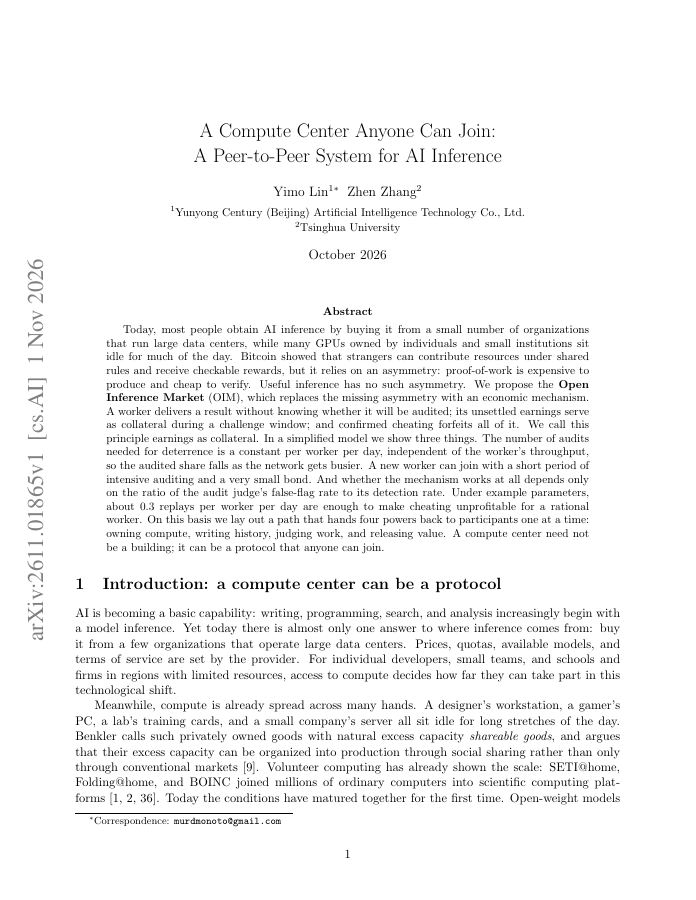
Today, most people obtain AI inference by buying it from a small number of organizations that run large data centers, while many GPUs owned by individuals and small institutions sit idle for much of the day.
Trending research and the full catalog - each paper linked to the benchmarks, methods, and models it introduces.
Filtering here covers the 2,000 most recent papers, as much as one page can hold in memory. See the full index of 23,103 papers.
1 Nov 2026
Today, most people obtain AI inference by buying it from a small number of organizations that run large data centers, while many GPUs owned by individuals and small institutions sit idle for much of the day.
1 Nov 2026
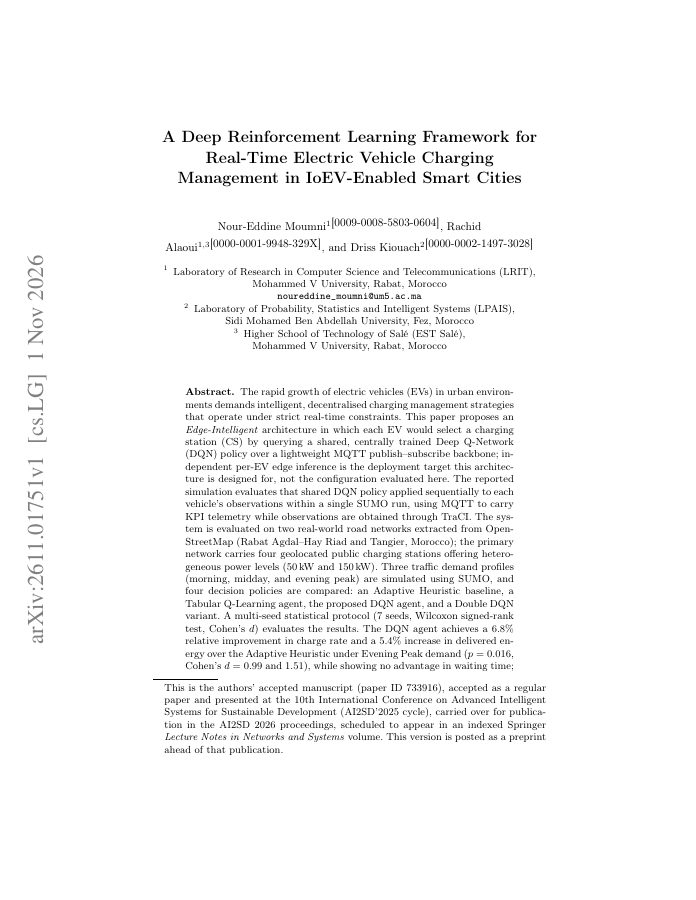
The rapid growth of electric vehicles (EVs) in urban environments demands intelligent, decentralised charging management strategies that operate under strict real-time constraints.
1 Nov 2026
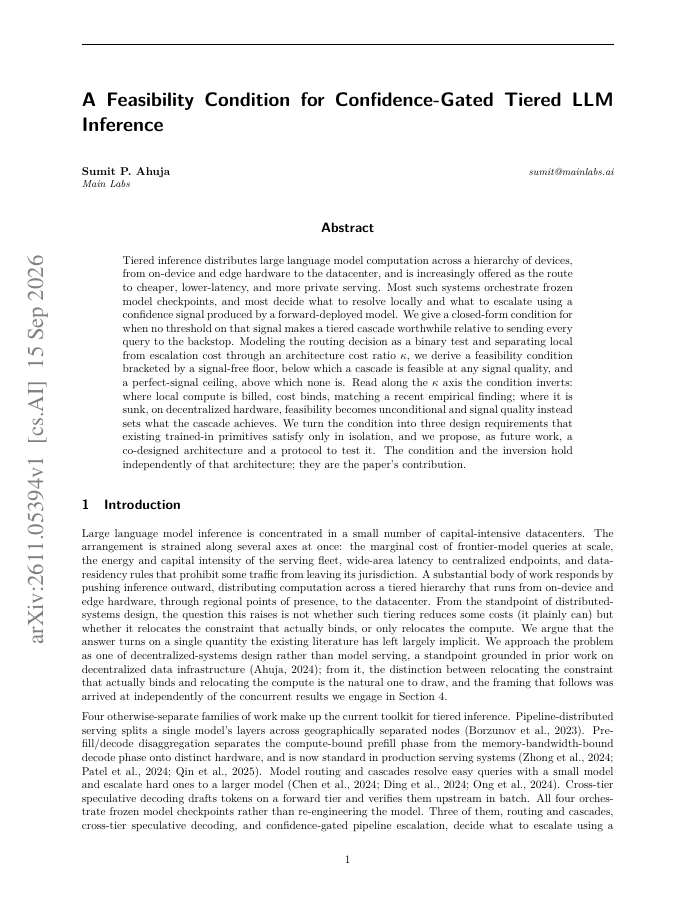
Tiered inference distributes large language model computation across a hierarchy of devices, from on-device and edge hardware to the datacenter, and is increasingly offered as the route to cheaper, lower-latency, and more private serving.
1 Nov 2026
In recent years, electric vehicles (EVs) have attracted much attention due to their potential to decarbonize the transport system. EV charging imposes challenges on power grids, such as load imbalance and voltage instability.
1 Nov 2026
Multivariate time series are ubiquitous in monitoring smart systems such as power plants, smart houses, and servers. These systems use multiple sensors to collect the system's status over time. Those sensors represent the status of the whole system as one entity.
1 Nov 2026
Large Language Models (LLMs) exhibit powerful code generation abilities, fostering agentic systems to automate edge AI application development. However, existing agents typically operate via fixed agentic workflows and predefined design spaces, struggling to handle rapidly…
1 Nov 2026
In nonconvex Burer--Monteiro low-rank matrix sensing of $U^\ast \in \mathbb{R}^{V \times D}$ under power-law covariance $Σ= \mathrm{diag}(j^{-s})_{j=1}^V$, the precision-wall approximation predicts that Adam stalls when the smallest non-gauge Hessian eigenvalue drops below its…
1 Nov 2026
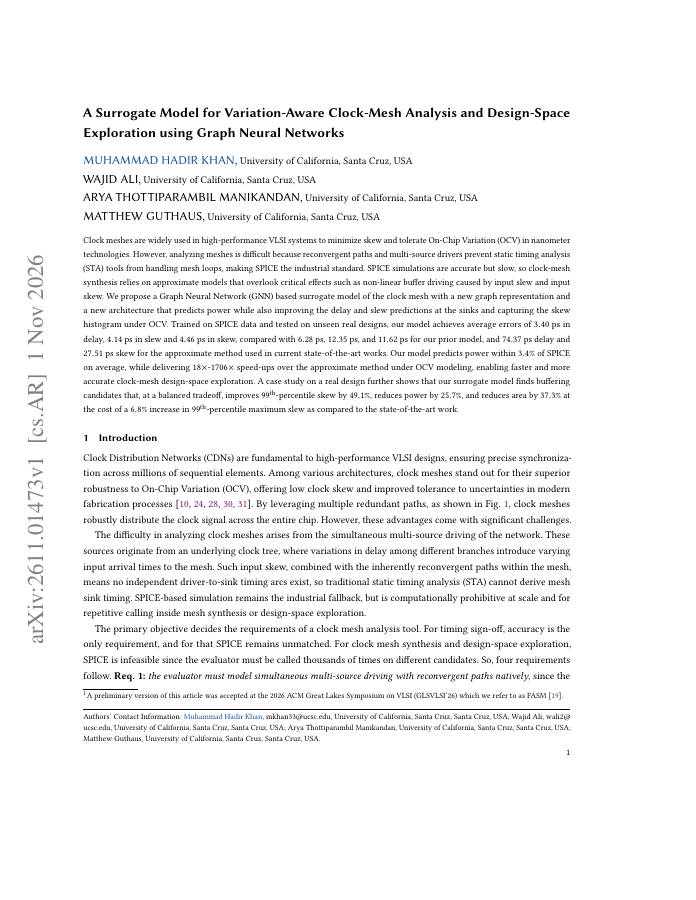
Clock meshes are widely used in high-performance VLSI systems to minimize skew and tolerate On-Chip Variation (OCV) in nanometer technologies. However, analyzing meshes is difficult because reconvergent paths and multi-source drivers prevent static timing analysis (STA) tools…
31 Oct 2026
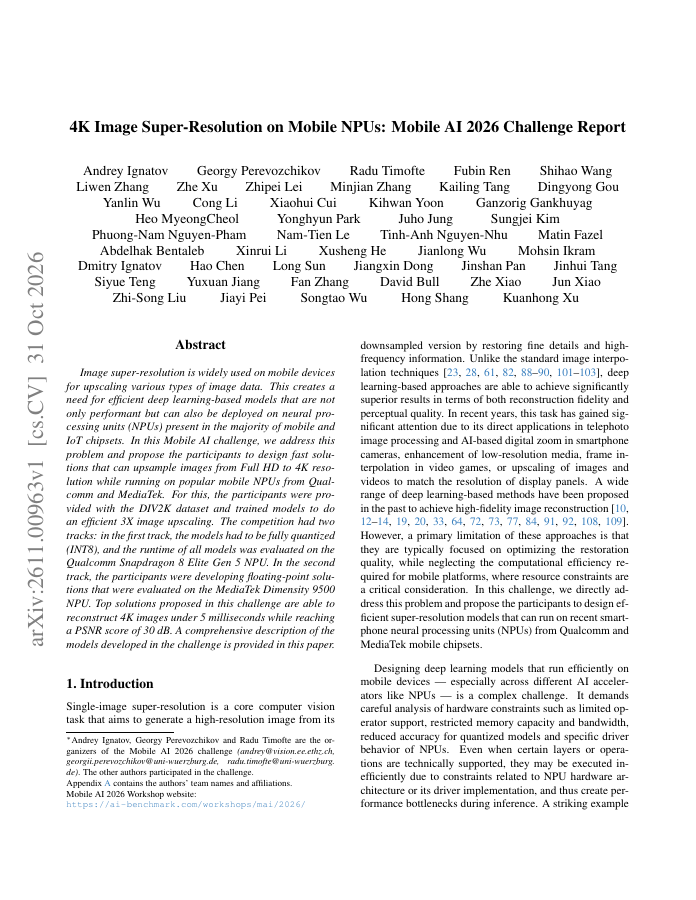
Image super-resolution is widely used on mobile devices for upscaling various types of image data. This creates a need for efficient deep learning-based models that are not only performant but can also be deployed on neural processing units (NPUs) present in the majority of…
31 Oct 2026
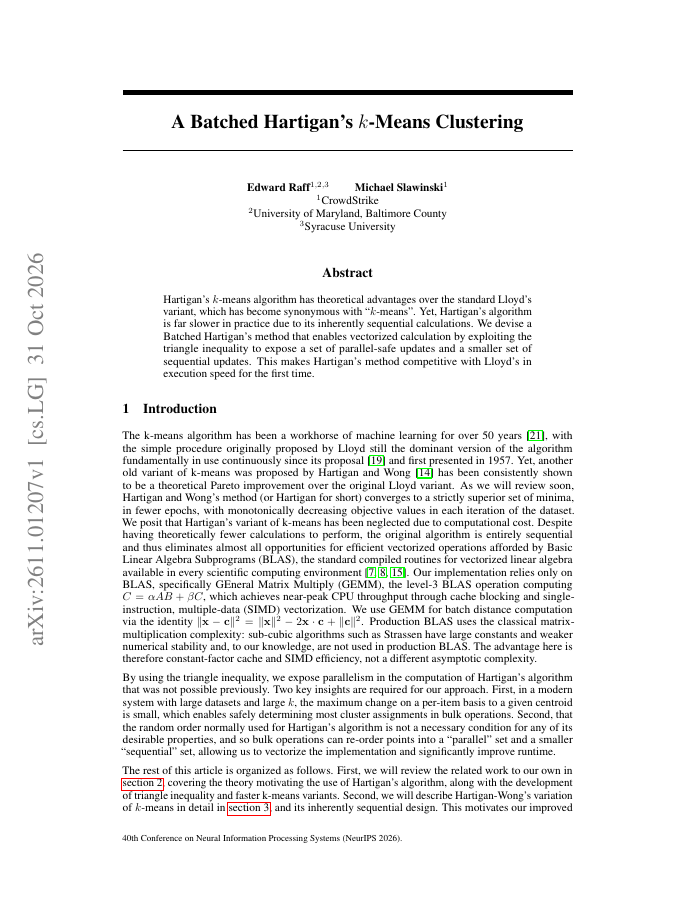
Hartigan's $k$-means algorithm has theoretical advantages over the standard Lloyd's variant, which has become synonymous with "$k$-means". Yet, Hartigan's algorithm is far slower in practice due to its inherently sequential calculations.
31 Oct 2026
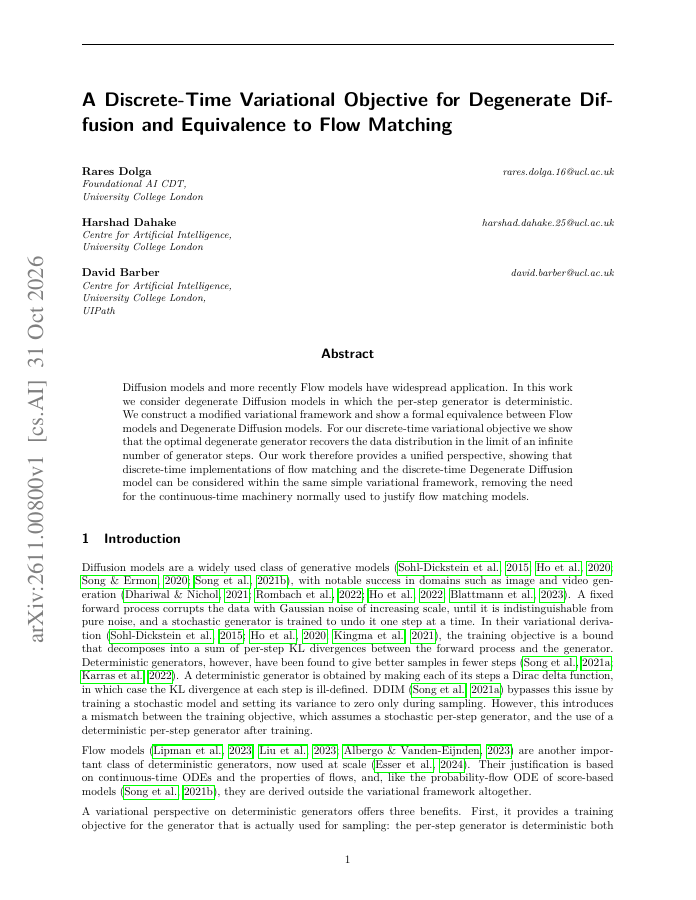
Diffusion models and more recently Flow models have widespread application. In this work we consider degenerate Diffusion models in which the per-step generator is deterministic.
31 Oct 2026
Early-exit language models decide for each token how much computation to spend, usually by stopping once the prediction is confident. Yet a token is not a fixed unit: tokenizers cut words into different numbers of pieces in different languages.
31 Oct 2026
Calling a tool through generated text adds decoding steps, even when the computation itself is short. We study an alternative: a small neural module that runs inside a language model's forward pass.
30 Oct 2026
Robot policy learning is dominated by zeroth-order methods such as PPO, which treat the simulator as a black box and pay for it with enormous sample counts. First-order policy learning differentiates through the dynamics, but on contact-rich whole-body control it has rarely…
30 Oct 2026
Distribution Matching Distillation (DMD) trains a few-step student using the difference between a teacher's score and an online critic's estimate of the student distribution's score.
30 Oct 2026
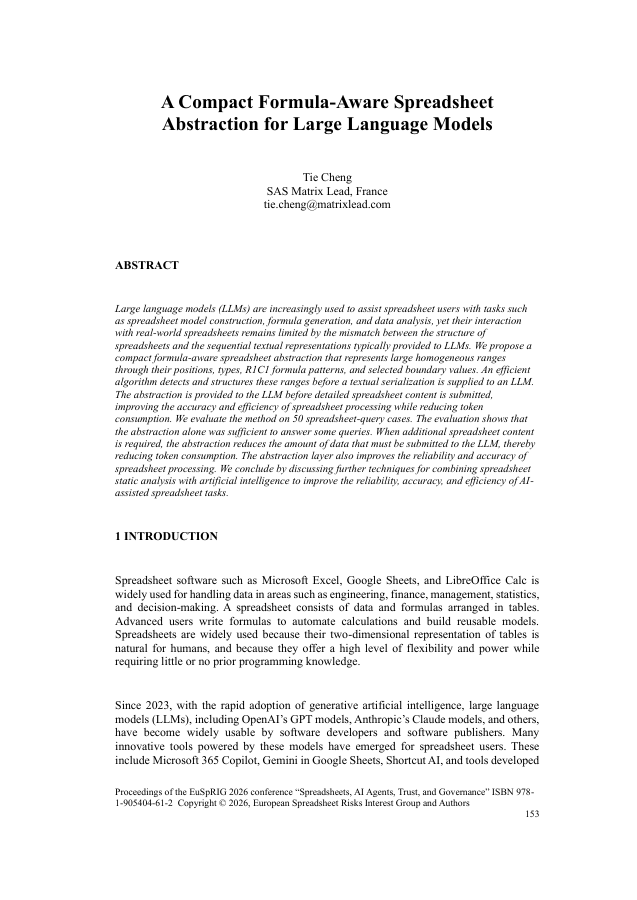
Large language models (LLMs) are increasingly used to assist spreadsheet users with tasks such as spreadsheet model construction, formula generation, and data analysis, yet their interaction with real-world spreadsheets remains limited by the mismatch between the structure of…
30 Oct 2026
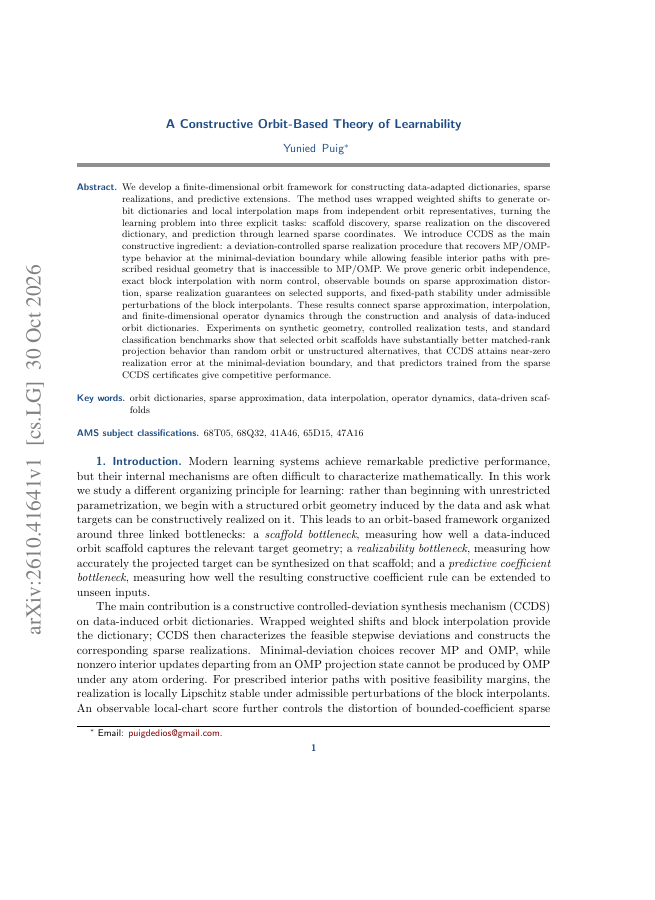
We develop a finite-dimensional orbit framework for constructing data-adapted dictionaries, sparse realizations, and predictive extensions. The method uses wrapped weighted shifts to generate orbit dictionaries and local interpolation maps from independent orbit representatives,…
30 Oct 2026
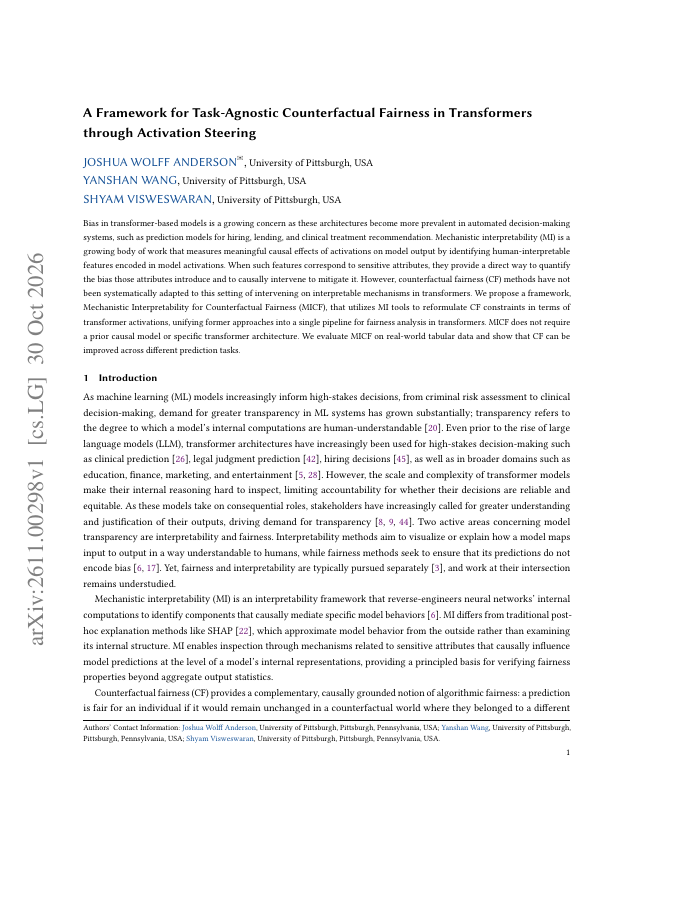
Bias in transformer-based models is a growing concern as these architectures become more prevalent in automated decision-making systems, such as prediction models for hiring, lending, and clinical treatment recommendation.
30 Oct 2026
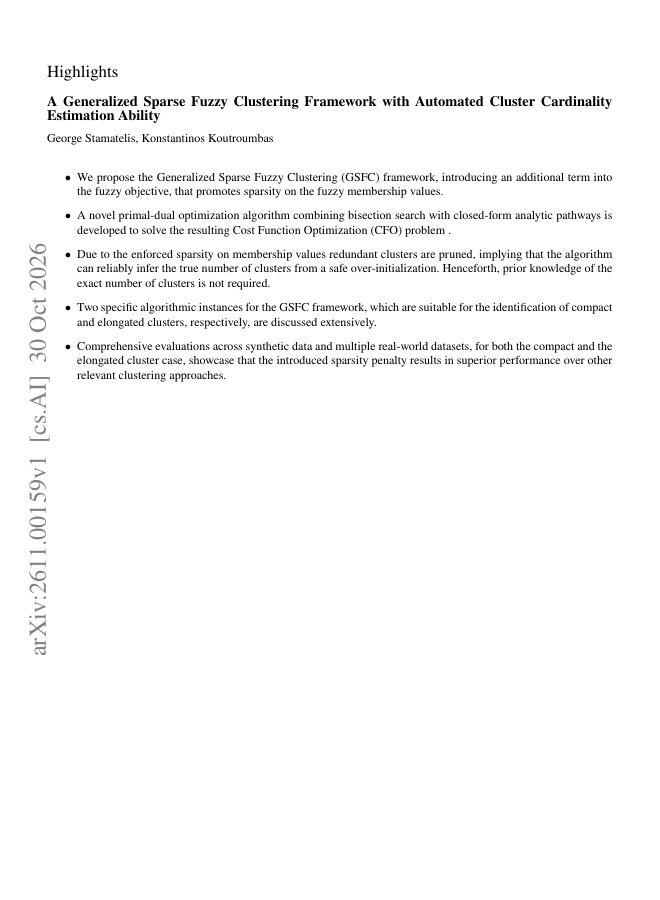
Fuzzy clustering provides a robust framework for handling ambiguous and overlapping data boundaries, yet its traditional formulation generates entirely dense membership assignments that limit noise resilience and prevent estimating the true number of clusters, when it is…
30 Oct 2026
Spline representations provide a compact way to approximate continuous trajectories using a finite number of parameters. When approximating trajectories generated by dynamical systems, the efficiency of a spline representation depends strongly on the placement of knot points.
30 Oct 2026
Why does length generalization (LG) depend so sharply on the positional encoding (PE)? Relative schemes extrapolate fixed offsets, absolute schemes fix positions, and neither handles growing offsets.
30 Oct 2026
We study how the layers in deep neural networks (NNs) converge, using Wilsonian Renormalization-Group (RG) ideas to organize the spectral picture. During training, these layers often develop heavy-tailed power-law (PL) spectra, and the strongest checkpoints often appear near the…
29 Oct 2026
Coding agents increasingly rely on automated approvers to decide whether a proposed shell command may run. Existing approvers, from rule-based checkers to guardrail models and deployed permission classifiers, base their decisions on the text of the request and command.
29 Oct 2026
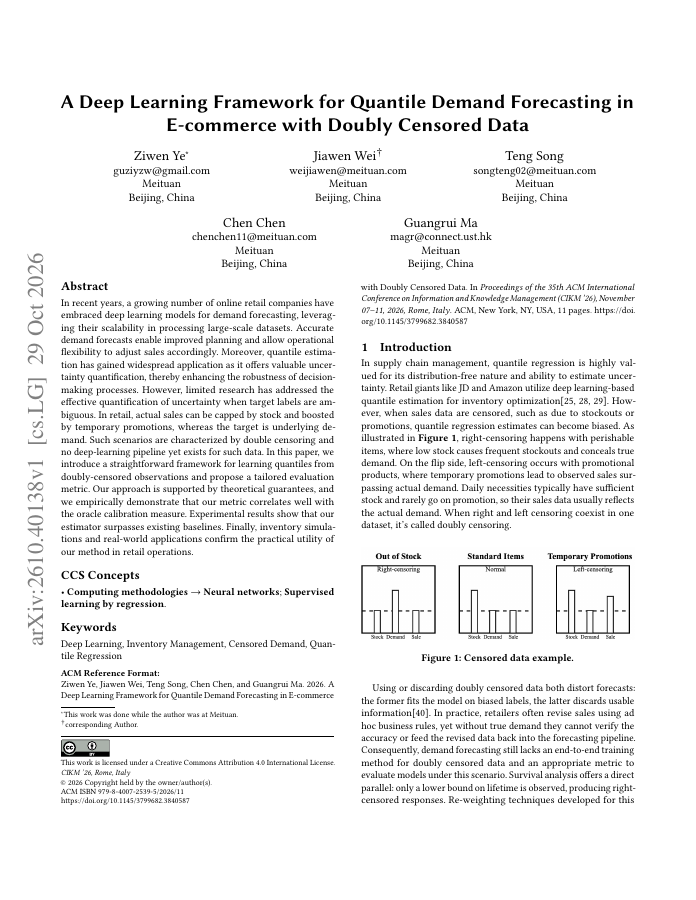
In recent years, a growing number of online retail companies have embraced deep learning models for demand forecasting, leveraging their scalability in processing large-scale datasets.