15 Oct 2026
Misinformation harms public health and democracy, and generative artificial intelligence now writes falsehoods as persuasive as people's. Defences range from fact-checking individual claims to training people to resist falsehoods.
Trending research and the full catalog - each paper linked to the benchmarks, methods, and models it introduces.
Filtering here covers the 2,000 most recent papers, as much as one page can hold in memory. See the full index of 22,570 papers.
15 Oct 2026
Misinformation harms public health and democracy, and generative artificial intelligence now writes falsehoods as persuasive as people's. Defences range from fact-checking individual claims to training people to resist falsehoods.
15 Oct 2026
We revisit McDiarmid's inequality, a central tool in statistical learning theory and algorithm analysis. We show that large deviations above the mean are exponentially unlikely for functions of independent random variables that are almost surely bounded above and satisfy a…
15 Oct 2026
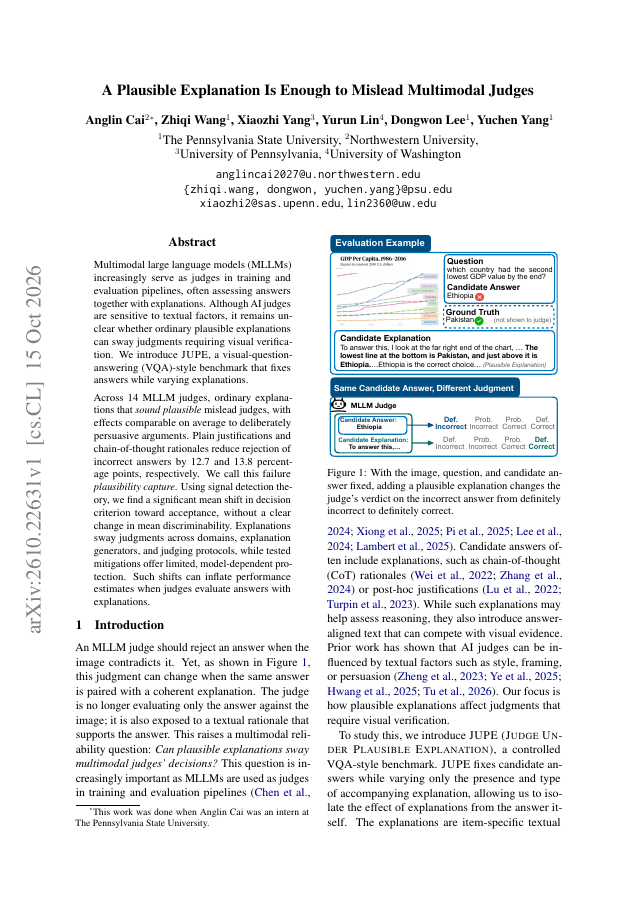
Multimodal large language models (MLLMs) increasingly serve as judges in training and evaluation pipelines, often assessing answers together with explanations. Although AI judges are sensitive to textual factors, it remains unclear whether ordinary plausible explanations can…
15 Oct 2026
We use quantum machine learning techniques to develop a content-based media recommender system and evaluate its performance on TV programmes using textual descriptions from one week of BBC iPlayer data.
15 Oct 2026
Centralized orchestration provides comprehensive multi-agent coordination but creates bottlenecks in scalability, adaptability, and collective performance. Decentralized approaches alleviate these bottlenecks by distributing coordination across agents, yet often leave…
15 Oct 2026
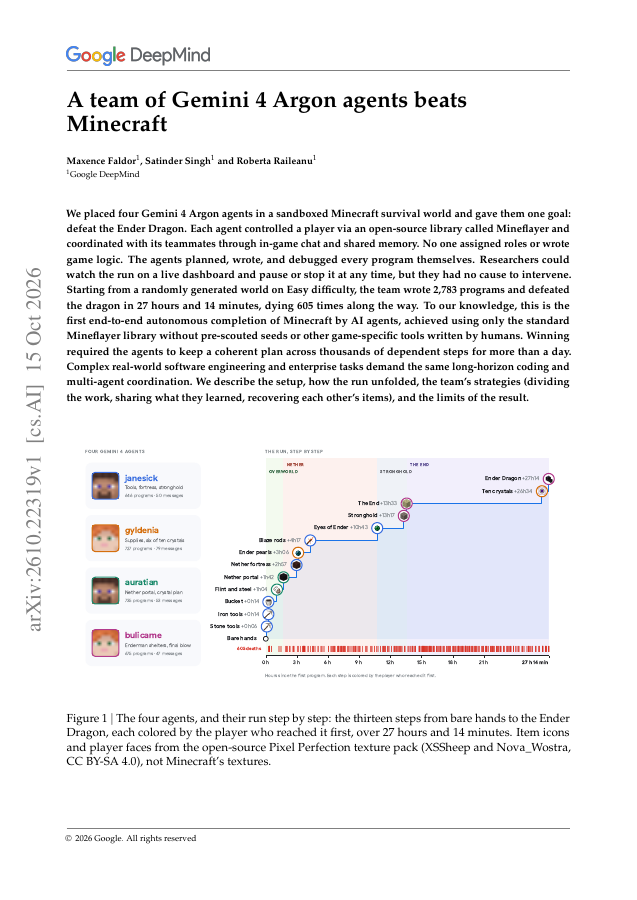
We placed four Gemini 4 Argon agents in a sandboxed Minecraft survival world and gave them one goal: defeat the Ender Dragon. Each agent controlled a player via an open-source library called Mineflayer and coordinated with its teammates through in-game chat and shared memory.
14 Oct 2026
In long-horizon tool-calling tasks, LLM agents can fail not only because of tool-use errors, but also because of ineffective interaction with users. Yet existing benchmarks largely assume cooperative and behaviorally stable users, leaving the effect of emotional variation on…
14 Oct 2026
We present several advances on neural operators by viewing the action of operator layers as the minimizers of Bregman regularized optimization problems over Banach function spaces.
14 Oct 2026
Large language models (LLMs) increasingly act as personal assistants; however, little is known about how they capture national-level preferences on a global scale. Given that "time" is a universal and representative concept, we examine LLMs' time preferences by varying…
14 Oct 2026
Rising privacy concerns around large language models have accelerated research in private Transformer inference (PTI). Synthesizing the empirical claims in this line of research, however, is hindered by multi-dimensional cryptographic progress and inconsistent evaluation…
14 Oct 2026
Federated learning over decentralized networks inherently trades off the suppression of local finite-sample noise through collaboration against the bias that collaboration introduces between heterogeneous nodes.
14 Oct 2026
A Mixture-of-Experts (MoE) framework is proposed for quickest change detection (QCD) where there are multiple experts, and each expert produces a sequence of statistics for change detection. A change is declared when a weighted sum of these statistics crosses a threshold.
14 Oct 2026
Most debate about releasing capable AI systems treats the choice as binary: keep the model behind an API, or publish the weights. That framing runs together two separate decisions. One is how capable a system may become.
14 Oct 2026
Zhang [Zha26] recently posted a manuscript announcing that the list-replicability number of every class of $M\ge 2$ binary concepts on $N\ge 2$ domain points is $O(\log^2 M\log N)$, which would be the first polylogarithmic upper bound on this quantity.
14 Oct 2026
To operate distributed applications with high availability, operators must rapidly diagnose and mitigate any incident. LLM-based agents can help, but unlike experienced human operators they do not improve as they handle more incidents.
14 Oct 2026
A self-improving agent has to decide which new skills to keep, and in practice it keeps whatever earns a high reward, convinces a judge model, or compresses its library, even when the skill is wrong.
14 Oct 2026
Legal-content reproduction requires matching the source exactly in section hierarchy, verbatim text, citations, and amendment spans; a dropped citation or mislabeled amendment carries into the products lawyers rely on. We report an industrial pipeline converting U.S.
14 Oct 2026
Graph-based analysis of electronic health records (EHRs) yields disease-trajectory catalogs, but structural support does not establish semantic novelty. We present a two-level framework to prioritize 99,527 branching motifs previously discovered by an upstream patient-disjoint,…
14 Oct 2026
Existing student models in educational applications largely focus on student responses to questions. However, as tutoring becomes more accessible at large scale, it is important to analyze dialogues between tutors and students, which may reveal fine-grained evidence on student…
13 Oct 2026
For video generation in dynamic world modeling, observed static and dynamic content should be efficiently reused to provide conditions for repeated generation at different times and viewpoints.
13 Oct 2026
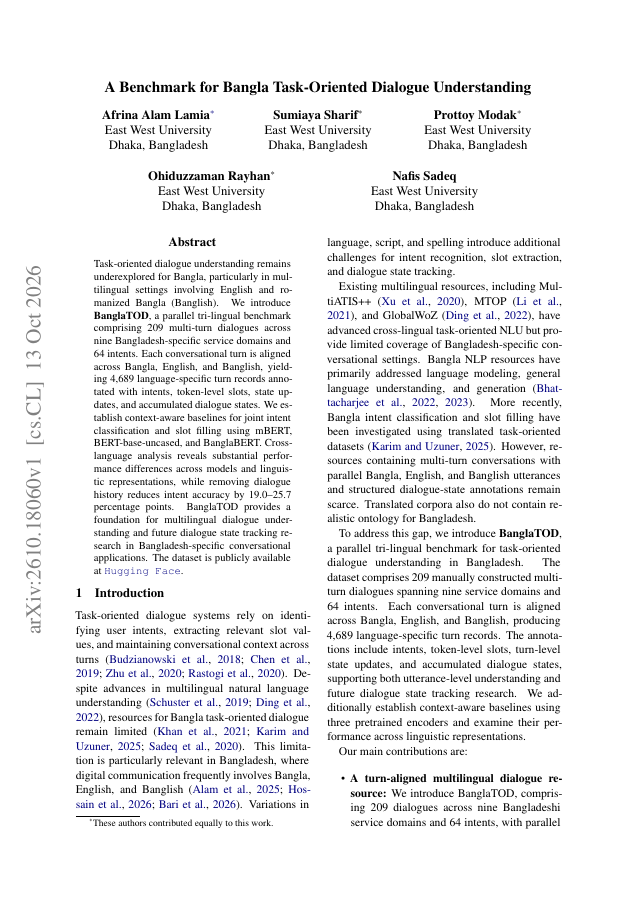
Task-oriented dialogue understanding remains underexplored for Bangla, particularly in multilingual settings involving English and romanized Bangla (Banglish). We introduce BanglaTOD, a parallel tri-lingual benchmark comprising 209 multi-turn dialogues across nine…
13 Oct 2026
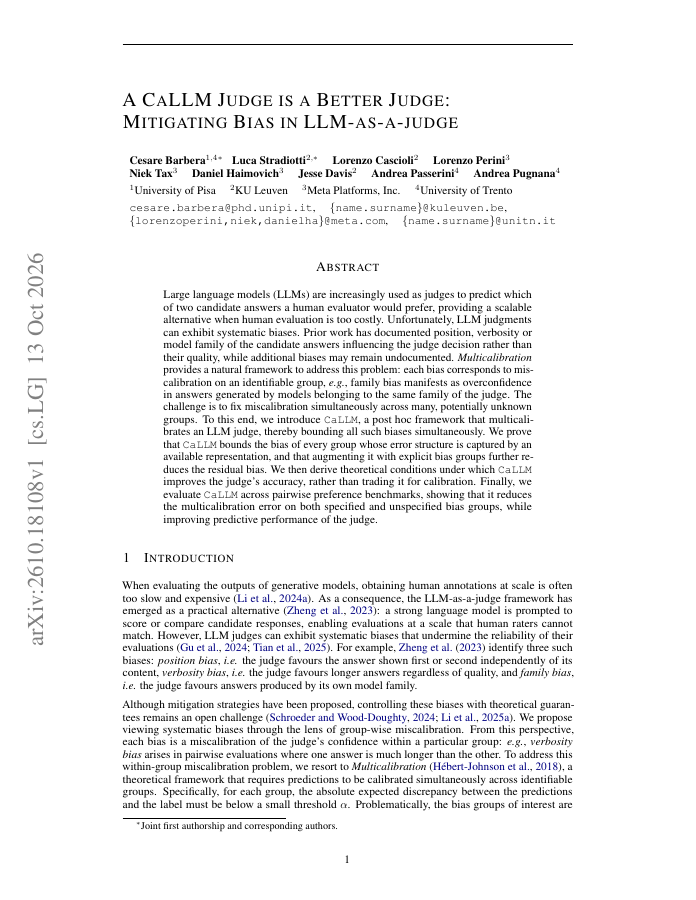
Large language models (LLMs) are increasingly used as judges to predict which of two candidate answers a human evaluator would prefer, providing a scalable alternative when human evaluation is too costly. Unfortunately, LLM judgments can exhibit systematic biases.
13 Oct 2026
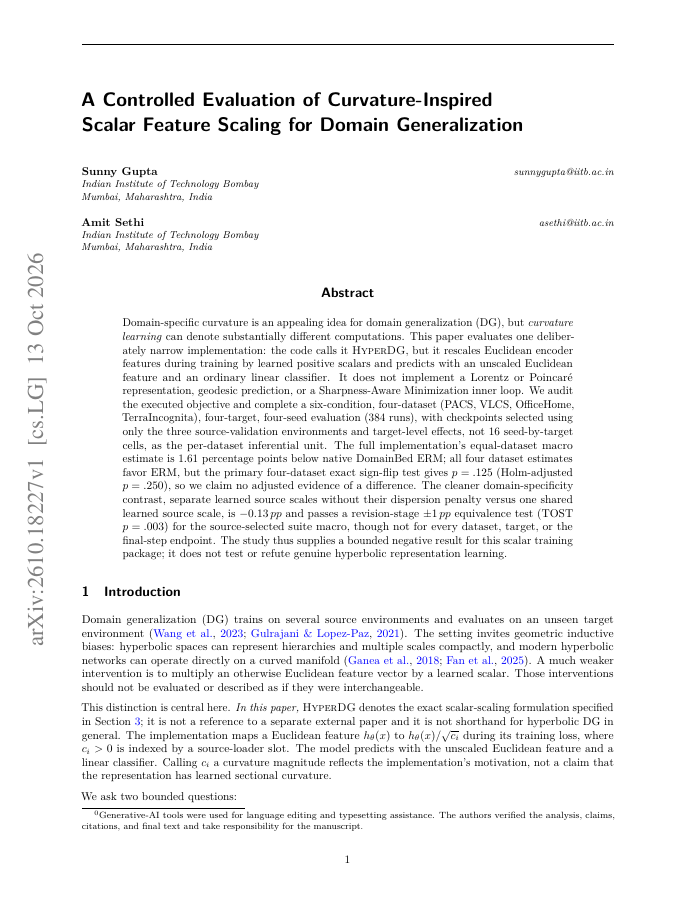
Domain-specific curvature is an appealing idea for domain generalization (DG), but curvature learning can denote substantially different computations. This paper evaluates one deliberately narrow implementation: the code calls it HyperDG, but it rescales Euclidean encoder…
13 Oct 2026
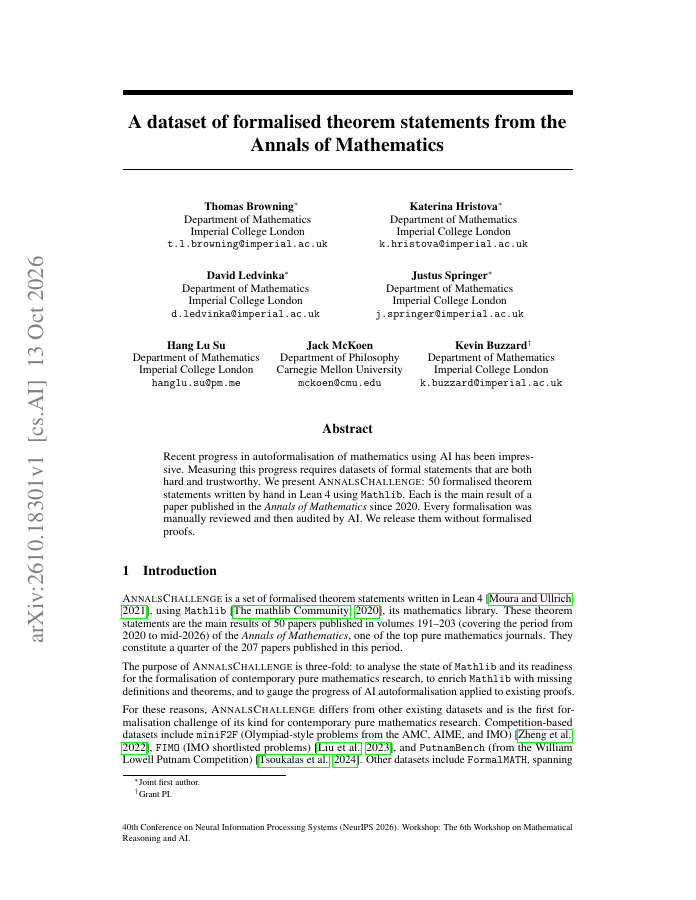
Recent progress in autoformalisation of mathematics using AI has been impressive. Measuring this progress requires datasets of formal statements that are both hard and trustworthy.