5 Jul 2026
Natural language requirements (NLRs) are essential for bridging communication gaps among diverse stakeholders in software development. However, the inherent ambiguity in NLRs can pose significant challenges.
Trending research and the full catalog - each paper linked to the benchmarks, methods, and models it introduces.
Filtering here covers the 2,000 most recent papers, as much as one page can hold in memory. See the full index of 22,570 papers.
5 Jul 2026
Natural language requirements (NLRs) are essential for bridging communication gaps among diverse stakeholders in software development. However, the inherent ambiguity in NLRs can pose significant challenges.
5 Jul 2026
In-context learning (ICL) has emerged as a central capability of pretrained language models, yet its theoretical analysis has focused primarily on causal language models trained by left-to-right autoregressive prediction, such as GPT-style models.
4 Jul 2026
We release a benchmark and failure-mode-aware evaluation framework for grounded QA under coordinated retrieval poisoning. The framework partitions reader outputs into four mutually exclusive categories (\emph{gold}, \emph{hijack}, \emph{abstention}, \emph{drift}), with…
4 Jul 2026
Relational databases (RDBs) are the primary data infrastructure in many enterprises, yet recent deep learning methods designed for RDBs have been evaluated under inconsistent experimental protocols, making fair comparison difficult.
4 Jul 2026
Minimum maximum mean discrepancy (MMD) estimation has emerged as a robust and likelihood-free alternative to maximum likelihood estimation for parameter estimation. Yet, despite its practical success, the associated optimization problem remains poorly understood, with…
4 Jul 2026
Modern supply chains span diverse operational environments, ranging from e-commerce distribution networks to customized production-to-order manufacturing lines. Across these settings, operational efficiency depends on coordinating two highly interdependent stages: order…
4 Jul 2026
For compact convex sets $L,K \subset \mathbb{R}^n$, denote by $λ_K(L)$ the smallest size of a homothet of $K$ that contains $L$. We define a measure of symmetry based on the $n$-simplex $Δ= Δ^n \subset \mathbb{R}^n$ as the ratio \[ ρ_Δ(L):=\frac{λ_{-Δ}(L)}{λ_Δ(L)}.
4 Jul 2026
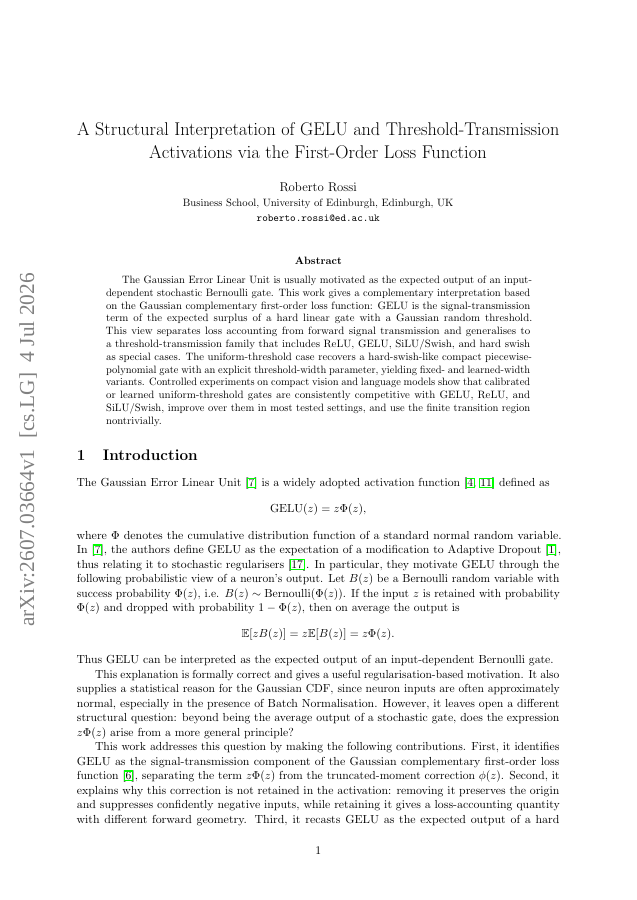
The Gaussian Error Linear Unit is usually motivated as the expected output of an input-dependent Bernoulli gate. This work gives an alternative interpretation: GELU is the expected output of a hard linear gate with a Gaussian random threshold.
4 Jul 2026
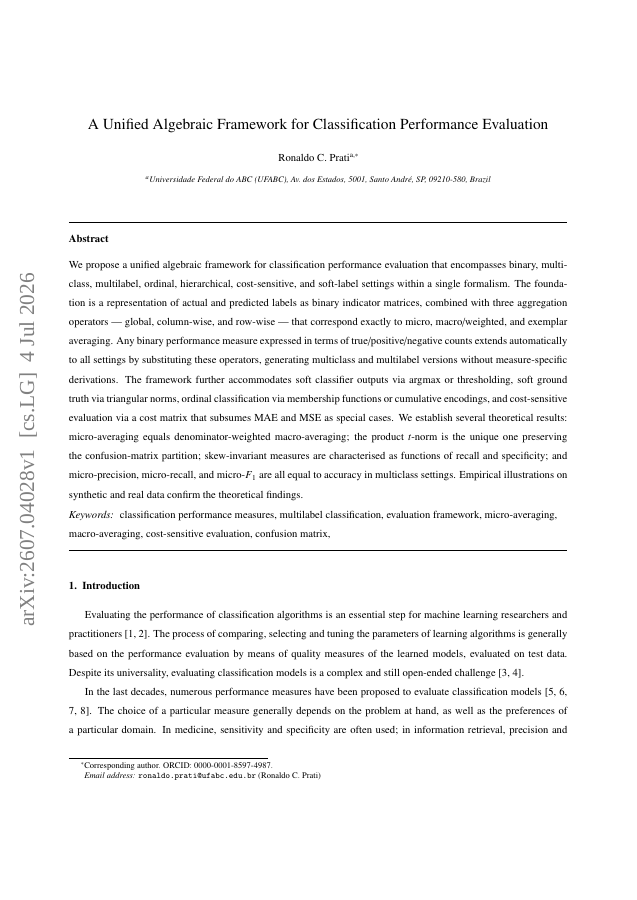
We propose a unified algebraic framework for classification performance evaluation covering binary, multiclass, multilabel, ordinal, hierarchical, cost-sensitive, and soft-label settings.
4 Jul 2026
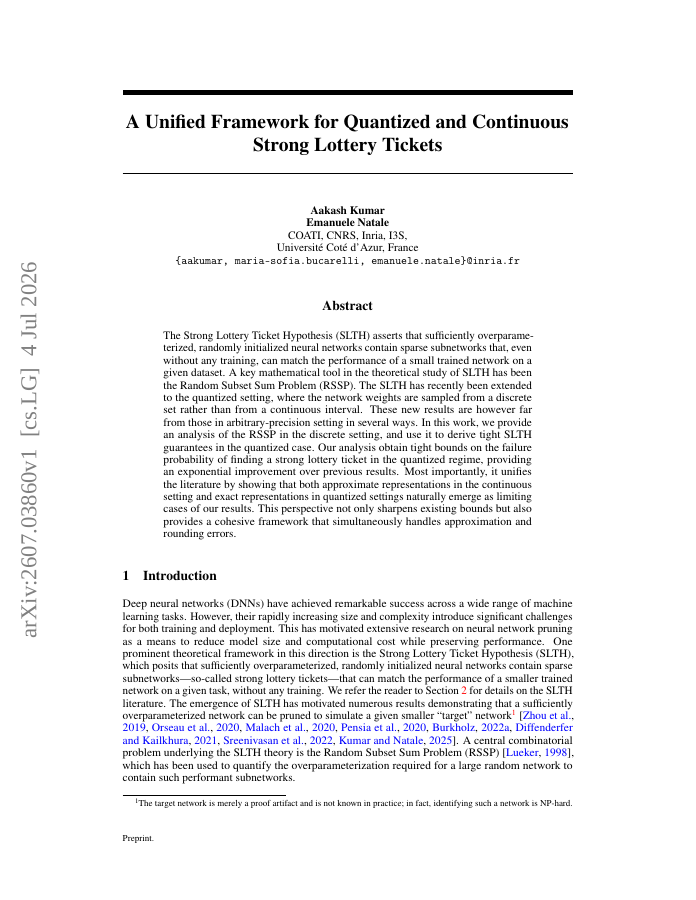
The Strong Lottery Ticket Hypothesis (SLTH) asserts that sufficiently overparameterized, randomly initialized neural networks contain sparse subnetworks that, even without any training, can match the performance of a small trained network on a given dataset.
3 Jul 2026
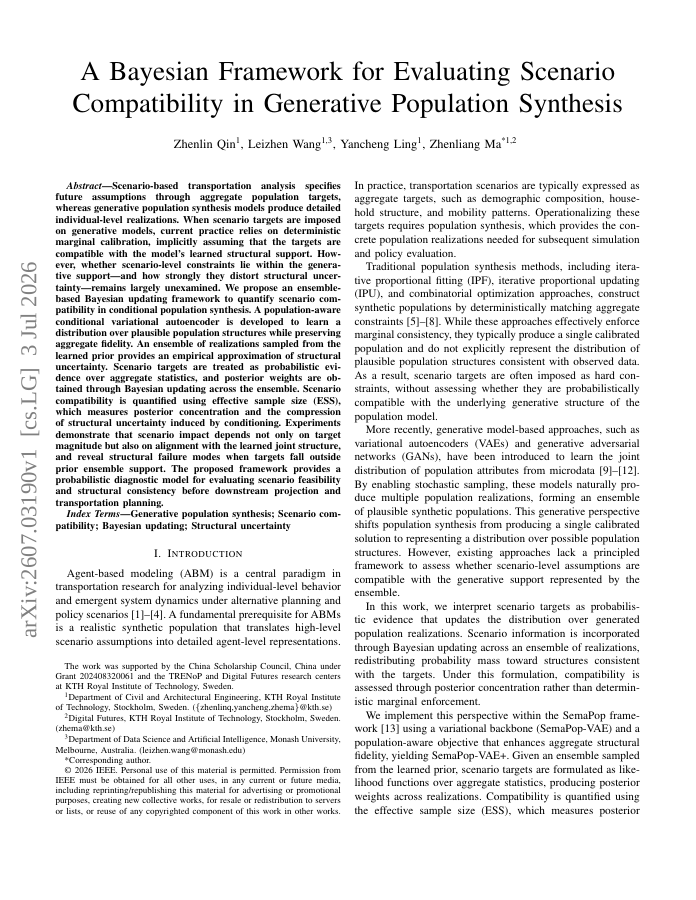
Scenario-based transportation analysis specifies future assumptions through aggregate population targets, whereas generative population synthesis models produce detailed individual-level realizations.
3 Jul 2026
Foundation models for Earth systems have so far been trained primarily on physical climate and weather data, with limited representation of the human systems that both drive and respond to environmental change.
3 Jul 2026
Policy learning has received substantial attention with the goal of learning policies from observational data for decision-making. A majority of work in this space has focused on developing algorithms for computing policies that minimize regret compared to the optimal policy.
3 Jul 2026
Modern video surveillance systems generate far more video streams than human operators can effectively monitor, making automated analysis essential for timely detection of security events.
3 Jul 2026
Graph-based semi-supervised learning (SSL) propagates a few labels over a similarity graph by minimizing a Dirichlet-type energy. The standard quadratic ($p=2$) energy reduces to a single graph-Laplacian solve, but it degenerates exactly where SSL is most useful when labels are…
3 Jul 2026
We propose PRECEDE, a precedent-guided co-scientist for side-effect-aware drug redesign that revises a parent compound to mitigate a specified side effect while preserving therapeutic function.
3 Jul 2026
Multi-product kitting delivery imposes significant challenges for real-time scheduling in hybrid manufacturing systems that integrate processing and assembly, as dynamic order arrivals simultaneously alter supply dependencies and the set of feasible job-machine assignments.
3 Jul 2026
Adversarial robustness in Unsupervised Domain Adaptation (UDA) remains a significant challenge due to noisy pseudo labels and inherent distributional shifts between the clean source and adversarially perturbed target domains.
3 Jul 2026
Least privilege, the principle that an identity should hold only the permissions strictly required for its task, has been a foundational primitive of access control for decades.
3 Jul 2026
Large Language Model (LLM) serving has become a critical cloud workload, and realistic traces are essential for motivating and benchmarking serving systems. However, existing LLM serving workload studies remain limited in scale and scope.
2 Jul 2026
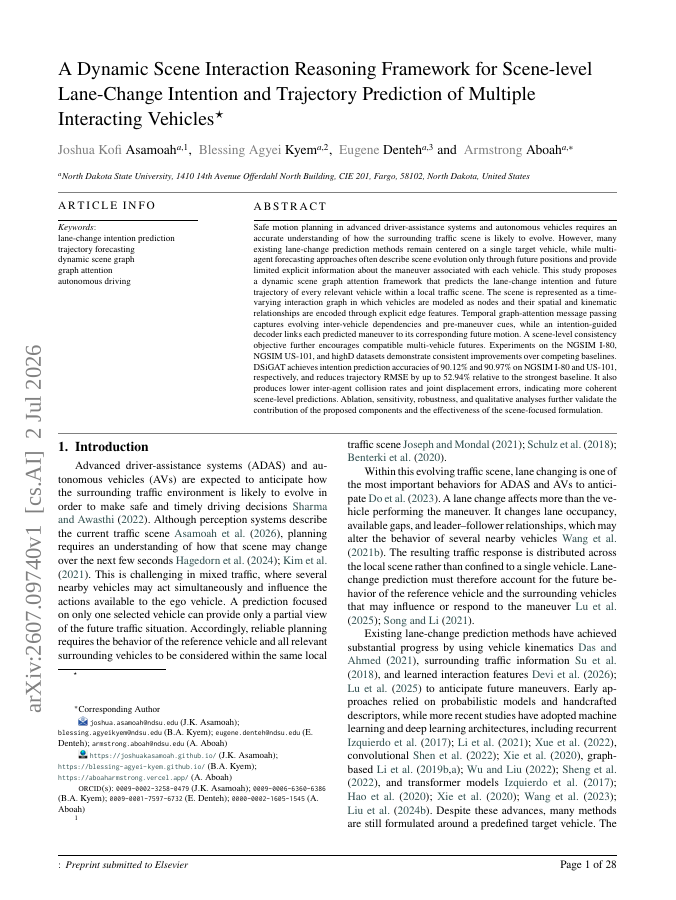
Safe motion planning in advanced driver-assistance systems and autonomous vehicles requires an accurate understanding of how the surrounding traffic scene is likely to evolve.
2 Jul 2026
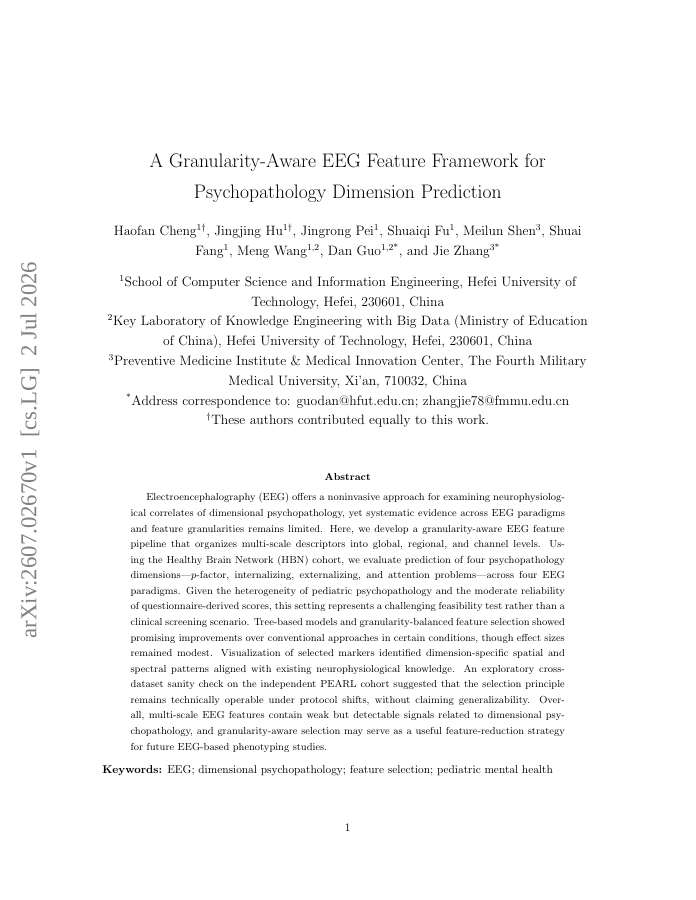
Electroencephalography (EEG) offers a noninvasive approach for examining neurophysiological correlates of dimensional psychopathology, yet systematic evidence across EEG paradigms and feature granularities remains limited.
2 Jul 2026
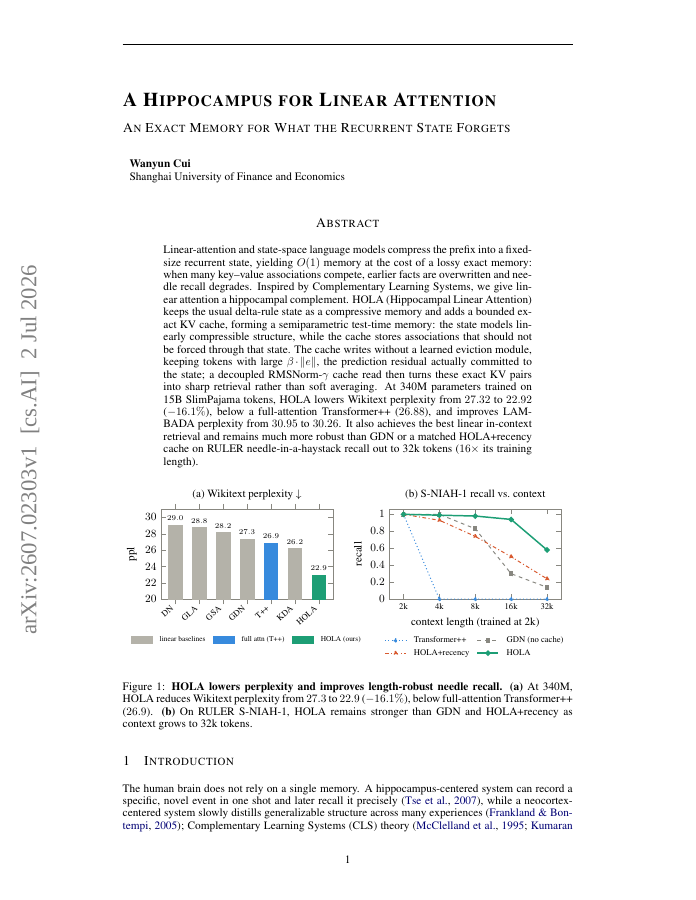
Linear-attention and state-space language models compress the prefix into a fixed-size recurrent state, yielding O(1) memory at the cost of a lossy exact memory: when many key--value associations compete, earlier facts are overwritten and needle recall degrades.
2 Jul 2026
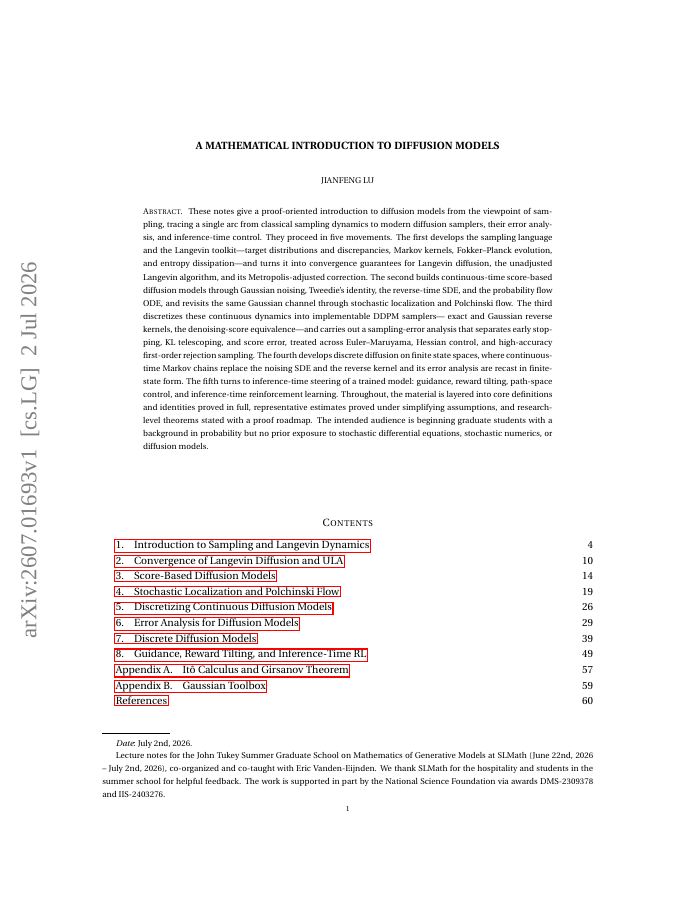
These notes give a proof-oriented introduction to diffusion models from the viewpoint of sampling, tracing a single arc from classical sampling dynamics to modern diffusion samplers, their error analysis, and inference-time control.