29 May 2026
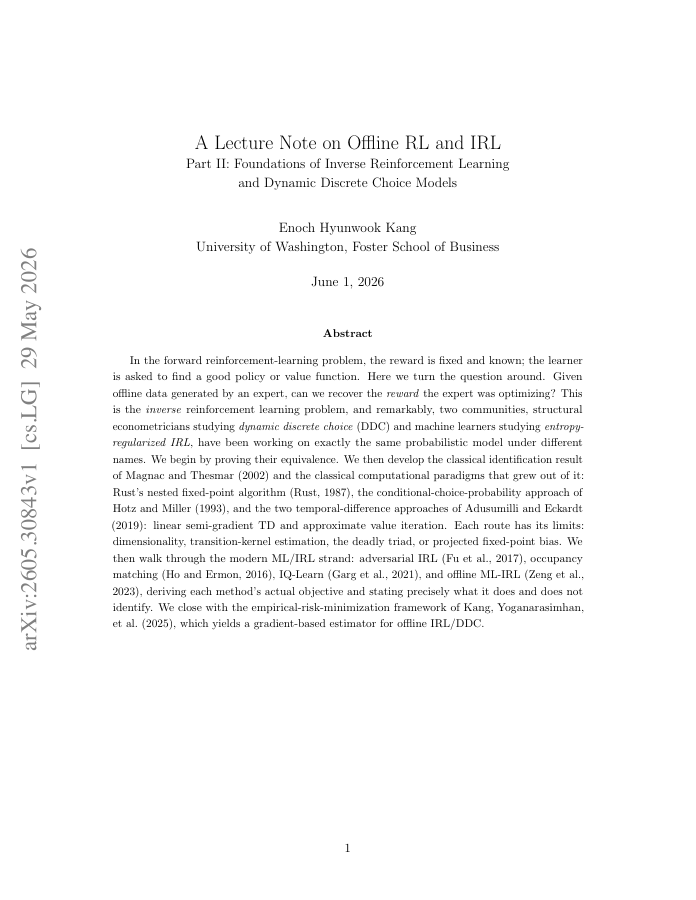
In the forward reinforcement-learning problem, the reward is fixed and known; the learner is asked to find a good policy or value function. Here we turn the question around.
Trending research and the full catalog - each paper linked to the benchmarks, methods, and models it introduces.
Filtering here covers the 2,000 most recent papers, as much as one page can hold in memory. See the full index of 22,617 papers.
29 May 2026
In the forward reinforcement-learning problem, the reward is fixed and known; the learner is asked to find a good policy or value function. Here we turn the question around.

29 May 2026
Current alignment paradigms for generative artificial intelligence rely predominantly on monolithic benchmarking frameworks that reduce the plurality of human judgment to aggregated statistical baselines, thereby obscuring cultural, demographic, and contextual variability in…
29 May 2026
Understanding the human brain requires access to its microscopic tissue architecture. Diffusion magnetic resonance imaging (MRI) provides the only noninvasive window into whole-brain microstructure in vivo, yet reliable quantitative mapping remains confined to specialized…
29 May 2026
Blind and low-vision (BLV) audiences remain underserved by visual art descriptions, particularly across languages and in museum settings where privacy and intellectual-property constraints may favour small on-premise vision-language models (VLMs).
29 May 2026
Grokking, the phenomenon in which neural networks generalize long after fitting their training data, has been studied in supervised settings on many epochs. LLM pre-training instead involves next-token prediction over an unlabeled corpus, with limited data repetition and no…
29 May 2026
Modern network intrusion detection systems (NIDS) are caught in a structural contradiction: the protocols carrying the highest threat intelligence are precisely those encrypted under TLS 1.3 and QUIC, where payload inspection yields nothing.
29 May 2026
Retrieval-Augmented Generation (RAG) systems are often evaluated using final answer accuracy, even though their failures can originate from preprocessing, retrieval, context packing, or generation.
29 May 2026
Communication costs are a major bottleneck in distributed learning and first-order optimization. A common approach to alleviate this issue is to compress the gradient information exchanged between agents.
29 May 2026
We propose a topological framework for comparing trained Graph Neural Networks (GNNs) by mapping the Stochastic Block Models (SBMs) induced on the graphon-signal space of a Message Passing Neural Network (MPNN) onto the unit $n$-sphere $\sphere^{n-1}\subset\R^n$.
29 May 2026
Speech foundation models and Speech LLMs have advanced speech understanding, yet deployment-oriented model selection is hindered by non-comparable evaluations caused by mismatched post-processing, and by training results that are hard to reproduce across data scales and…
29 May 2026
Anchored fixed point and monotone equation methods, including Halpern iteration, extra anchored gradient, and their relatives, add a vanishing pull toward a reference point to obtain last-iterate guarantees.
29 May 2026
Many modern generative models can be viewed as minimizing divergences between probability distributions, yet they rely on different algorithmic and geometric principles.
28 May 2026
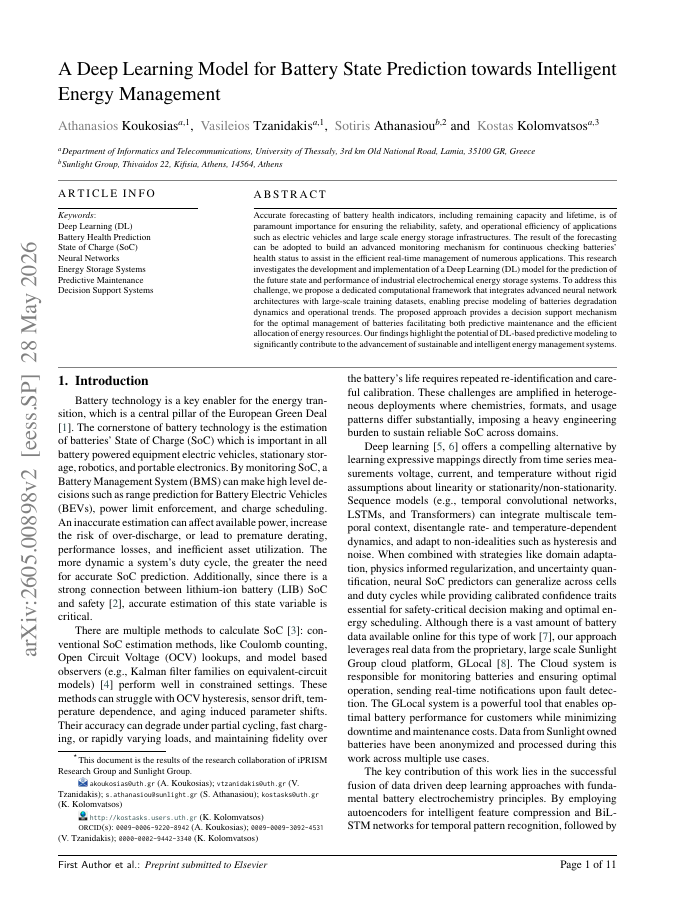
Accurate forecasting of battery health indicators, including remaining capacity and lifetime, is of paramount importance for ensuring the reliability, safety, and operational efficiency of applications such as electric vehicles and large scale energy storage infrastructures.
28 May 2026
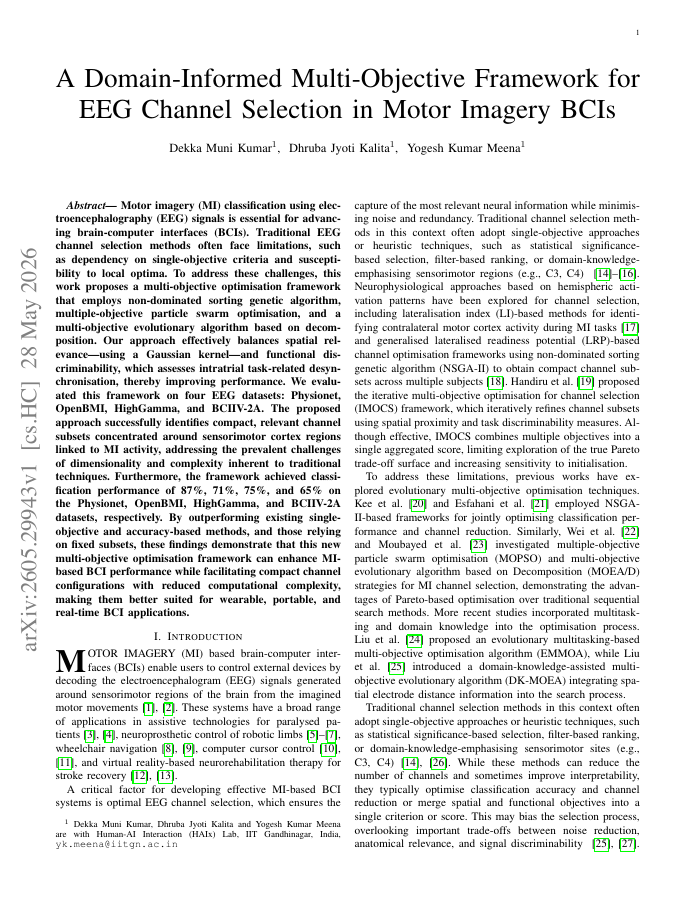
Motor imagery (MI) classification using electroencephalography (EEG) signals is essential for advancing brain-computer interfaces (BCIs). Traditional EEG channel selection methods often face limitations, such as dependency on single-objective criteria and susceptibility to local…
28 May 2026
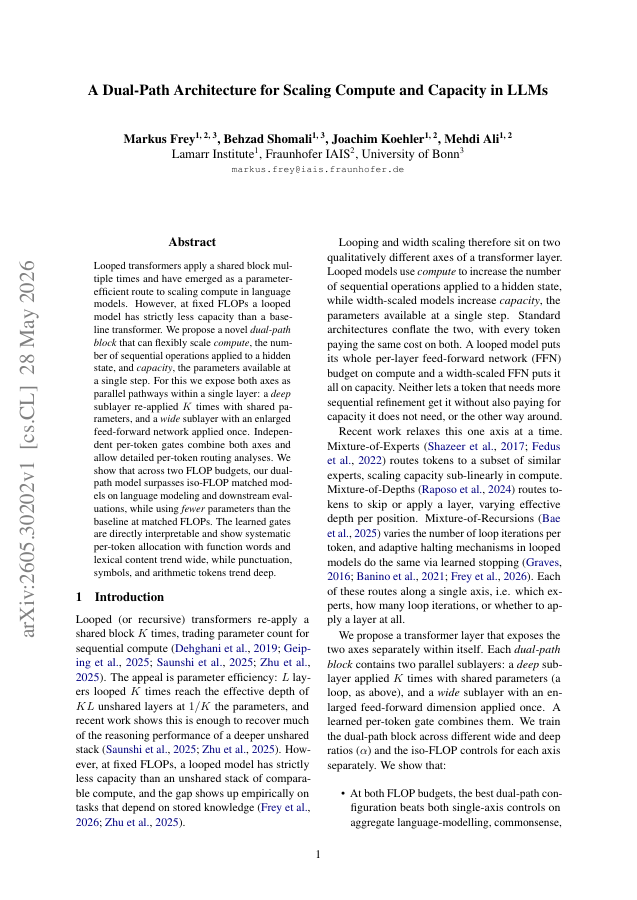
Looped transformers apply a shared block multiple times and have emerged as a parameter-efficient route to scaling compute in language models. However, at fixed FLOPs a looped model has strictly less capacity than a baseline transformer.
Yin Jun Phua · 28 May 2026
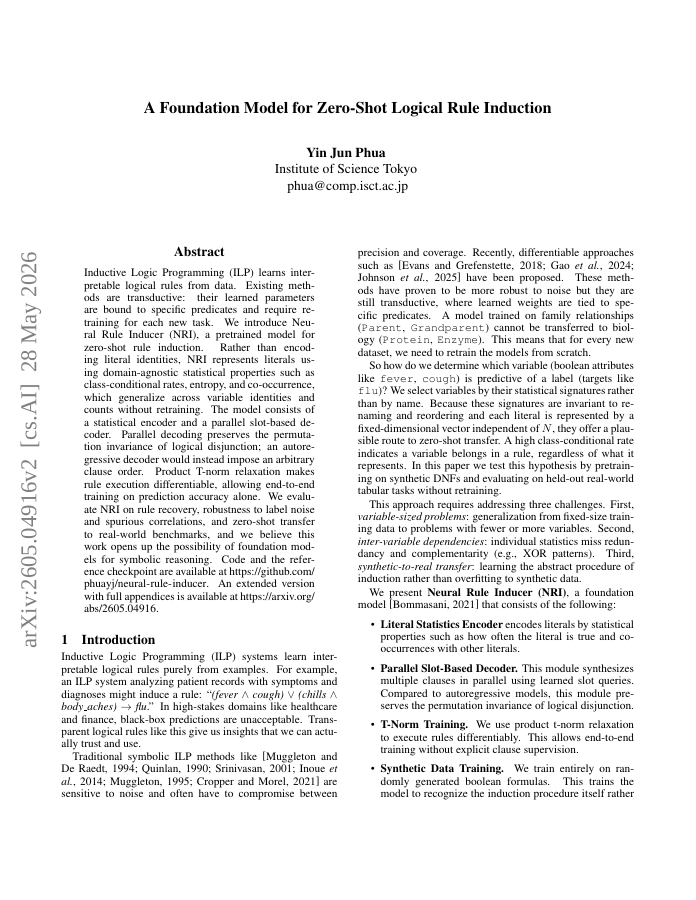
Inductive Logic Programming (ILP) learns interpretable logical rules from data. Existing methods are transductive: their learned parameters are bound to specific predicates and require retraining for each new task.
28 May 2026
While Membership Inference Attacks (MIAs) are the prevailing method for identifying training data, their application has expanded into privacy auditing and machine unlearning.
28 May 2026
We present a fully convolutional denoising autoencoder (FC-DAE) tailored for two-dimensional representations of dynamic correlations that is applicable to many experimental techniques.
28 May 2026
Reconstruction-based inference assigns a class by comparing class-wise reconstruction residuals; Sparse Representation Classification (SRC) is a canonical instance whose reliability depends on the geometry of the learned representation.
28 May 2026
The widespread use of image classification models in high-risk, real-world situations necessitates making these models robust to slight disturbances or perturbations, such as blurring or sharpening, in the input images.
28 May 2026
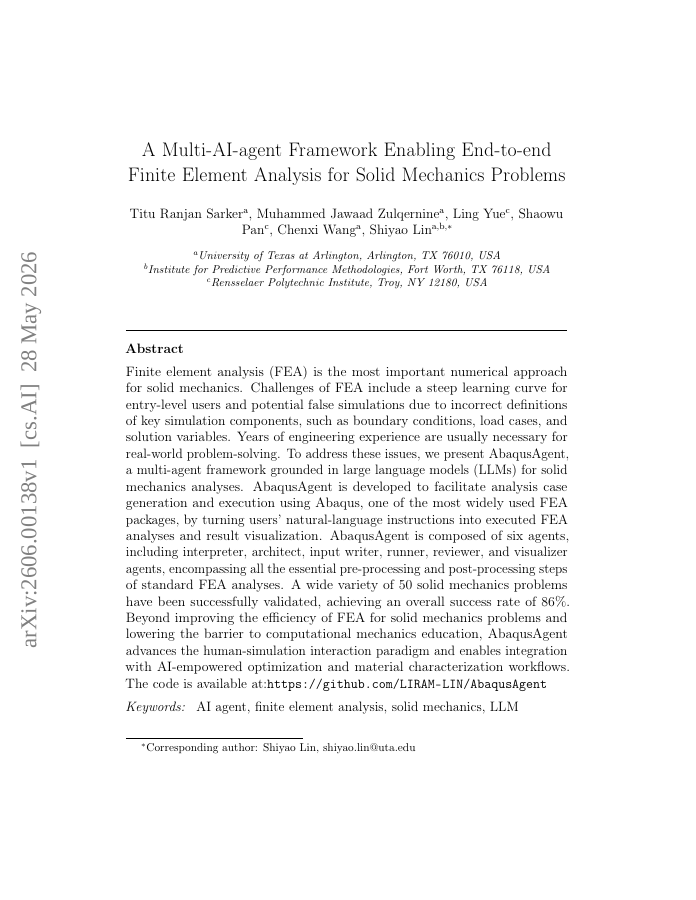
Finite element analysis (FEA) is the most important numerical approach for solid mechanics. Challenges of FEA include a steep learning curve for entry-level users and potential false simulations due to incorrect definitions of key simulation components, such as boundary…
28 May 2026
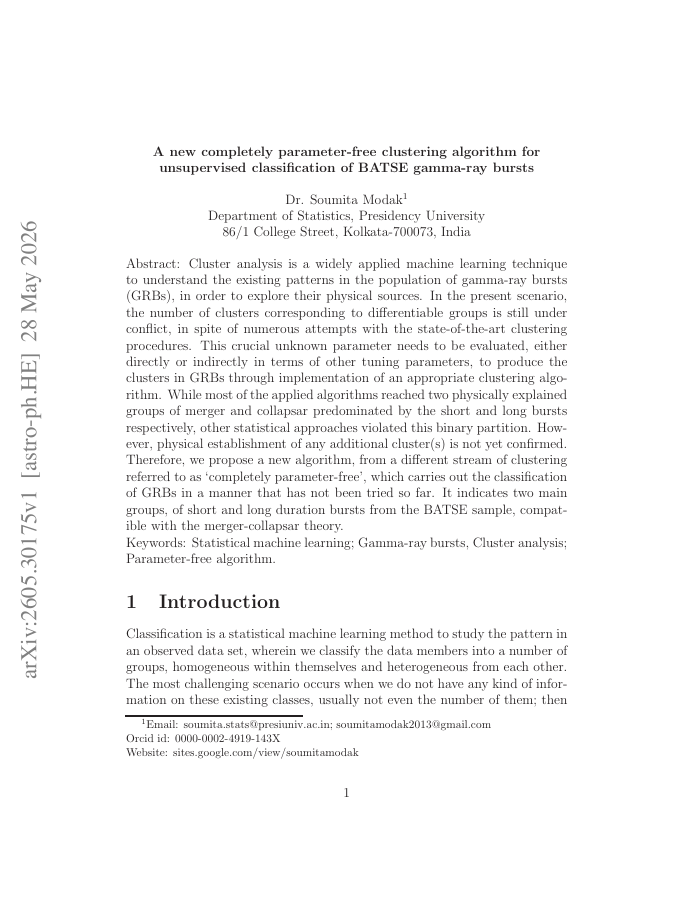
Cluster analysis is a widely applied machine learning technique to understand the existing patterns in the population of gamma-ray bursts (GRBs), in order to explore their physical sources.
28 May 2026
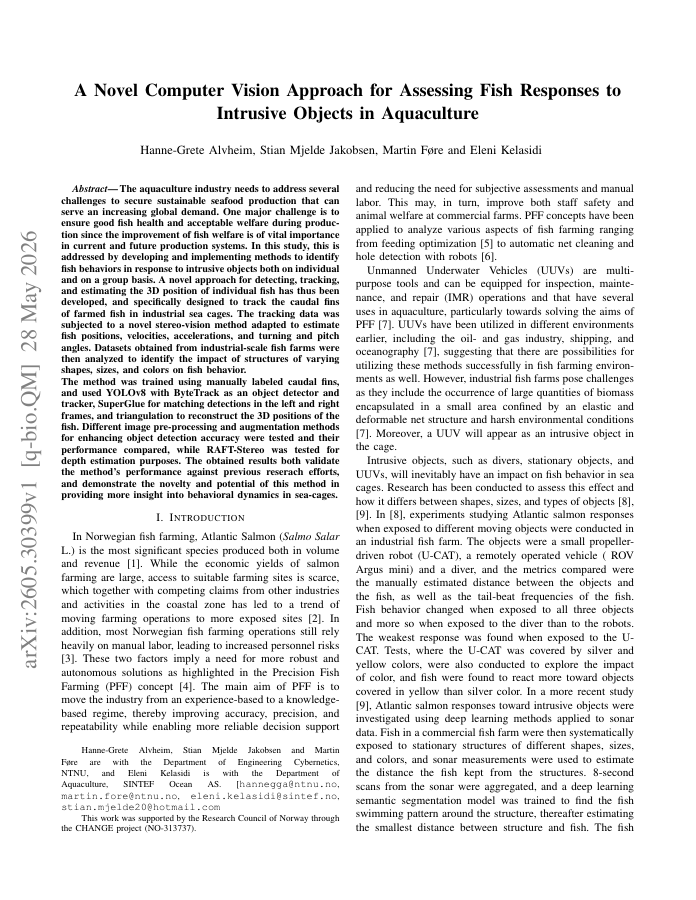
The aquaculture industry needs to address several challenges to secure sustainable seafood production that can serve an increasing global demand. One major challenge is to ensure good fish health and acceptable welfare during production since the improvement of fish welfare is…
28 May 2026
This paper introduces a new systematic framework for detecting anomalies in maritime Automatic Identification System (AIS) datasets. These anomalies include abnormal vessel behaviours related to speed, position jumps, time gaps, and turn angles.