1 Feb 2026
Large language models (LLMs) are increasingly being used in a zero-shot (generative) fashion to assess mental health conditions, yet we have limited knowledge on what factors affect their accuracy.
Trending research and the full catalog - each paper linked to the benchmarks, methods, and models it introduces.
Filtering here covers the 2,000 most recent papers, as much as one page can hold in memory. See the full index of 22,617 papers.
1 Feb 2026
Large language models (LLMs) are increasingly being used in a zero-shot (generative) fashion to assess mental health conditions, yet we have limited knowledge on what factors affect their accuracy.
1 Feb 2026
Iterative self-improvement fine-tunes an autoregressive large language model (LLM) on reward-verified outputs generated by the LLM itself. In contrast to the empirical success of self-improvement, the theoretical foundation of this generative, iterative procedure in a practical,…
1 Feb 2026
Code assistants are increasingly utilized in test-driven software development, yet the theoretical mechanisms behind their environment-interaction strategies remain underexplored.
1 Feb 2026
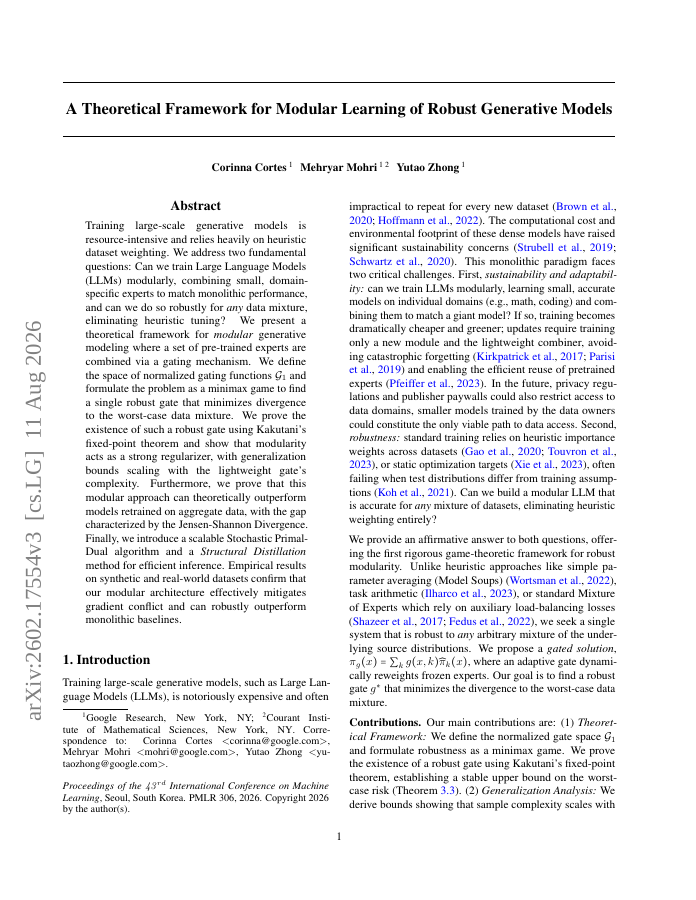
Training large-scale generative models is resource-intensive and relies heavily on heuristic dataset weighting. We address two fundamental questions: Can we train Large Language Models (LLMs) modularly, combining small, domain-specific experts to match monolithic performance,…
1 Feb 2026
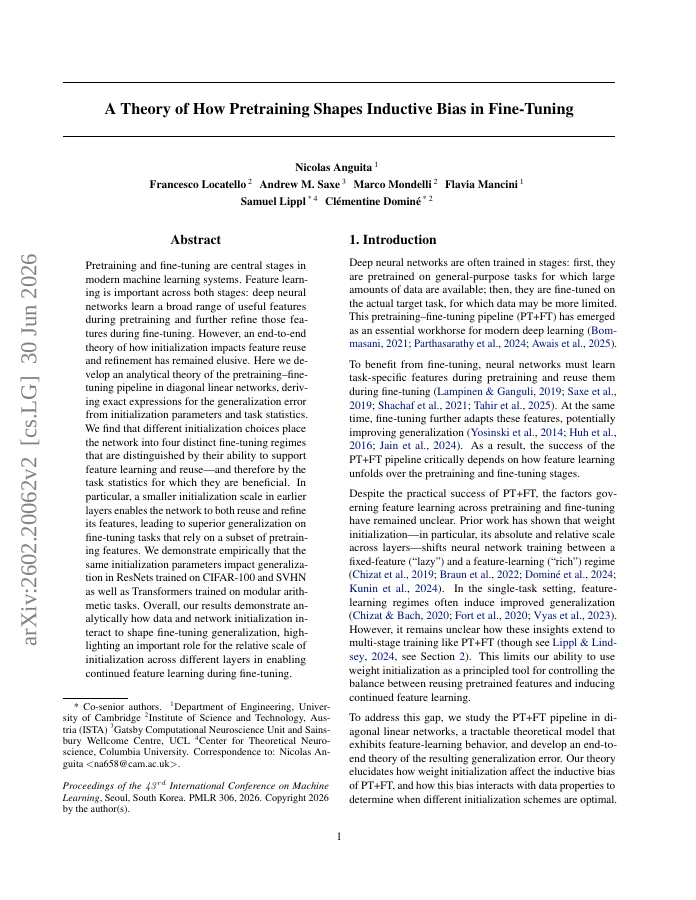
Pretraining and fine-tuning are central stages in modern machine learning systems. In practice, feature learning plays an important role across both stages: deep neural networks learn a broad range of useful features during pretraining and further refine those features during…
1 Feb 2026
We formulate plasticity as target-dependent, finite-horizon reachability under history-dependent dynamics, using standard minimum-energy control theory. An extended state includes parameters and internal variables that affect future updates.
1 Feb 2026
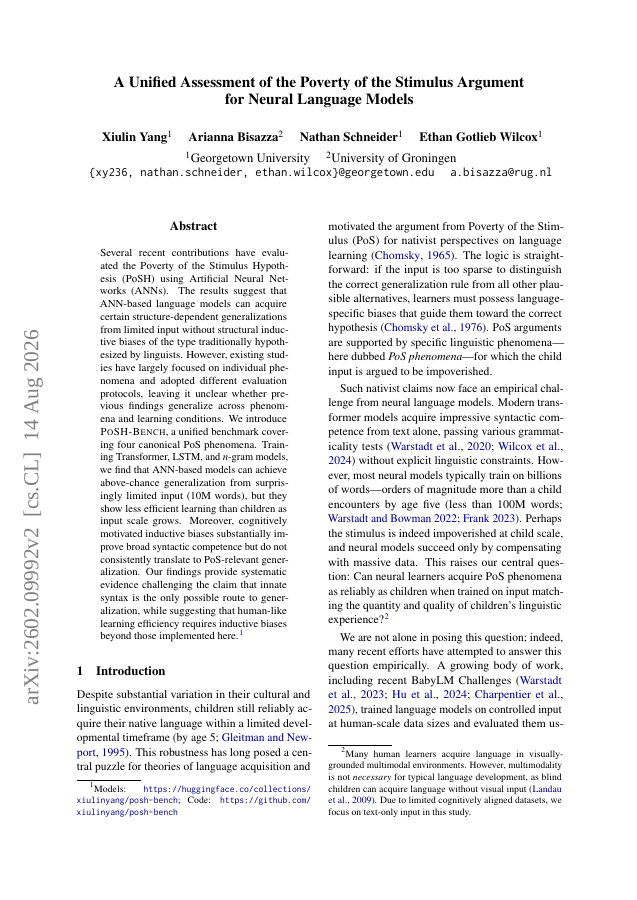
Several recent contributions have evaluated the Poverty of the Stimulus Hypothesis (PoSH) using Artificial Neural Networks (ANNs). The results suggest that ANN-based language models can acquire certain structure-dependent generalizations from limited input without structural…
1 Feb 2026
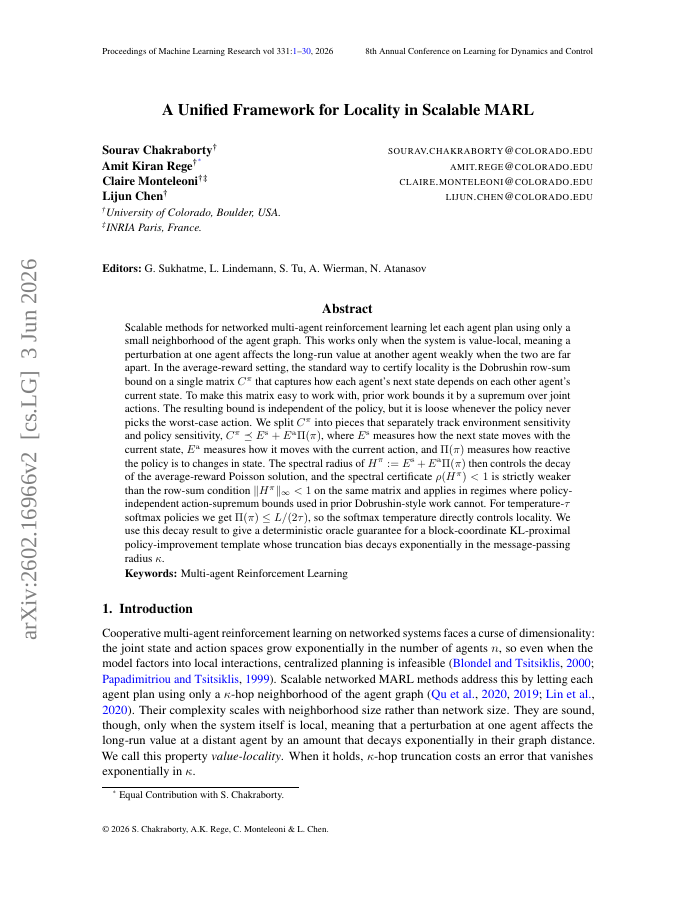
Scalable methods for networked multi-agent reinforcement learning let each agent plan using only a small neighborhood of the agent graph. This works only when the system is value-local, meaning a perturbation at one agent affects the long-run value at another agent weakly when…
1 Feb 2026
Physics-Informed Neural Networks present a novel approach in SciML that integrates physical laws in the form of partial differential equations directly into the NN through soft constraints in the loss function.
1 Feb 2026
Ptychographic imaging at synchrotron and X-ray free-electron laser sources requires densely overlapping scans, which limits throughput and increases dose; extending coherent diffractive imaging to overlap-free operation on extended samples remains an open problem.
1 Feb 2026
Formal semantics and distributional semantics are distinct approaches to linguistic meaning: the former models meaning as reference via model-theoretic structures; the latter as vectors in high-dimensional spaces shaped by usage.
Li Dong, Ming Hu, Zhonghua Wang · 31 Jan 2026
RetSAM is a comprehensive retinal imaging framework that provides accurate segmentation and standardized biomarker extraction from fundus images, supporting large-scale ophthalmic research and disease correlation studies.
31 Jan 2026
Incorporating Machine Learning (ML) into material property prediction has become a crucial step in accelerating materials discovery. A key challenge is the severe lack of training data, as many properties are too complicated to calculate with high-throughput first principles…
30 Jan 2026
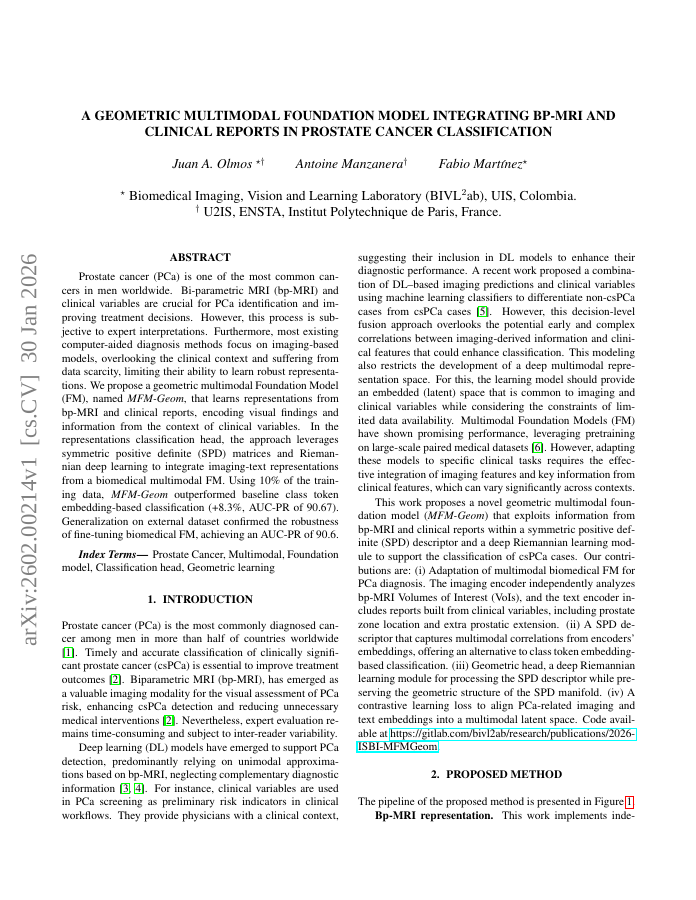
Prostate cancer (PCa) is one of the most common cancers in men worldwide. Bi-parametric MRI (bp-MRI) and clinical variables are crucial for PCa identification and improving treatment decisions. However, this process is subjective to expert interpretations.
Bo Zheng, Helin Wang, Kai Li · 30 Jan 2026
Automated pipeline for sound separation using high-purity single-event segments from in-the-wild datasets achieves competitive performance with significantly reduced data requirements.
28 Jan 2026
Photoacoustic computed tomography (PACT) is a promising imaging modality that combines the advantages of optical contrast with ultrasound detection. Utilizing ultrasound transducers with larger surface areas can improve detection sensitivity.
28 Jan 2026
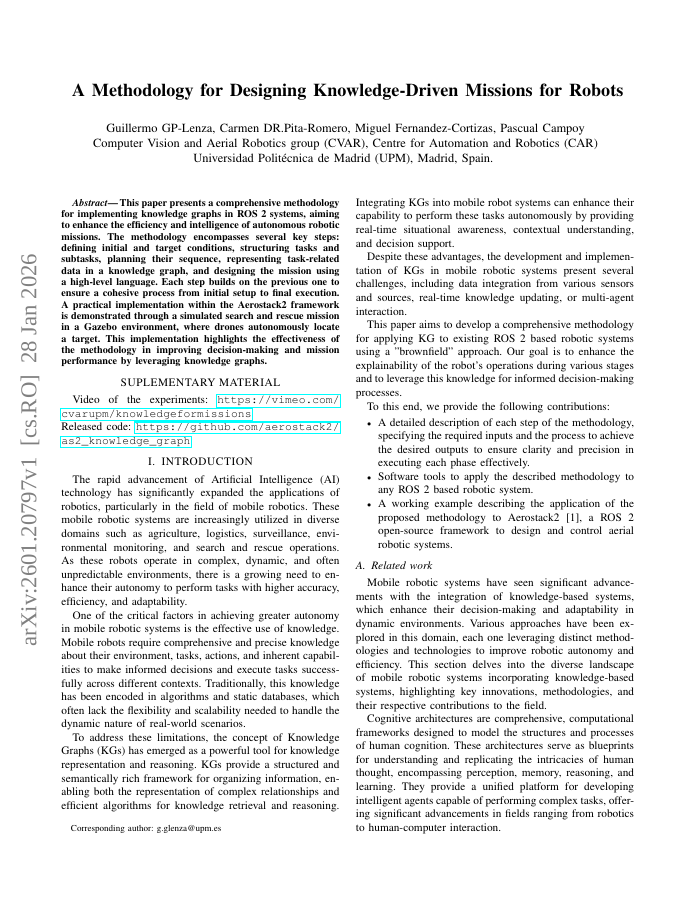
This paper presents a comprehensive methodology for implementing knowledge graphs in ROS 2 systems, aiming to enhance the efficiency and intelligence of autonomous robotic missions.
27 Jan 2026
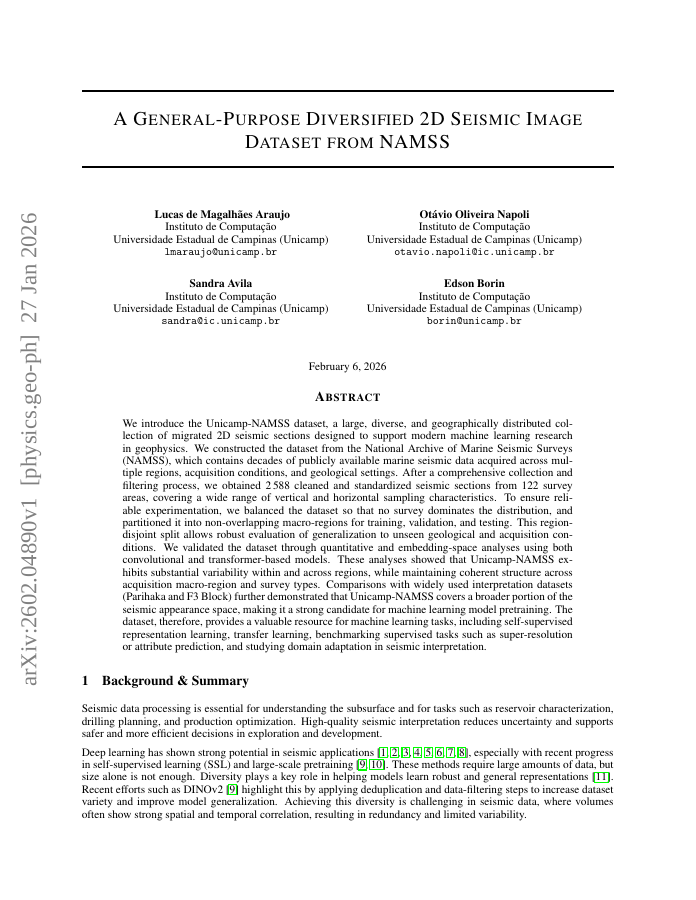
We introduce the Unicamp-NAMSS dataset, a large, diverse, and geographically distributed collection of migrated 2D seismic sections designed to support modern machine learning research in geophysics.
Xing Zhu, Yujun Shen, Wei Wu · 26 Jan 2026
Offering great potential in robotic manipulation, a capable Vision-Language-Action (VLA) foundation model is expected to faithfully generalize across tasks and platforms while ensuring cost efficiency (e.g., data and GPU hours required for adaptation).
Wenhang Ge, Pengfei Wan, Peiran Ren · 22 Jan 2026
Video generation models are categorized based on state construction and dynamics modeling approaches, with emphasis on transitioning evaluation metrics from visual quality to functional capabilities like physical persistence and causal reasoning.
Luciano del Corro, Gonzalo Ariel Meyoyan · 19 Jan 2026
Lightweight probes trained on hidden states of LLMs enable efficient classification tasks without additional computational overhead, improving safety and sentiment analysis performance.
19 Jan 2026
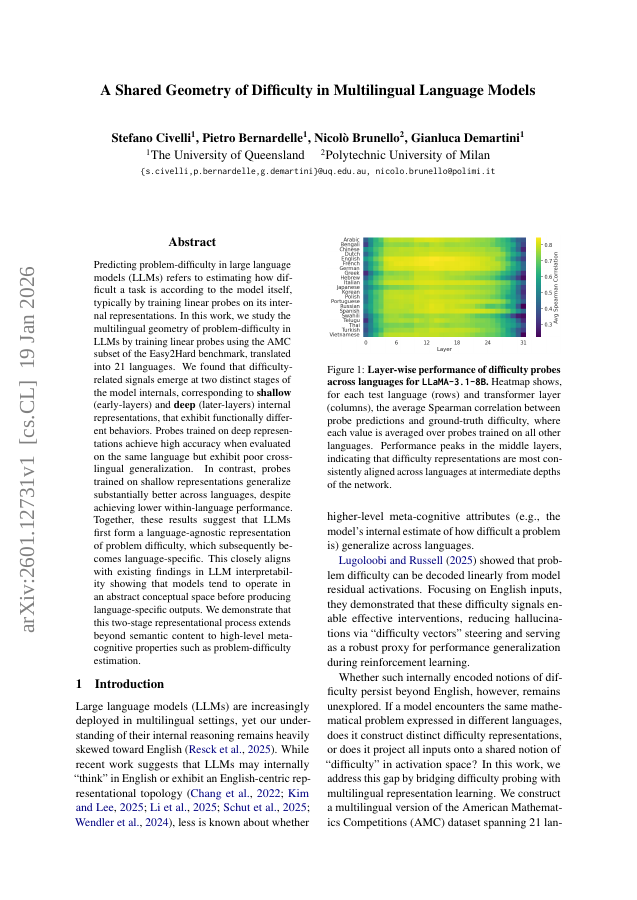
Predicting problem-difficulty in large language models (LLMs) refers to estimating how difficult a task is according to the model itself, typically by training linear probes on its internal representations.
Heng Ji, Yu Wang, Cheng Qian · 18 Jan 2026
Reasoning is a fundamental cognitive process underlying inference, problem-solving, and decision-making. While large language models (LLMs) demonstrate strong reasoning capabilities in closed-world settings, they struggle in open-ended and dynamic environments.
Zilong Wang, Xin Wang, Zuxuan Wu · 15 Jan 2026
The rapid evolution of Large Language Models (LLMs) and Multimodal Large Language Models (MLLMs) has produced substantial gains in reasoning, perception, and generative capability across language and vision.