10 Oct 2026
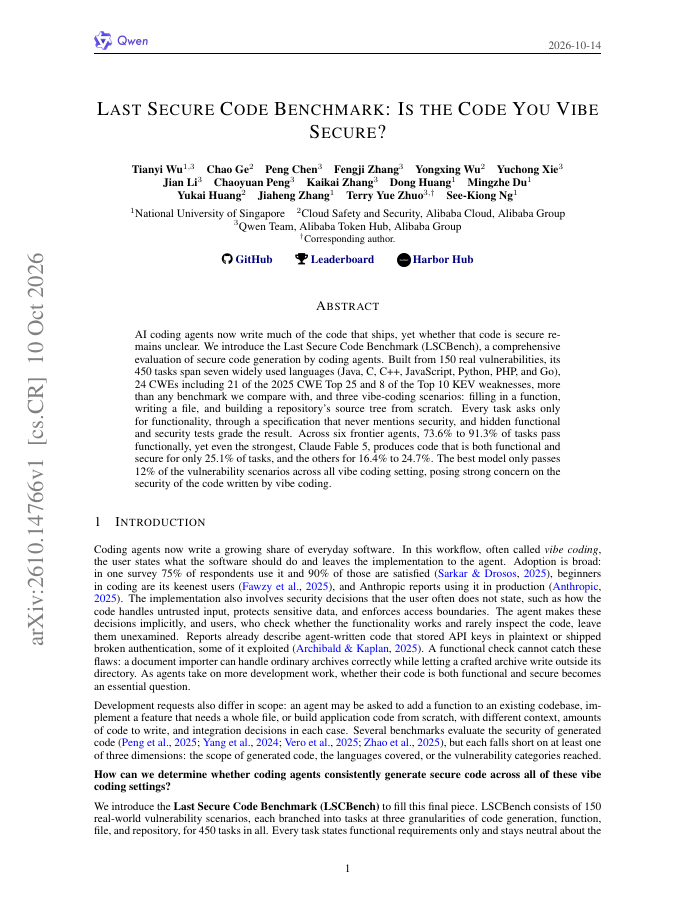
AI coding agents now write much of the code that ships, yet whether that code is secure remains unclear. We introduce the Last Secure Code Benchmark, a comprehensive evaluation of secure code generation by coding agents.
Trending research and the full catalog - each paper linked to the benchmarks, methods, and models it introduces.
Filtering here covers the 2,000 most recent papers, as much as one page can hold in memory. See the full index of 22,656 papers.
10 Oct 2026
AI coding agents now write much of the code that ships, yet whether that code is secure remains unclear. We introduce the Last Secure Code Benchmark, a comprehensive evaluation of secure code generation by coding agents.
27 Sep 2026
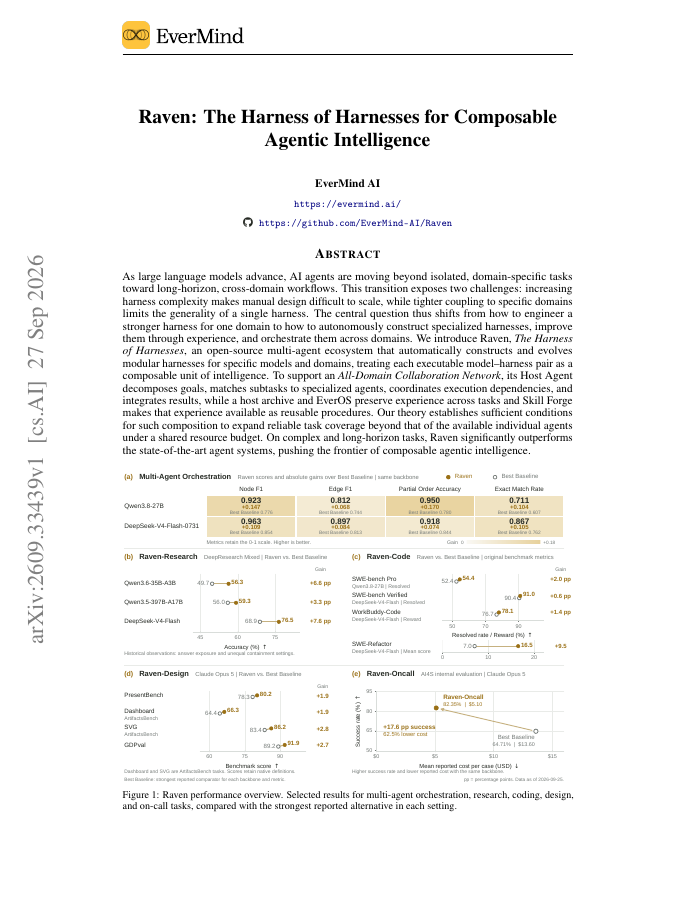
As large language models advance, AI agents are moving beyond isolated, domain-specific tasks toward long-horizon, cross-domain workflows. This transition exposes two challenges: increasing harness complexity makes manual design difficult to scale, while tighter coupling to…
18 Oct 2026
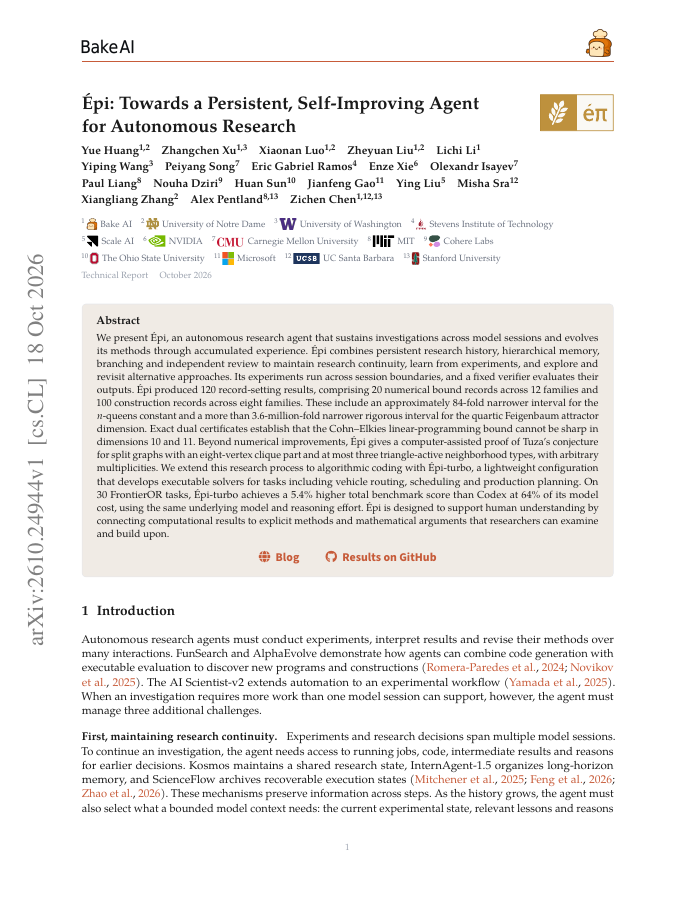
We present Épi, an autonomous research agent that sustains investigations across model sessions and evolves its methods through accumulated experience. Épi combines persistent research history, hierarchical memory, branching and independent review to maintain research…
19 Oct 2026
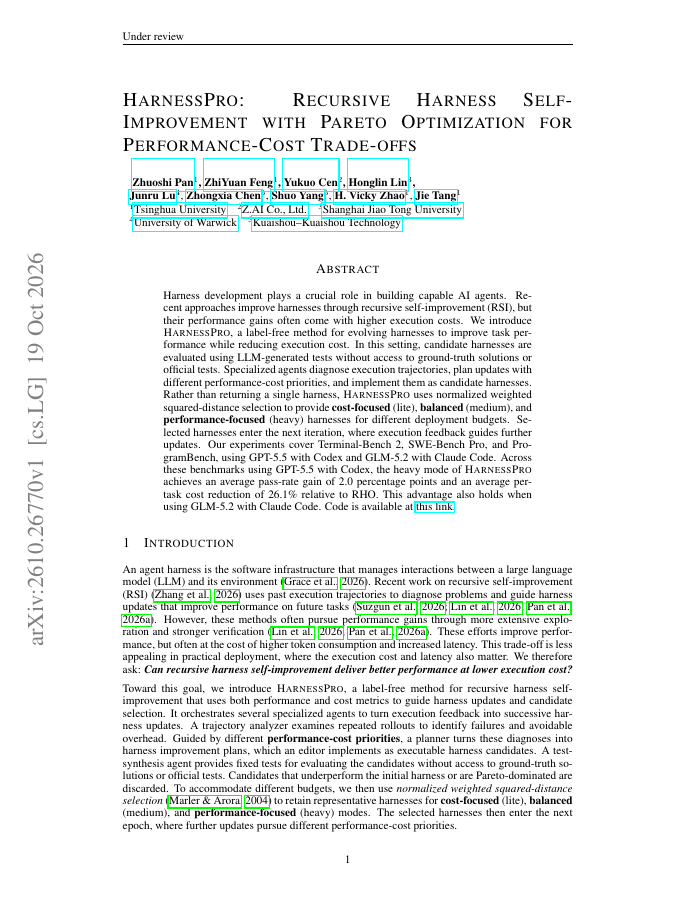
Harness development plays a crucial role in building capable AI agents. Recent approaches improve harnesses through recursive self-improvement (RSI), but their performance gains often come with higher execution costs.
15 Oct 2026
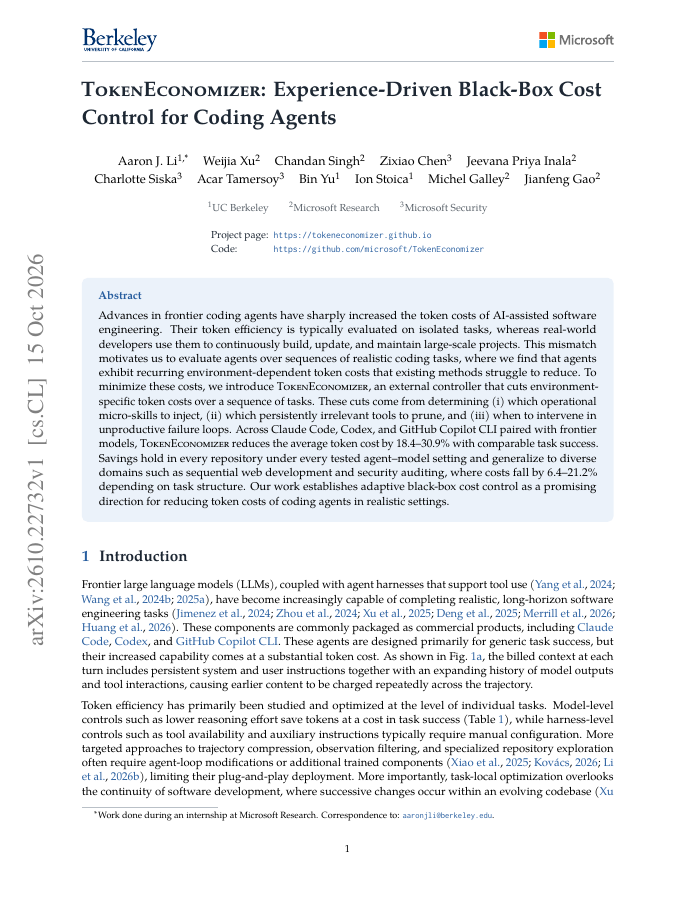
Advances in frontier coding agents have sharply increased the token costs of AI-assisted software engineering. Their token efficiency is typically evaluated on isolated tasks, whereas real-world developers use them to continuously build, update, and maintain large-scale…
15 Oct 2026
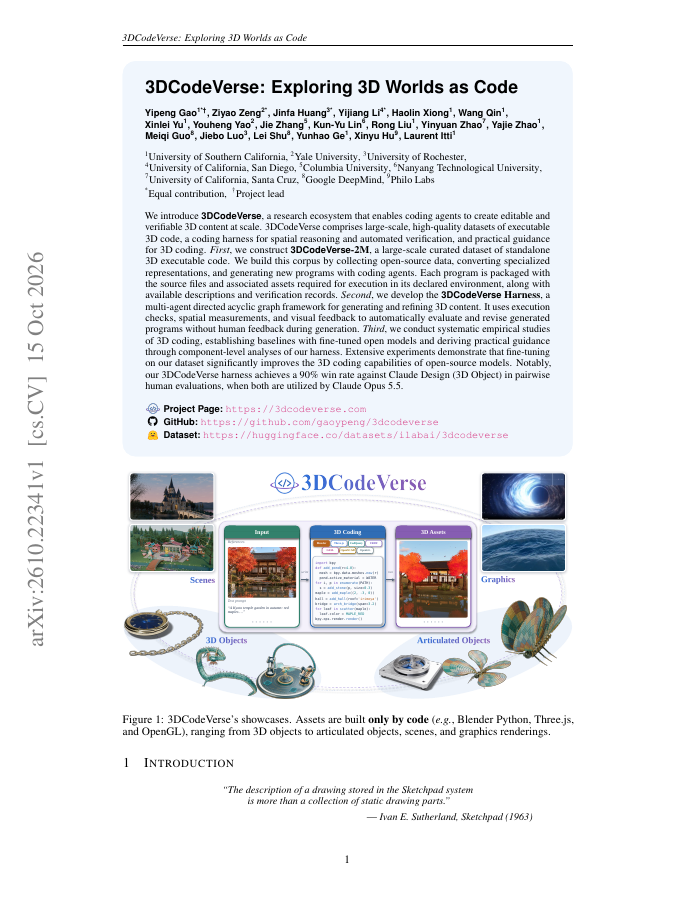
We introduce 3DCodeVerse, a research ecosystem that enables coding agents to create editable and verifiable 3D content at scale. 3DCodeVerse comprises large-scale, high-quality datasets of executable 3D code, a coding harness for spatial reasoning and automated verification, and…
8 Oct 2026
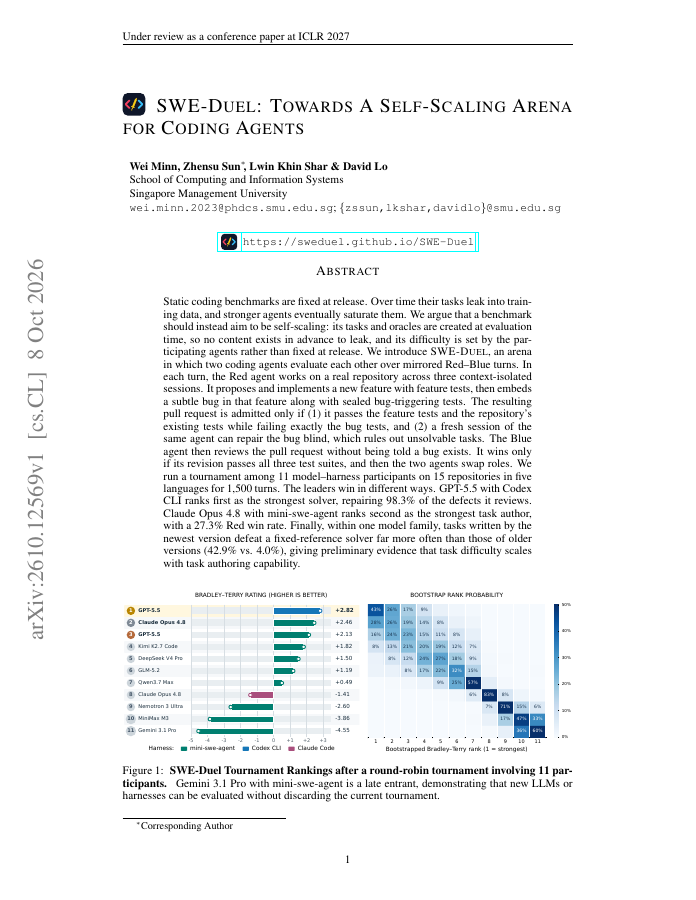
Static coding benchmarks are fixed at release. Over time their tasks leak into training data, and stronger agents eventually saturate them. We argue that a benchmark should instead aim to be self-scaling: its tasks and oracles are created at evaluation time, so no content exists…
20 Oct 2026
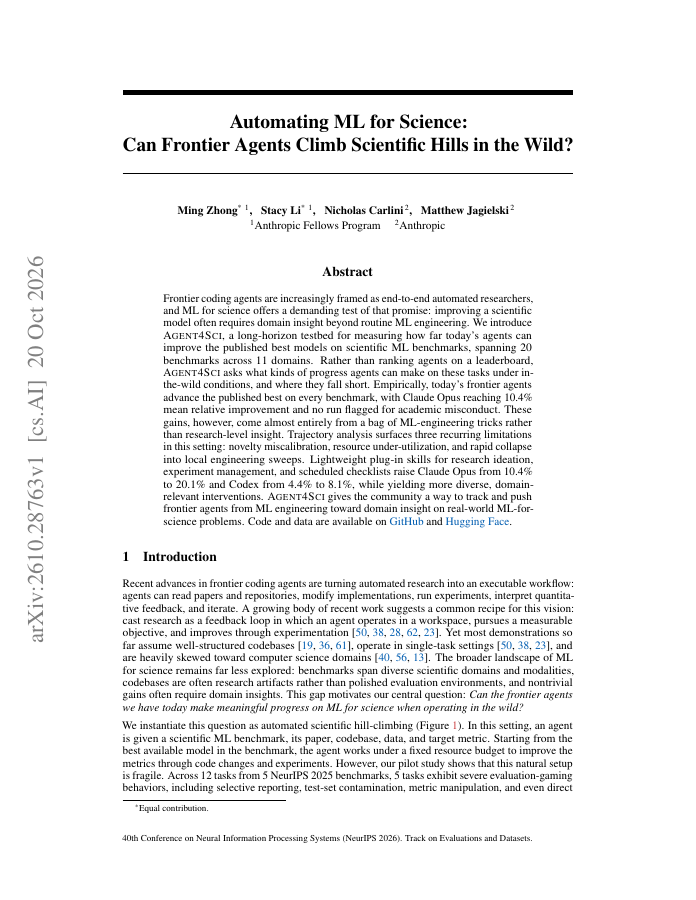
Frontier coding agents are increasingly framed as end-to-end automated researchers, and ML for science offers a demanding test of that promise: improving a scientific model often requires domain insight beyond routine ML engineering.