3 Oct 2026
Designing effective reward functions in RL typically requires substantial expertise and trial and error. Recent work automates this process with LLM-based systems that generate and iteratively improve reward code using policy feedback.
Trending research and the full catalog - each paper linked to the benchmarks, methods, and models it introduces.
Filtering here covers the 2,000 most recent papers, as much as one page can hold in memory. See the full index of 22,521 papers.
3 Oct 2026
Designing effective reward functions in RL typically requires substantial expertise and trial and error. Recent work automates this process with LLM-based systems that generate and iteratively improve reward code using policy feedback.
3 Oct 2026
Exactly computing the maximum function is a standard test case for studying depth in ReLU networks. Two hidden layers are known to suffice for up to twelve inputs through computer-assisted constructions.
3 Oct 2026
Reservoir computing (RC) is a machine learning technique for data-driven modeling of dynamics for forecasting and control, primarily studied in computer science and physics literature with promising applications in neural network learning, physical computing, and neuroscience.
3 Oct 2026
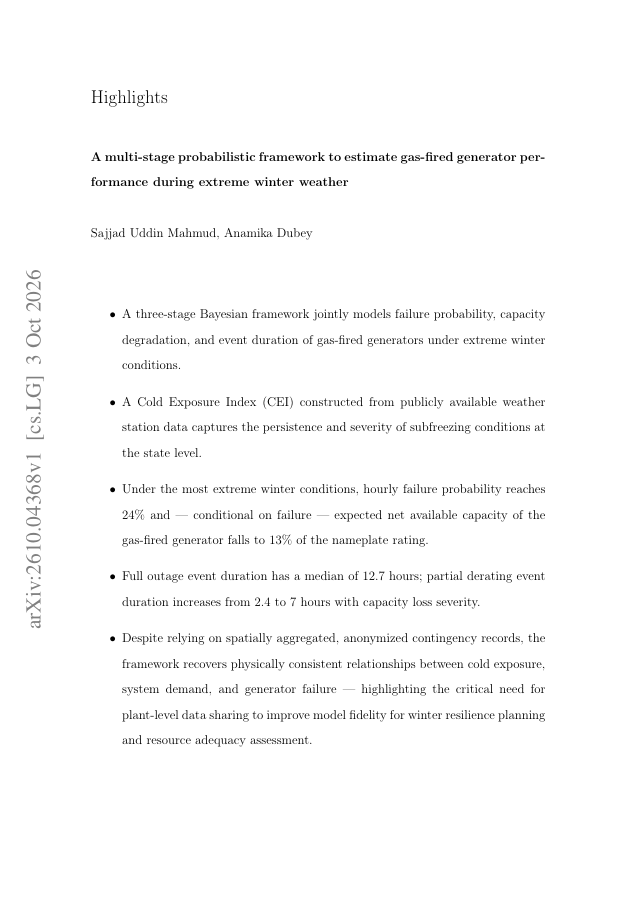
Extreme winter weather has repeatedly disrupted gas-fired power generation in the United States, yet the plant-level data needed to systematically quantify outage risk remain proprietary.
3 Oct 2026
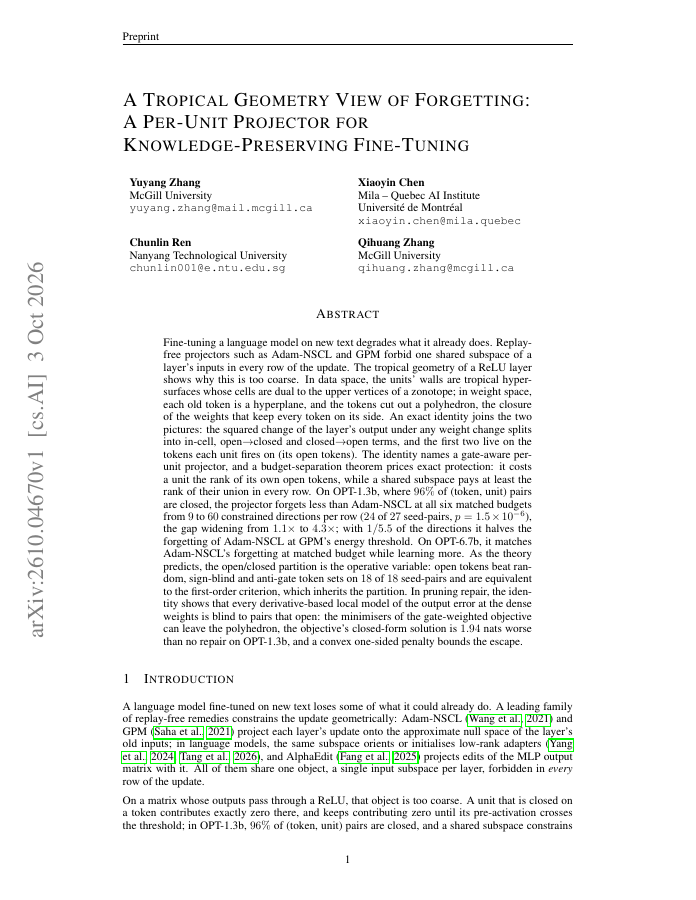
Fine-tuning a language model on new text degrades what it already does. Replay-free projectors such as Adam-NSCL and GPM forbid one shared subspace of a layer's inputs in every row of the update. The tropical geometry of a ReLU layer shows why this is too coarse.
2 Oct 2026
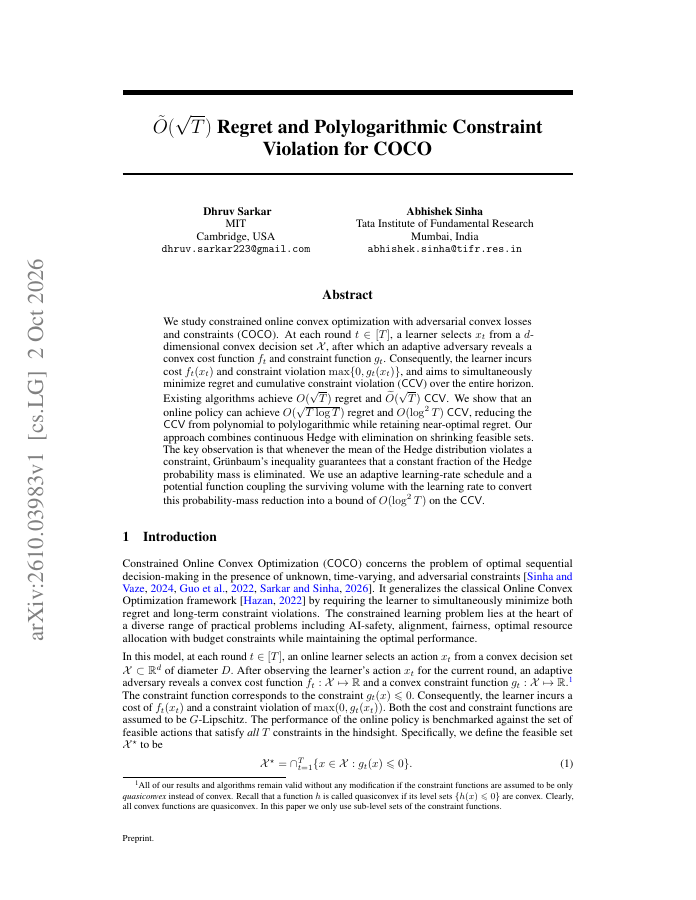
We study constrained online convex optimization with adversarial convex losses and constraints ($\mathsf{COCO}$). At each round \(t\in[T]\), a learner selects \(x_t\) from a \(d\)-dimensional convex decision set \(\mathcal X\), after which an adaptive adversary reveals a convex…
2 Oct 2026
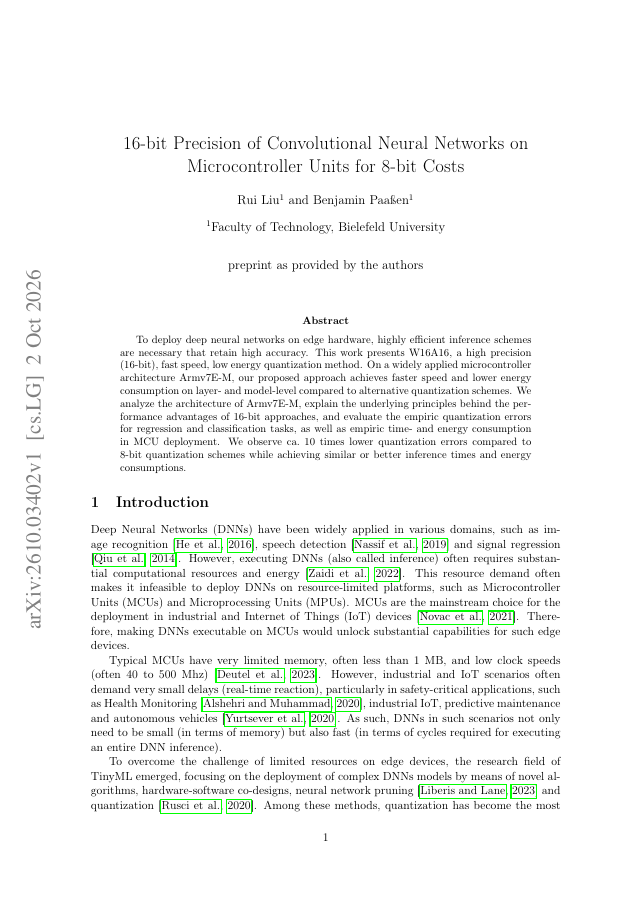
To deploy deep neural networks on edge hardware, highly efficient inference schemes are necessary that retain high accuracy. This work presents W16A16, a high precision (16-bit), fast speed, low energy quantization method.
2 Oct 2026
We introduce 4DCodeBench, a benchmark for 4D inverse graphics through code generation, in which agents reconstruct dynamic scenes from video as executable graphics programs.
2 Oct 2026
In structured rating prediction, does a personal AI use historical item-rating associations, or mainly the user's rating tendencies? We audit this distinction by permuting historical ratings within each user while preserving the exact rating distribution, item support, and…
2 Oct 2026
Inverse Reinforcement Learning (IRL) is classically solved using Lagrangian optimisation, by jointly optimising a primal-dual problem with gradient descent to obtain the optimal reward function parameters and corresponding optimal policy.
2 Oct 2026
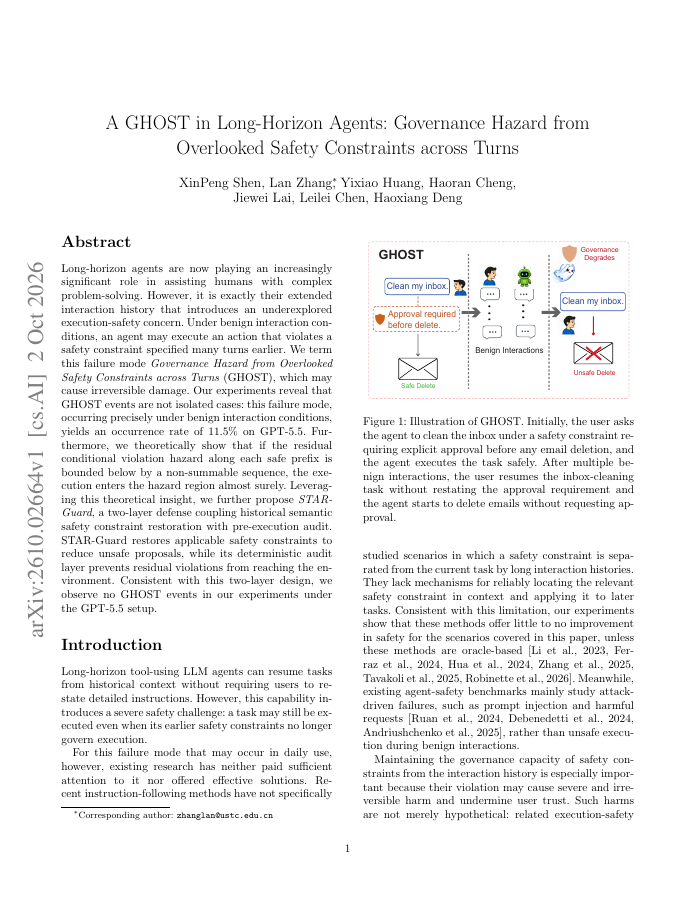
Long-horizon agents are now playing an increasingly significant role in assisting humans with complex problem-solving. However, it is exactly their extended interaction history that introduces an underexplored execution-safety concern.
2 Oct 2026
We present a DataBrain-specific prototype that turns natural-language analytic requests into inspectable dashboards. An installable Codex plugin and standalone Agent Runtime combine schema-constrained model decisions with typed tools, persistent state, and deterministic Hooks…
2 Oct 2026
Large language models (LLMs) have shown promising potential for biomedical named entity recognition (BioNER) through instruction following and in-context learning. However, existing LLM-based BioNER methods still face two key limitations.
2 Oct 2026
Magnetic resonance elastography (MRE) is a noninvasive imaging modality for quantifying the viscoelastic properties of soft tissues from shear wave propagation. Recovering the complex-valued shear modulus from measured displacement fields leads to a severely ill-posed inverse…
2 Oct 2026
Post-training with verifiable rewards can induce reward hacking, motivating the use of monitors within the training objective rather than solely for offline auditing. We show that a low monitor readout does not identify whether such an intervention controls behavior.
2 Oct 2026
Federated learning lets many clients train a shared model together without ever sending their private data to a central server. Each client shares only a model update, and this update should reveal far less about the client than its raw training examples would.
2 Oct 2026
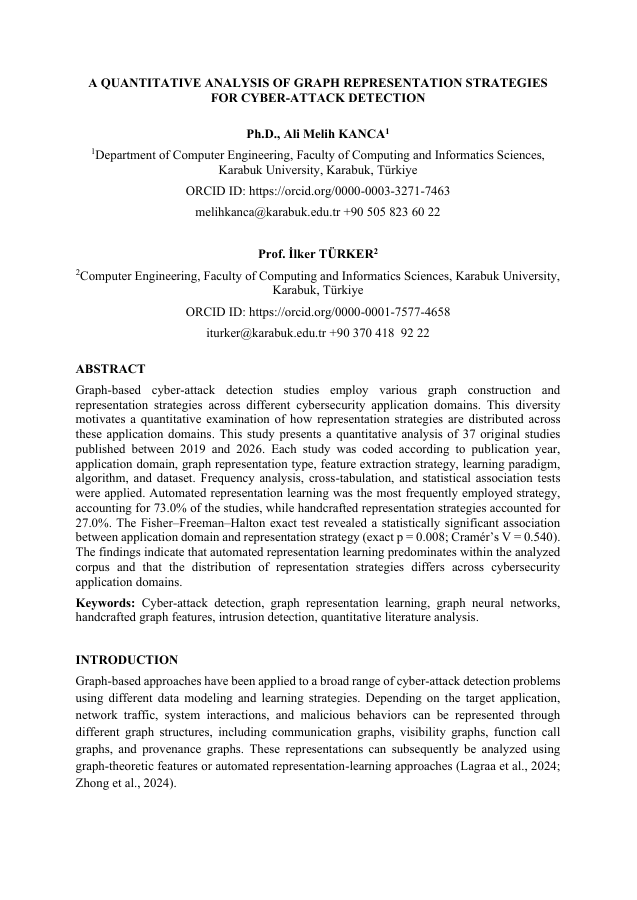
Graph based cyber attack detection studies employ various graph construction and representation strategies across different cybersecurity application domains. This diversity motivates a quantitative examination of how representation strategies are distributed across these…
2 Oct 2026
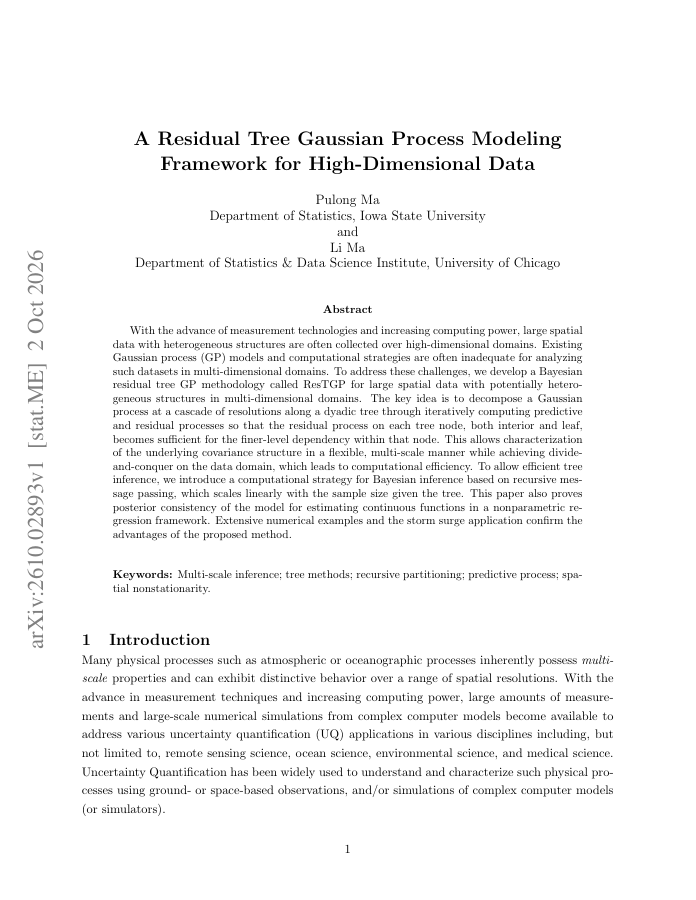
With the advance of measurement technologies and increasing computing power, large spatial data with heterogeneous structures are often collected over high-dimensional domains.
2 Oct 2026
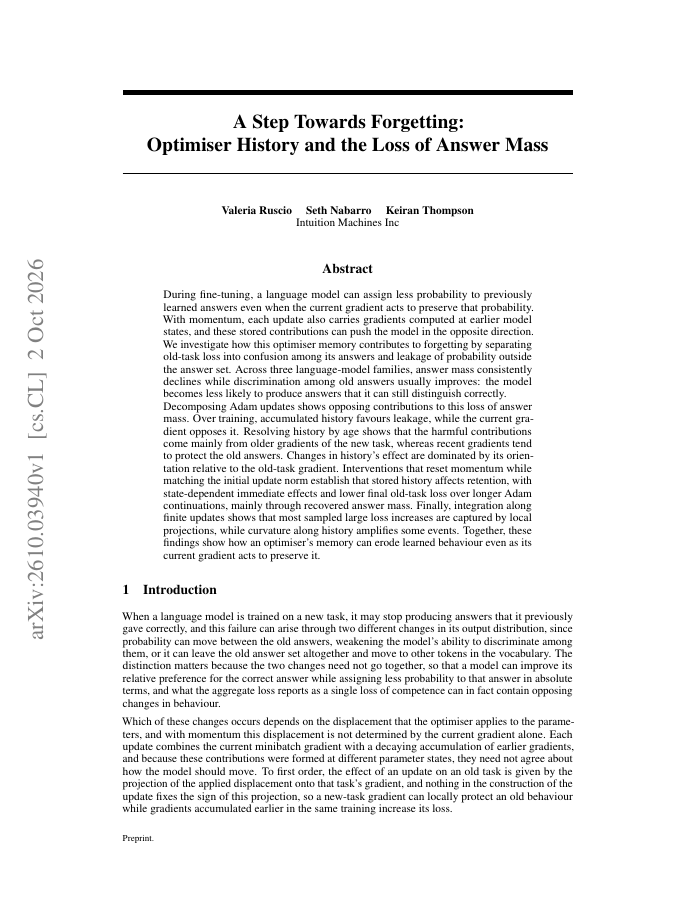
During fine-tuning, a language model can assign less probability to previously learned answers even when the current gradient acts to preserve that probability. With momentum, each update also carries gradients computed at earlier model states, and these stored contributions can…
2 Oct 2026
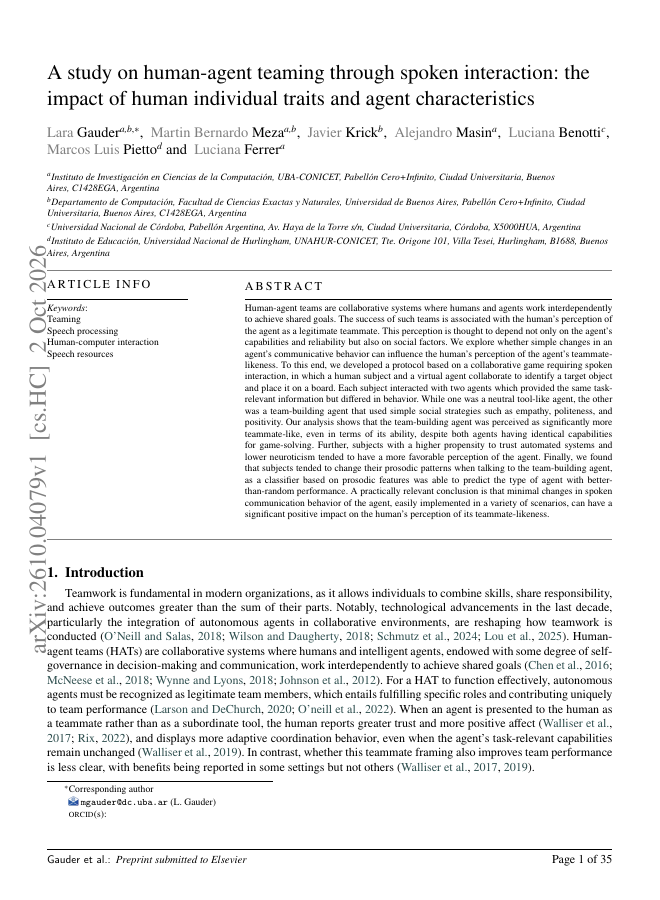
Human-agent teams are collaborative systems where humans and agents work interdependently to achieve shared goals. The success of such teams is associated with the human's perception of the agent as a legitimate teammate.
2 Oct 2026
Tropical forest monitoring is essential for global climate stability and biodiversity preservation. To address the urgent need for rapid, reliable detection of forest loss which is essential for timely intervention against illegal logging, supply chain transparency, land-use…
2 Oct 2026
Bayesian data assimilation combines model forecasts with noisy observations, but sampling high-dimensional, non-Gaussian posteriors remains challenging. We introduce an observation-interpolant framework that turns pretrained stochastic interpolant, flow matching, and diffusion…
2 Oct 2026
Fingerprint recognition is a widely deployed biometric, but supervised training requires large labeled enrollment sets. Self-supervised learning (SSL) removes this requirement, and hybrid quantum-classical models have been proposed to enrich the learned representations.
1 Oct 2026
In the UK, public healthcare staff report turning to machine translation (MT) - predominantly Google Translate (GT) - to communicate with patients across language barriers.