Zeyu Zhang, Hao Tang, Ting Huang · 10 Jan 2026
3D CoCa v2 enhances 3D captioning by combining contrastive vision-language learning with spatially-aware 3D scene encoding and test-time search for improved generalization across diverse environments.
Trending research and the full catalog - each paper linked to the benchmarks, methods, and models it introduces.
Filtering here covers the 2,000 most recent papers, as much as one page can hold in memory. See the full index of 22,445 papers.
Zeyu Zhang, Hao Tang, Ting Huang · 10 Jan 2026
3D CoCa v2 enhances 3D captioning by combining contrastive vision-language learning with spatially-aware 3D scene encoding and test-time search for improved generalization across diverse environments.
7 Jan 2026
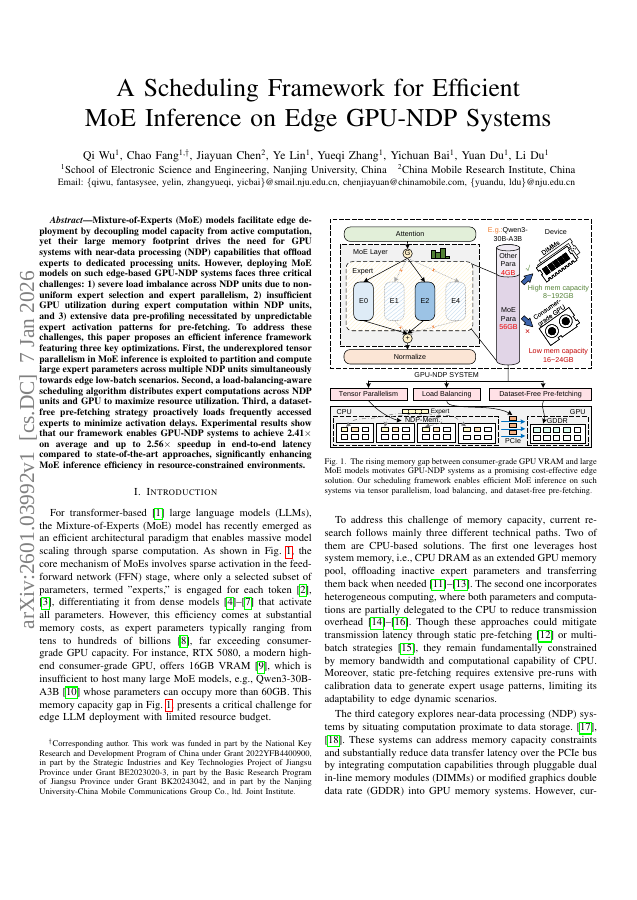
Mixture-of-Experts (MoE) models facilitate edge deployment by decoupling model capacity from active computation, yet their large memory footprint drives the need for GPU systems with near-data processing (NDP) capabilities that offload experts to dedicated processing units.
Xiaopeng Guo, Yinzhe Xu, Huajian Huang · 5 Jan 2026
A deep learning-based monocular omnidirectional visual odometry system uses a distortion-aware spherical feature extractor and differentiable bundle adjustment to improve robustness and accuracy over existing methods.
1 Jan 2026
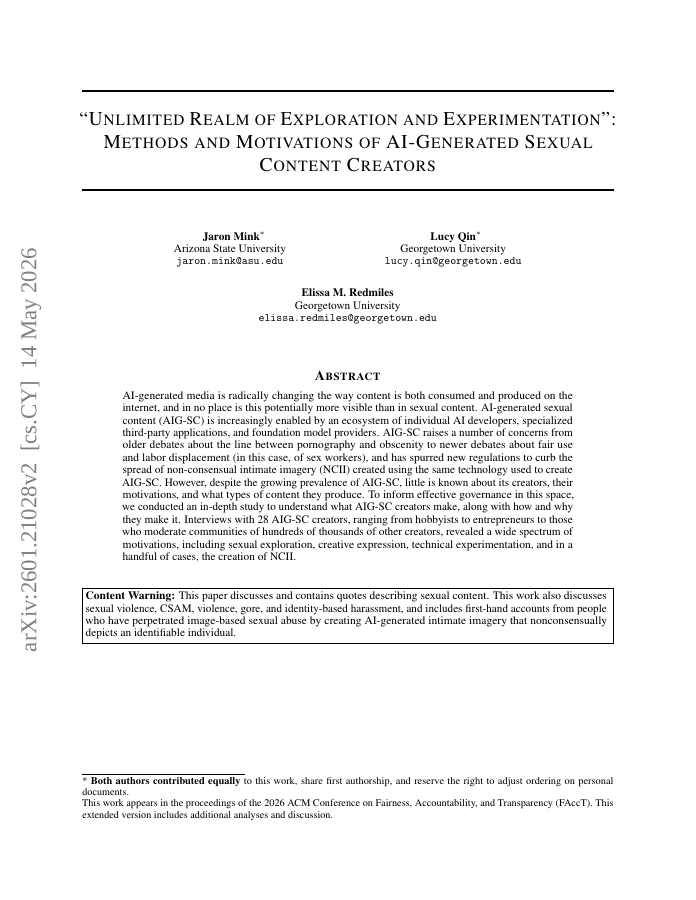
AI-generated media is radically changing the way content is both consumed and produced on the internet, and in no place is this potentially more visible than in sexual content.
1 Jan 2026
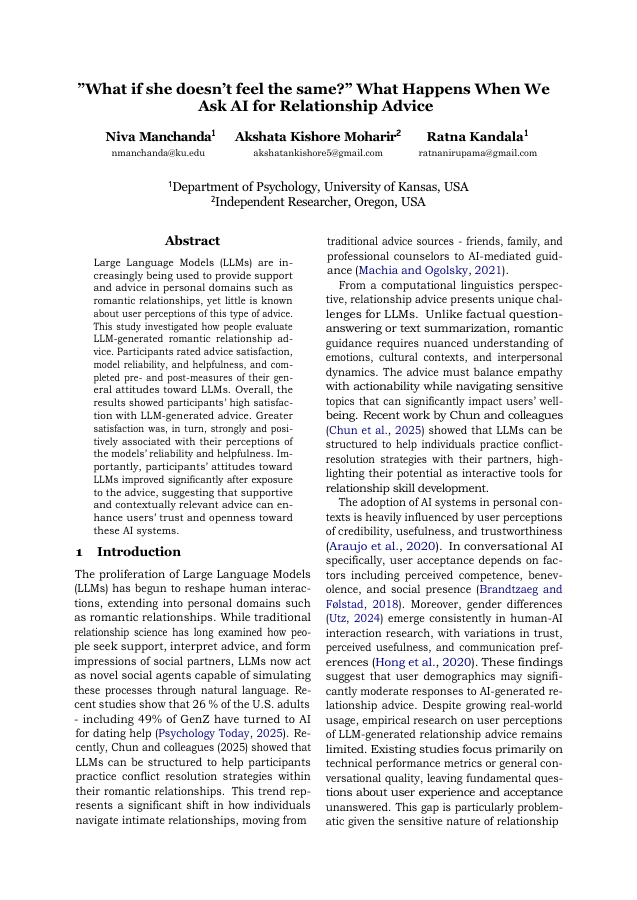
Large Language Models (LLMs) are increasingly being used to provide support and advice in personal domains such as romantic relationships, yet little is known about user perceptions of this type of advice.
1 Jan 2026
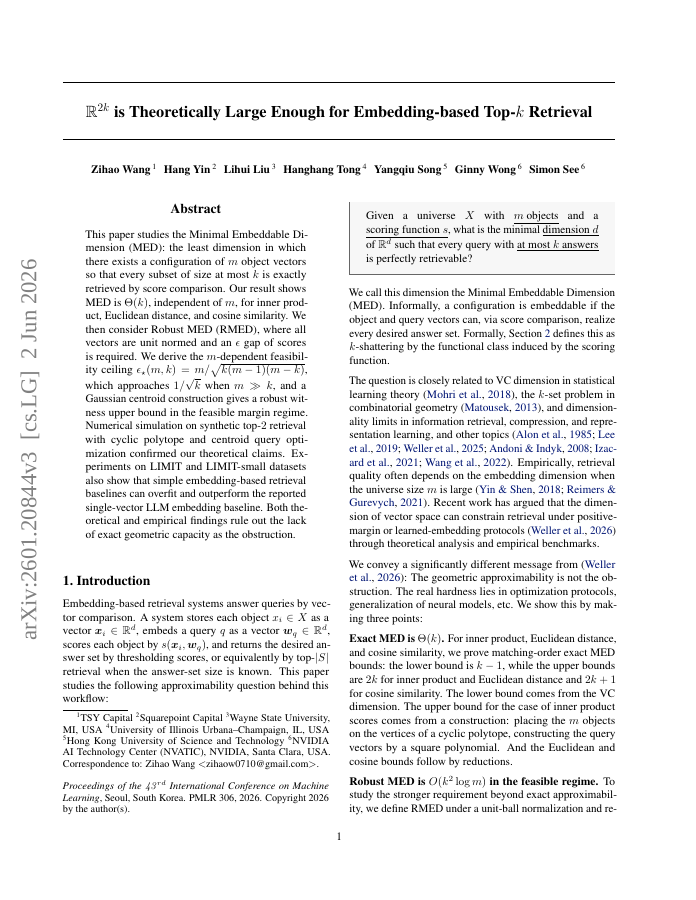
This paper studies the Minimal Embeddable Dimension (MED): the least dimension in which there exists a configuration of $m$ object vectors so that every subset of size at most $k$ is exactly retrieved by score comparison.
1 Jan 2026
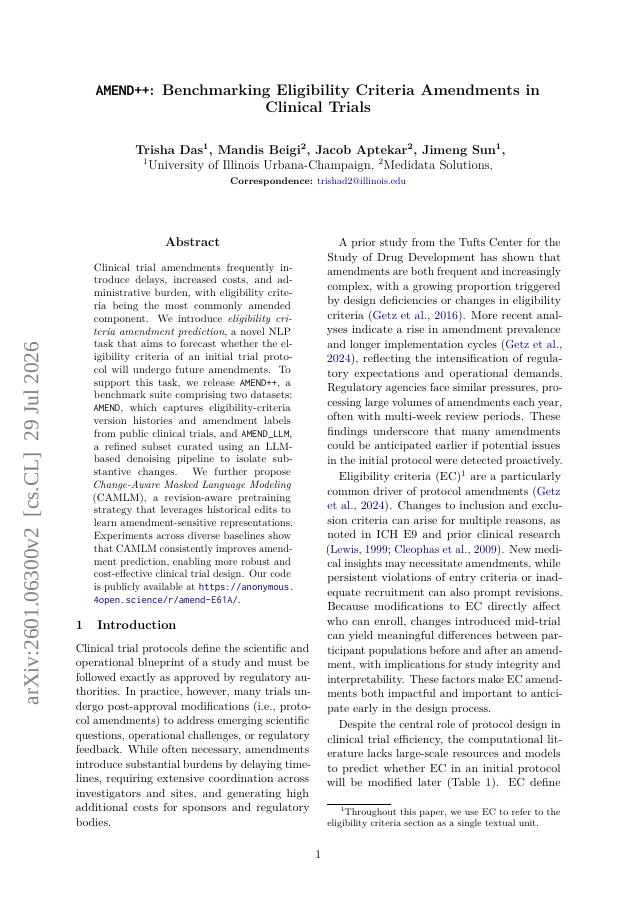
Clinical trial amendments frequently introduce delays, increased costs, and administrative burden, with eligibility criteria being the most commonly amended component. We introduce \textit{eligibility criteria amendment prediction}, a novel NLP task that aims to forecast whether…
1 Jan 2026
To address the scalability of feedback in computer science while mitigating the privacy and cost limitations of commercial Large Language Models (LLMs), this study evaluates a locally hosted Small Language Model (SLM).
1 Jan 2026
We introduce a constrained optimization framework for training transformers that behave like optimization descent algorithms. Specifically, we enforce layerwise descent constraints on the objective function and replace standard empirical risk minimization (ERM) with a…
1 Jan 2026
Anticlustering is an NP-hard combinatorial optimization problem that consists of partitioning a set of objects into equal-sized groups called anticlusters such that the objects in the same anticluster are as dissimilar as possible and thereby representative of the entire set of…
1 Jan 2026
We introduce a flexible empirical Bayes approach for fitting Bayesian generalized linear models. Specifically, we adopt a novel mean-field variational inference (VI) method and the prior is estimated within the VI algorithm, making the method tuning-free.
1 Jan 2026
This paper introduces an analytical approach to quantifying and optimizing the distributional discrepancy in generative diffusion models. For a multivariate Gaussian source, we explicitly derive the closed-form evolution trajectory and the resulting Kullback-Leibler (KL)…
1 Jan 2026
Mixed-integer linear programming (MILP) is a foundational framework for combinatorial optimization across science and engineering, but remains hard to solve at scale due to NP-hardness.
1 Jan 2026
This paper presents a hybrid insider threat detection framework for enterprise environments, integrating multi-agent simulation, layered SIEM correlation, trust-adaptive thresholds, behavioral and communication forensics, and Theory-of-Mind reasoning.
1 Jan 2026
Evaluating large language models (LLMs) on open-ended tasks without ground-truth labels is increasingly done via the LLM-as-a-judge paradigm. A critical but under-modeled issue is that judge LLMs differ substantially in reliability; treating all judges equally can yield biased…
1 Jan 2026
The synthesis of nanocrystals has been highly dependent on trial-and-error, due to the complex correlation between synthesis parameters and physicochemical properties. Although deep learning offers a potential methodology to achieve generative inverse design, it is still…
1 Jan 2026
Generative AI systems increasingly enable the production of highly realistic synthetic media. Civitai, a popular community-driven platform for AI-generated content, operates a monetized feature called Bounties, which allows users to commission the generation of content in…
1 Jan 2026
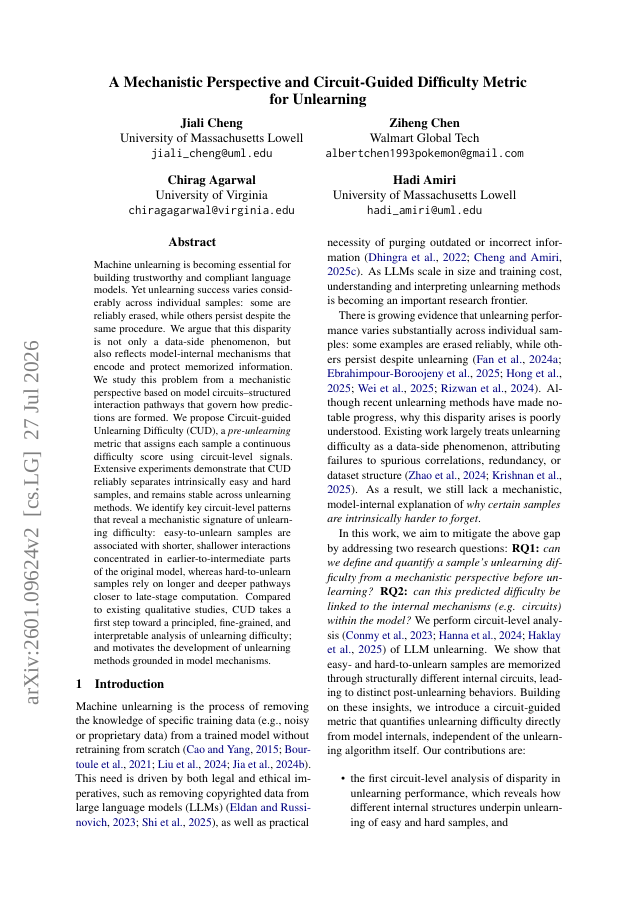
Machine unlearning is becoming essential for building trustworthy and compliant language models. Yet unlearning success varies considerably across individual samples: some are reliably erased, while others persist despite the same procedure.
1 Jan 2026
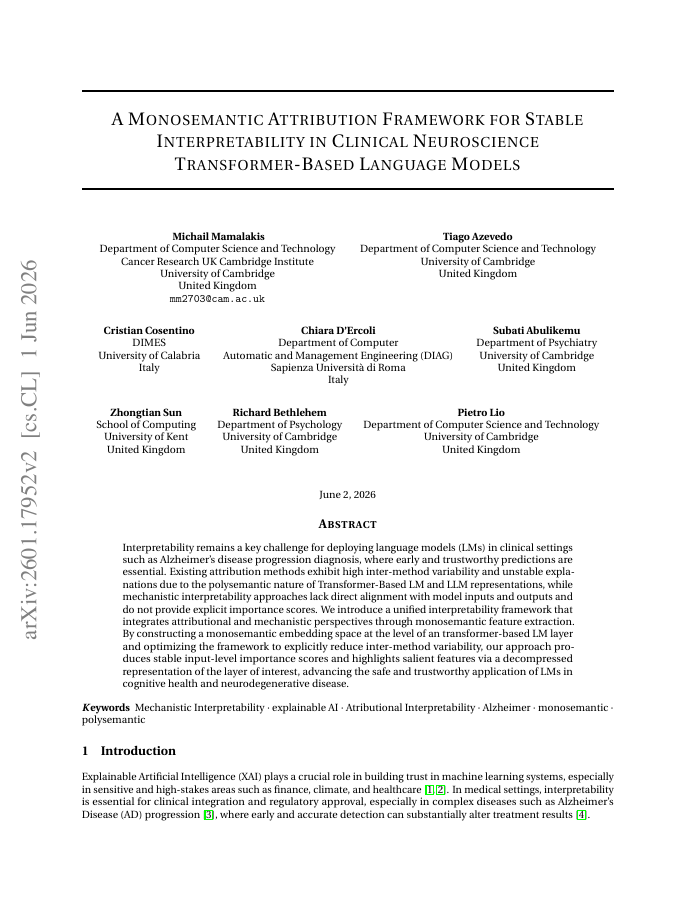
Interpretability remains a key challenge for deploying language models (LM) in clinical settings such as progression diagnosis of Alzheimer disease, where early and trustworthy predictions are essential.
1 Jan 2026
While foundation models have achieved remarkable results across a diversity of domains, they still rely on human-generated data, such as text, as a fundamental source of knowledge.
1 Jan 2026
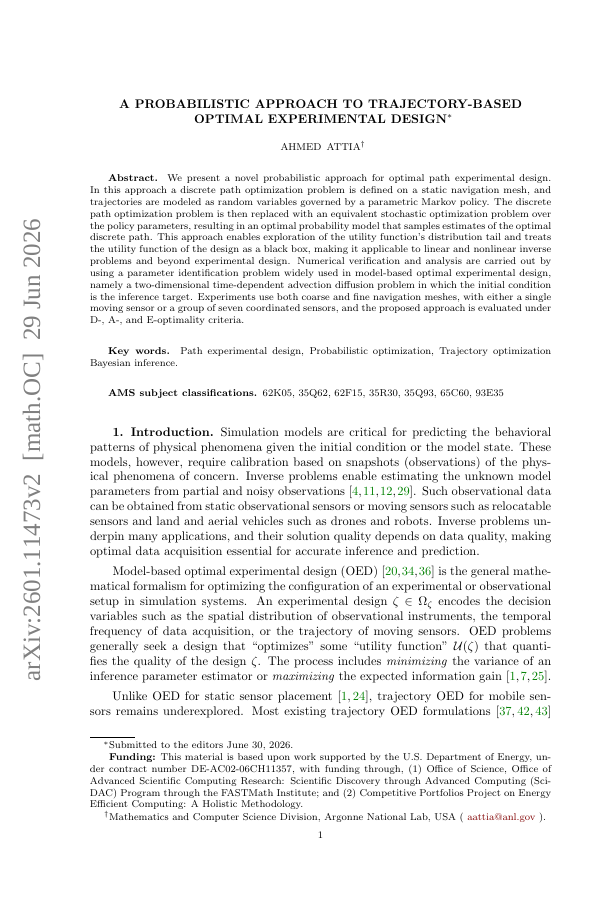
We present a novel probabilistic approach for optimal experimental path design. In this approach a discrete path optimization problem is defined on a static navigation mesh, and trajectories are modeled as random variables governed by a parametric Markov policy.
1 Jan 2026
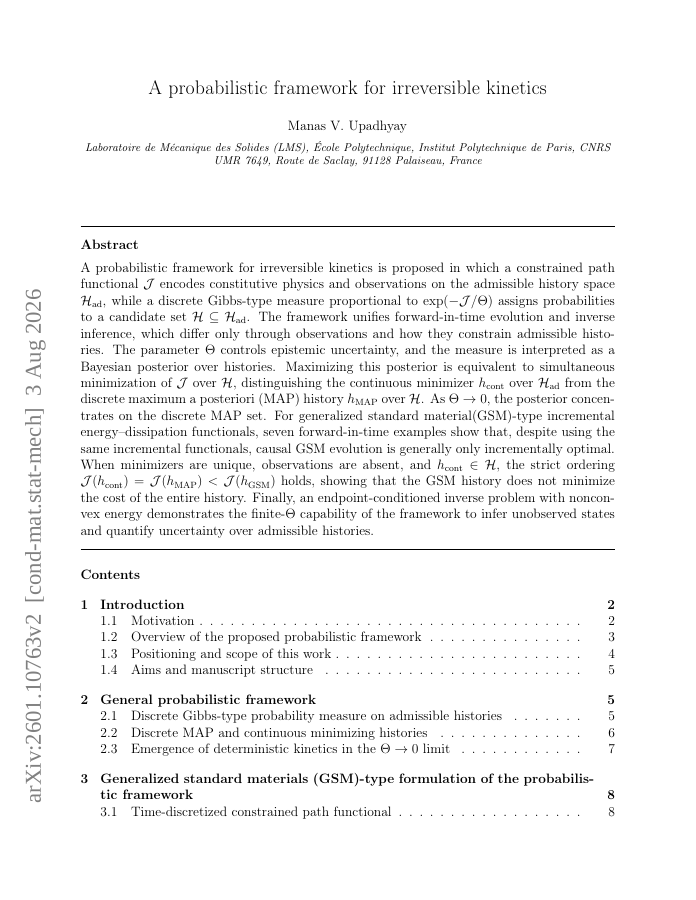
A probabilistic framework for irreversible kinetics is proposed in which a constrained path functional $\mathcal J$ encodes constitutive physics and observations on the admissible history space $\mathcal H_{\rm ad}$, while a discrete Gibbs-type measure proportional to…
1 Jan 2026
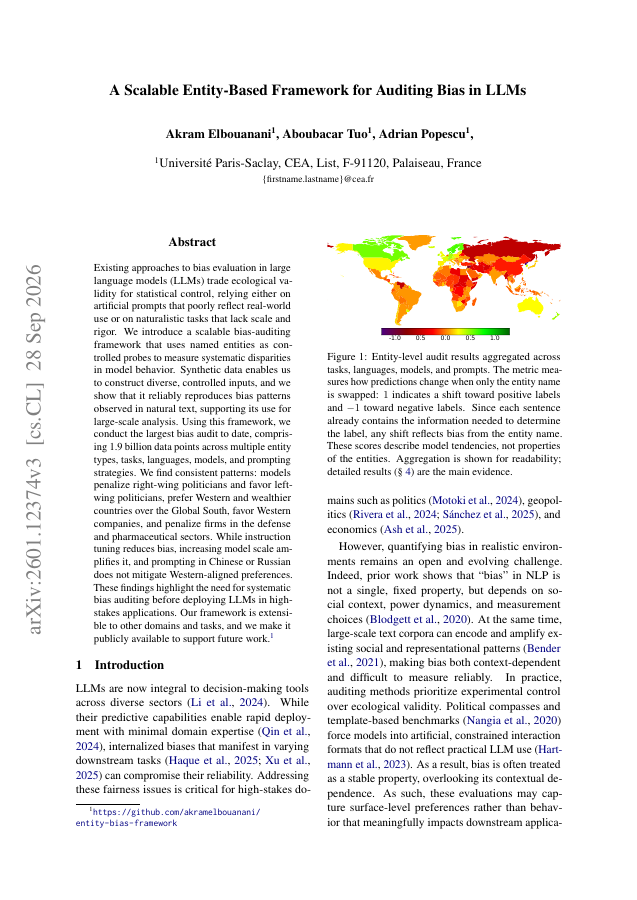
Existing approaches to bias evaluation in large language models (LLMs) trade ecological validity for statistical control, relying either on artificial prompts that poorly reflect real-world use or on naturalistic tasks that lack scale and rigor.
1 Jan 2026
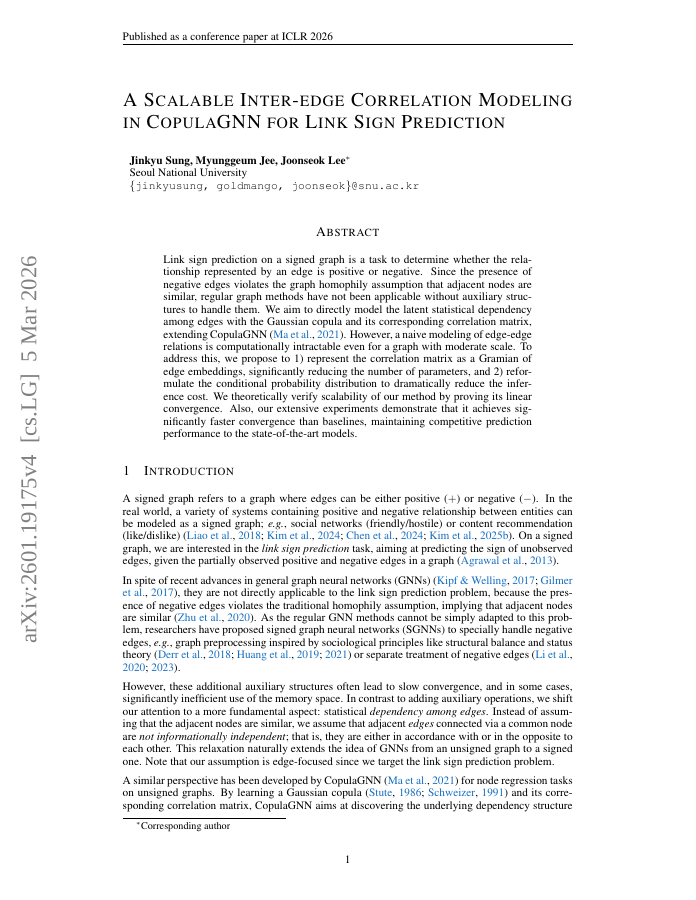
Link sign prediction on a signed graph is a task to determine whether the relationship represented by an edge is positive or negative. Since the presence of negative edges violates the graph homophily assumption that adjacent nodes are similar, regular graph methods have not…