1 Mar 2026
Data leakage has been identified in 648 published papers across 30 scientific fields. The knowledge to prevent it has existed for over a decade; the problem persists because the tools do not enforce what the textbooks teach.
Trending research and the full catalog - each paper linked to the benchmarks, methods, and models it introduces.
Filtering here covers the 2,000 most recent papers, as much as one page can hold in memory. See the full index of 22,736 papers.
1 Mar 2026
Data leakage has been identified in 648 published papers across 30 scientific fields. The knowledge to prevent it has existed for over a decade; the problem persists because the tools do not enforce what the textbooks teach.
1 Mar 2026
Delineating the clinical target volume (CTV) in radiotherapy involves complex margins constrained by tumor location and anatomical barriers. While deep learning models automate this process, their rigid reliance on expert-annotated data requires costly retraining whenever…
1 Mar 2026
Accurate financial volatility forecasting is crucial but challenged by the non-linear, highly correlated nature of market data. Recently, quantum computing has emerged as a promising paradigm for solving complex high-dimensional sampling problems.
1 Mar 2026
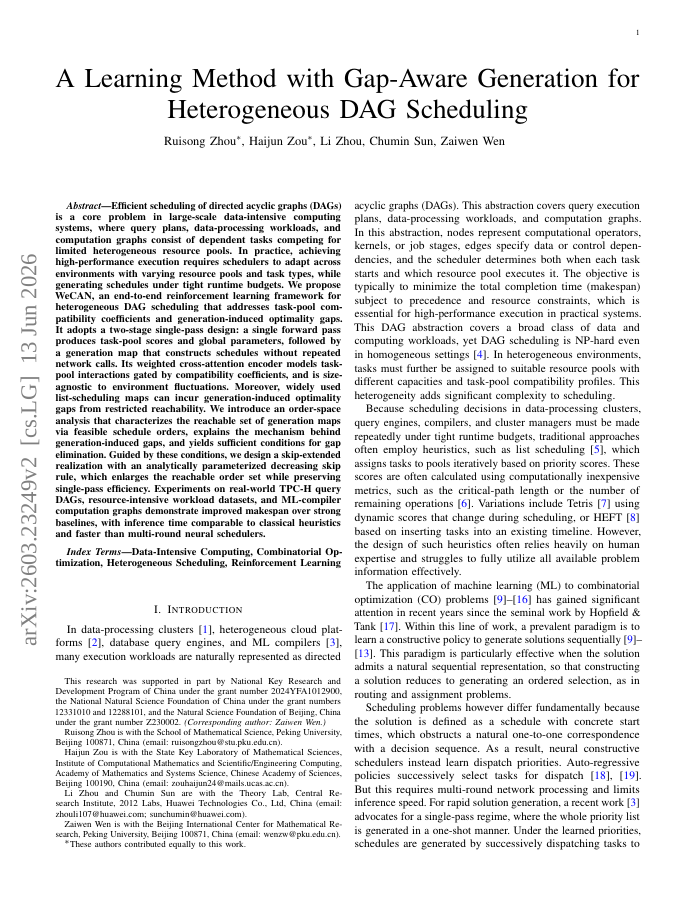
Efficient scheduling of directed acyclic graphs (DAGs) is a core problem in large-scale data-intensive computing systems, where query plans, data-processing workloads, and computation graphs consist of dependent tasks competing for limited heterogeneous resource pools.
1 Mar 2026
Brand advertising plays a critical role in building long-term consumer awareness and loyalty, making it a key objective for advertisers across digital platforms. Although real-time bidding has been extensively studied, there is limited literature on algorithms specifically…
1 Mar 2026
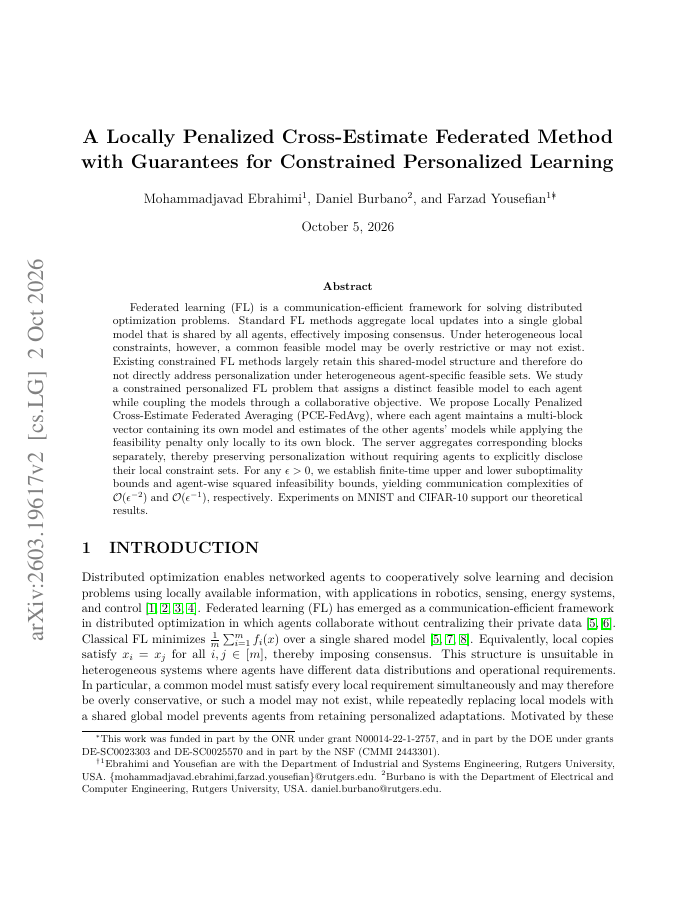
Federated learning (FL) is a communication-efficient framework for solving distributed optimization problems. Standard FL methods aggregate local updates into a single global model that is shared by all agents, effectively imposing consensus.
1 Mar 2026
Accurate modeling of gas flow through porous media is critical for many technological applications, including reservoir performance prediction, carbon capture and sequestration, and fuel cells and batteries.
1 Mar 2026
We propose a control-theoretic framework for evolutionary clustering based on quasi-stationary Mean Field Games. Each cluster is represented by a probability density whose evolution is governed by a Fokker--Planck equation, while the associated velocity field is determined…
1 Mar 2026
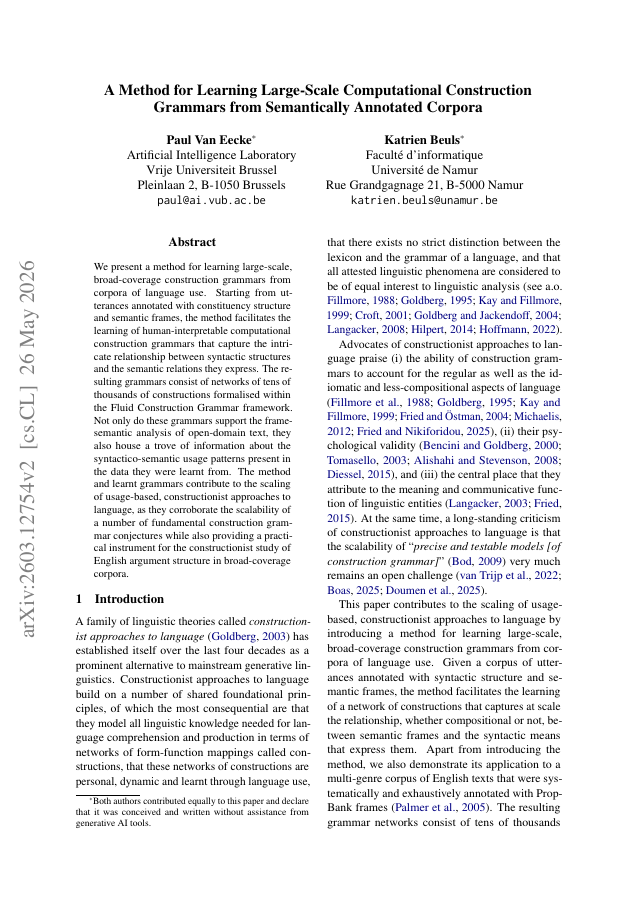
We present a method for learning large-scale, broad-coverage construction grammars from corpora of language use. Starting from utterances annotated with constituency structure and semantic frames, the method facilitates the learning of human-interpretable computational…
1 Mar 2026
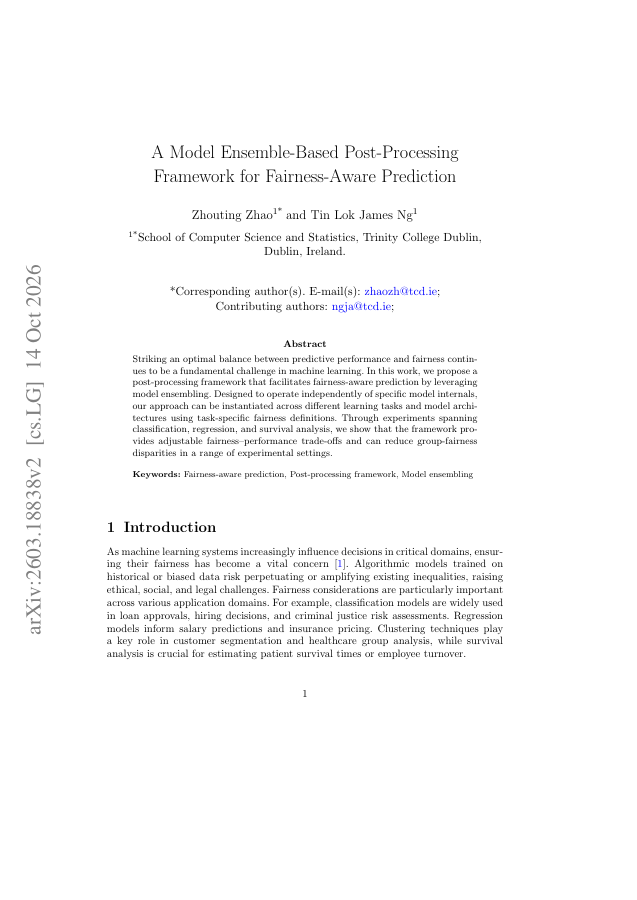
Striking an optimal balance between predictive performance and fairness continues to be a fundamental challenge in machine learning. In this work, we propose a post-processing framework that facilitates fairness-aware prediction by leveraging model ensembling.
1 Mar 2026
Accurately estimating human mobility in peripheral regional economies presents a fundamental measurement challenge: physical ground-truth sensors are sparse, behavioral intent signals are heterogeneous, and environmental friction introduces systematic bias into demand inference.
1 Mar 2026
Artificial intelligence in molecular science must move beyond pattern recognition toward chemically valid and interpretable reasoning. We present a task-adaptive large reasoning model that integrates chemical knowledge through a synergistic multispecialist architecture,…
1 Mar 2026
Large language models (LLMs) display a unified "general factor" of capability across 10 benchmarks (a finding confirmed by our factor analysis of 156 models), yet they still struggle with simple, trivial tasks for humans.
1 Mar 2026
Existing convergence analyses of distributed optimization methods in non-Euclidean geometries typically rely on kernel assumptions: (i) global Lipschitz smoothness and (ii) bi-convexity of the associated Bregman divergence function.
1 Mar 2026
In this paper, we present a network structure for classifying metadata of cuneiform tablets. The problem is of practical importance, as the size of the existing corpus far exceeds the number of experts available to analyze it.
1 Mar 2026
We introduce FCBNet, an efficient model designed for camouflaged weed detection. The architecture is based on a fully frozen ConvNeXt backbone, the proposed Feature Correction Block (FCB), which leverages efficient convolutions for feature refinement, and a lightweight decoder.
1 Mar 2026
We revisit the standard perturbation-based approach of Abernethy et al. (2008) in the context of unconstrained Bandit Linear Optimization (uBLO). We show the surprising result that in the unconstrained setting, this approach effectively reduces Bandit Linear Optimization (BLO)…
1 Mar 2026
Accurate cardiovascular risk prediction is crucial for preventive healthcare; however, the development of robust Artificial Intelligence (AI) models is hindered by the fragmentation of clinical data across institutions due to stringent privacy regulations.
1 Mar 2026
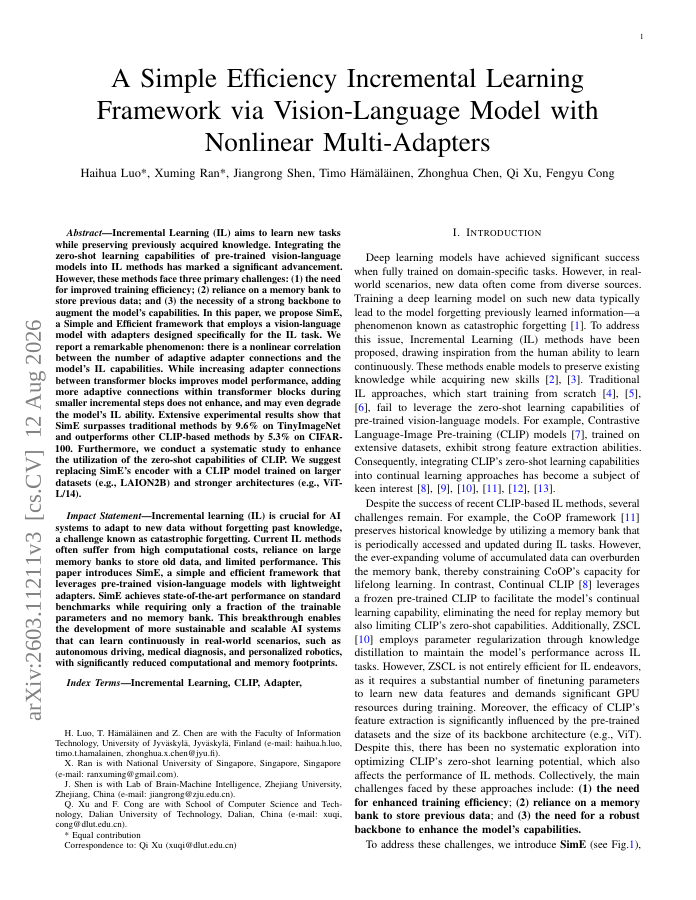
Incremental Learning (IL) aims to learn new tasks while preserving previously acquired knowledge. Integrating the zero-shot learning capabilities of pre-trained vision-language models into IL methods has marked a significant advancement.
1 Mar 2026
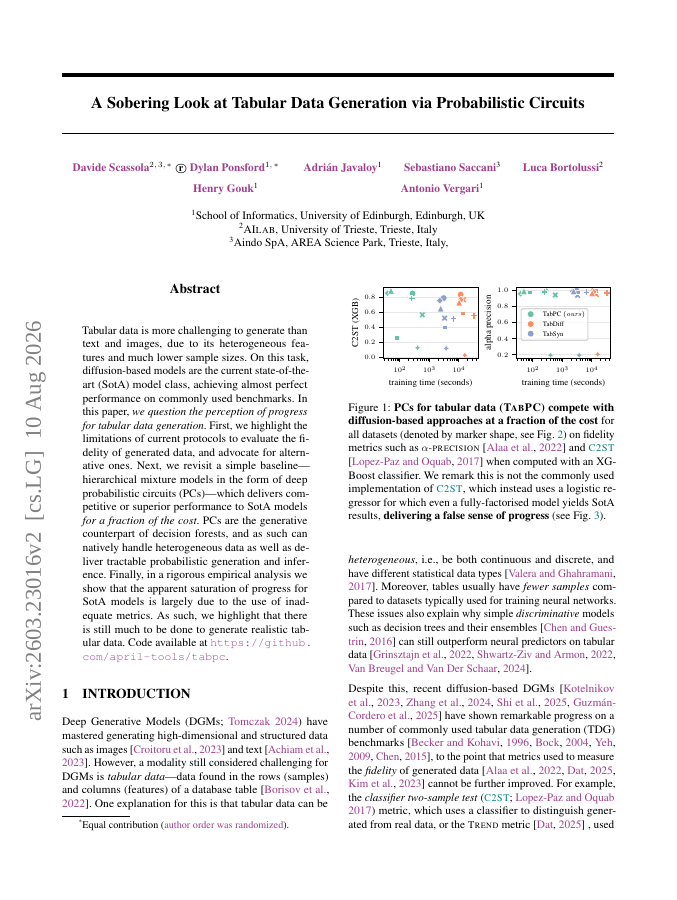
Tabular data is more challenging to generate than text and images, due to its heterogeneous features and much lower sample sizes. On this task, diffusion-based models are the current state-of-the-art (SotA) model class, achieving almost perfect performance on commonly used…
1 Mar 2026
Automatic Speech Recognition (ASR) systems are widely used in everyday communication, education, healthcare, and industry, yet their performance remains uneven across speakers, particularly when dialectal variation diverges from the mainstream accents represented in training…
1 Mar 2026
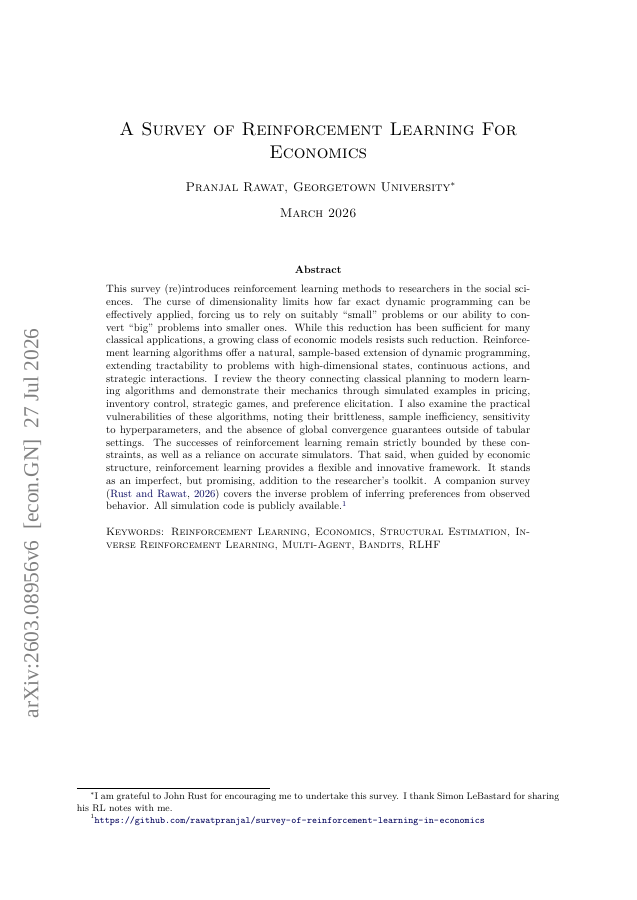
This survey (re)introduces reinforcement learning methods to economists. The curse of dimensionality limits how far exact dynamic programming can be effectively applied, forcing us to rely on suitably "small" problems or our ability to convert "big" problems into…
1 Mar 2026
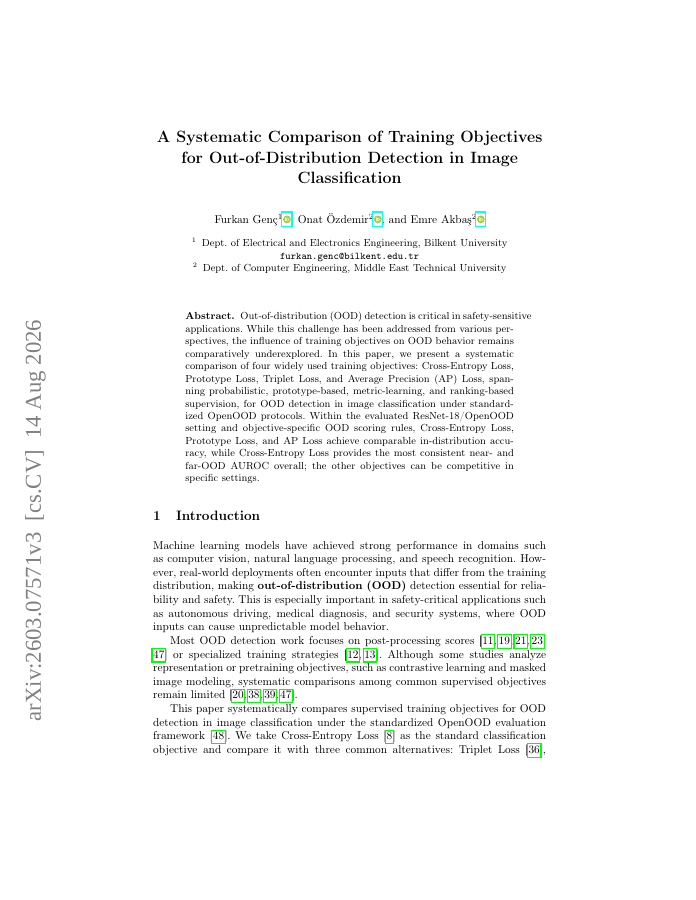
Out-of-distribution (OOD) detection is critical in safety-sensitive applications. While this challenge has been addressed from various perspectives, the influence of training objectives on OOD behavior remains comparatively underexplored.
1 Mar 2026
The identification of hazardous driving behaviors from in-cabin video streams is essential for enhancing road safety and supporting the detection of traffic violations and unsafe driver actions.