30 Oct 2026
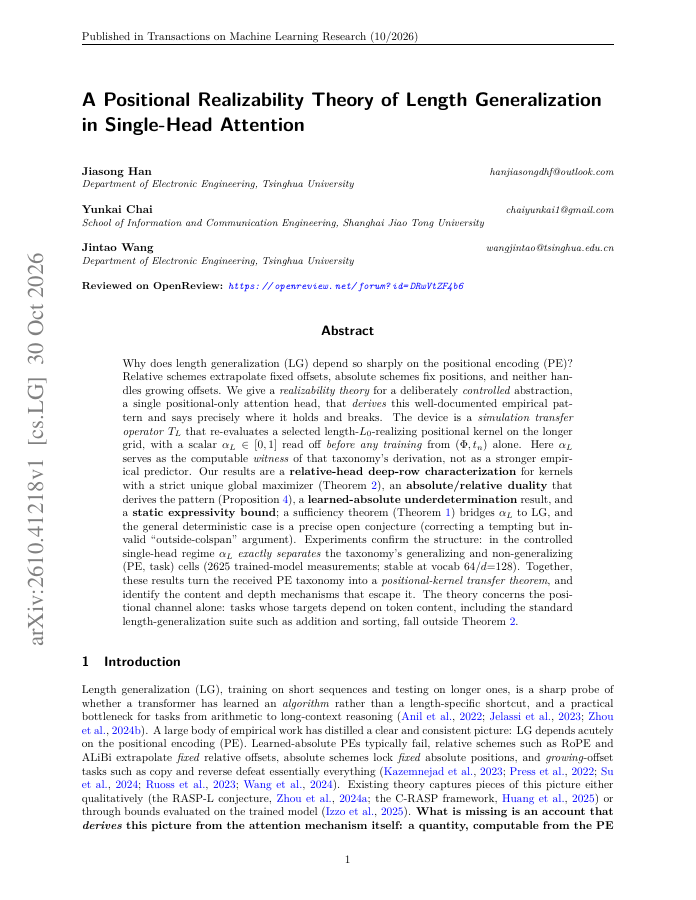
Why does length generalization (LG) depend so sharply on the positional encoding (PE)? Relative schemes extrapolate fixed offsets, absolute schemes fix positions, and neither handles growing offsets.
Trending research and the full catalog - each paper linked to the benchmarks, methods, and models it introduces.
Filtering here covers the 2,000 most recent papers, as much as one page can hold in memory. See the full index of 22,841 papers.
30 Oct 2026
Why does length generalization (LG) depend so sharply on the positional encoding (PE)? Relative schemes extrapolate fixed offsets, absolute schemes fix positions, and neither handles growing offsets.
30 Oct 2026
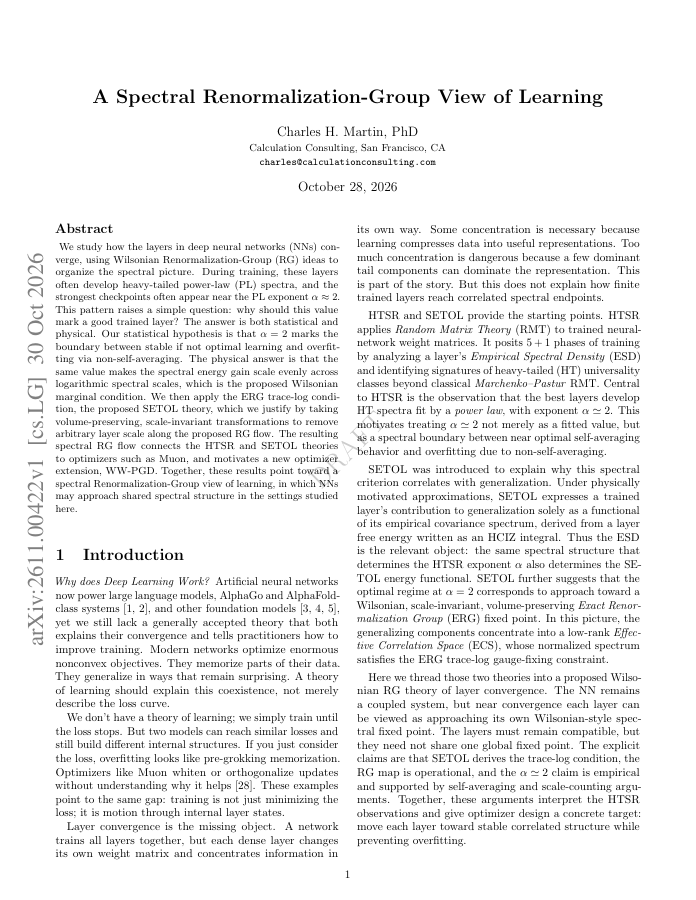
We study how the layers in deep neural networks (NNs) converge, using Wilsonian Renormalization-Group (RG) ideas to organize the spectral picture. During training, these layers often develop heavy-tailed power-law (PL) spectra, and the strongest checkpoints often appear near the…
30 Oct 2026
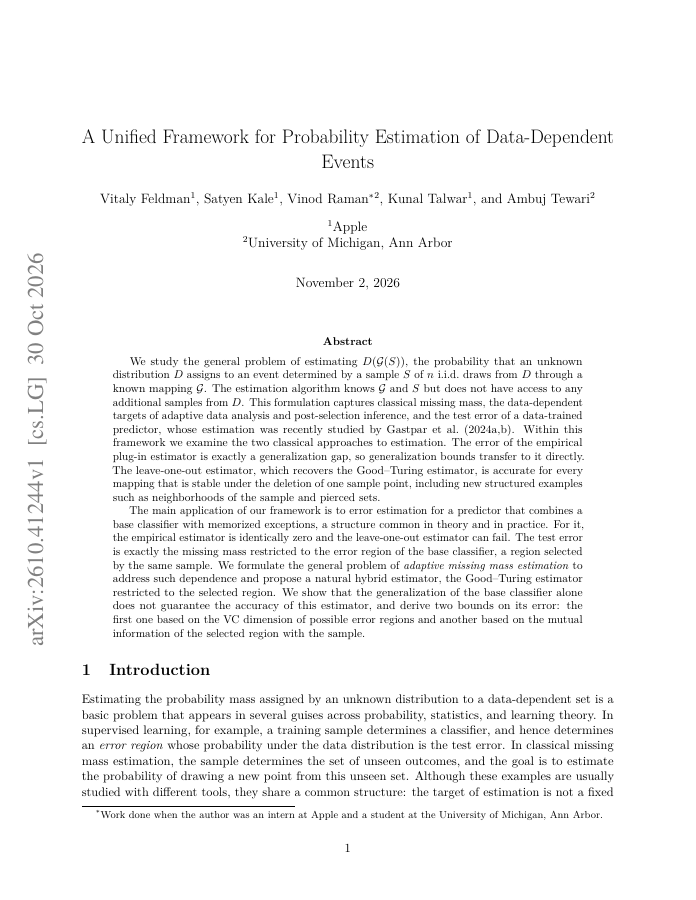
We study the general problem of estimating $D(\dde(S))$, the probability that an unknown distribution $D$ assigns to an event determined by a sample $S$ of $n$ i.i.d.\ draws from $D$ through a known mapping $\dde$.
30 Oct 2026
The widespread deployment of Internet of Things (IoT) devices in critical environments makes anomaly detection essential for identifying abnormal behaviors and supporting timely investigation and response. However, accurate detection alone is insufficient.
29 Oct 2026
Coding agents increasingly rely on automated approvers to decide whether a proposed shell command may run. Existing approvers, from rule-based checkers to guardrail models and deployed permission classifiers, base their decisions on the text of the request and command.
29 Oct 2026
In recent years, a growing number of online retail companies have embraced deep learning models for demand forecasting, leveraging their scalability in processing large-scale datasets.
29 Oct 2026
Large language models (LLMs) are increasingly used as computational models of human language processing, yet it remains unclear which components of their representations drive alignment with neural activity.
29 Oct 2026
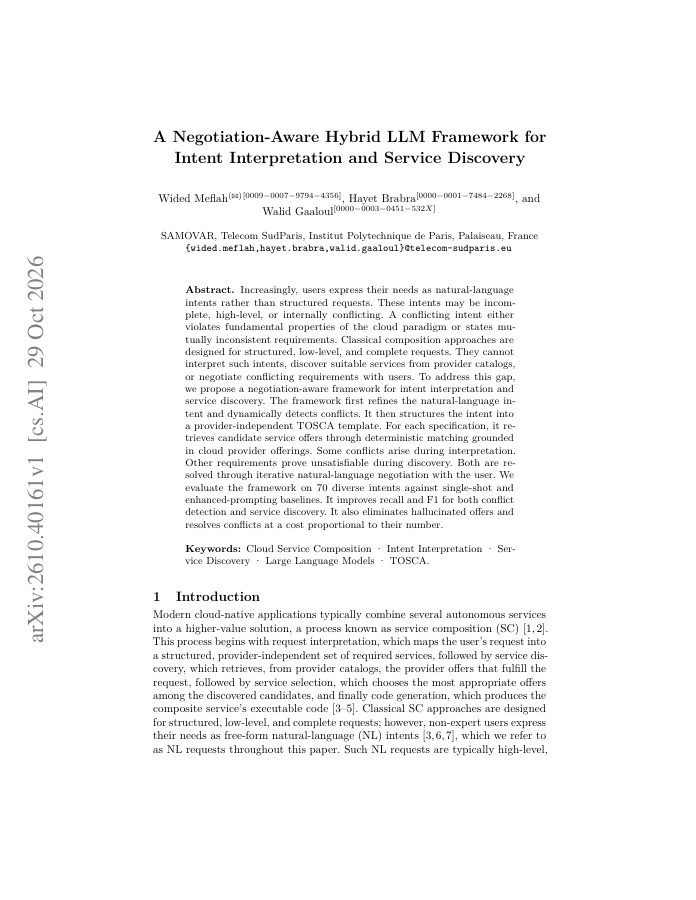
Increasingly, users express their needs as natural-language intents rather than structured requests. These intents may be incomplete, high-level, or internally conflicting.
29 Oct 2026
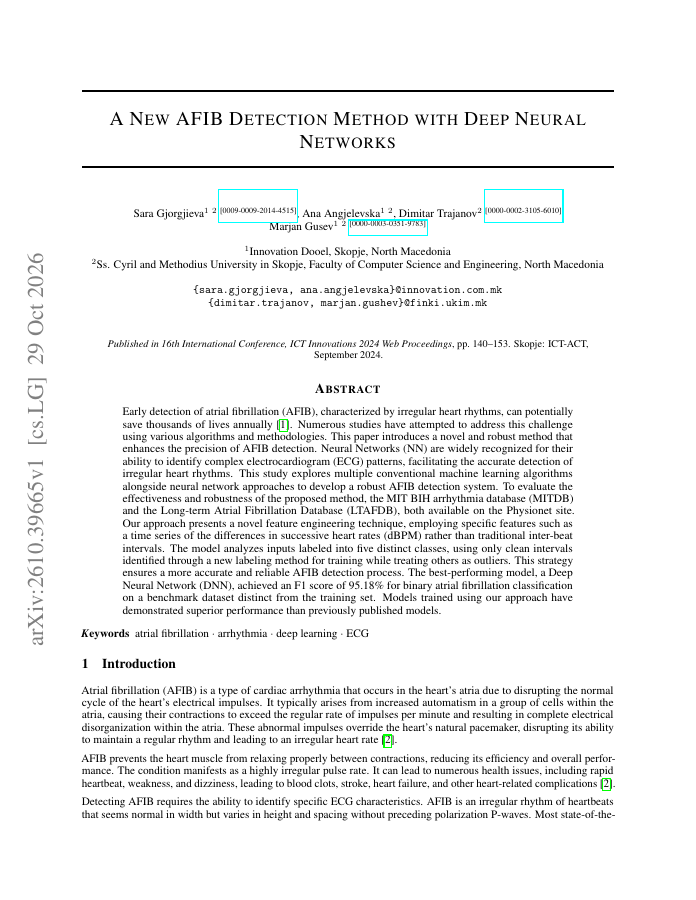
Early detection of atrial fibrillation (AFIB), characterized by irregular heart rhythms, can potentially save thousands of lives annually [20]. Numerous studies have attempted to address this challenge using various algorithms and methodologies.
29 Oct 2026
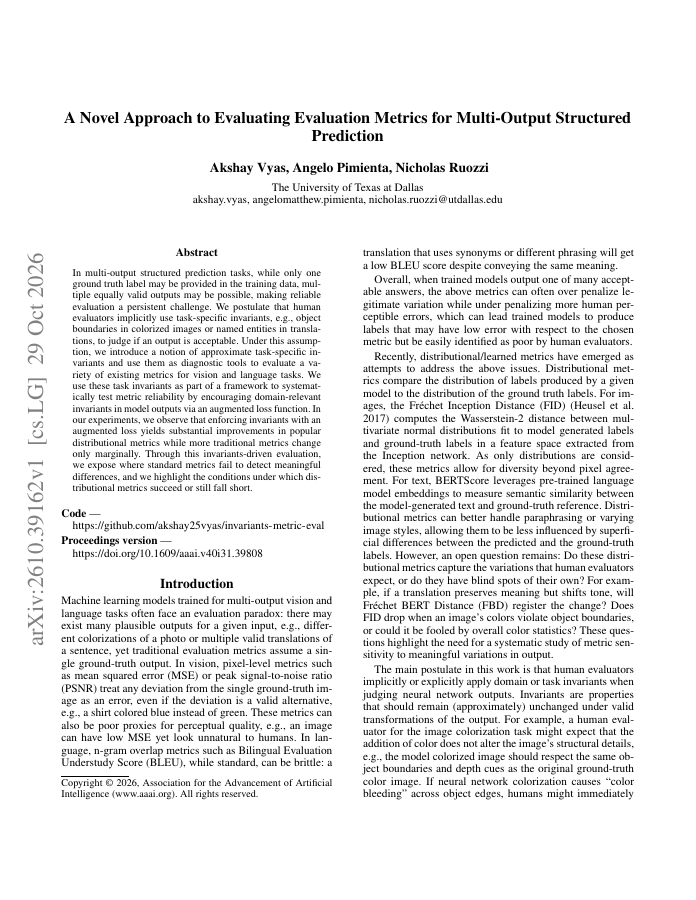
In multi-output structured prediction tasks, while only one ground truth label may be provided in the training data, multiple equally valid outputs may be possible, making reliable evaluation a persistent challenge.
29 Oct 2026
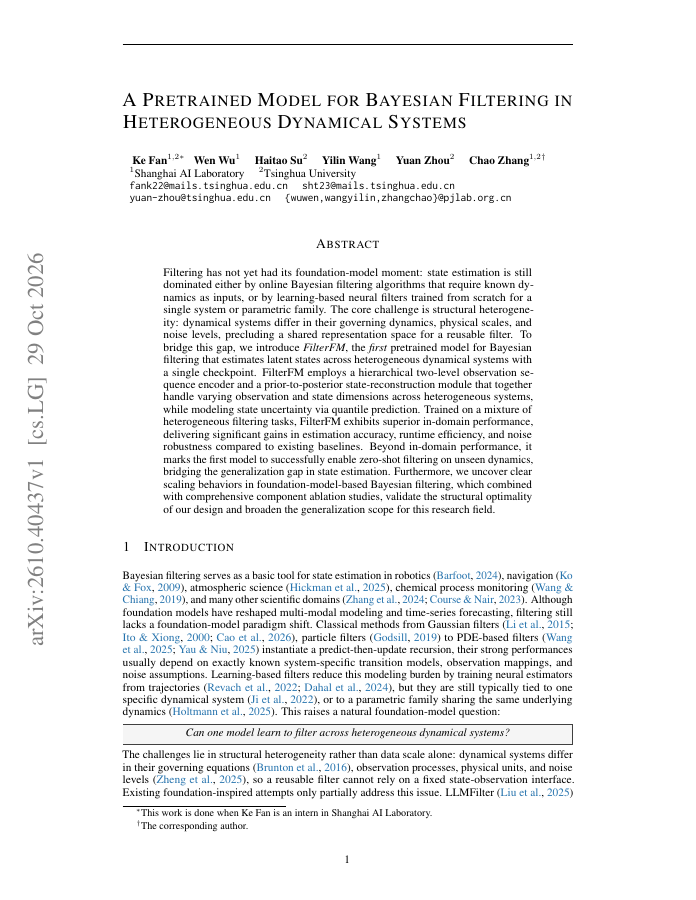
Filtering has not yet had its foundation-model moment: state estimation is still dominated either by online Bayesian filtering algorithms that require known dy- namics as inputs, or by learning-based neural filters trained from scratch for a single system or parametric family.
29 Oct 2026
In this work, we provide a formal framework and mathematical definition for the subset of foundation models focused on enabling the property of "any-task inference" (ATI) (similar to zero-shot inference), rather than those designed for pre-training fine-tuning.
29 Oct 2026
Low-bit quantization enables efficient deployment of large language models by reducing memory footprint and computational cost. Achieving high accuracy at low precision requires selecting quantization ranges, linear transformations, and weight rounding decisions.
28 Oct 2026
Large language models (LLMs) frequently fail at multi-digit arithmetic, but the underlying mechanisms governing these failures remain poorly understood. While recent work demonstrates that addition errors follow a "noisy quantisation" model localised around carry…
28 Oct 2026
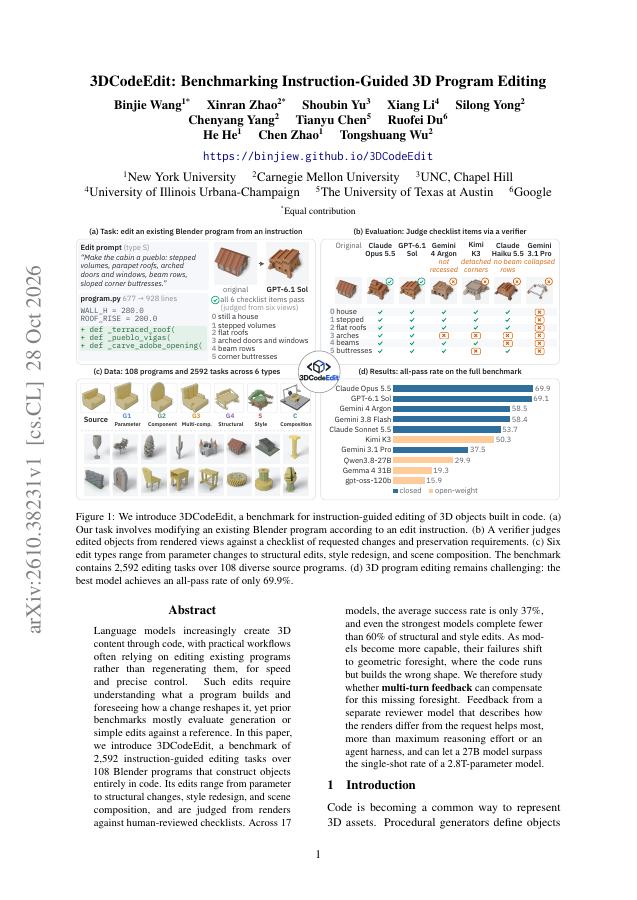
Language models increasingly create 3D content through code, with practical workflows often relying on editing existing programs rather than regenerating them, for speed and precise control.
28 Oct 2026
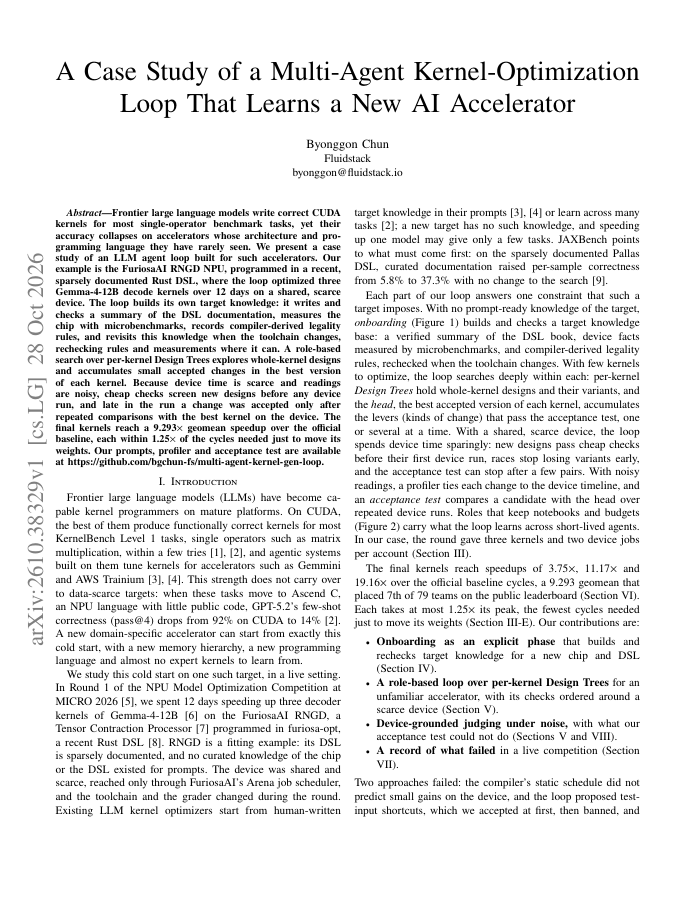
Frontier large language models write correct CUDA kernels for most single-operator benchmark tasks, yet their accuracy collapses on accelerators whose architecture and programming language they have rarely seen.
28 Oct 2026
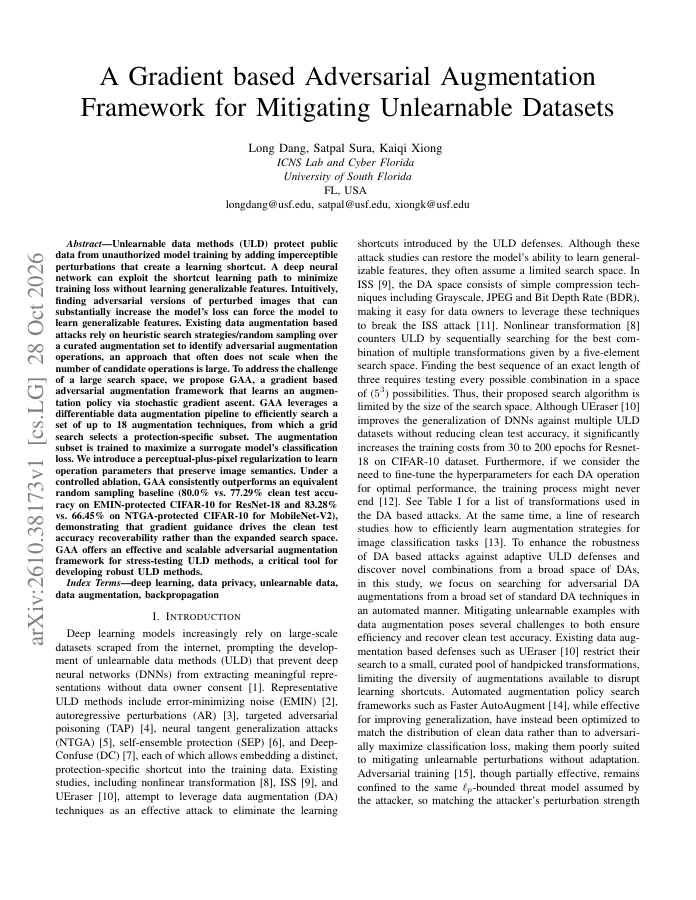
Unlearnable data methods (ULD) protect public data from unauthorized model training by adding imperceptible perturbations that create a learning shortcut. A deep neural network can exploit the shortcut learning path to minimize training loss without learning generalizable…
28 Oct 2026
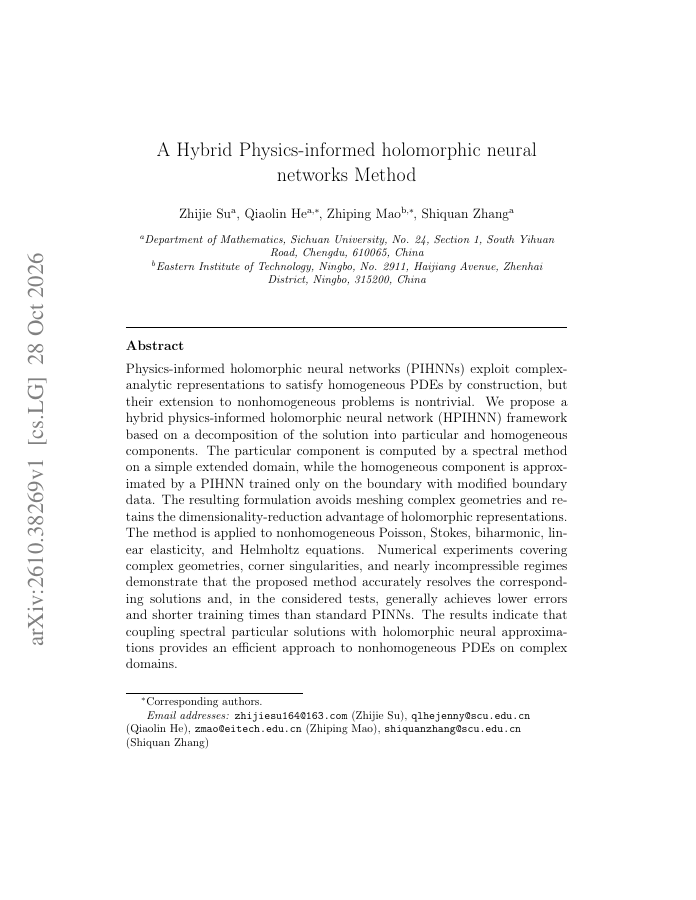
Physics-informed holomorphic neural networks (PIHNNs) exploit complex-analytic representations to satisfy homogeneous PDEs by construction, but their extension to nonhomogeneous problems is nontrivial.
28 Oct 2026
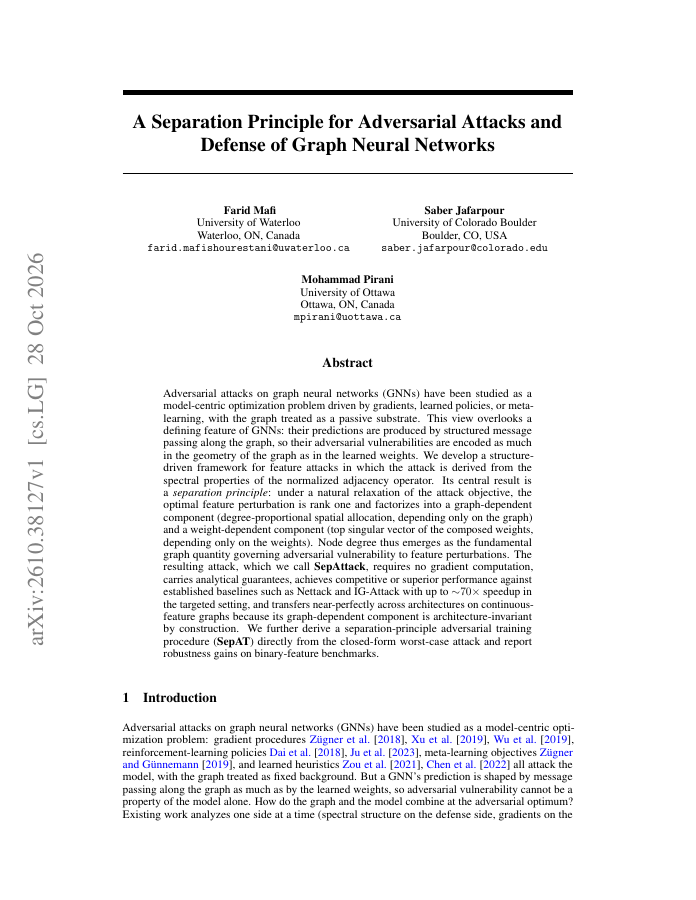
Adversarial attacks on graph neural networks (GNNs) have been studied as a model-centric optimization problem driven by gradients, learned policies, or meta-learning, with the graph treated as a passive substrate.
28 Oct 2026
Learning independence is fundamental to statistical inference and machine learning, yet learning independence between entire time series by a test remains challenging when only a single observation record is available.
28 Oct 2026
Music audio generation spans instrumental clips, full songs with vocals, edits of existing recordings, and systems that play alongside a musician in real time. This monograph explains the methods behind these systems for readers familiar with neural-network training who are new…
28 Oct 2026
A depth lower bound for ReLU networks asserts that every shallower network errs on some input; we ask when a weak theory can prove such a bound so that an error can be computed.
27 Oct 2026
Automatic speech recognition (ASR) systems often perform less accurately for speakers of regional dialects, but less is known about how users respond to these limitations and how regional voices produced by voice assistants (VAs) are evaluated through a sociolinguistic lens.
27 Oct 2026
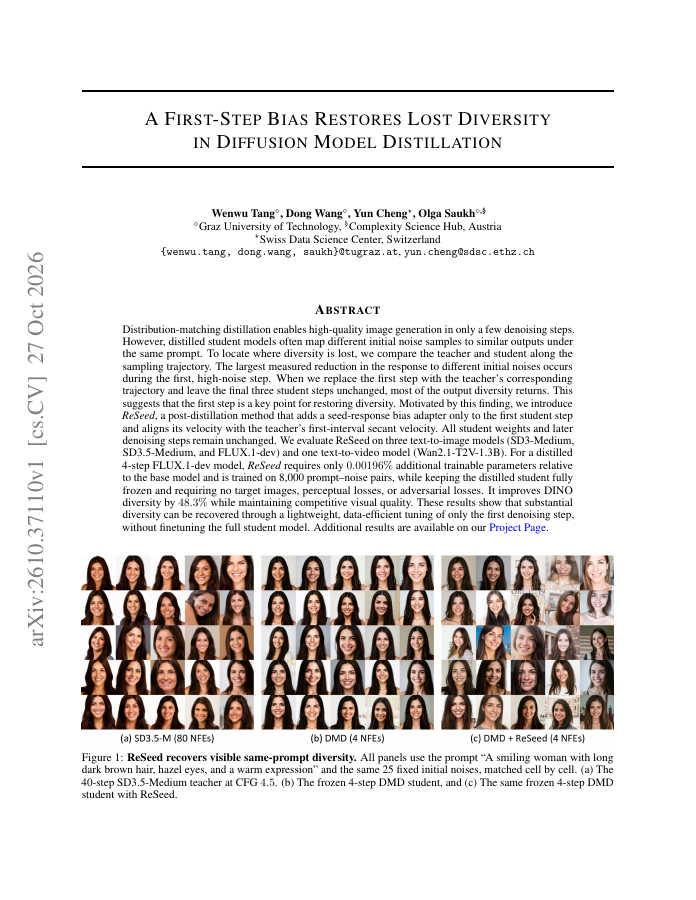
Distribution-matching distillation enables high-quality image generation in only a few denoising steps. However, distilled student models often map different initial noise samples to similar outputs under the same prompt.