3 Nov 2026
While conversational recommendation systems provide a more natural user interface, they face the challenge of progressively discovering a user's needs before they can recommend an item that satisfies them.
Trending research and the full catalog - each paper linked to the benchmarks, methods, and models it introduces.
Filtering here covers the 2,000 most recent papers, as much as one page can hold in memory. See the full index of 22,841 papers.
3 Nov 2026
While conversational recommendation systems provide a more natural user interface, they face the challenge of progressively discovering a user's needs before they can recommend an item that satisfies them.
3 Nov 2026
The classical model-based optimal design criteria (D-, T-, L-, C-, and A-optimality) are usually motivated via the Cramér--Rao bound as optimizing scalar functions of the Fisher information matrix (FIM).
3 Nov 2026
In-context learning (ICL) lets a pretrained language model perform a task specified by demonstrations in its prompt, with no parameter updates. With arbitrary labels the model must acquire a mapping it cannot have memorized, so the learning happens within a single forward pass.
3 Nov 2026
We study a fundamental problem in machine learning: partial recovery of a planted signal $\boldsymbol{v} \in \mathbb{S}^{n-1}$ from a spiked tensor $\boldsymbol{\mathsf{X}} = λ\, \boldsymbol{v}^{\otimes p} + \boldsymbol{\mathsf{Z}}$, where $\boldsymbol{\mathsf{Z}}$ has symmetric…
2 Nov 2026
Sycophancy in language models is well documented as a behaviour but poorly localised as a mechanism. We ask whether capitulation under user pushback, the abandonment of a correct answer when a user objects, corresponds to a linear direction in the residual stream, and whether…
2 Nov 2026
Large language models provide a variety of responses at inference (generation) that conventionally depend on a temperature parameter. Using a conditional mutual information approach, a quantitative, entropy based analysis of response variety is given.
2 Nov 2026
Long-lived agents rely on persistent memory of users, tasks and decisions, and this memory must stay consistent with a world that keeps changing. When an upstream fact changes, however, memory systems can revise the contradicted memory itself while the beliefs, plans and actions…
1 Nov 2026
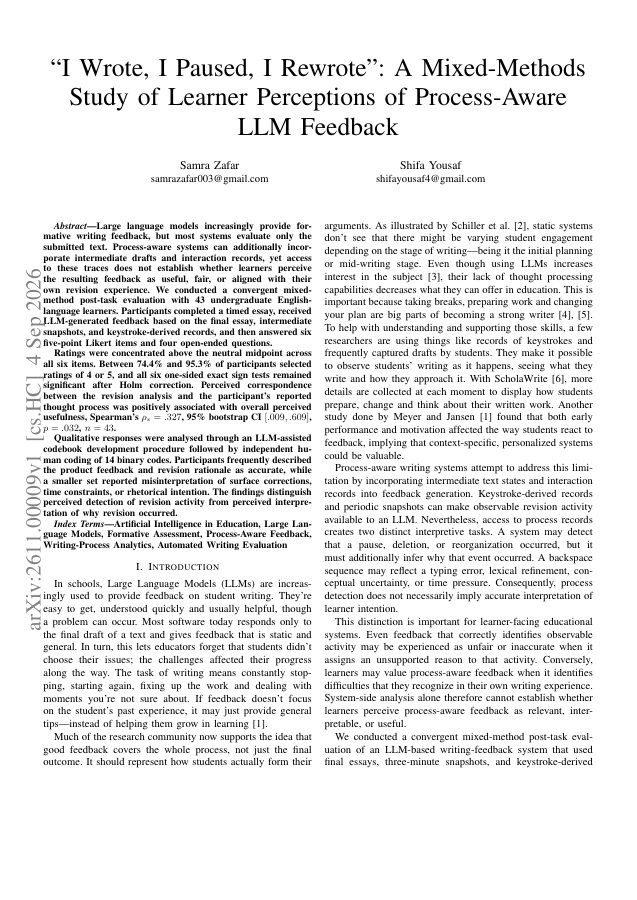
Large language models increasingly provide formative writing feedback, but most systems evaluate only the submitted text. Process-aware systems can additionally incorporate intermediate drafts and interaction records, yet access to these traces does not establish whether…
1 Nov 2026
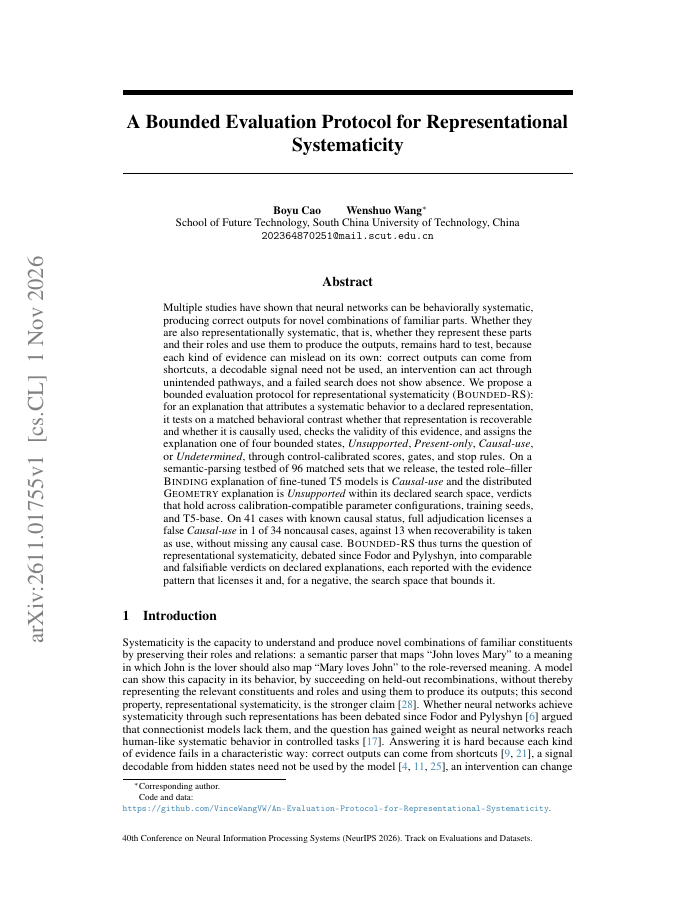
Multiple studies have shown that neural networks can be behaviorally systematic, producing correct outputs for novel combinations of familiar parts. Whether they are also representationally systematic, that is, whether they represent these parts and their roles and use them to…
1 Nov 2026
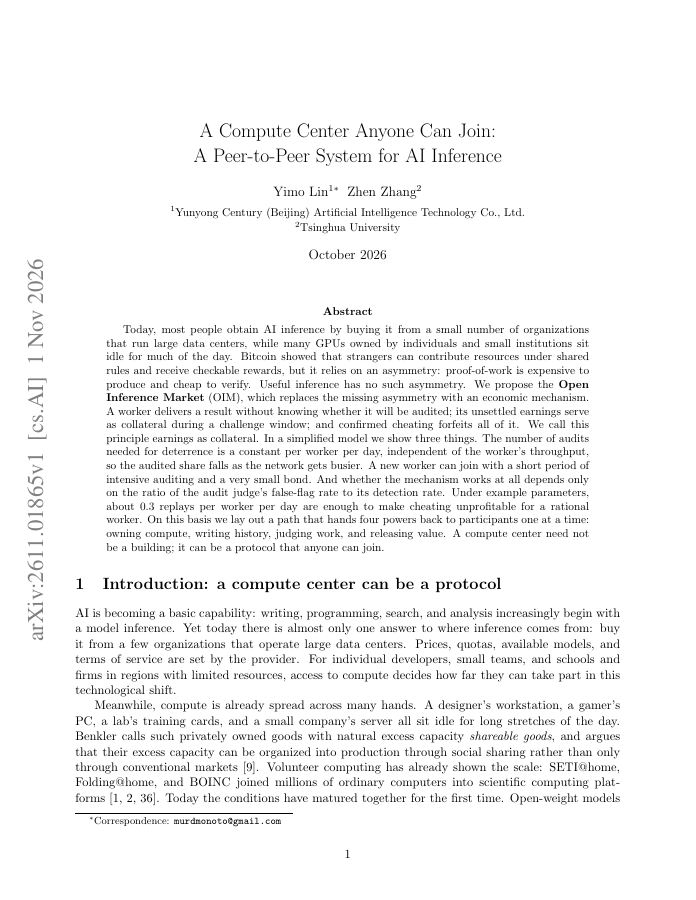
Today, most people obtain AI inference by buying it from a small number of organizations that run large data centers, while many GPUs owned by individuals and small institutions sit idle for much of the day.
1 Nov 2026
In recent years, electric vehicles (EVs) have attracted much attention due to their potential to decarbonize the transport system. EV charging imposes challenges on power grids, such as load imbalance and voltage instability.
1 Nov 2026
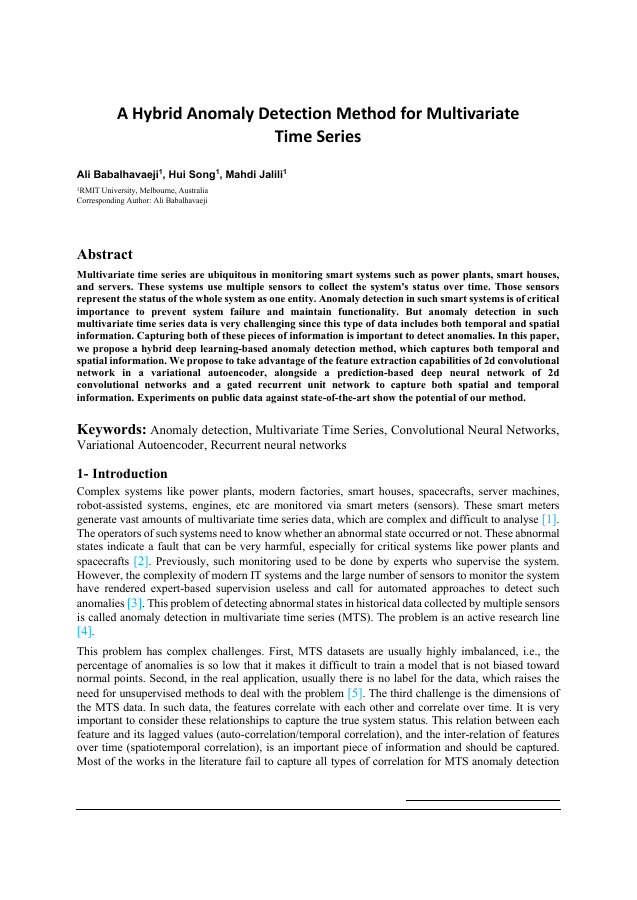
Multivariate time series are ubiquitous in monitoring smart systems such as power plants, smart houses, and servers. These systems use multiple sensors to collect the system's status over time. Those sensors represent the status of the whole system as one entity.
1 Nov 2026
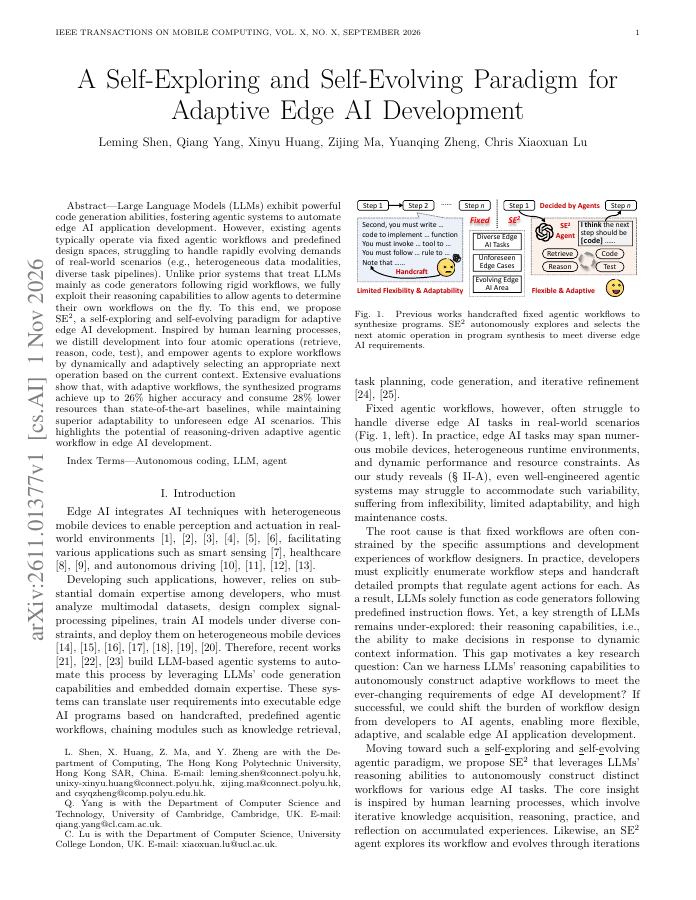
Large Language Models (LLMs) exhibit powerful code generation abilities, fostering agentic systems to automate edge AI application development. However, existing agents typically operate via fixed agentic workflows and predefined design spaces, struggling to handle rapidly…
31 Oct 2026
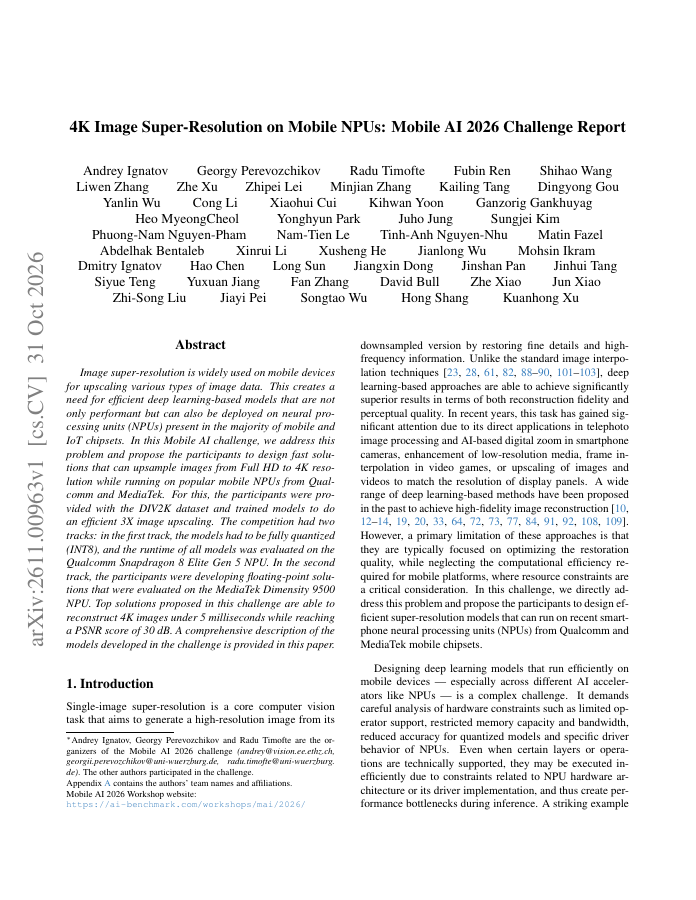
Image super-resolution is widely used on mobile devices for upscaling various types of image data. This creates a need for efficient deep learning-based models that are not only performant but can also be deployed on neural processing units (NPUs) present in the majority of…
31 Oct 2026
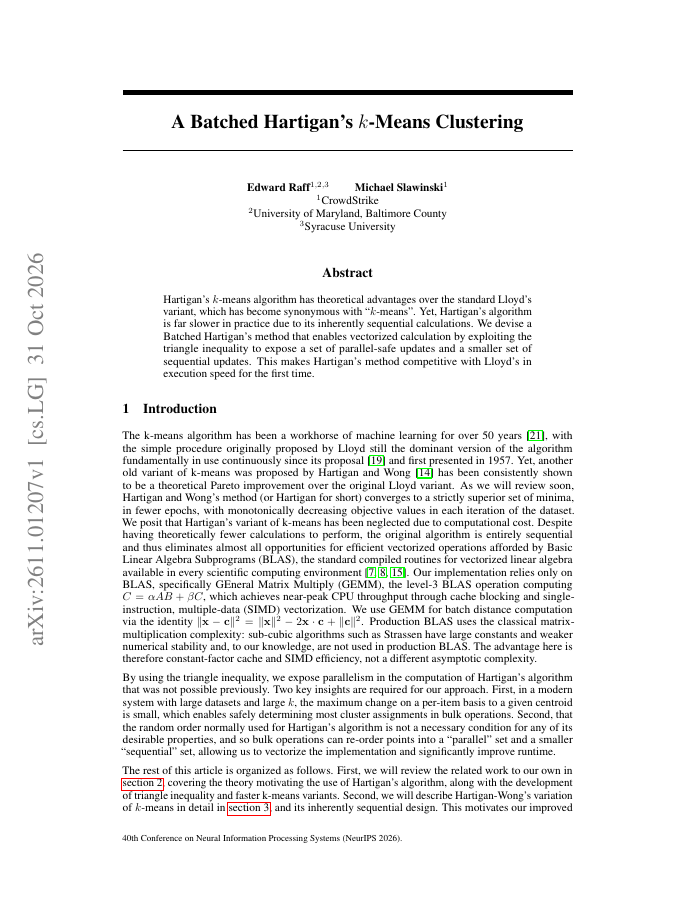
Hartigan's $k$-means algorithm has theoretical advantages over the standard Lloyd's variant, which has become synonymous with "$k$-means". Yet, Hartigan's algorithm is far slower in practice due to its inherently sequential calculations.
31 Oct 2026
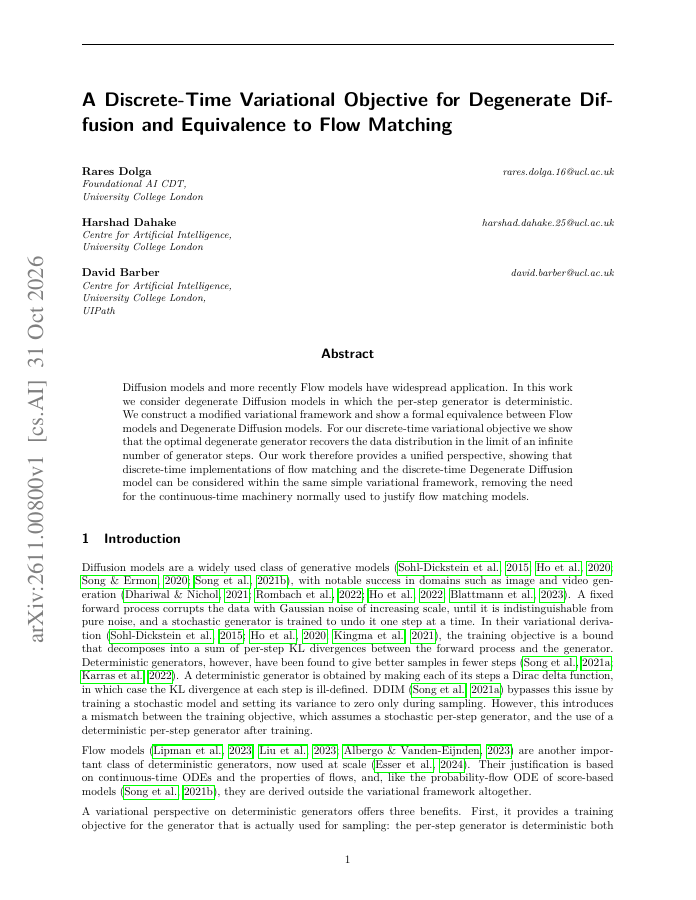
Diffusion models and more recently Flow models have widespread application. In this work we consider degenerate Diffusion models in which the per-step generator is deterministic.
31 Oct 2026
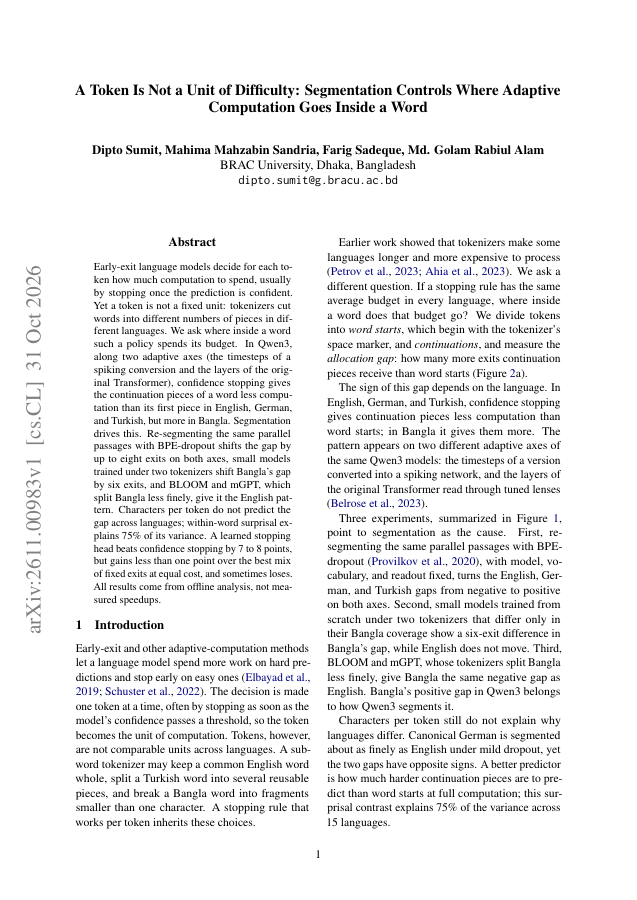
Early-exit language models decide for each token how much computation to spend, usually by stopping once the prediction is confident. Yet a token is not a fixed unit: tokenizers cut words into different numbers of pieces in different languages.
31 Oct 2026
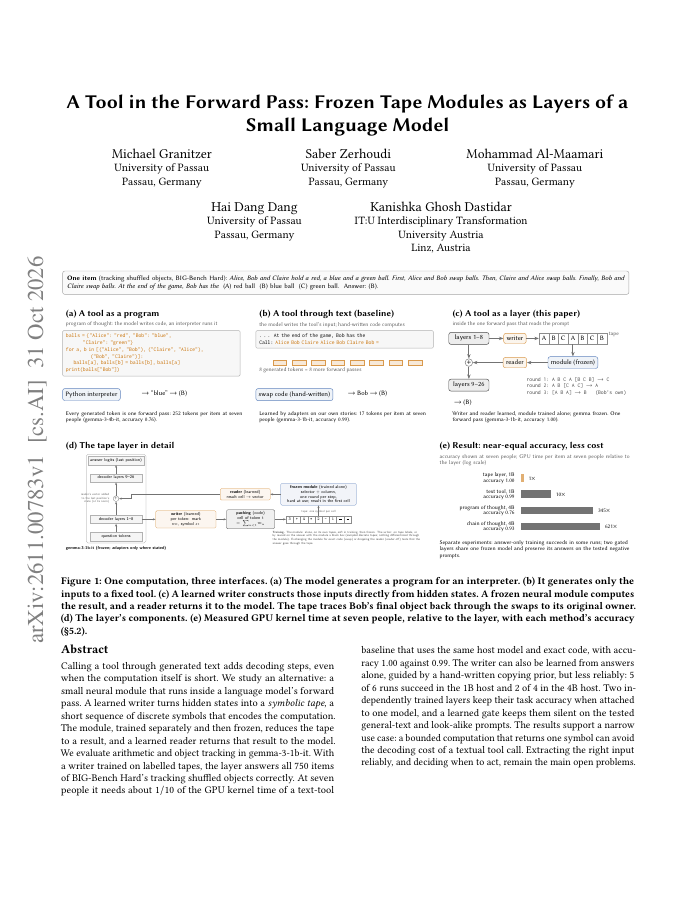
Calling a tool through generated text adds decoding steps, even when the computation itself is short. We study an alternative: a small neural module that runs inside a language model's forward pass.
30 Oct 2026
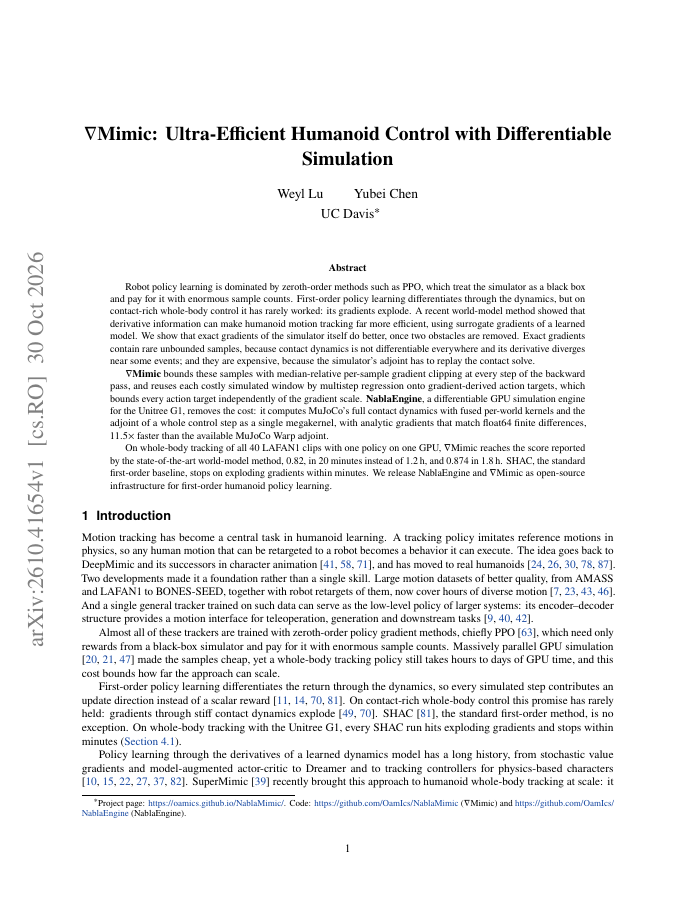
Robot policy learning is dominated by zeroth-order methods such as PPO, which treat the simulator as a black box and pay for it with enormous sample counts. First-order policy learning differentiates through the dynamics, but on contact-rich whole-body control it has rarely…
30 Oct 2026
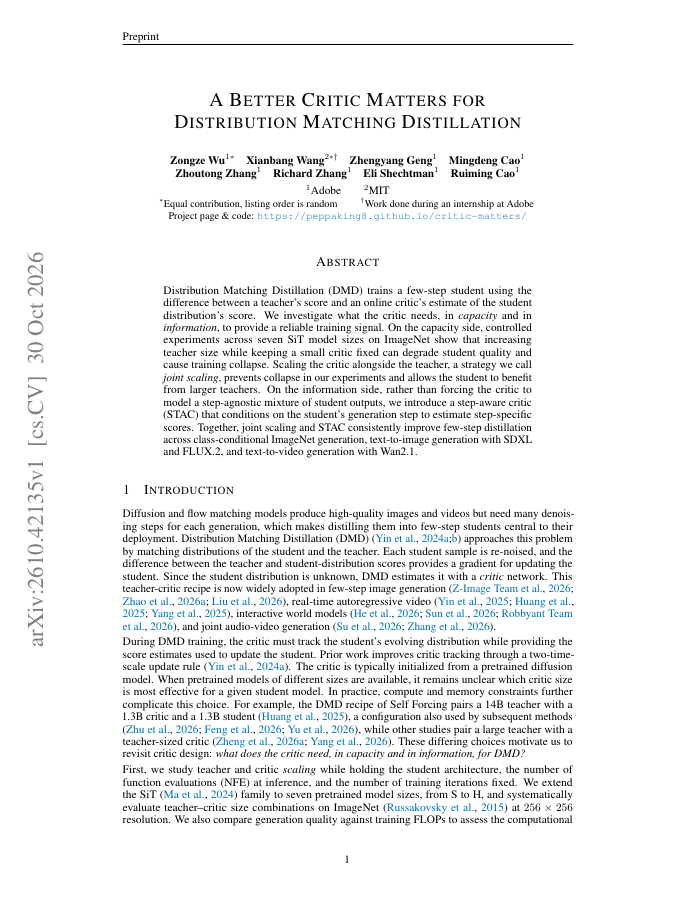
Distribution Matching Distillation (DMD) trains a few-step student using the difference between a teacher's score and an online critic's estimate of the student distribution's score.
30 Oct 2026
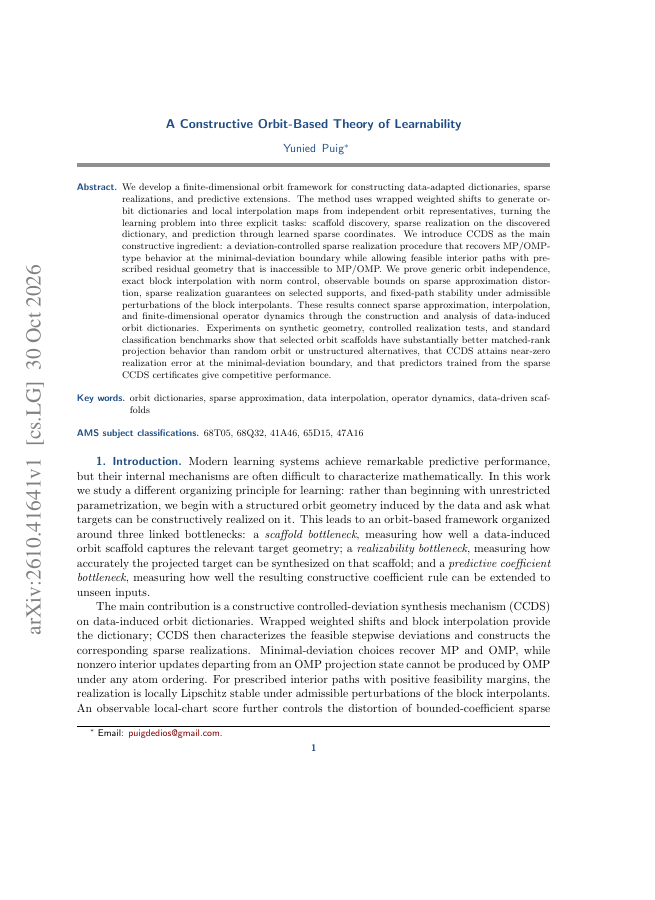
We develop a finite-dimensional orbit framework for constructing data-adapted dictionaries, sparse realizations, and predictive extensions. The method uses wrapped weighted shifts to generate orbit dictionaries and local interpolation maps from independent orbit representatives,…
30 Oct 2026
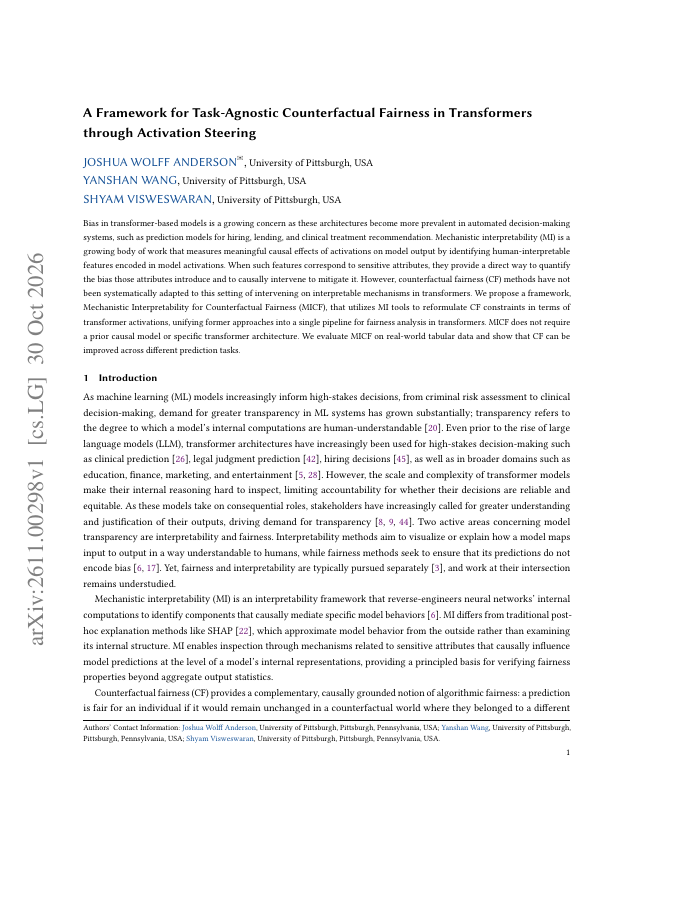
Bias in transformer-based models is a growing concern as these architectures become more prevalent in automated decision-making systems, such as prediction models for hiring, lending, and clinical treatment recommendation.
30 Oct 2026
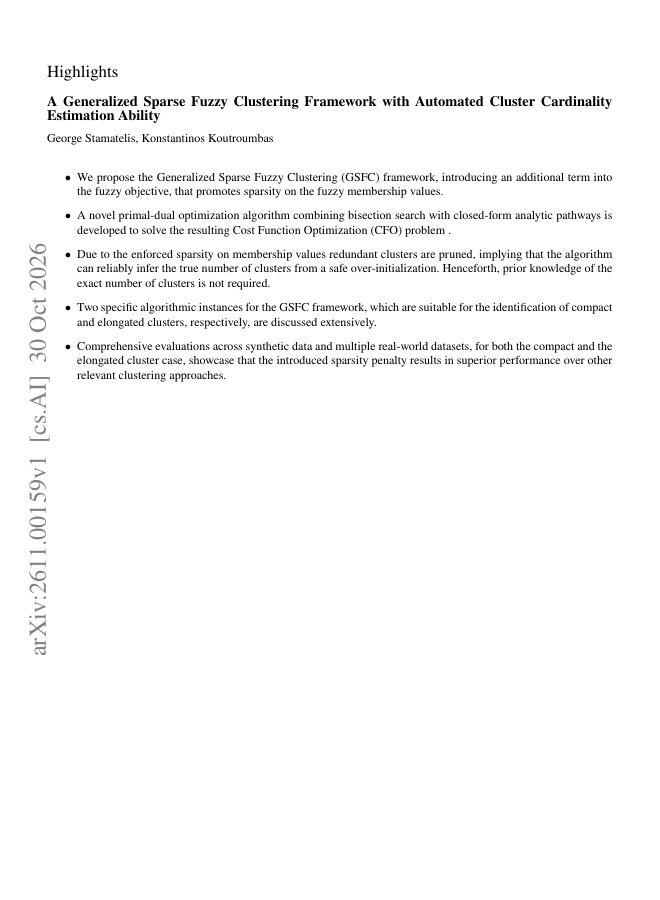
Fuzzy clustering provides a robust framework for handling ambiguous and overlapping data boundaries, yet its traditional formulation generates entirely dense membership assignments that limit noise resilience and prevent estimating the true number of clusters, when it is…
30 Oct 2026
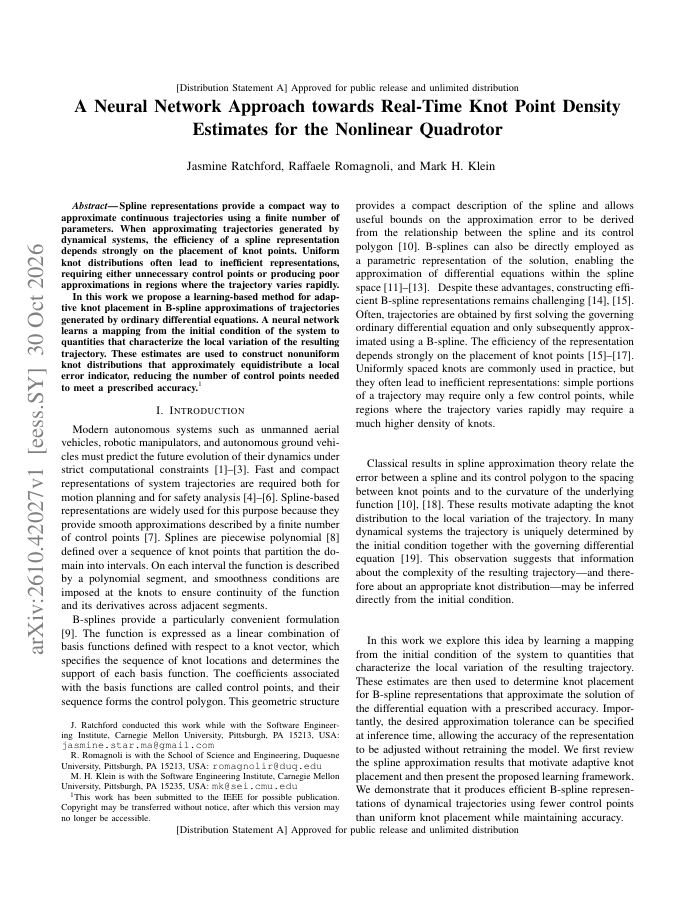
Spline representations provide a compact way to approximate continuous trajectories using a finite number of parameters. When approximating trajectories generated by dynamical systems, the efficiency of a spline representation depends strongly on the placement of knot points.