4 Jun 2026
We introduce pVR, a topological machine learning framework for alignment-free genomic sequence classification that combines $p$-adic numbers with topological data analysis.
Trending research and the full catalog - each paper linked to the benchmarks, methods, and models it introduces.
Filtering here covers the 2,000 most recent papers, as much as one page can hold in memory. See the full index of 22,929 papers.
4 Jun 2026
We introduce pVR, a topological machine learning framework for alignment-free genomic sequence classification that combines $p$-adic numbers with topological data analysis.
4 Jun 2026
Autonomous underwater vehicle (AUV) launch and recovery (LAR) into the hull of an advancing host platform requires traversal of a complex, three-dimensional propeller wake whose hydrodynamic structure cannot be characterised by a uniform current model.
4 Jun 2026
We prove the positive-real $n=9$ case of the Vasc cyclic inequality. The proof was obtained with human-guided assistance from the AI agent MechMath Agent Team: the human-readable part reduces the rational inequality to a homogeneous polynomial inequality, fixes a cyclic maximum,…
4 Jun 2026
Appropriate reliance on AI advice has become a central research theme in human-AI collaboration. Existing frameworks have focused exclusively on point predictions as AI advice.
4 Jun 2026
Ambulatory neck-surface acceleration enables non-invasive monitoring of vocal hyperfunction, yet robust biomarkers for its subtypes remain limited. This study investigates the NeckVibe Challenge dataset to distinguish phonotraumatic (PVH) and non-phonotraumatic (NPVH) from…
4 Jun 2026
We present the first Komi-Yazva--Russian parallel corpus together with an explicit evaluation protocol for studying LLM translation in an endangered, extremely low-resource setting.
4 Jun 2026
Huntington's disease (HD) is a progressive brain disorder that gradually affects movement, cognitive function, and behavior. Identifying the stage of the disease accurately and consistently is important for understanding its course, grouping patients, personalized care, and…
4 Jun 2026
Across contemplative, philosophical, and psychological accounts, human consciousness is often described along a similar spectrum, ranging from reactive and self-focused patterns to more integrative and coherent ones.
4 Jun 2026
Reinforcement learning from verifiable rewards (RLVR) improves reasoning even when the reward signal is spurious -- assigning credit to the group-plurality answer rather than a ground-truth verifier.
4 Jun 2026
Customer churn prediction is a central task in customer analytics, particularly in non-contractual, pay-per-use service environments where disengagement is not explicitly observed and must be inferred from behavioral inactivity.
4 Jun 2026
Electroencephalography (EEG) offers noninvasive, millisecond resolution recordings of neuronal activity and is widely used in neuroscience and healthcare. Many EEG decoding pipelines rely on covariance descriptors for their robustness to noise, but such representations are…
3 Jun 2026
Although it is generally agreed that AI-generated text poses a broad societal risk, there is no common understanding in the AI-generated text detection literature on what constitutes harmful use.
3 Jun 2026
Helpful-only models, that is, models that are trained to always follow user intent, are valuable for dangerous capability evaluations and other areas of AI R&D where refusals would be an obstacle.
3 Jun 2026
Embodied agents that navigate cities rely on world models that predict how their surroundings will change as they move. But for navigation, what matters is not what the buildings look like; it is where the agent can go.
3 Jun 2026
Technical-standard compliance reasoning may involve incomplete evidence, inconsistent observations, exceptions, and derived normative outputs. This paper presents \textsc{Monir}, a four-valued normative intermediate representation for ASP-oriented compliance workflows.
3 Jun 2026
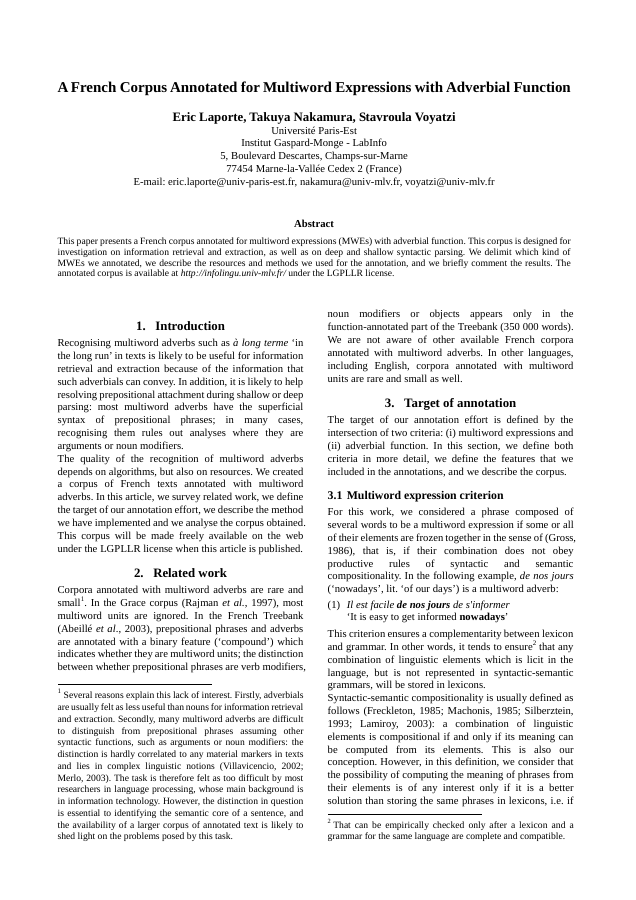
This paper presents a French corpus annotated for multiword expressions (MWEs) with adverbial function. This corpus is designed for investigation on information retrieval and extraction, as well as on deep and shallow syntactic parsing.
3 Jun 2026
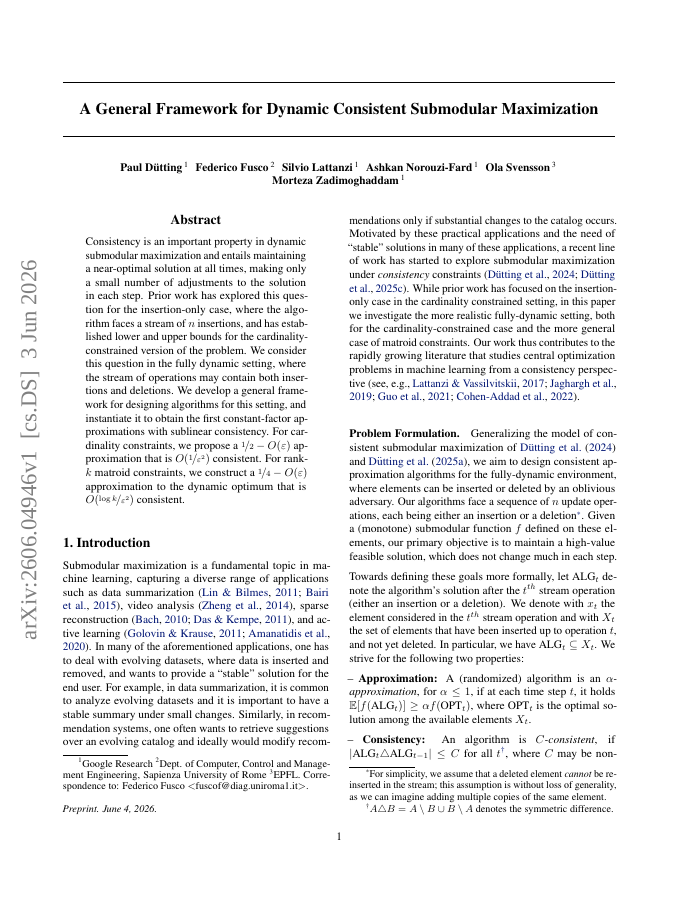
Consistency is an important property in dynamic submodular maximization and entails maintaining a near-optimal solution at all times, making only a small number of adjustments to the solution in each step.
3 Jun 2026
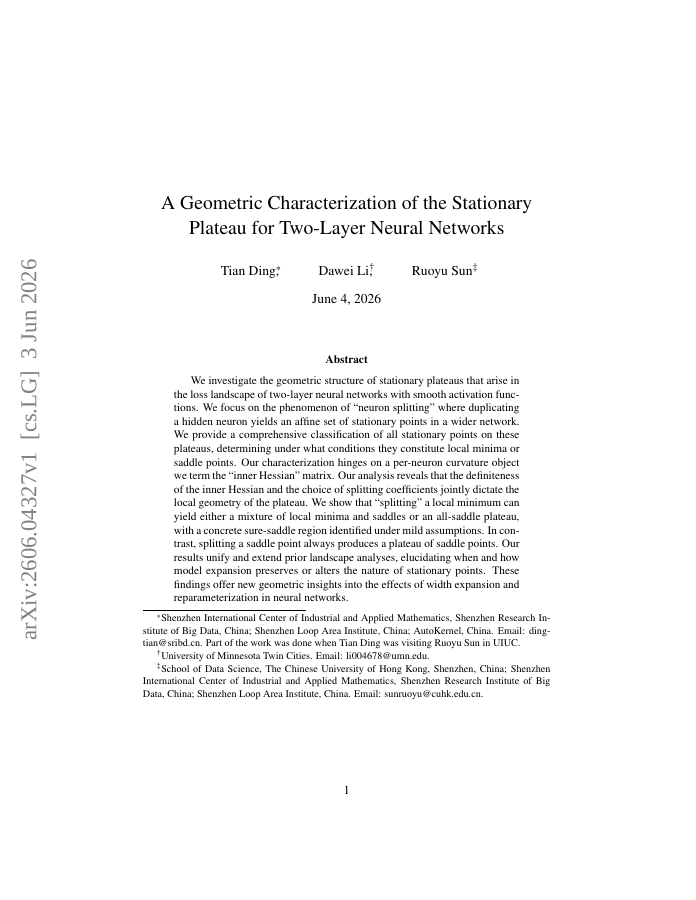
We investigate the geometric structure of stationary plateaus that arise in the loss landscape of two-layer neural networks with smooth activation functions. We focus on the phenomenon of "neuron splitting" where duplicating a hidden neuron yields an affine set of…
3 Jun 2026
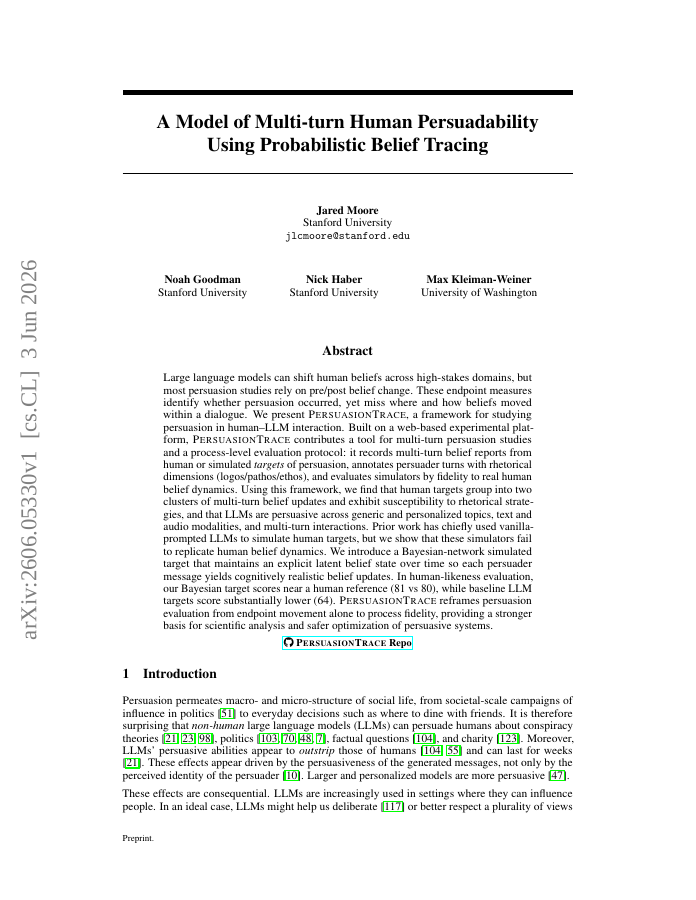
Large language models can shift human beliefs across high-stakes domains, but most persuasion studies rely on pre/post belief change. These endpoint measures identify whether persuasion occurred, yet miss where and how beliefs moved within a dialogue.
3 Jun 2026
Motivational architectures in cognitive AI have largely been designed for physical agents regulating bodily needs. Conversational agents operate in a different regime: their sensorimotor loop is linguistic, their environment is a user's evolving mental state, and their…
3 Jun 2026
Automatic text summarization has become increasingly important due to the rapid growth of digital textual information. This paper presents a Multi-Model Summarization Framework designed to improve the robustness and quality of abstractive text summarization.
3 Jun 2026
Robotic arms capable of traversing arbitrary spatial paths, especially in highly obstructed workspaces, are highly desired across several industries. Quaternion-joints have recently empowered a specific class of robotic arms -- cable-driven redundant manipulators -- beyond its…
3 Jun 2026
Multimodal Large Language Models (MLLMs) are increasingly used for video understanding, yet their reliability under multi-video inputs remains poorly understood. We study positional bias in multi-video summarization, where the quality of a per-video summary can change with the…
3 Jun 2026
MCP (Model Context Protocol) enables LLMs (Large Language Models) to interact with external tools and data sources via a standardized protocol. Its rapid adoption in tool-augmented Artificial Intelligence (AI) workflows has introduced new reliability challenges, such as…