10 Jun 2026
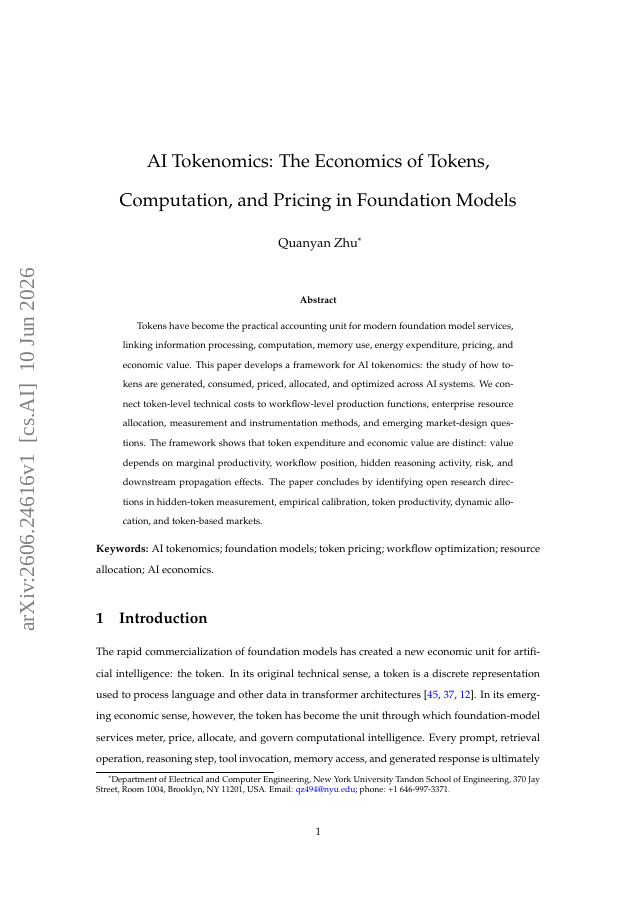
Tokens have become the practical accounting unit for modern foundation model services, linking information processing, computation, memory use, energy expenditure, pricing, and economic value.
Trending research and the full catalog - each paper linked to the benchmarks, methods, and models it introduces.
Filtering here covers the 2,000 most recent papers, as much as one page can hold in memory. See the full index of 22,091 papers.
10 Jun 2026
Tokens have become the practical accounting unit for modern foundation model services, linking information processing, computation, memory use, energy expenditure, pricing, and economic value.
10 Jun 2026
Domain fine-tuning degrades the safety of large language models: fine-tuned specialists readily comply with harmful prompts framed in domain language. Existing inference-time defenses that mix logits from a safe anchor model require both models to share a vocabulary, which rules…
10 Jun 2026
Generic time-series foundation models transfer poorly to wireless network telemetry whose signals are bursty, zero-inflated, and coupled across protocol layers. We present APEX, a network-native, decoder-only transformer for forecasting enterprise AP telemetry, and evaluate it…
10 Jun 2026
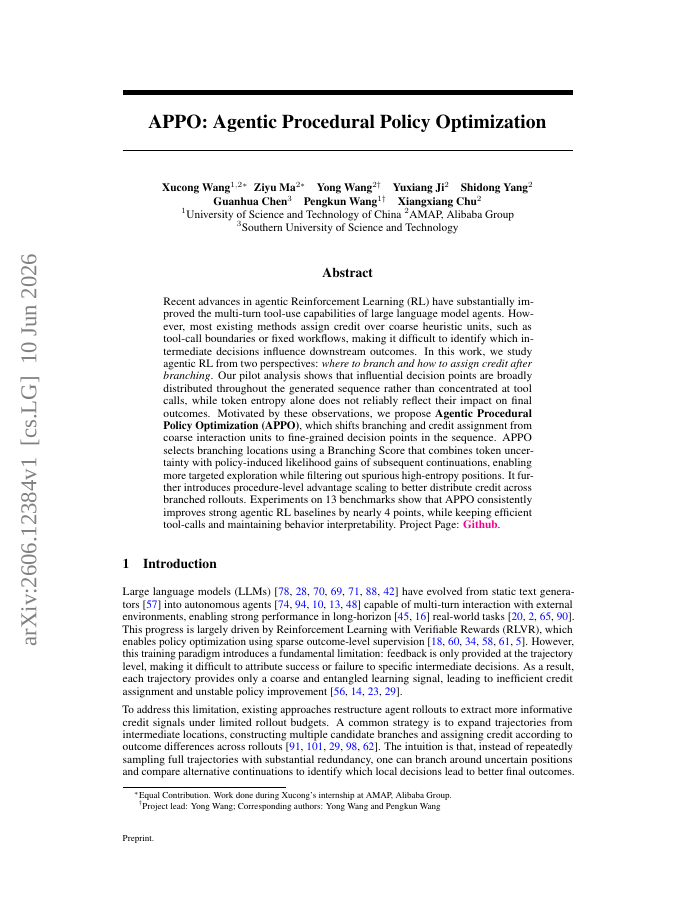
Recent advances in agentic Reinforcement Learning (RL) have substantially improved the multi-turn tool-use capabilities of large language model agents. However, most existing methods assign credit over coarse heuristic units, such as tool-call boundaries or fixed workflows,…
10 Jun 2026
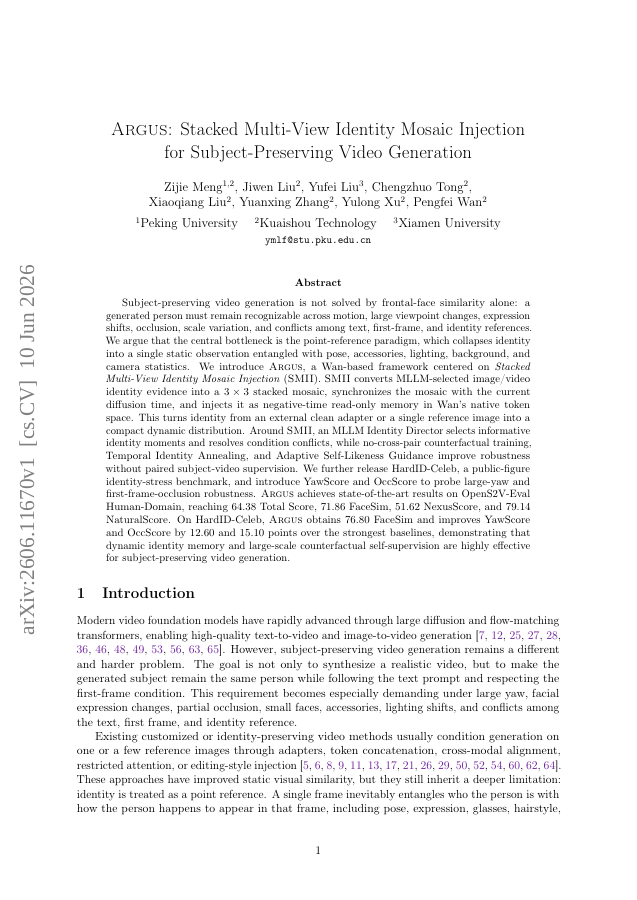
Subject-preserving video generation is not solved by frontal-face similarity alone: a generated person must remain recognizable across motion, large viewpoint changes, expression shifts, occlusion, scale variation, and conflicts among text, first-frame, and identity references.
10 Jun 2026
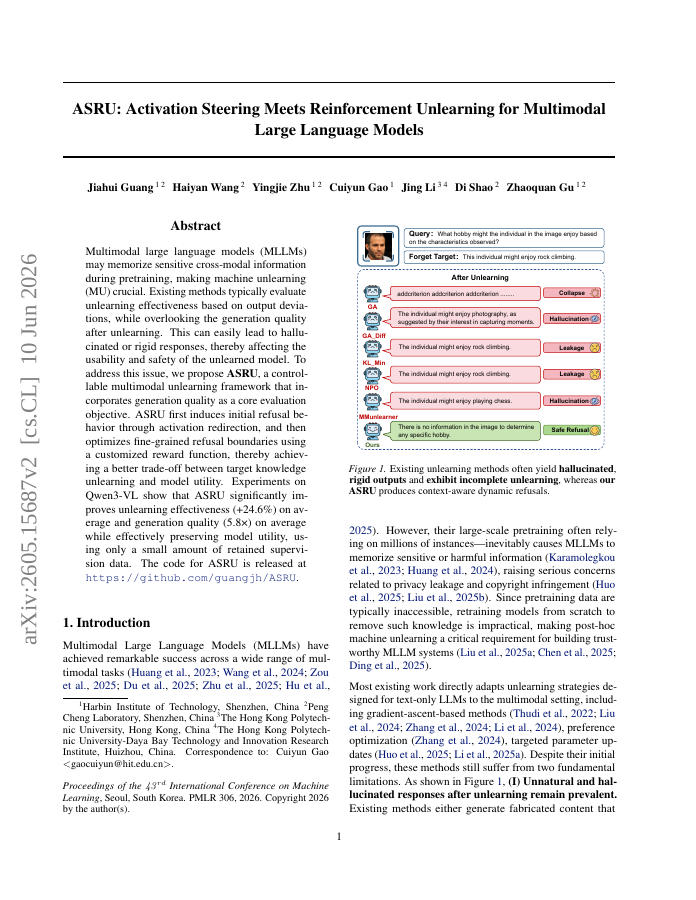
Multimodal large language models (MLLMs) may memorize sensitive cross-modal information during pretraining, making machine unlearning (MU) crucial. Existing methods typically evaluate unlearning effectiveness based on output deviations, while overlooking the generation quality…
9 Jun 2026
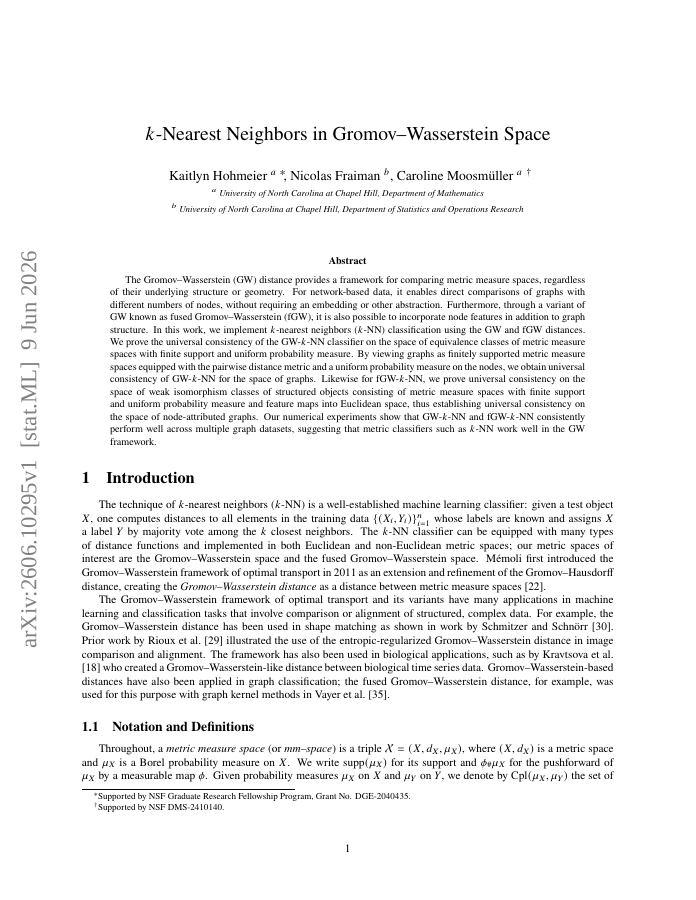
The Gromov--Wasserstein (GW) distance provides a framework for comparing metric measure spaces, regardless of their underlying structure or geometry. For network-based data, it enables direct comparisons of graphs with different numbers of nodes, without requiring an embedding…
9 Jun 2026
Large language models generate code from natural language prompts, enabling "vibe coding," which allows non-programmers to develop computational solutions. Vibe coding for teachers amplifies the value of teachers-as-designers, improving technology integration while…
9 Jun 2026
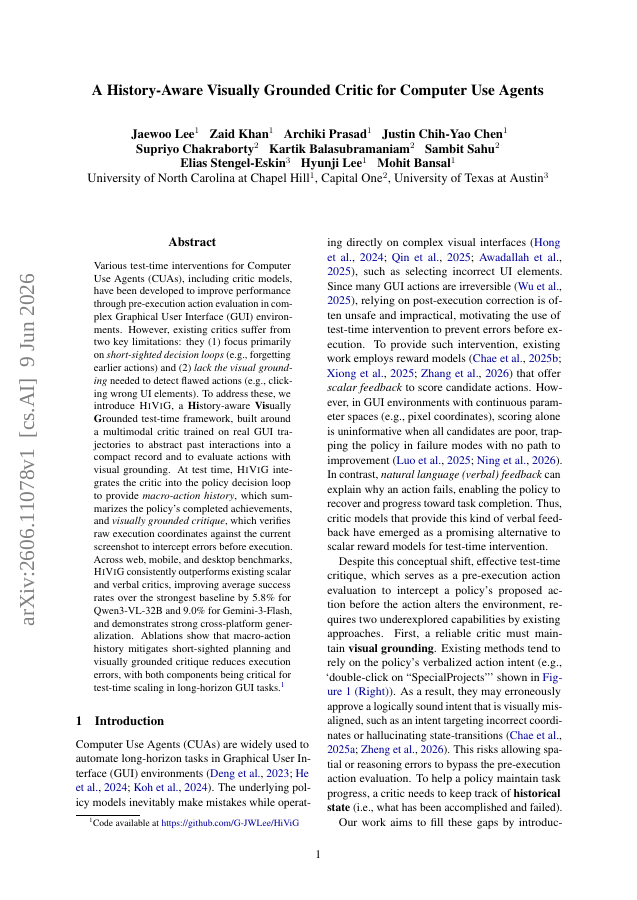
Various test-time interventions for Computer Use Agents (CUAs), including critic models, have been developed to improve performance through pre-execution action evaluation in complex Graphical User Interface (GUI) environments.
9 Jun 2026
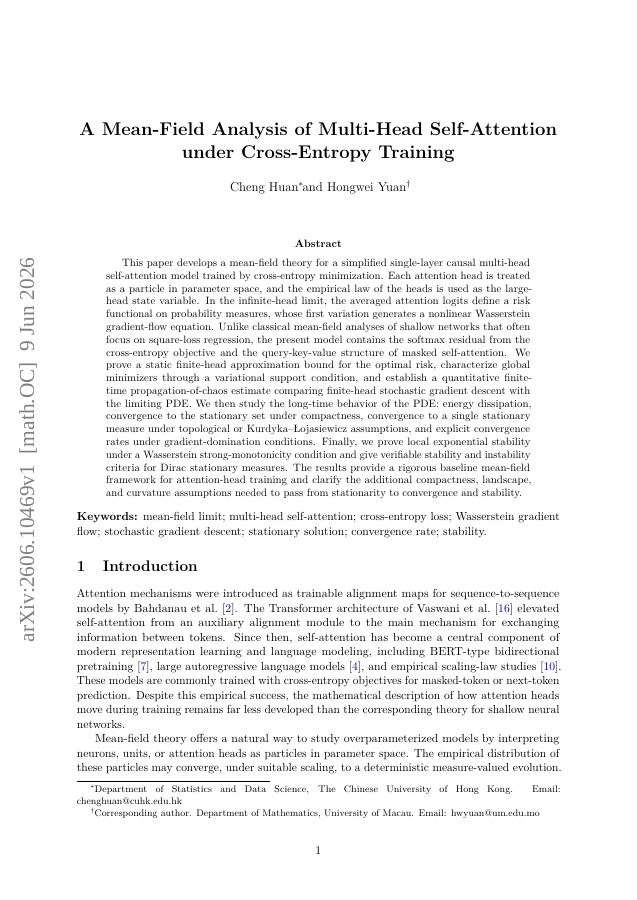
This paper develops a mean-field theory for a simplified single-layer causal multi-head self-attention model trained by cross-entropy minimization. Each attention head is treated as a particle in parameter space, and the empirical law of the heads is used as the large-head state…
9 Jun 2026
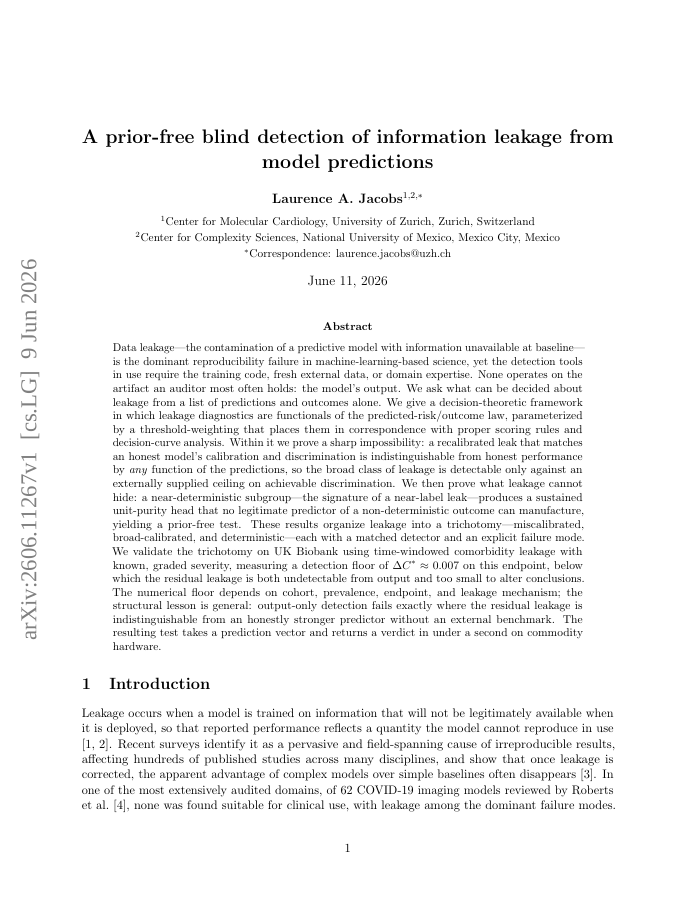
Data leakage -- contamination of a model with information unavailable at baseline -- is the dominant reproducibility failure in machine-learning-based science, yet detection tools require training code, external data, or domain expertise.
9 Jun 2026
Structured abstracts are important for biomedical literature processing, by facilitating information retrieval, text mining, and knowledge synthesis. However, a vast portion of abstracts indexed in PubMed remain unstructured, presenting a significant bottleneck for downstream…
9 Jun 2026
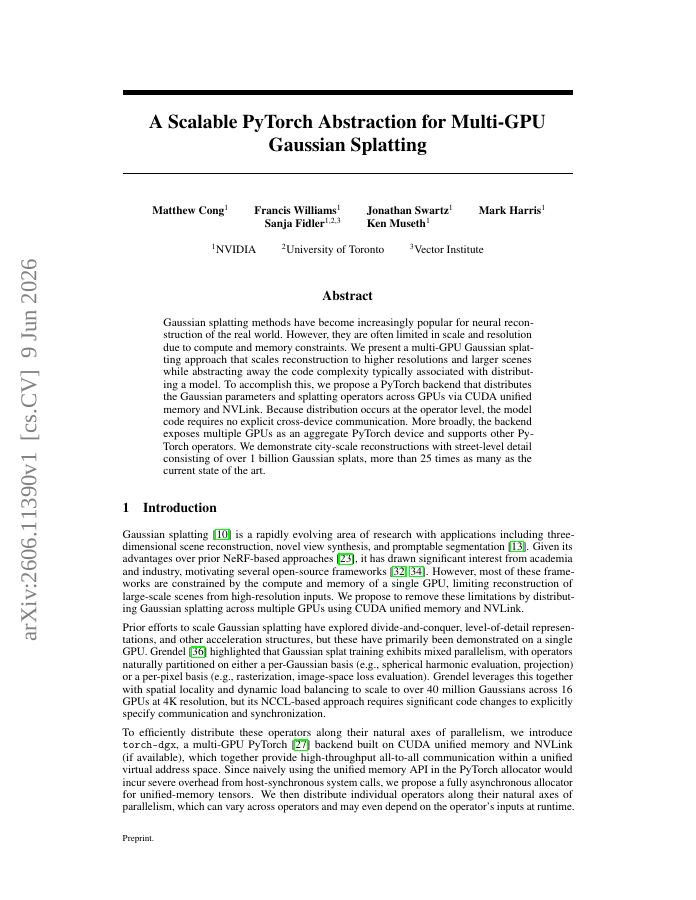
Gaussian splatting methods have become increasingly popular for neural reconstruction of the real world. However, they are often limited in scale and resolution due to compute and memory constraints.
9 Jun 2026
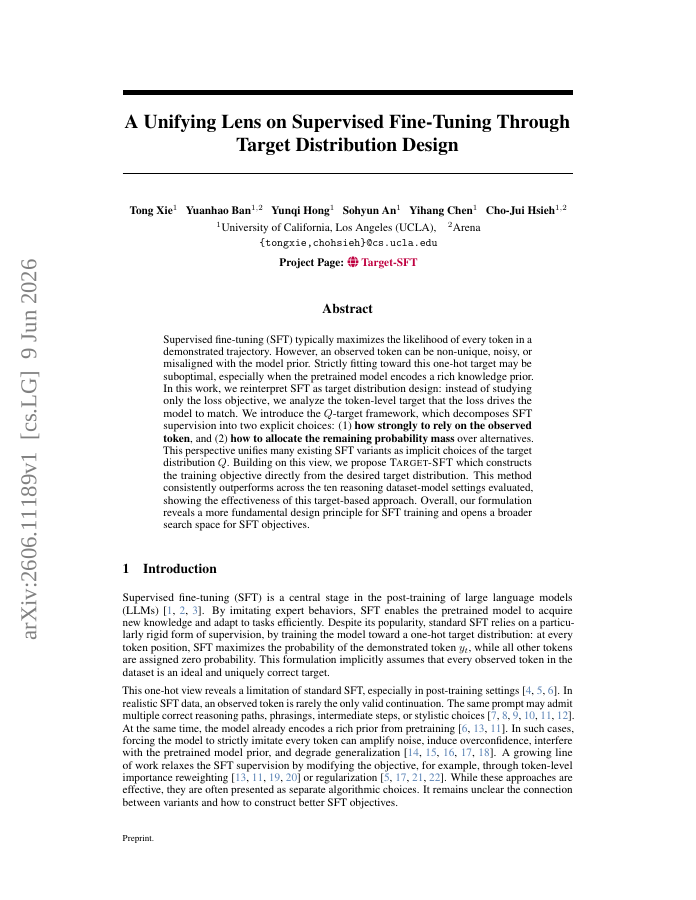
Supervised fine-tuning (SFT) typically maximizes the likelihood of every token in a demonstrated trajectory. However, an observed token can be non-unique, noisy, or misaligned with the model prior.
9 Jun 2026
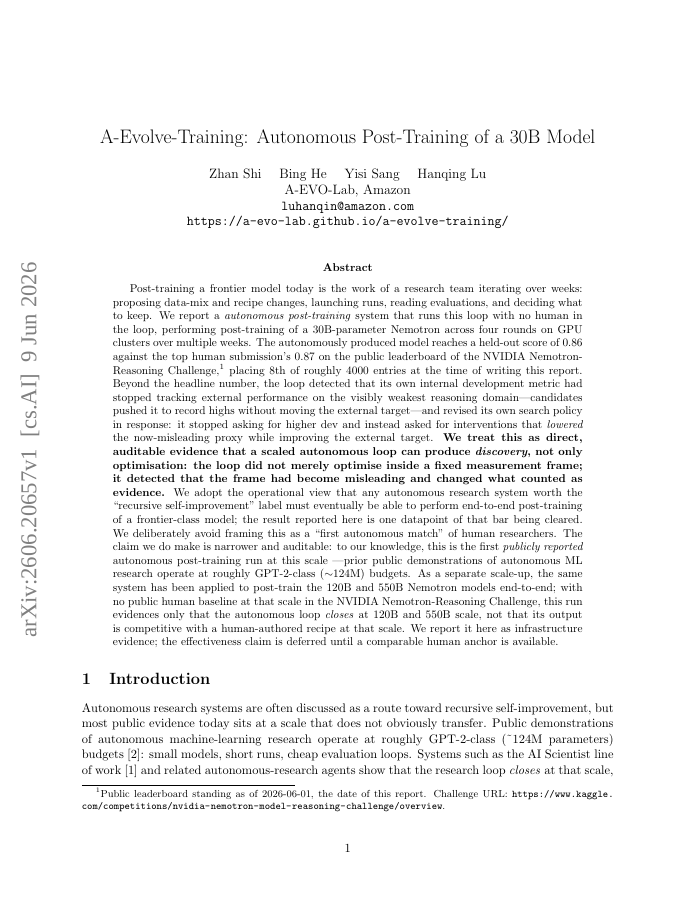
Post-training a frontier model is normally weeks of human work: proposing data and recipe changes, launching runs, reading evals, deciding what to keep. We report an autonomous system that runs this loop with no human in the loop, post-training a 30B Nemotron across four rounds…
9 Jun 2026
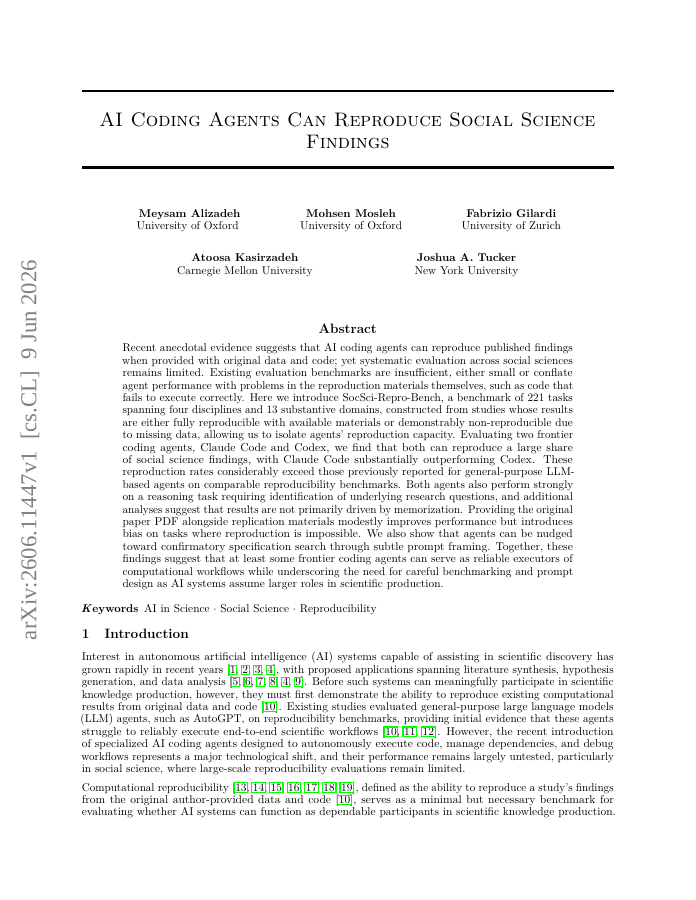
Recent anecdotal evidence suggests that AI coding agents can reproduce published findings when provided with original data and code; yet systematic evaluation across social sciences remains limited.
9 Jun 2026
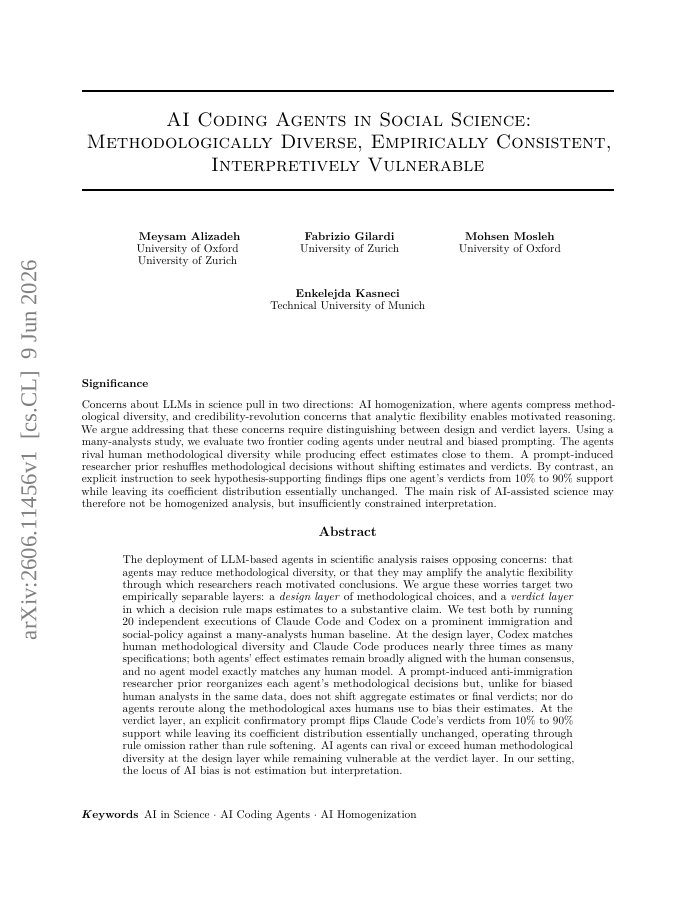
The deployment of LLM-based agents in scientific analysis raises opposing concerns: that agents may reduce methodological diversity, or that they may amplify the analytic flexibility through which researchers reach motivated conclusions.
9 Jun 2026
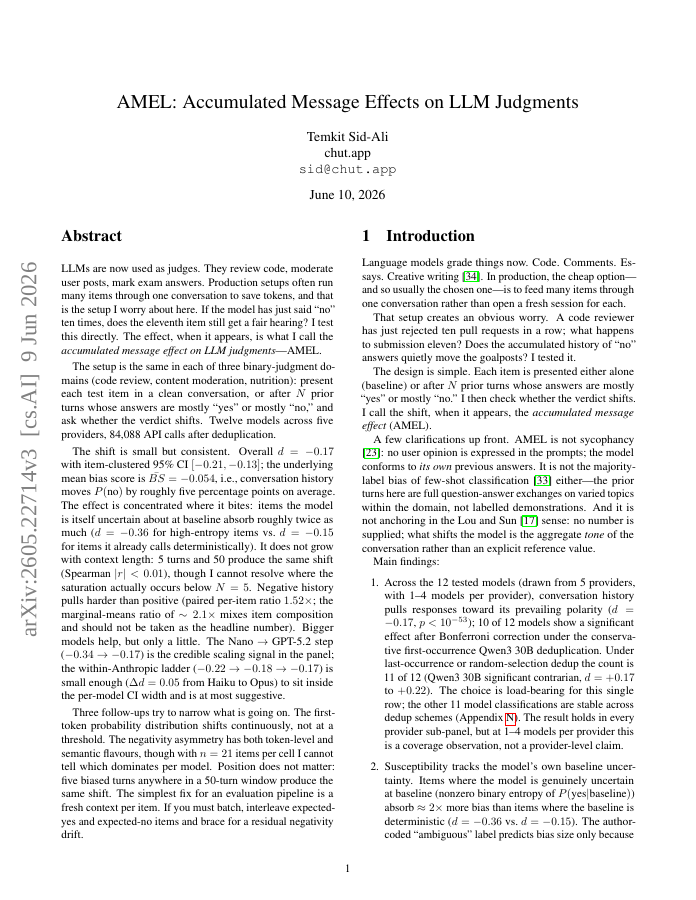
Large language models are routinely used as automated evaluators: to review code, moderate content, or score outputs, often with many items passing through one conversation.
9 Jun 2026
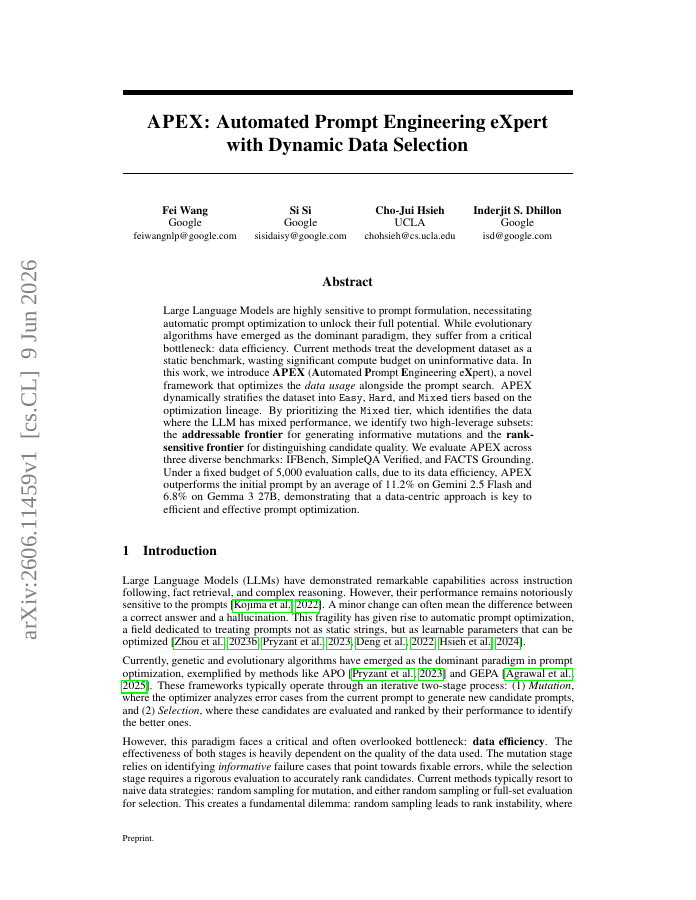
Large Language Models are highly sensitive to prompt formulation, necessitating automatic prompt optimization to unlock their full potential. While evolutionary algorithms have emerged as the dominant paradigm, they suffer from a critical bottleneck: data efficiency.
8 Jun 2026
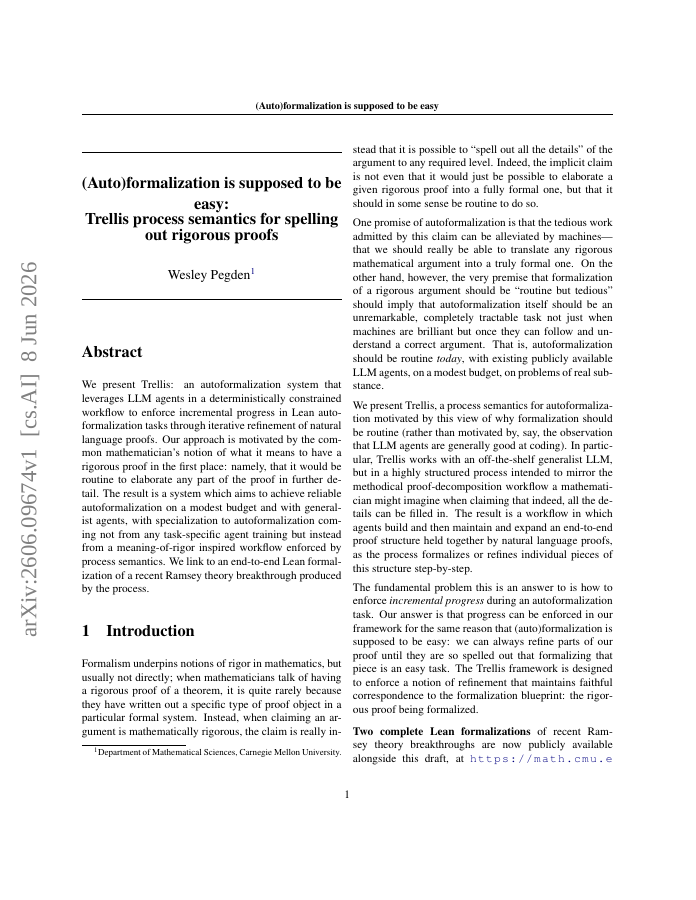
We present Trellis: an autoformalization system that leverages LLM agents in a deterministically constrained workflow to enforce incremental progress in Lean autoformalization tasks through iterative refinement of natural language proofs.
8 Jun 2026
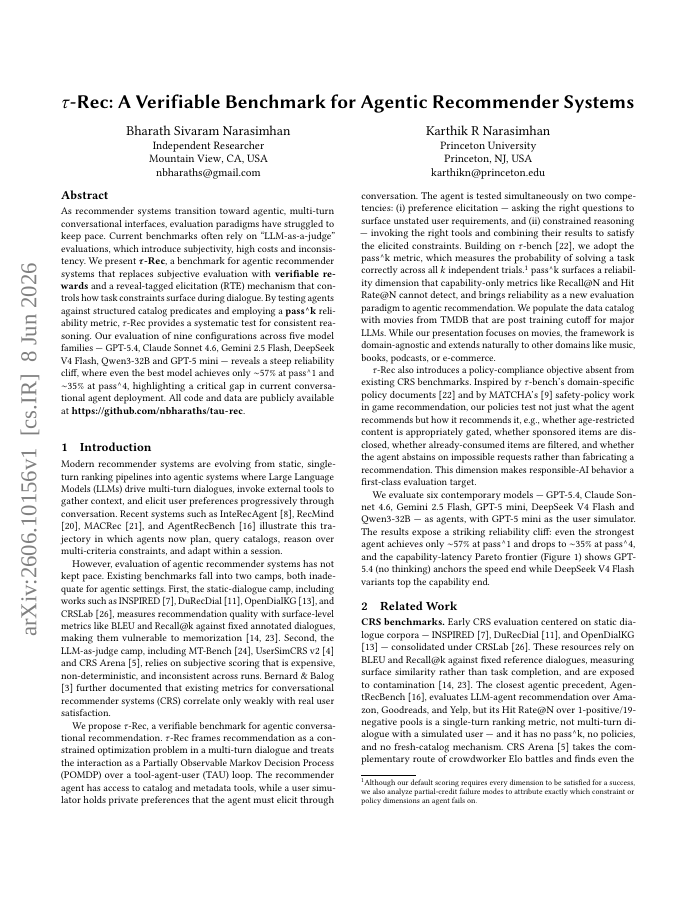
As recommender systems transition toward agentic, multi-turn conversational interfaces, evaluation paradigms have struggled to keep pace. Current benchmarks often rely on "LLM-as-a-judge" evaluations, which introduce subjectivity, high costs and inconsistency.
8 Jun 2026
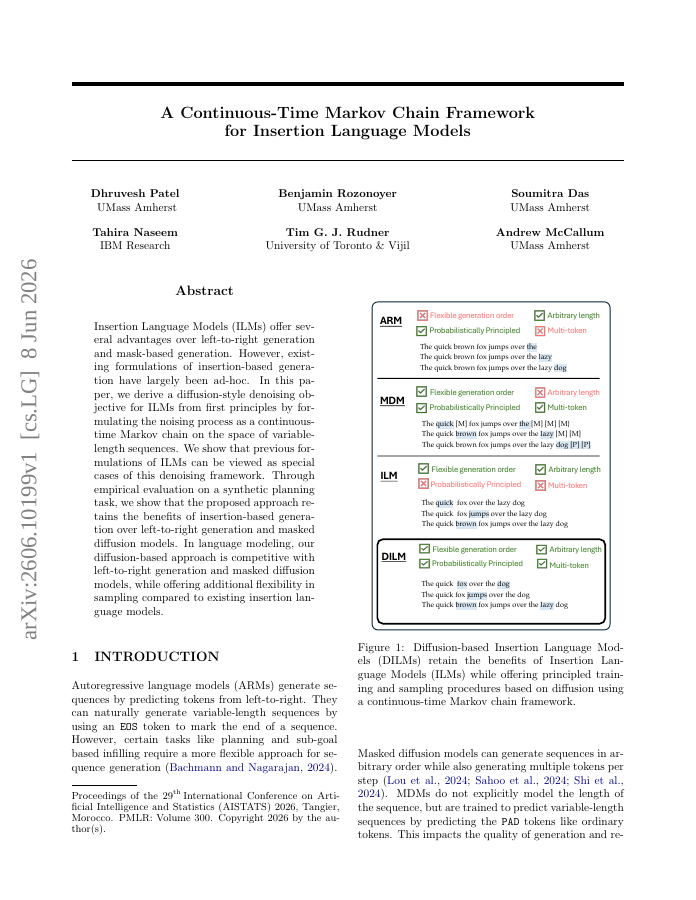
Insertion Language Models (ILMs) offer several advantages over left-to-right generation and mask-based generation. However, existing formulations of insertion-based generation have largely been ad-hoc.
8 Jun 2026
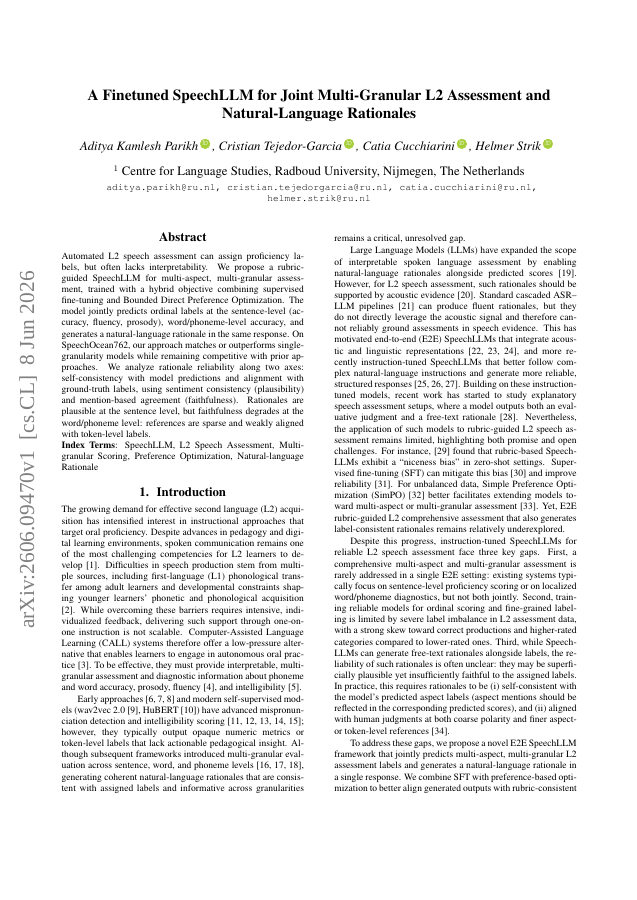
Automated L2 speech assessment can assign proficiency labels, but often lacks interpretability. We propose a rubric-guided SpeechLLM for multi-aspect, multi-granular assessment, trained with a hybrid objective combining supervised fine-tuning and Bounded Direct Preference…
8 Jun 2026
Conditional average treatment effects (CATEs) are central to treatment decision-making in personalized medicine. In competing risks settings, estimating CATEs from survival data allows for patient-specific assessments of treatment effectiveness for a specific event of interest…