2 Jun 2026
The number of malware (either variant or novel) is rapidly increasing, making malware detection and mitigation a complex problem. One approach to improving malware mitigation is automatic detection and malware family classification.
Trending research and the full catalog - each paper linked to the benchmarks, methods, and models it introduces.
Filtering here covers the 2,000 most recent papers, as much as one page can hold in memory. See the full index of 22,091 papers.
2 Jun 2026
The number of malware (either variant or novel) is rapidly increasing, making malware detection and mitigation a complex problem. One approach to improving malware mitigation is automatic detection and malware family classification.
2 Jun 2026
The correct sequence of courses in the curriculum based on prerequisites between courses is of great importance for students to develop their knowledge and skills holistically.
2 Jun 2026
Recent work shows that language models can transmit behavioural traits through hidden signals in generated data during training. We ask whether a different activation-mediated channel is viable: can one language model communicate a useful intermediate reasoning state to another…
2 Jun 2026
We implement simultaneous translation capability with the offline direct speech-to-text translation model Canary, using the state-of-the-art policy AlignAtt, and submit it to IWSLT 2026 Simultaneous Speech Translation Shared task for Czech to English and English to German and…
2 Jun 2026
Large language models are increasingly used for knowledge acquisition, code generation, academic writing, and agent-based automation. In these settings, users may obtain highly structured answers, plans, and judgments without sufficient domain practice.
2 Jun 2026
We develop a quantitative framework for diffusion distillation by viewing few step sampling as approximation through compositions of learned flow maps. For trajectory distillation of the probability flow ODE, we show that low noise multimodal regimes separate score…
2 Jun 2026
While principal component analysis (PCA) is a fundamental tool for dimensionality reduction, its dense representations make it ill-suited for high-dimensional data. Existing methods address this by promoting sparsity through explicit $\ell_1$-penalties, but these are not obvious…
2 Jun 2026
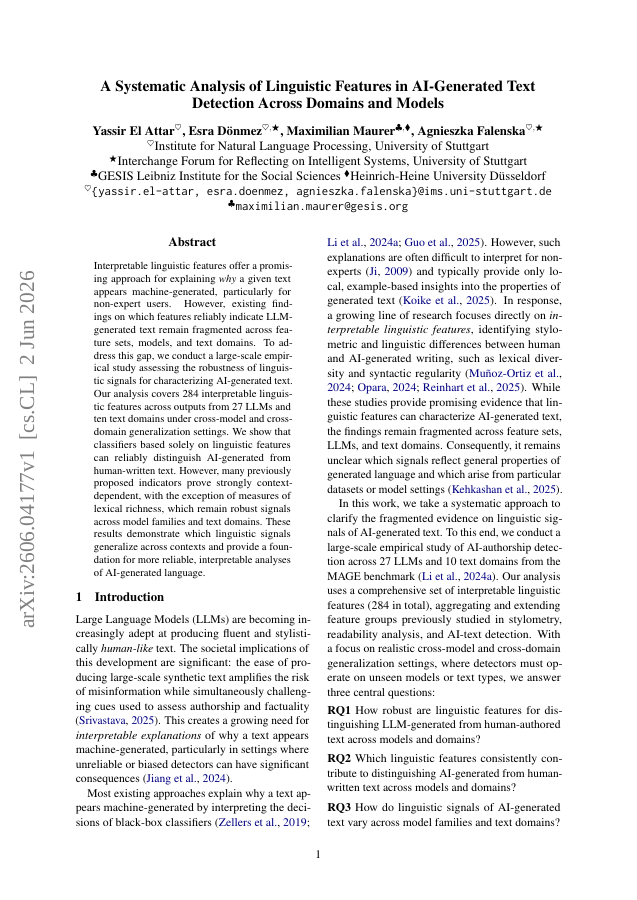
Interpretable linguistic features offer a promising approach for explaining why a given text appears machine-generated, particularly for non-expert users. However, existing findings on which features reliably indicate LLM-generated text remain fragmented across feature sets,…
2 Jun 2026
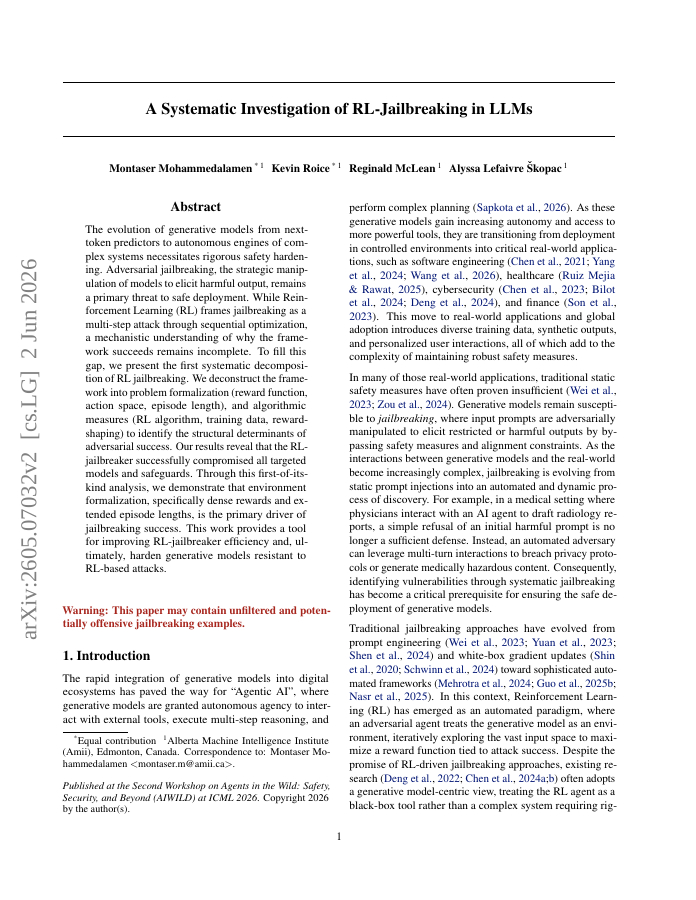
The evolution of generative models from next-token predictors to autonomous engines of complex systems necessitates rigorous safety hardening. Adversarial jailbreaking, the strategic manipulation of models to elicit harmful output, remains a primary threat to safe deployment.
2 Jun 2026
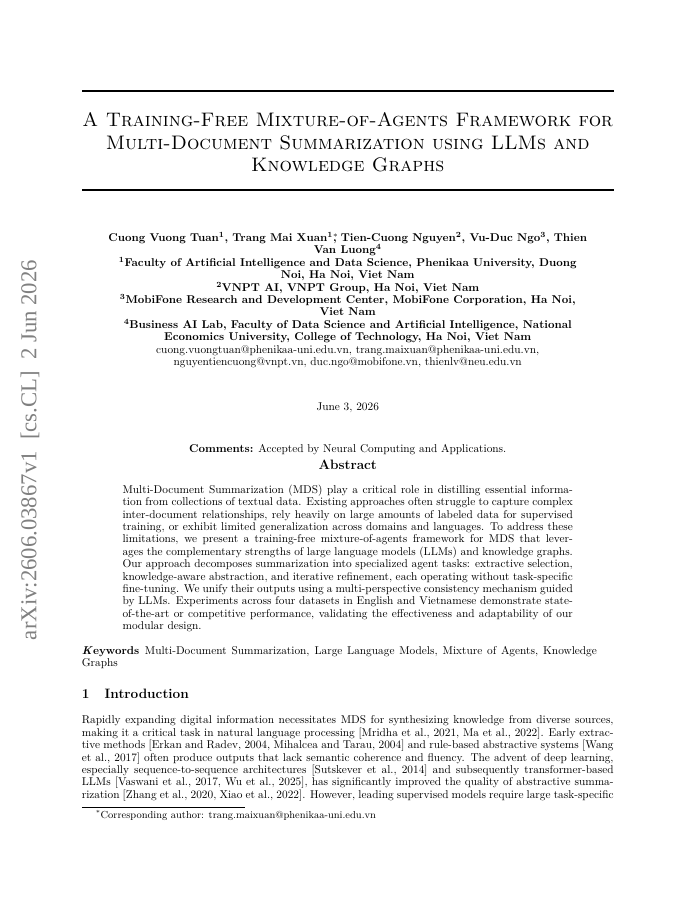
Multi-Document Summarization (MDS) plays a critical role in distilling essential information from collections of textual data. Existing approaches often struggle to capture complex inter-document relationships, rely heavily on large amounts of labeled data for supervised…
2 Jun 2026
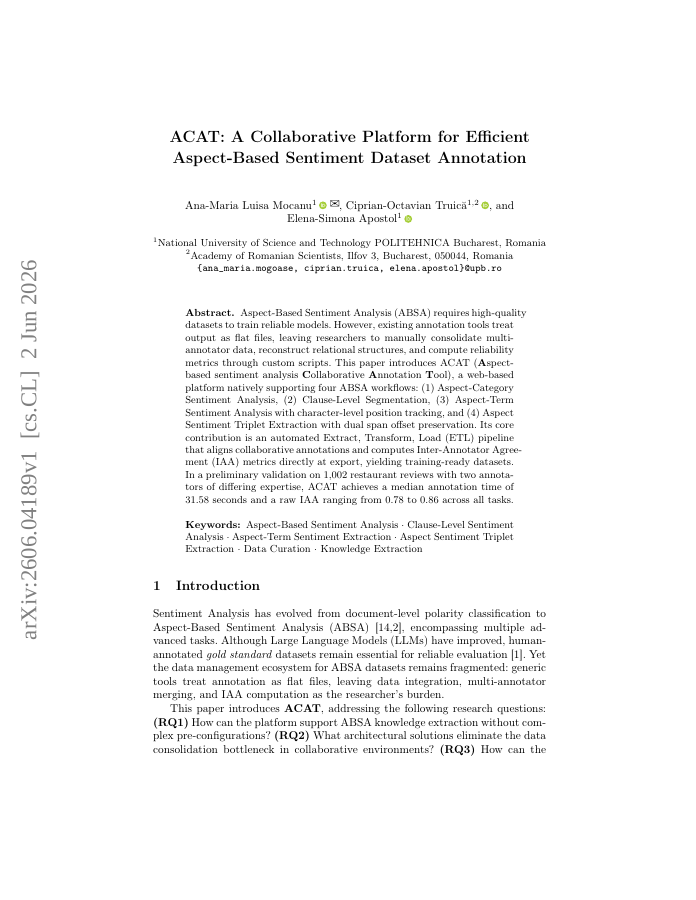
Aspect-Based Sentiment Analysis (ABSA) requires high-quality datasets to train reliable models. However, existing annotation tools treat output as flat files, leaving researchers to manually consolidate multi-annotator data, reconstruct relational structures, and compute…
2 Jun 2026
Data samples used for training often differ from those encountered during fine-tuning and deployment, and while ML models show promise, their performance remains limited when only small annotated datasets are available.
2 Jun 2026
A computer worm is malware that spreads on a network by replicating itself from one machine to another. Traditional worms, like WannaCry, exploited predetermined vulnerabilities, and their spread can be halted by patching those vulnerabilities.
2 Jun 2026
Ensuring the protection of Artificial Intelligence (AI) models deployed in military Command and Control (C2) systems and critical infrastructure is essential for maintaining information superiority.
2 Jun 2026
Clinical AI evaluation increasingly delegates scoring to large language models (LLMs) acting as AI raters, yet their scoring behavior across evaluation conditions has not been quantitatively characterized.
2 Jun 2026
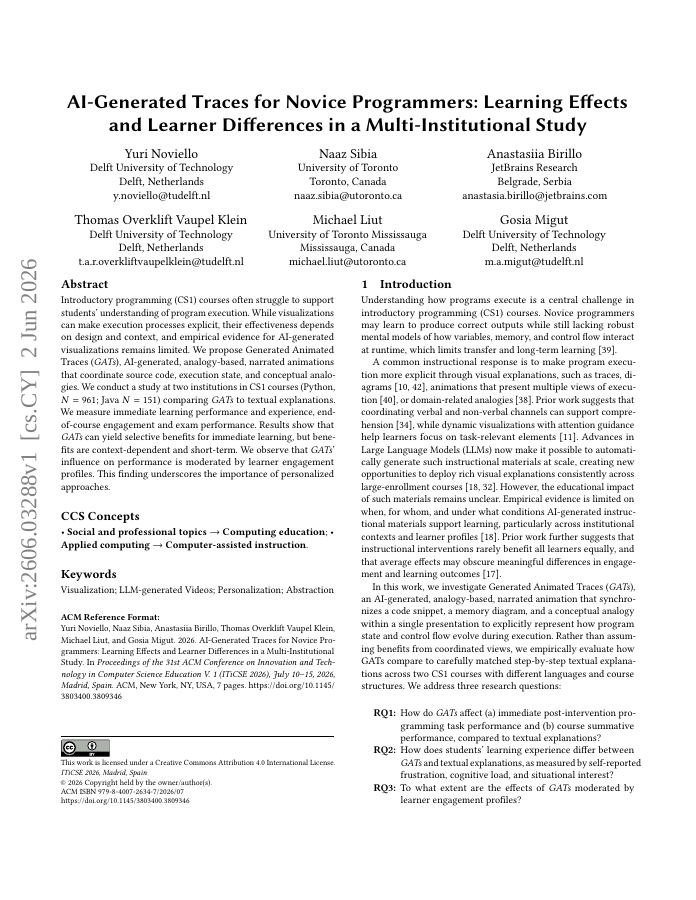
Introductory programming (CS1) courses often struggle to support students' understanding of program execution. While visualizations can make execution processes explicit, their effectiveness depends on design and context, and empirical evidence for AI-generated visualizations…
2 Jun 2026
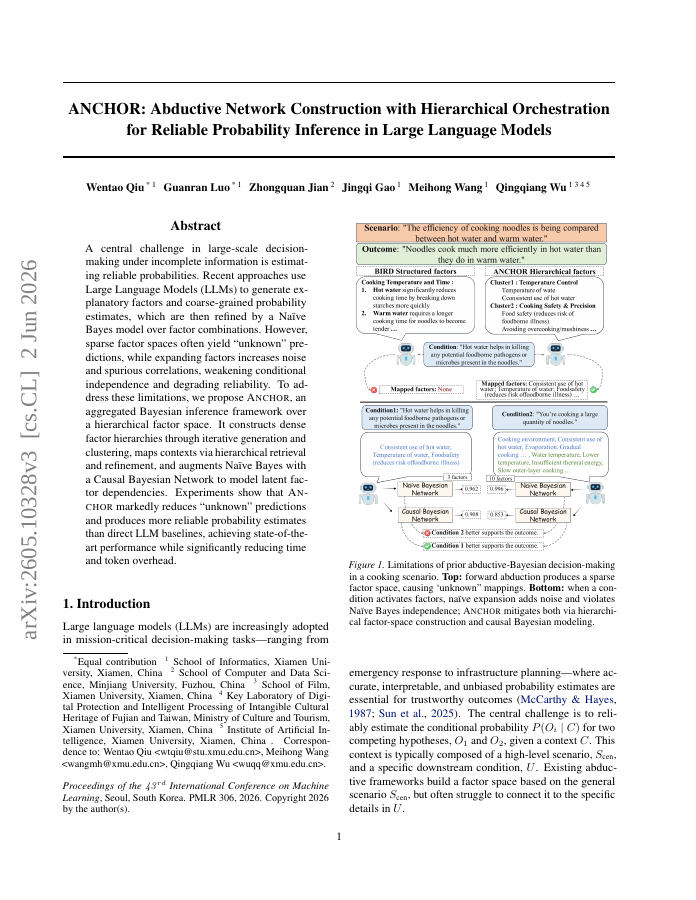
A central challenge in large-scale decision-making under incomplete information is estimating reliable probabilities. Recent approaches use Large Language Models (LLMs) to generate explanatory factors and coarse-grained probability estimates, which are then refined by a Naïve…
2 Jun 2026
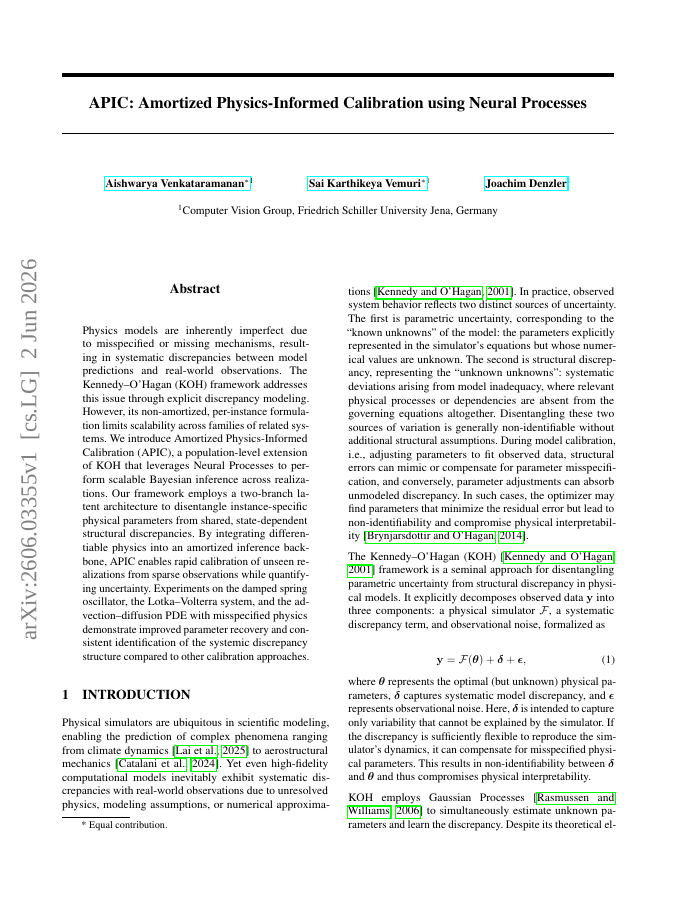
Physics models are inherently imperfect due to misspecified or missing mechanisms, resulting in systematic discrepancies between model predictions and real-world observations. The Kennedy-O'Hagan (KOH) framework addresses this issue through explicit discrepancy modeling.
2 Jun 2026
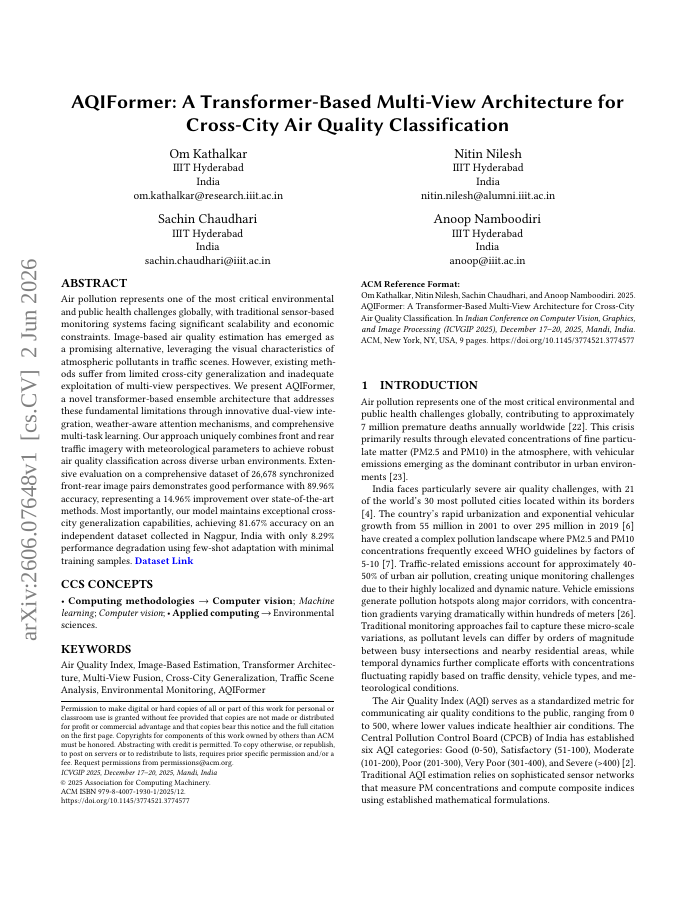
Air pollution represents one of the most critical environmental and public health challenges globally, with traditional sensor-based monitoring systems facing significant scalability and economic constraints.
2 Jun 2026
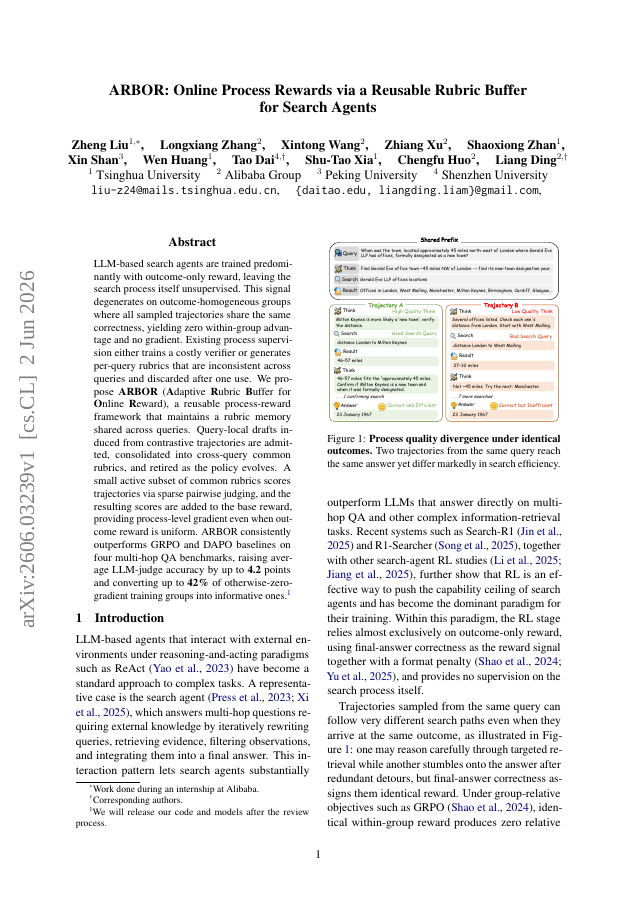
LLM-based search agents are trained predominantly with outcome-only reward, leaving the search process itself unsupervised. This signal degenerates on outcome-homogeneous groups where all sampled trajectories share the same correctness, yielding zero within-group advantage and…
1 Jun 2026
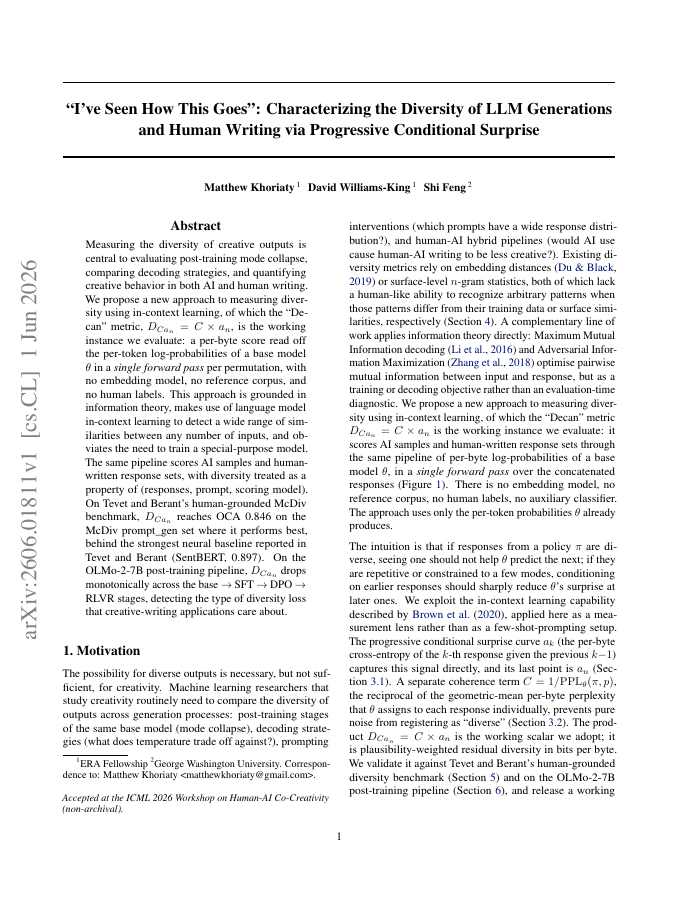
Measuring the diversity of creative outputs is central to evaluating post-training mode collapse, comparing decoding strategies, and quantifying creative behavior in both AI and human writing.
1 Jun 2026
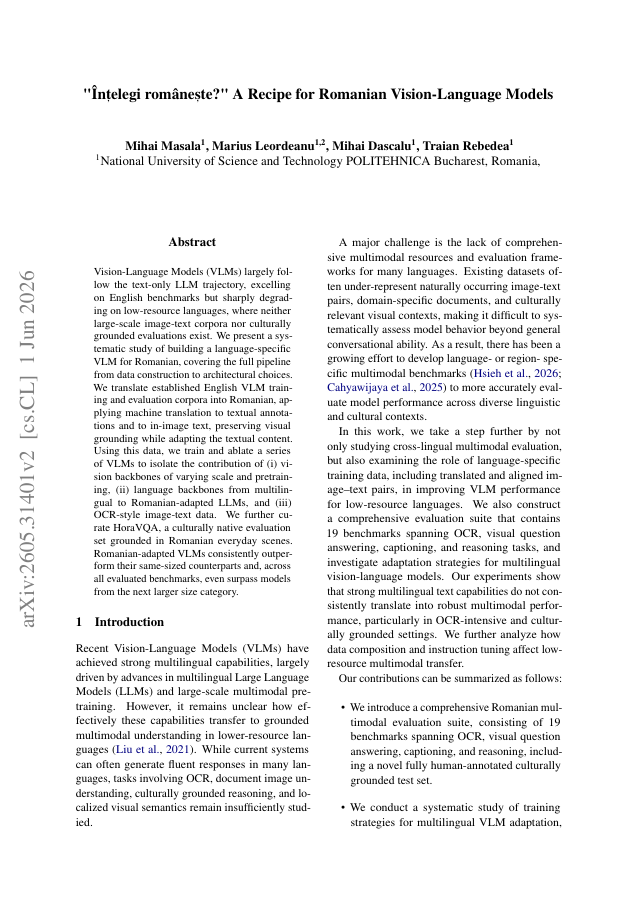
Vision-Language Models (VLMs) largely follow the text-only LLM trajectory, excelling on English benchmarks but sharply degrading on low-resource languages, where neither large-scale image-text corpora nor culturally grounded evaluations exist.
1 Jun 2026
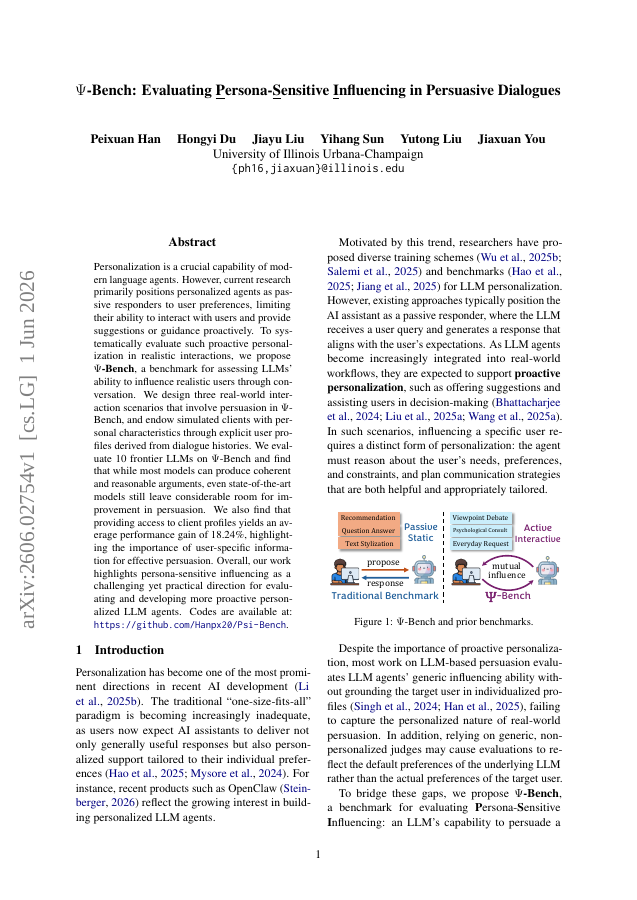
Personalization is a crucial capability of modern language agents. However, current research primarily positions personalized agents as passive responders to user preferences, limiting their ability to interact with users and provide suggestions or guidance proactively.
1 Jun 2026
Optimal transport (OT) provides a principled framework for mapping between probability distributions. Despite extensive progress, applying OT to large-scale data remains computationally demanding, and the resulting pointwise transport plans are often difficult to interpret.