27 Jul 2026
Ethical governance of AI-driven systems is often expressed through high-level principles and static documentation, creating a gap between regulatory requirements and system-level verification.
Trending research and the full catalog - each paper linked to the benchmarks, methods, and models it introduces.
Filtering here covers the 2,000 most recent papers, as much as one page can hold in memory. See the full index of 22,712 papers.
27 Jul 2026
Ethical governance of AI-driven systems is often expressed through high-level principles and static documentation, creating a gap between regulatory requirements and system-level verification.
27 Jul 2026
Scientific user facilities accumulate decades of operational knowledge that no single search index covers: electronic logbooks, technical documents, internal wikis, operations chat messages, maintenance records, and live control-system data.
27 Jul 2026
Brain-Machine Interfaces (BMIs), which link the brain to external devices, hold great potential in rehabilitation, human performance augmentation, and human-centered robotics.
27 Jul 2026
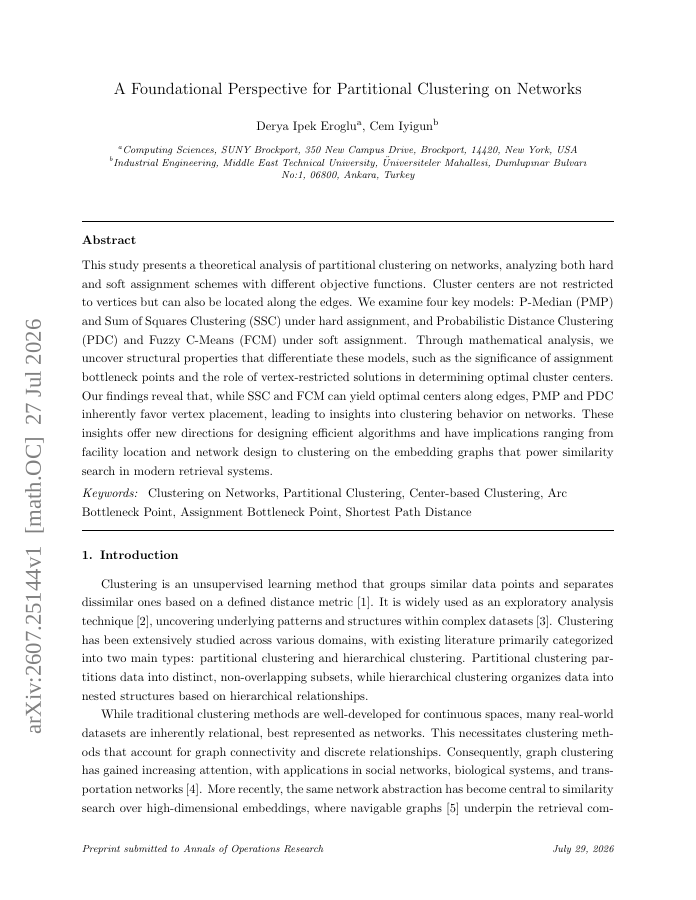
This study presents a theoretical analysis of partitional clustering on networks, analyzing both hard and soft assignment schemes with different objective functions. Cluster centers are not restricted to vertices but can also be located along the edges.
27 Jul 2026
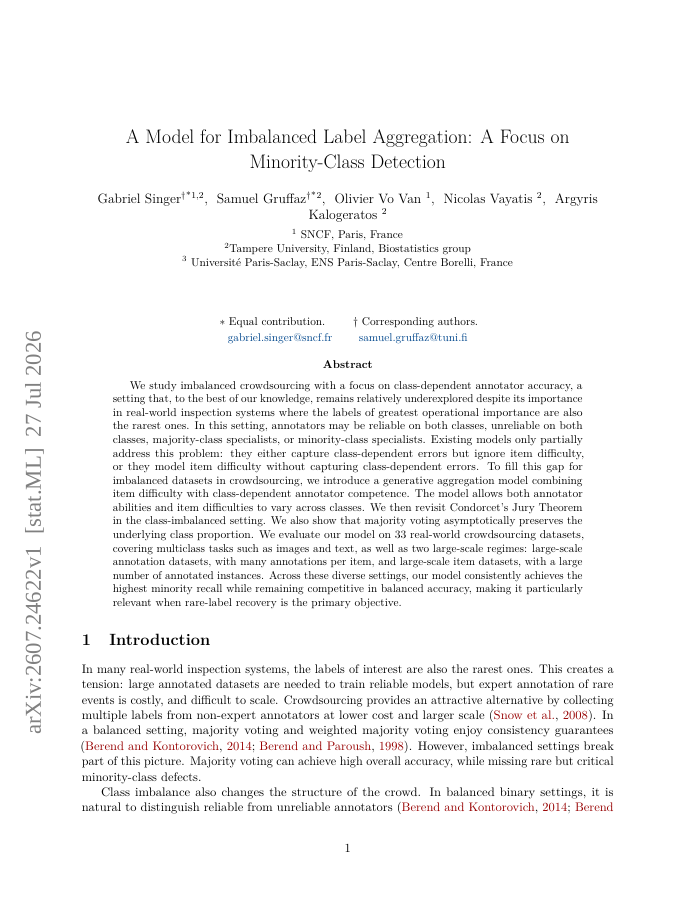
We study imbalanced crowdsourcing with a focus on class-dependent annotator accuracy, a setting that, to the best of our knowledge, remains relatively underexplored despite its importance in real-world inspection systems where the labels of greatest operational importance are…
27 Jul 2026
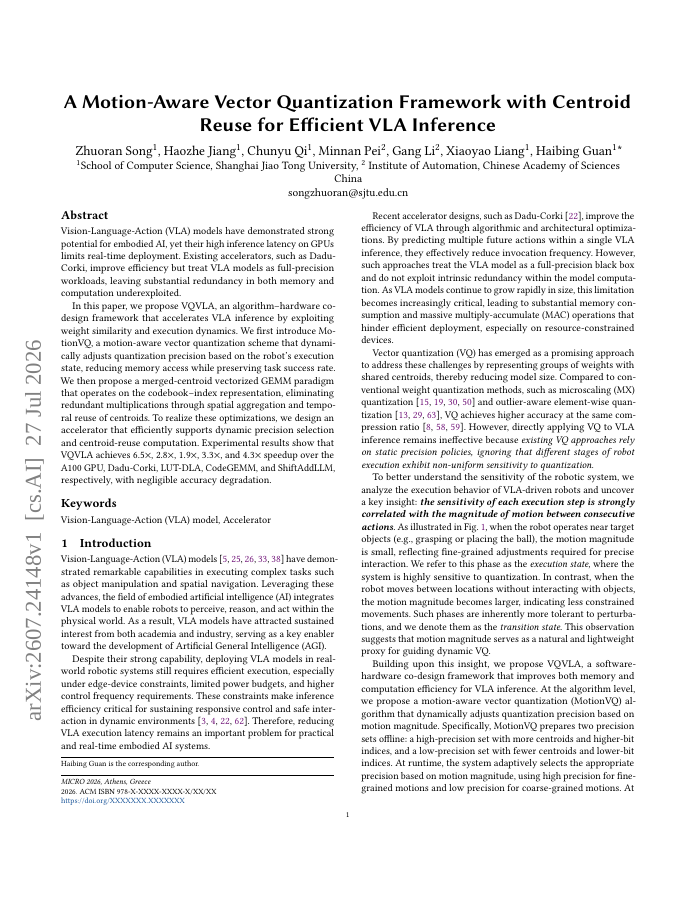
Vision-Language-Action (VLA) models have demonstrated strong potential for embodied AI, yet their high inference latency on GPUs limits real-time deployment. Existing accelerators, such as Dadu-Corki, improve efficiency but treat VLA models as full-precision workloads, leaving…
27 Jul 2026
EEG foundation-model gains may depend on cohort, montage, or probe design. We evaluated five models on five tasks across four benchmark datasets plus Korean CAUEEG, using subject-disjoint validation where identifiers exist.
27 Jul 2026
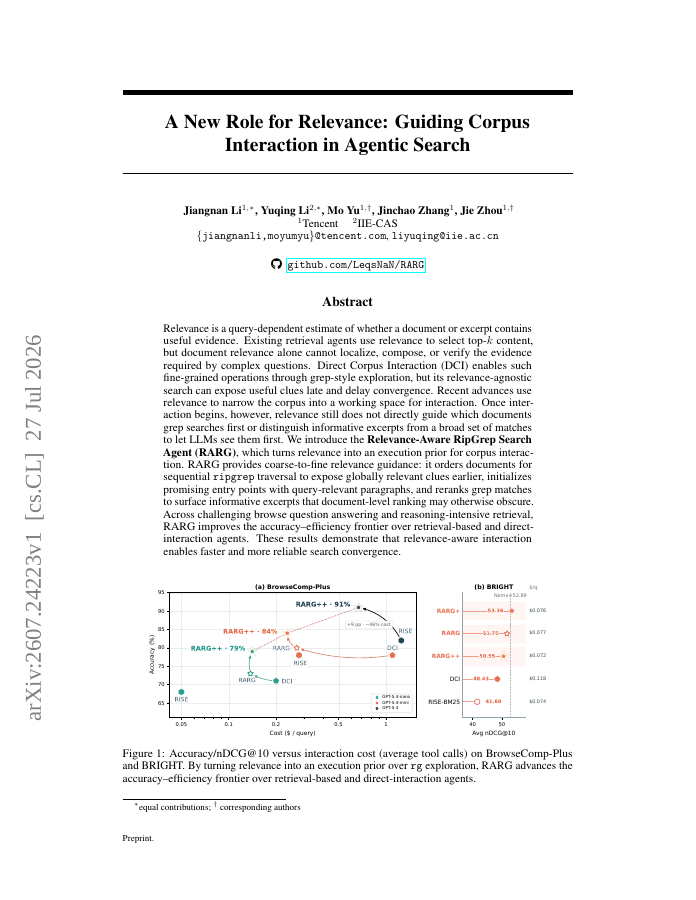
Relevance is a query-dependent estimate of whether a document or excerpt contains useful evidence. Existing retrieval agents use relevance to select top-$k$ content, but document relevance alone cannot localize, compose, or verify the evidence required by complex questions.
26 Jul 2026
Graphical models are ubiquitous in social and empirical science as they are intuitive and easy to use. These models belong to the broader class of Markov models, defined using solely conditional independence (CI) restrictions.
26 Jul 2026
In this work we study Automatic Target Recognition (ATR) for Synthetic Aperture Sonar (SAS) data with a focus on deep neural networks (DNNs). The main challenge in training DNNs for SAS-ATR arises from the limited quantity of labeled target examples due to the significant costs…
26 Jul 2026
Randomized features provide a scalable approximation to kernel machines, but their performance depends strongly on the choice of feature distribution. We propose a particle-based method that learns this distribution by optimizing kernel-target alignment while regularizing…
26 Jul 2026
While vision-language-action models have demonstrated impressive zero-shot manipulation capabilities, they remain fundamentally black box policies that are difficult to interpret, adapt, or correct when they inevitably fail.
26 Jul 2026
Improving a language model today means retraining it: enormous compute, a new opaque model each cycle, non-deterministic output. We take the opposite path: the model stays frozen, and a persistent memory of verified solutions grows beside it.
26 Jul 2026
Variational autoencoders (VAEs) transform high-dimensional, often noisy data into a compact latent representation, making downstream optimization more tractable. Three challenges persist in VAE-based constrained optimization: (i) sampling effectively within the latent space,…
26 Jul 2026
Hierarchical neural networks are widely used in artificial intelligence, yet their mathematical properties remain incompletely understood. In the infinite-width limit, two different theoretical frameworks have been proposed.
26 Jul 2026
In this paper, we develop a trust-region framework for understanding the behavior of adaptive moment estimation mechanisms, such as \textsc{Adam}, in stochastic gradient optimization.
24 Jul 2026
Most endangered languages lack the parallel data required for machine translation, despite the existence of descriptive grammar books. We introduce a pipeline that uses large language models to extract grammatical rules, example sentences, and lexicons from grammar books and…
24 Jul 2026
Multiclass classification is a fundamental problem across a wide range of domains. It is still challenging due to possession of high inter-class similarity, class imbalance datasets, and variability in data distributions.
24 Jul 2026
Integrating multi-level information, from physical models through data-driven diagnostics to natural language reasoning, into verifiable decision chains is a growing need in intelligent manufacturing.
24 Jul 2026
Pluralistic value alignment---the goal of building AI systems that represent and serve diverse human values and perspectives---has emerged as an active research agenda. Yet, there's no public evidence that it has shaped the training or evaluation of the AI systems people…
24 Jul 2026
Large Language Models (LLMs) are increasingly deployed as autonomous agents, transitioning from static conversational interfaces to dynamic systems capable of complex reasoning, tool execution, and decision-making.
23 Jul 2026
Despite rapid progress, most existing vision-language models (VLMs) built from 2D visual inputs often struggle when handling various 3D tasks that require fine-grained spatial understanding and reasoning.
23 Jul 2026
We present CUP, a Greek book retrieval benchmark consisting of 868 catalog records and 104 expert-annotated queries with graded relevance judgments. We evaluate sparse (BM25), dense (sentence-transformers), hybrid, and LLM-assisted retrieval methods in this book-search setting.
23 Jul 2026
Due to the complexity of neural network loss landscapes, optimization theory is forced to rely on idealized models, and there is generally a tradeoff between how theoretically tractable the model is, and how accurately it describes the true optimization dynamics.