9 Oct 2026
LLM agents' capabilities depend not only on their underlying models but also on their execution harnesses. Recursive self-improvement (RSI) offers a promising approach to automatically evolve these harnesses.
Trending research and the full catalog - each paper linked to the benchmarks, methods, and models it introduces.
Filtering here covers the 2,000 most recent papers, as much as one page can hold in memory. See the full index of 22,688 papers.
9 Oct 2026
LLM agents' capabilities depend not only on their underlying models but also on their execution harnesses. Recursive self-improvement (RSI) offers a promising approach to automatically evolve these harnesses.
Cheng Qian, Yuanchen Bei, Xuying Ning et al. · 18 May 2026
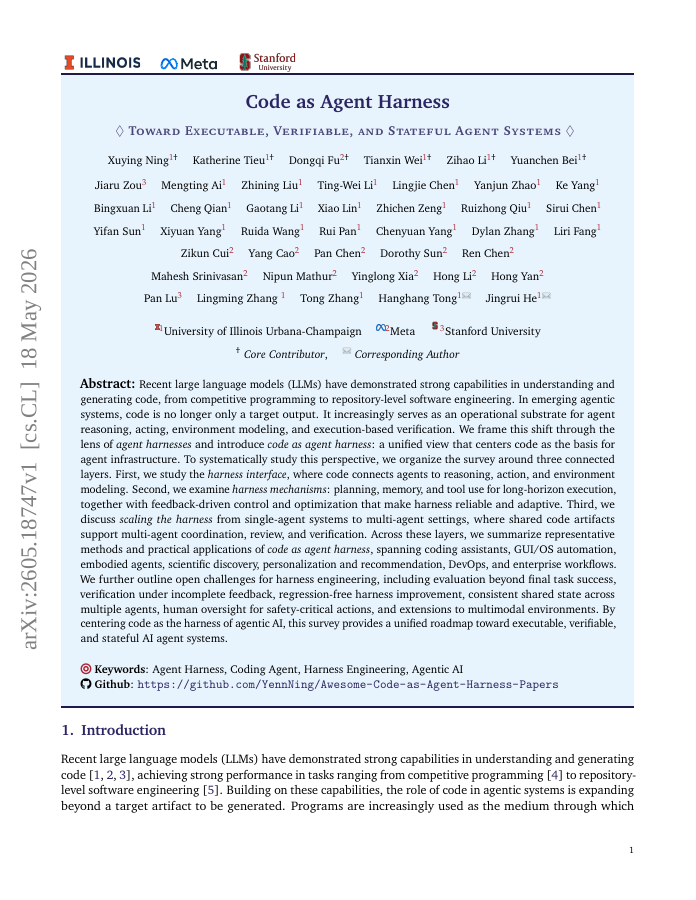
Recent large language models (LLMs) have demonstrated strong capabilities in understanding and generating code, from competitive programming to repository-level software engineering.
25 Aug 2026
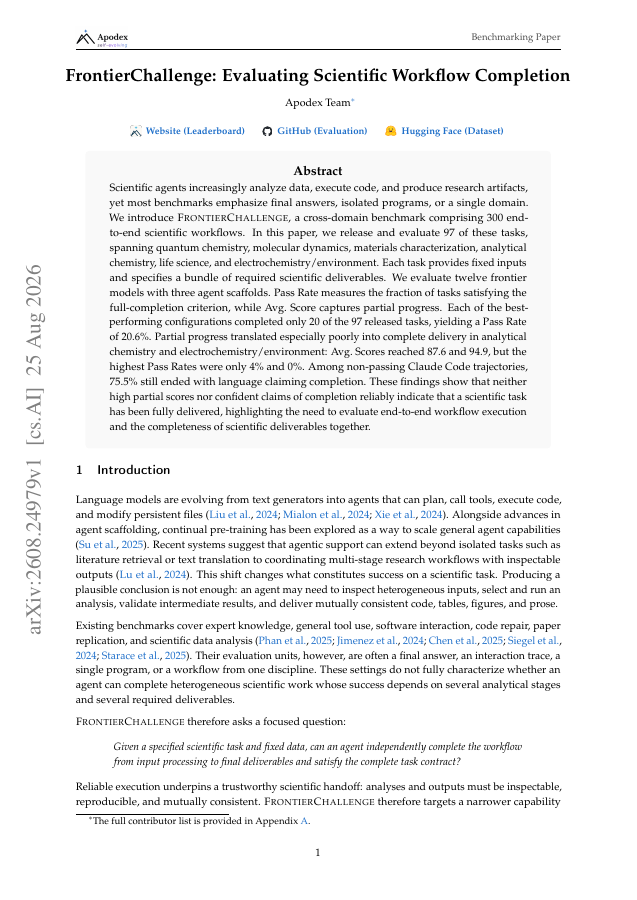
Scientific agents increasingly analyze data, execute code, and produce research artifacts, yet most benchmarks emphasize final answers, isolated programs, or a single domain. We introduce FrontierChallenge, a cross-domain benchmark comprising 300 end-to-end scientific workflows.
13 Oct 2026
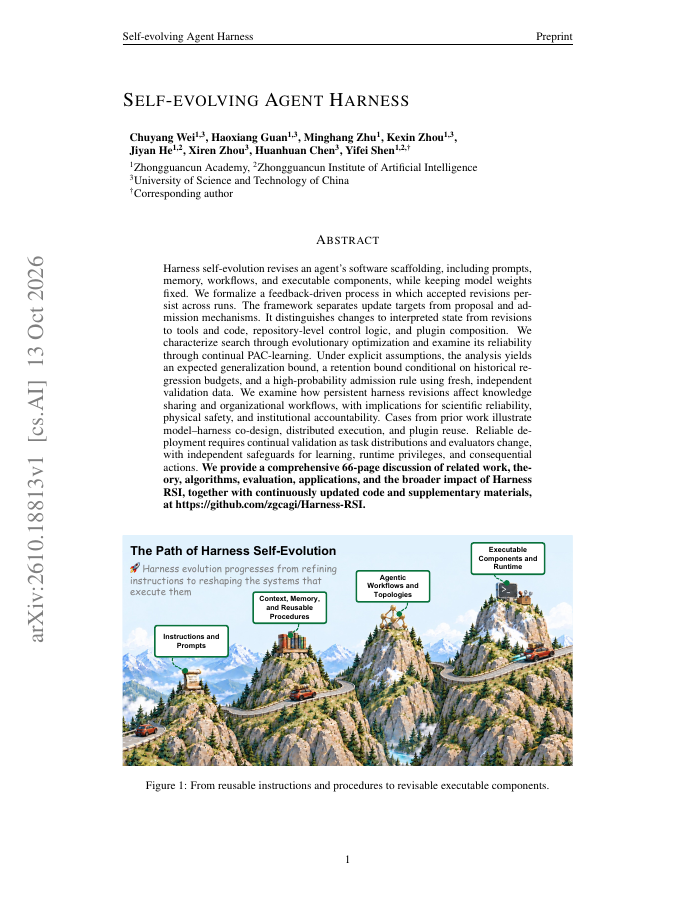
Harness self-evolution revises an agent's software scaffolding, including prompts, memory, workflows, and executable components, while keeping model weights fixed. We formalize a feedback-driven process in which accepted revisions persist across runs.
23 Oct 2026
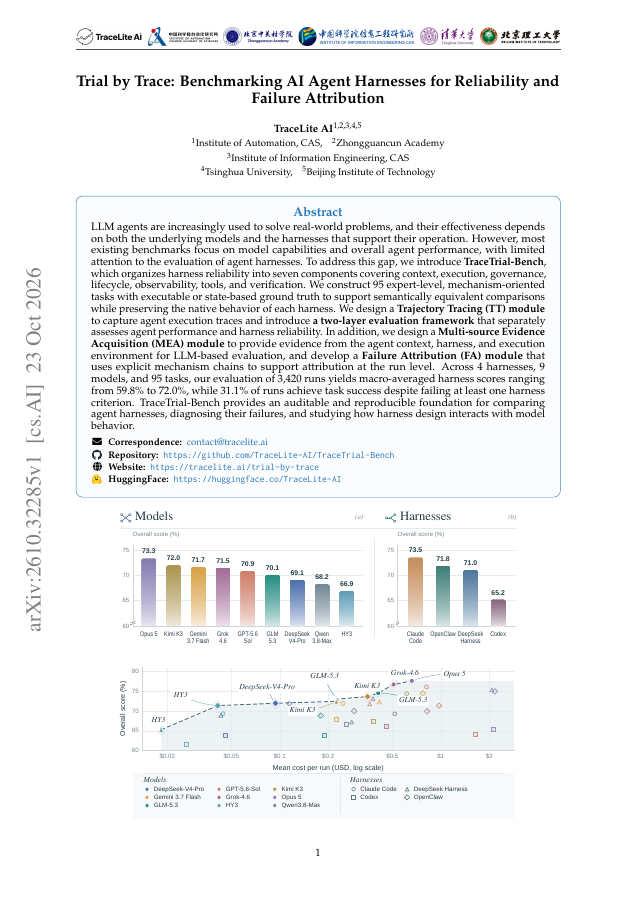
LLM agents are increasingly used to solve real-world problems, and their effectiveness depends on both the underlying models and the harnesses that support their operation.