1 Jul 2026
The proliferation of visual data in Science, Technology, Engineering, and Mathematics (STEM) fields presents accessibility barrier for individuals with blindness or visual impairments.
Trending research and the full catalog - each paper linked to the benchmarks, methods, and models it introduces.
Filtering here covers the 2,000 most recent papers, as much as one page can hold in memory. See the full index of 22,667 papers.
1 Jul 2026
The proliferation of visual data in Science, Technology, Engineering, and Mathematics (STEM) fields presents accessibility barrier for individuals with blindness or visual impairments.
1 Jul 2026
While long-horizon mobile GUI agents typically rely on thought-action-observation loops, they struggle to separate persistent task states from transient screen observations.
1 Jul 2026
We present a real-time musical interface that converts natural-language scene descriptions into evolving procedural soundscapes. A performer types a prompt such as "warm jazz cafe at midnight" and steers it through direct parameter adjustments - stepping brightness down,…
1 Jul 2026
Despite the success of knowledge distillation (KD) in Large Language Models (LLMs), the underlying mechanism behind its efficacy remains unclear. In this paper, we propose a unified approach to explore the common mechanism of various KD methods using interactions.
30 Jun 2026
Hierarchical Vision-Language-Action (VLA) models decouple high-level planning from low-level control to improve generalization in robot manipulation. Recent work in this paradigm uses 2D end-effector trajectories predicted by a Vision-Language Model (VLM) as explicit guidance…
30 Jun 2026
This paper proposes a Bayesian filtering-based approach for learning the dynamics of a physical system from partial, noisy measurements. We model the system dynamics using a Lagrangian mechanics formulation.
30 Jun 2026
Artificial intelligence (AI) systems are routinely modified after deployment through retraining and changes in their environments. These transformations raise a metaphysical question: under what conditions does an AI system remain the same system over time or across deployments?…
30 Jun 2026
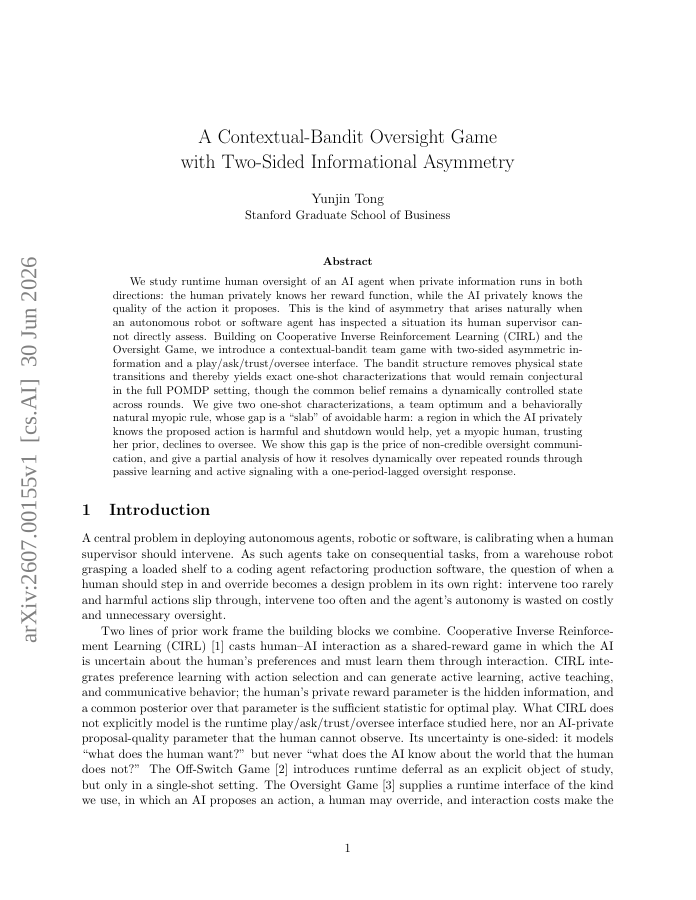
We study runtime human oversight of an AI agent when private information runs in both directions: the human privately knows her reward function, while the AI privately knows the quality of the action it proposes.
30 Jun 2026
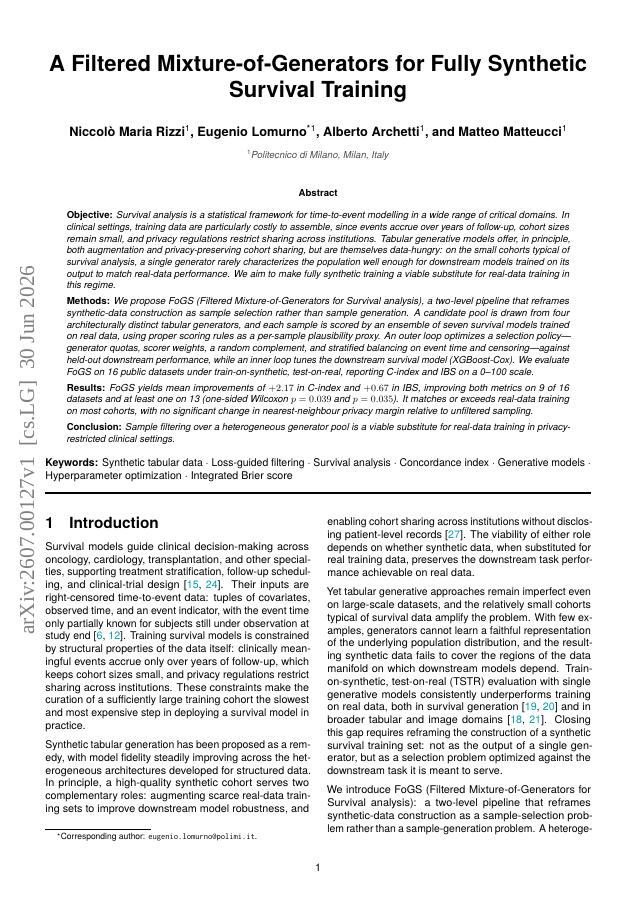
Survival analysis models time-to-event data, but in clinical settings training data are costly and scarce: events accrue over years of follow-up, cohorts are small, and privacy regulations restrict sharing across institutions.
30 Jun 2026
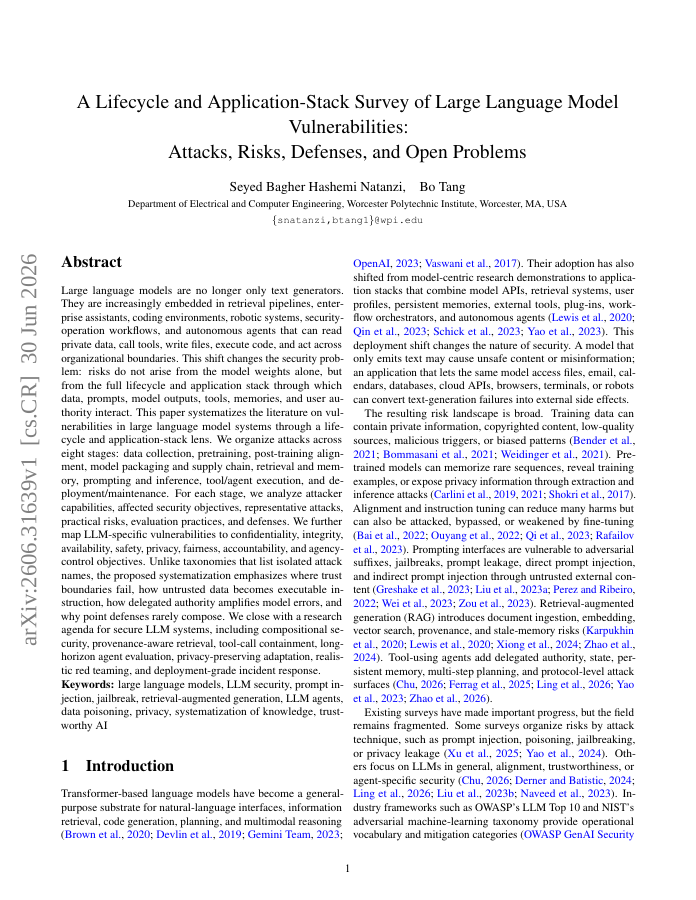
Large language models are no longer only text generators. They are increasingly embedded in retrieval pipelines, enterprise assistants, coding environments, robotic systems, security-operation workflows, and autonomous agents that can read private data, call tools, write files,…
30 Jun 2026
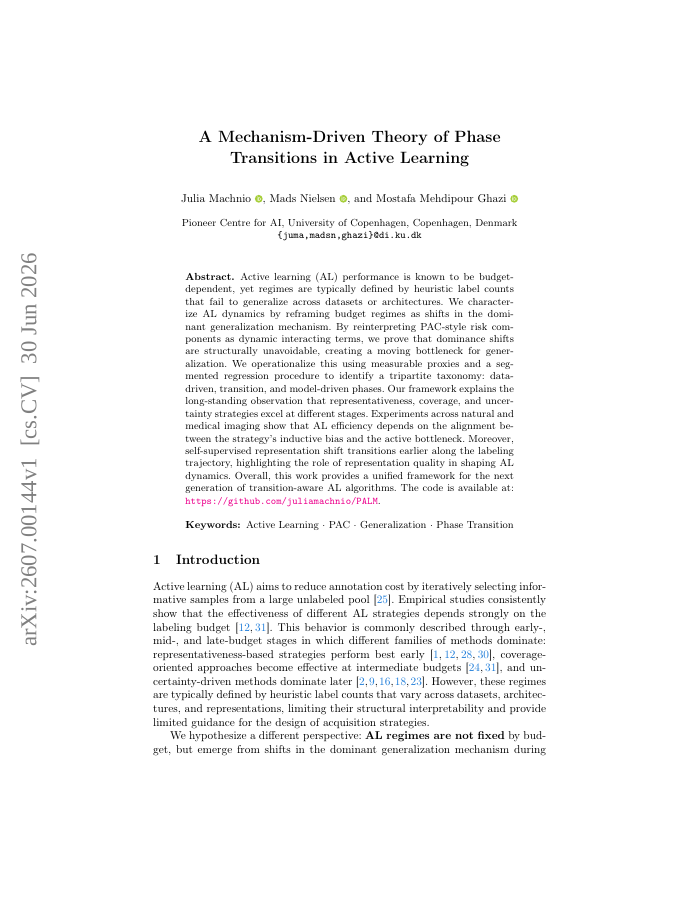
Active learning (AL) performance is known to be budget-dependent, yet regimes are typically defined by heuristic label counts that fail to generalize across datasets or architectures.
30 Jun 2026
This paper presents an integrated system for the CMU Vision-Language-Action (VLA) Challenge, designed to enable an autonomous agent to perform complex tasks based on natural language instructions.
30 Jun 2026
Autonomous wet-lab experimentation requires more than plausible protocol text: biological intent, quantitative procedures, device constraints and experimental feedback must remain aligned from protocol and SOP design to code and physical execution.
30 Jun 2026
Natural language-to-SQL (NL2SQL) over real-world enterprise databases remains significantly more challenging than on academic benchmarks. Enterprise schemas often contain hundreds of physical tables with cryptic column names, heterogeneous SQL dialects, and complex analytical…
30 Jun 2026
Research on artificial intelligence (AI) in the public sector often treats "AI" as a single category, neglecting technical distinctions between different AI systems.
30 Jun 2026
We present a three-phase deep reinforcement learning system for personalized portfolio management that addresses three limitations shared by all prior financial RL work: 1) ticker lock-in, 2) monolithic objectives , and 3) static user models.
30 Jun 2026
Fault recovery in process plants still relies heavily on plant operators, especially when faults fall outside predefined supervisory logic. Operators interpret alarms, procedures, P\&IDs, interlocks, and process trends, then decide how to move the plant to a safe operating mode…
29 Jun 2026
Current generative models, including GANs and diffusion models, have reached an outstanding level of photorealism, posing significant risks to privacy and security. To ensure real-world applicability, deepfake detectors must generalise effectively to unseen generators.
29 Jun 2026
Decision theory provides a formal framework for how agents should make choices under uncertainty, drawing on ideas from philosophy, probability, and causality. Despite significant progress, the field still lacks a unified modeling language, and key concepts - such as the…
29 Jun 2026
Objective: Accurate classification of physiological signals in real-world deployments is challenged by sensor noise, motion artifacts, and distribution shifts between training and deployment data.
29 Jun 2026
Measurements of proprietary LLM evaluators can become invalid within weeks -- we document one case and provide the diagnostic framework to detect it. We introduce EPC -- comprising the Multimodal Preference Collapse Index (MPCI), evaluator-indexed coupling matrix, and…
29 Jun 2026
Learned reconstruction operators for inverse problems are typically trained under a fixed noise model, and generalize poorly when the distribution during testing differs from the one assumed during training.
29 Jun 2026
Most corporate workplace environments enforce policies and technical controls that limit the storage of sensitive data on client endpoints. Consequently, ransomware operators have evolved variants that expand their attack surface from local systems to network drives and shared…
29 Jun 2026
We report a machine-verified resolution of a problem open for over a decade in quantum optimization: the Farhi, Goldstone and Gutmann (FGG) conjecture that depth-$p$ Quantum Approximate Optimization Algorithm (QAOA) on the ring of disagrees attains approximation ratio…