A Framework for Directed Acyclic Hypergraph Learning
19 Jun 2026
Continuous optimization methods for learning Directed Acyclic Graphs (DAGs) operate on weighted adjacency matrices and are therefore limited to pairwise causal relationships.
Trending research and the full catalog - each paper linked to the benchmarks, methods, and models it introduces.
Filtering here covers the 2,000 most recent papers, as much as one page can hold in memory. See the full index of 22,213 papers.
19 Jun 2026
Continuous optimization methods for learning Directed Acyclic Graphs (DAGs) operate on weighted adjacency matrices and are therefore limited to pairwise causal relationships.
19 Jun 2026
Phishing is a multi-modal threat. We present a hybrid pipeline that scores each modality with its own engine and fuses the results. Three engines are built, deployed, and independently benchmarked: a four-stage URL stack (Domain Guard, lexical model, threat intelligence, and an…
19 Jun 2026
High-stakes reasoning tasks necessitate transparent and verifiable workflows, yet conventional single-model large language models (LLMs) often struggle with hallucination and low interpretability under zero-shot paradigms.
19 Jun 2026
Minimum Spanning Trees have been used in unsupervised learning, particularly in clustering tasks, due to their ability to recognize clusters by removing edges that are considered inconsistent in defining those clusters.
19 Jun 2026
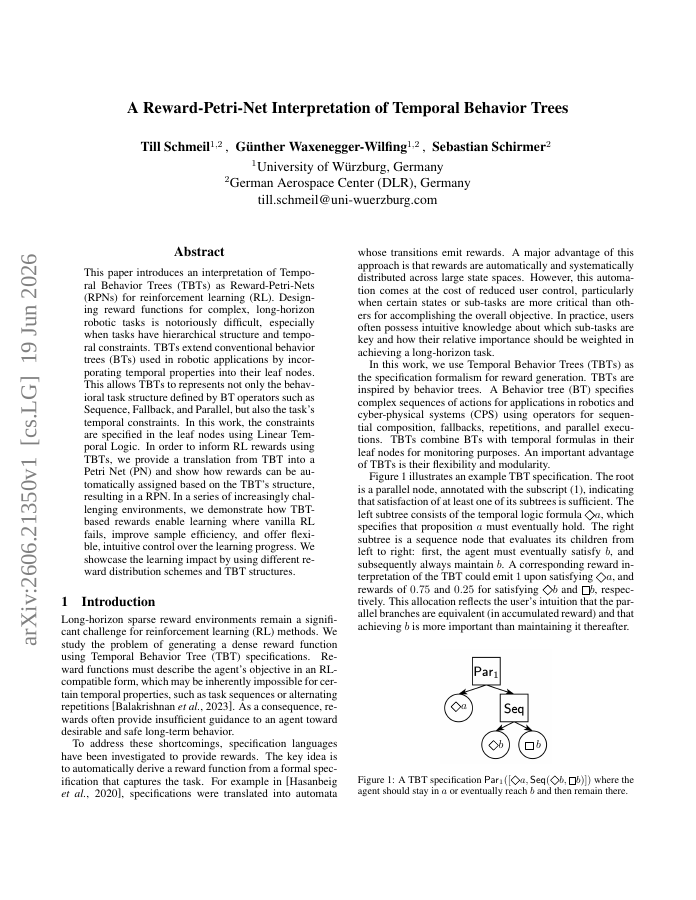
This paper introduces an interpretation of Temporal Behavior Trees (TBTs) as Reward-Petri-Nets (RPNs) for reinforcement learning (RL). Designing reward functions for complex, long-horizon robotic tasks is notoriously difficult, especially when tasks have hierarchical structure…
19 Jun 2026
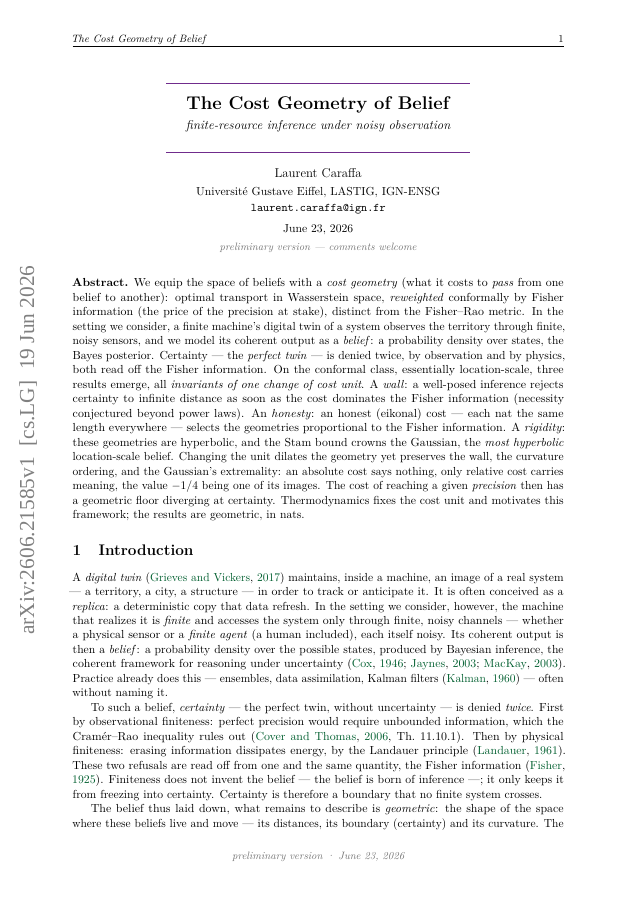
A finite agent, a machine's digital twin or any bounded reasoner, infers a fixed and noisy world through finite sensors, so its coherent output is a belief: a probability density over states (the Bayes posterior).
19 Jun 2026
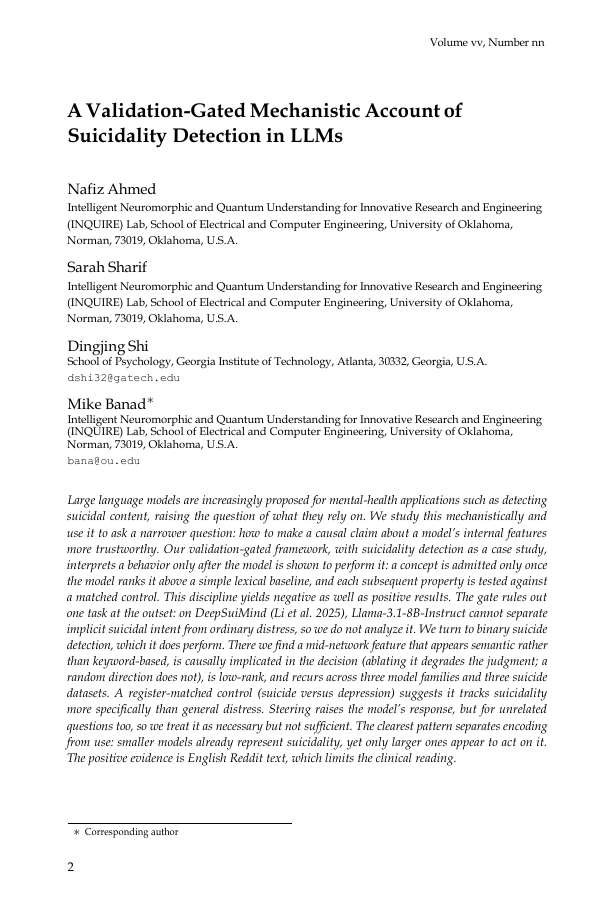
Large language models are increasingly proposed for mental-health applications such as detecting suicidal content, raising the question of what they rely on. We study this mechanistically and use it to ask a narrower question: how to make a causal claim about a model's internal…
19 Jun 2026
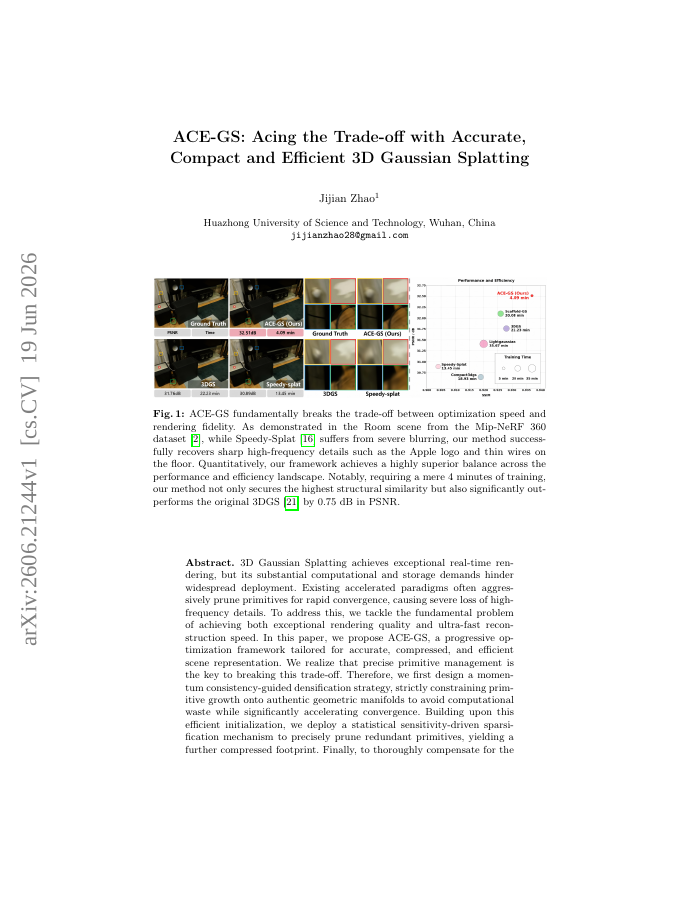
3D Gaussian Splatting achieves exceptional real-time rendering, but its substantial computational and storage demands hinder widespread deployment. Existing accelerated paradigms often aggressively prune primitives for rapid convergence, causing severe loss of high-frequency…
19 Jun 2026
Alignment from human feedback uses human judgments about model outputs to steer the behavior of language models after pretraining. When those judgments reflect conflicting views of desirable behavior, the learned objective becomes an aggregate determination of what the model…
18 Jun 2026
Characterizing non-Gaussian posterior distributions in partially observed high-dimensional nonlinear systems remains a fundamental challenge in data assimilation. Ensemble Kalman filters rely on Gaussian approximations that can be inaccurate for strongly non-Gaussian posteriors,…
18 Jun 2026
Quran Automatic Speech Recognition (ASR) aims to convert Quranic recitation into text, enabling applications such as aided memorisation tools and Quranic search engines.
18 Jun 2026
Medical image classification is often constrained by limited labeled data, motivating generative augmentation; recently, quantum generative models have been proposed for this purpose, frequently reporting accuracy gains.
18 Jun 2026
Field-based modeling from onboard measurements can produce autonomous underwater vehicle (AUV) maneuvering models that reflect real operating characteristics. From an approximation perspective, conventional maneuvering models use predefined constraint polynomial bases, whereas…
18 Jun 2026
The matrices arising from large scale $N$-body problems can be efficiently represented using hierarchical matrices, whose key idea is that the admissible off-diagonal sub-matrices can be well approximated by low-rank matrices across a hierarchy of matrix partitions.
18 Jun 2026
Dynamic average estimation is a critical problem in multi-agent systems, enabling agents to collaboratively estimate time-varying signals using only local information exchange.
18 Jun 2026
Nuclear Magnetic Resonance (NMR) spectroscopy is a powerful tool for molecular structure analysis, and spectral artificial intelligence offers great potential for its rapid and automated interpretation.
18 Jun 2026
Virtual training environments are software-intensive systems in which reinforcement learning (RL) agents learn, adapt, and demonstrate meaningful behavior. Virtual training environments offer a safe and cost-efficient alternative to training agents in real-world settings.
18 Jun 2026
Many decision-making problems in computing and networking systems can be naturally formulated as cost-minimization problems under performance constraints. In dynamic environments, reinforcement learning (RL) is often used to solve such problems at runtime by embedding both costs…
18 Jun 2026
Dynamic environmental changes, confined workspaces, and stringent real-time constraints make pathfinding in Robotic Mobile Fulfillment Systems (RMFS) a challenging problem for conventional search- and rule-based methods, which typically suffer from high computational complexity…
18 Jun 2026
Although large language models (LLMs) have shown strong capabilities across a wide range of tasks, their outputs often remain unreliable and may contain hallucinations, making uncertainty estimation (UE) essential for building trustworthy LLMs.
18 Jun 2026
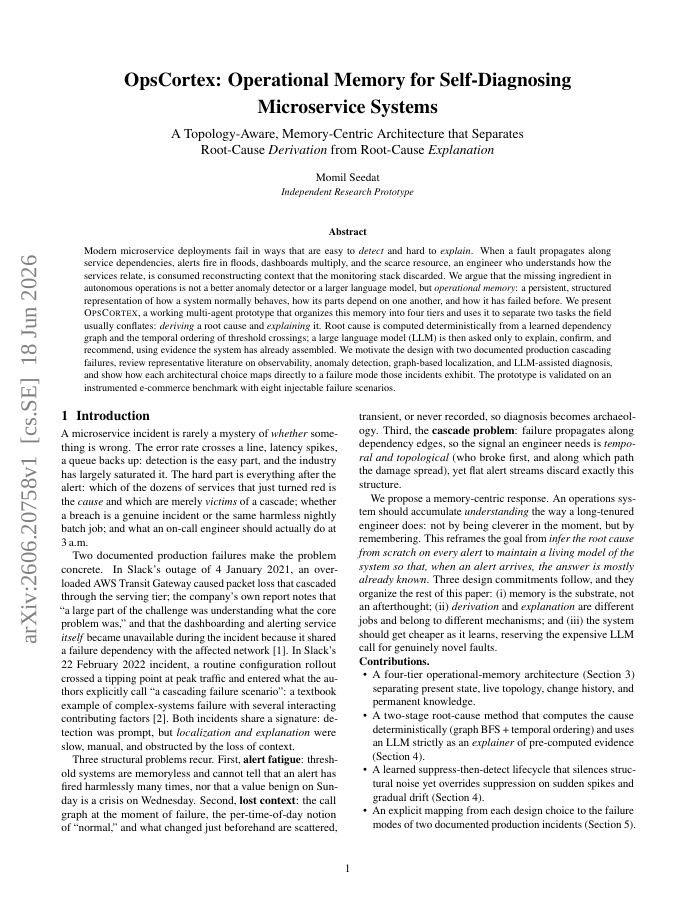
Modern microservice deployments fail in ways that are easy to detect and hard to explain. When a fault propagates along service dependencies, alerts fire in floods, dashboards multiply, and the scarce resource, an engineer who understands how the services relate, is consumed…
18 Jun 2026
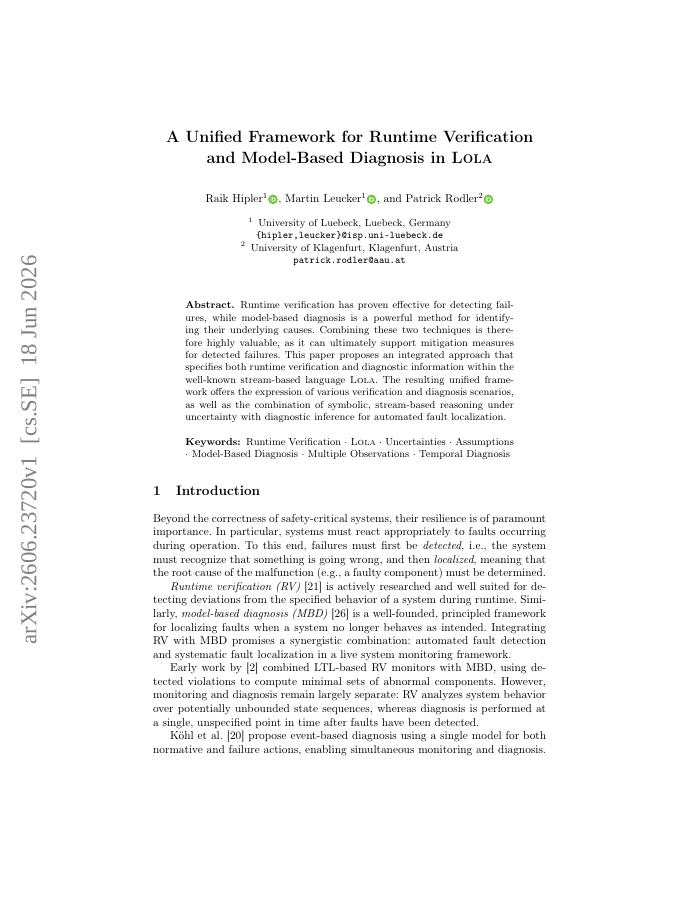
We present an integrated framework that unifies runtime verification and model-based diagnosis within the stream specification language LOLA. By encoding system descriptions, component health states, and observations into a single stream-based formalism, the approach enables…
18 Jun 2026
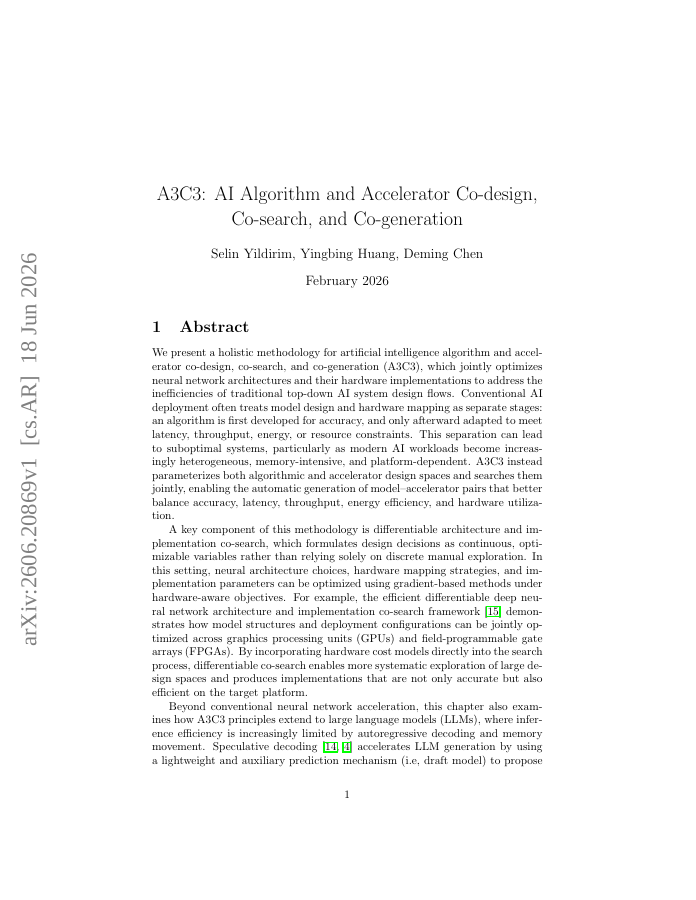
We present a holistic methodology for artificial intelligence algorithm and accelerator co-design, co-search, and co-generation (A3C3), which jointly optimizes neural network architectures and their hardware implementations to address the inefficiencies of traditional top-down…
18 Jun 2026
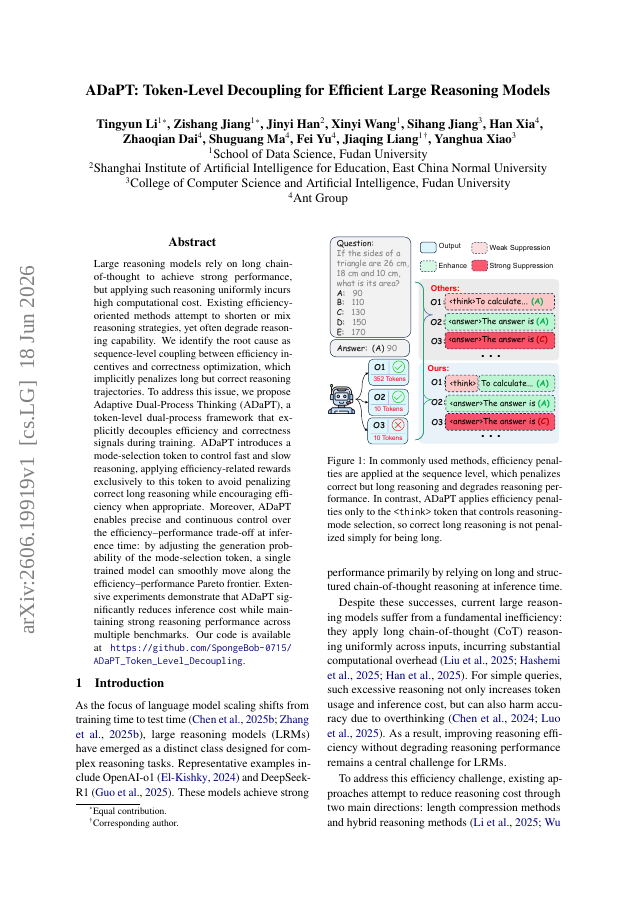
Large reasoning models rely on long chain-of-thought to achieve strong performance, but applying such reasoning uniformly incurs high computational cost. Existing efficiency-oriented methods attempt to shorten or mix reasoning strategies, yet often degrade reasoning capability.