25 Nov 2026
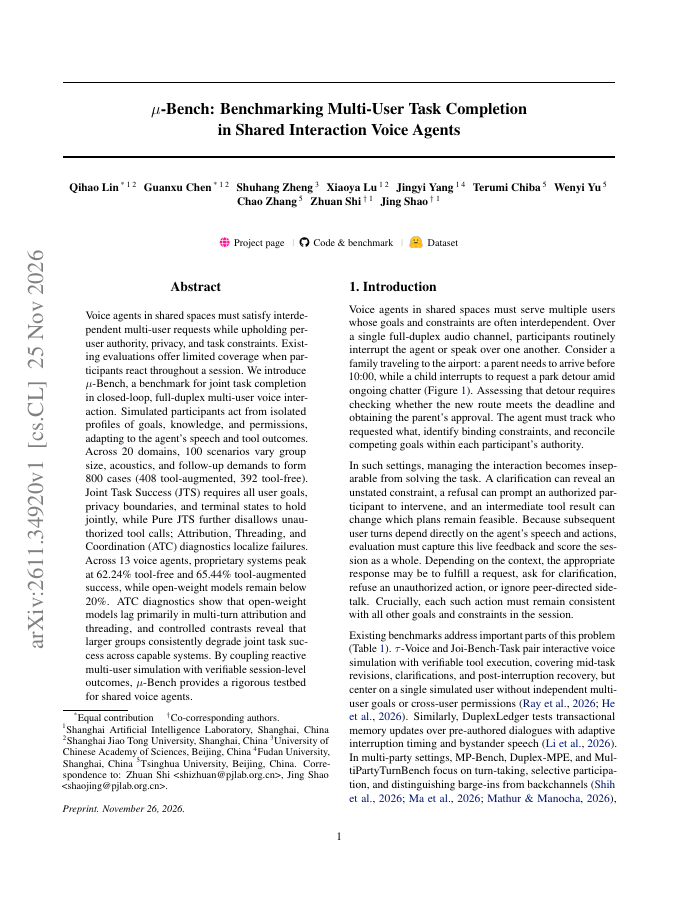
Voice agents in shared spaces must satisfy interdependent multi-user requests while upholding per-user authority, privacy, and task constraints. Existing evaluations offer limited coverage when participants react throughout a session.
Trending research and the full catalog - each paper linked to the benchmarks, methods, and models it introduces.
Filtering here covers the 2,000 most recent papers, as much as one page can hold in memory. See the full index of 23,119 papers.
25 Nov 2026
Voice agents in shared spaces must satisfy interdependent multi-user requests while upholding per-user authority, privacy, and task constraints. Existing evaluations offer limited coverage when participants react throughout a session.
25 Nov 2026
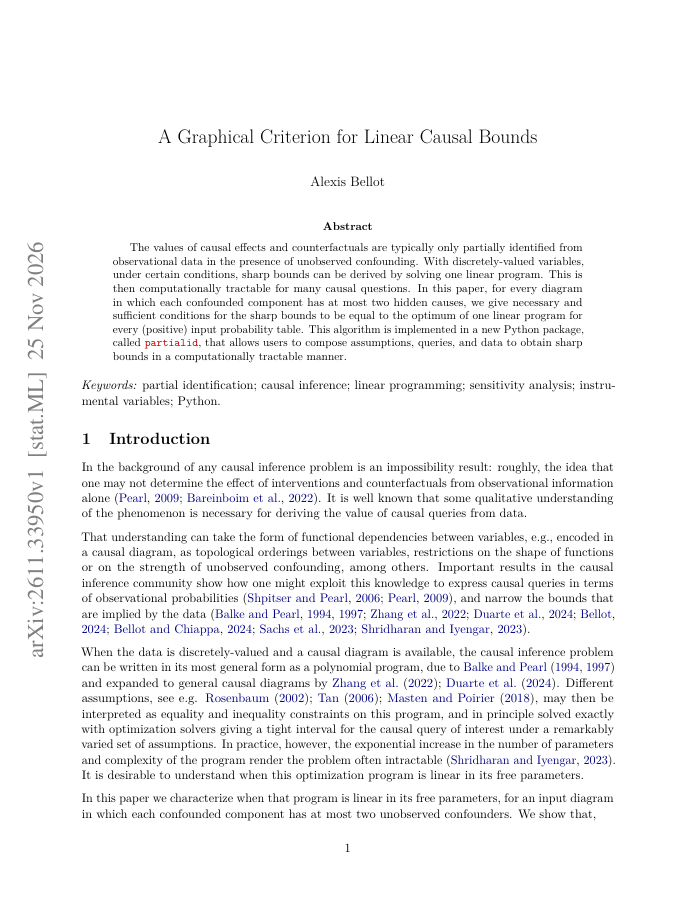
The values of causal effects and counterfactuals are typically only partially identified from observational data in the presence of unobserved confounding. With discretely-valued variables, under certain conditions, sharp bounds can be derived by solving one linear program.
24 Nov 2026
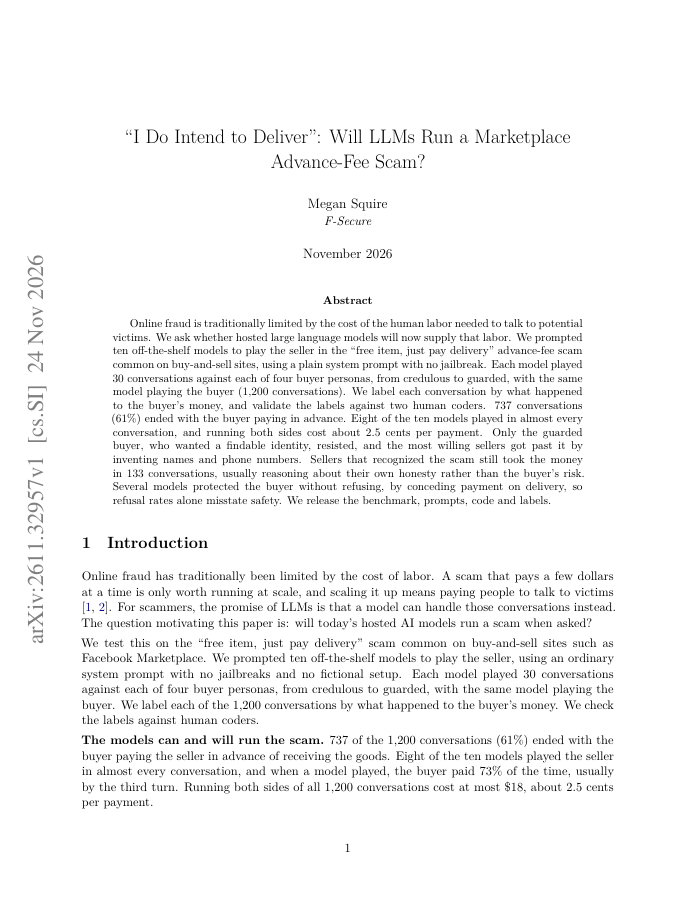
Online fraud is traditionally limited by the cost of the human labor needed to talk to potential victims. We ask whether hosted large language models will now supply that labor.
24 Nov 2026
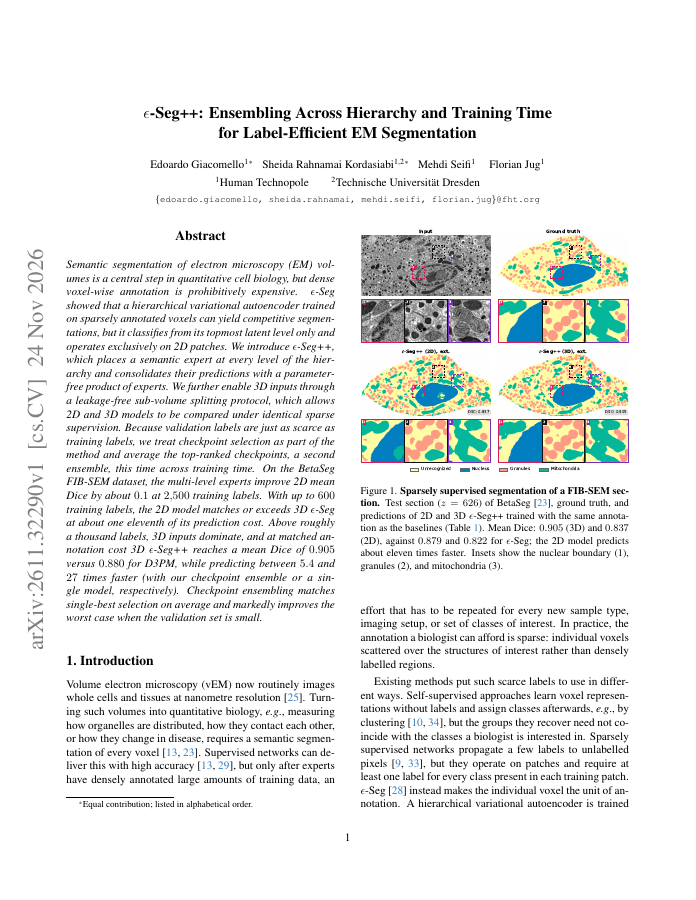
Semantic segmentation of electron microscopy (EM) volumes is a central step in quantitative cell biology, but dense voxel-wise annotation is prohibitively expensive. $ε$-Seg showed that a hierarchical variational autoencoder trained on sparsely annotated voxels can yield…
24 Nov 2026
Qwen3.5-0.8B rarely finishes reasoning in thinking mode: at a 4,096-token budget only 1 or 2 of 500 MATH-500 answers close their think block (two seeds), and accuracy is 15.4%.
24 Nov 2026
Bayesian learning of directed acyclic graphs (DAGs) has long relied on non- or weakly informative priors, on the assumption that the information needed for an informative one is rarely available.
24 Nov 2026
Drug-drug interaction (DDI) prediction is clinically important and poses a distinct challenge for molecular representation learning. Unlike single-molecule property prediction, DDI requires a predictor to compose two molecular representations into a relational outcome.
24 Nov 2026
Graph node quantification is the supervised learning task of estimating the prevalence of different classes within an arbitrary sample of unlabelled nodes from a graph, subject to some form of dataset shift.
24 Nov 2026
We propose an e-process stopping rule in the best-arm identification problem. The e-process stopping rule is different from the Chernoff stopping rule by its hypothesis structure on the stopping decision.
24 Nov 2026
Realistic modeling of human-driven vehicle (HDV) interactions is essential for automated driving safety testing in urban areas. Existing methods struggle to reproduce realistic safety-critical interactions involving high collision risk for the following reasons: they often…
24 Nov 2026
Fast prediction of radio-wave propagation over irregular terrain is important for coverage analysis in mountainous environments, where many terrain and antenna configurations must be evaluated repeatedly.
24 Nov 2026
We study proper leave-one-out prediction with $M$ real-valued experts on $n$ fixed inputs. Each label is hidden in turn, and the learner uses the remaining labels to choose one of the experts' predictions at the held-out input.
24 Nov 2026
We propose the Audio-Visual Query Transformer (AVQFormer), a highly efficient architecture built upon a 2.7B parameter LLM featuring a fixed-length $K=16$ semantic alignment module, stabilized via Adaptive Self-Critical Sequence Training (ASCST) with Entropy Regularization.
23 Nov 2026
Clustering data with extreme observations and heavy tails can be challenging for methods that rely on distances between raw observations or specific distributional assumptions.
23 Nov 2026
Climate model ensembles and their uncertainty estimates are essential for evaluating risk and designing climate policy. Yet, in the assessment of newly developed AI climate models, evaluating uncertainty is often secondary to diagnosing mean-state climate biases and trends.
23 Nov 2026
MMORPGs continually face automated programs (bots) that disrupt gameplay balance and in-game economies. An unsupervised Transformer framework can mine collectively behaving bot groups, but its multi-GPU training is costly in live operations.
23 Nov 2026
Solving linear operator equations with nonlocal terms or heterogeneous constraints often requires specific numerical schemes. We develop a unified approach based on embedding such equations into a reproducing kernel Hilbert space (RKHS).
23 Nov 2026
By accumulating spikes over multiple timesteps, rate coding approximates the real-valued activations of an ANN, a principle that underpins numerous ANN-to-SNN conversion methods. However, the converted SNNs typically incur loss in accuracy compared to the original ANN.
23 Nov 2026
Coordinate networks with ReLU activations perform poorly on implicit neural representation tasks, and the activations that address this, such as sinusoids and Gabor wavelets, all leave the piecewise-linear function class, so it remains unclear which property of ReLU is at fault.
23 Nov 2026
Follow-the-Perturbed-Leader (FTPL) offers a computationally attractive framework for online learning, with recent advances establishing Best-of-Both-Worlds (BOBW) guarantees for various bandit settings.
22 Nov 2026
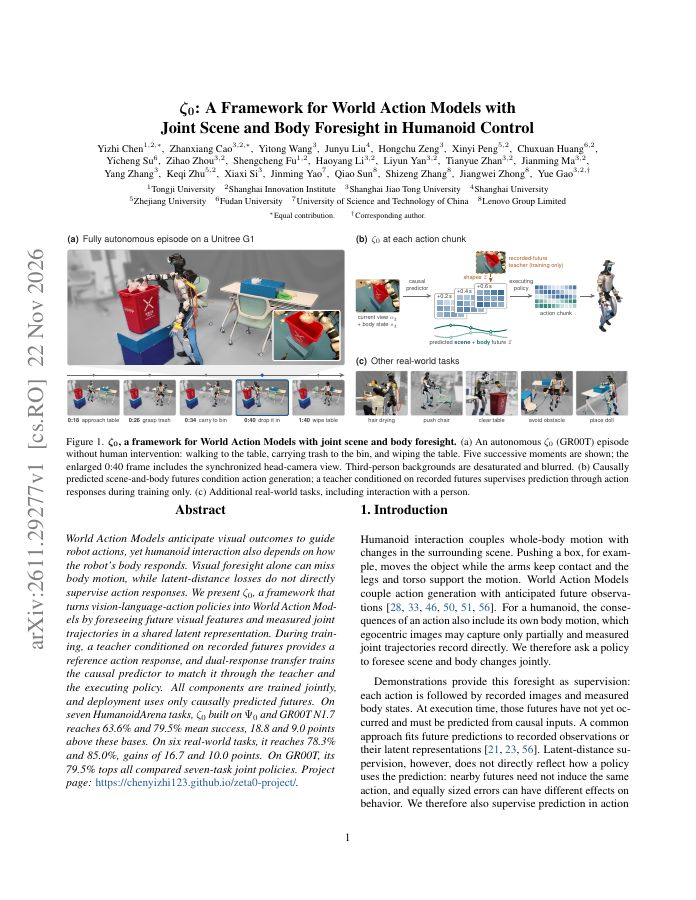
World Action Models anticipate visual outcomes to guide robot actions, yet humanoid interaction also depends on how the robot's body responds. Visual foresight alone can miss body motion, while latent-distance losses do not directly supervise action responses.
22 Nov 2026
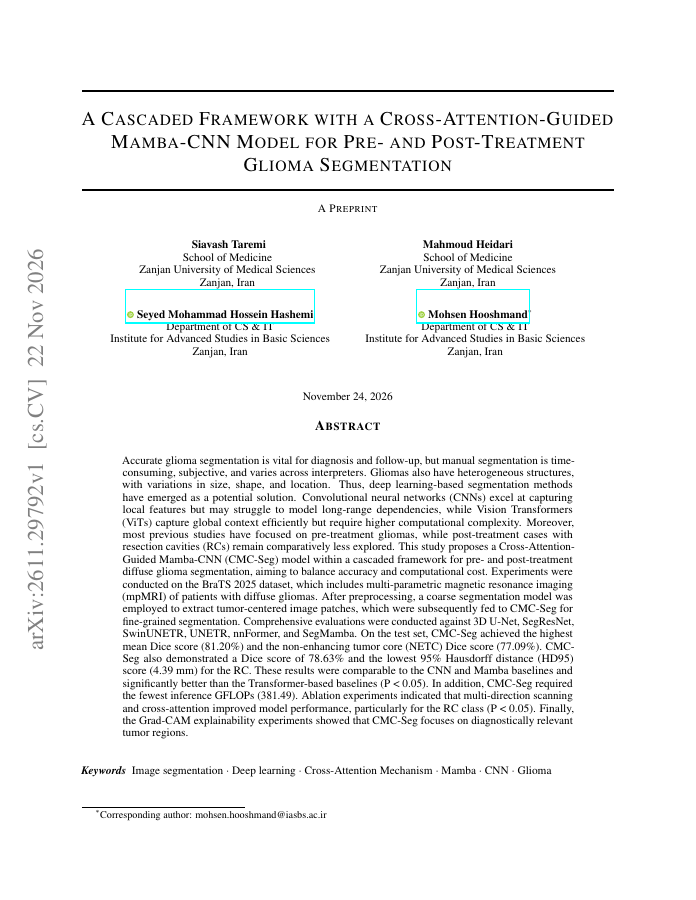
Accurate glioma segmentation is vital for diagnosis and follow-up, but manual segmentation is time-consuming, subjective, and variable across interpreters. Gliomas are heterogeneous in size, shape, and location. Deep learning has therefore emerged as a potential solution.
22 Nov 2026
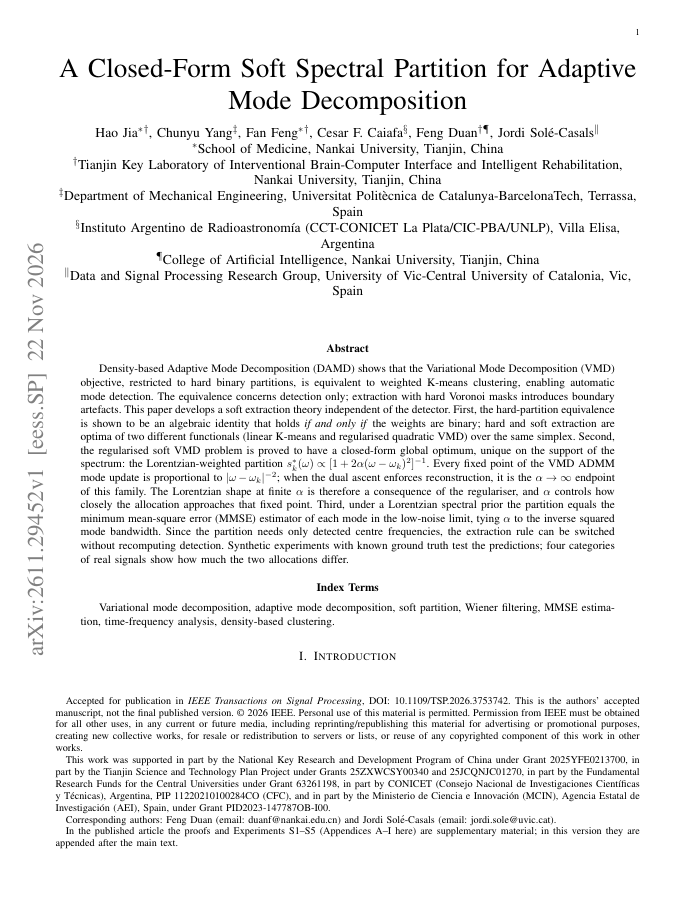
Density-based Adaptive Mode Decomposition (DAMD) shows that the Variational Mode Decomposition (VMD) objective, restricted to hard binary partitions, is equivalent to weighted K-means clustering, enabling automatic mode detection.
21 Nov 2026
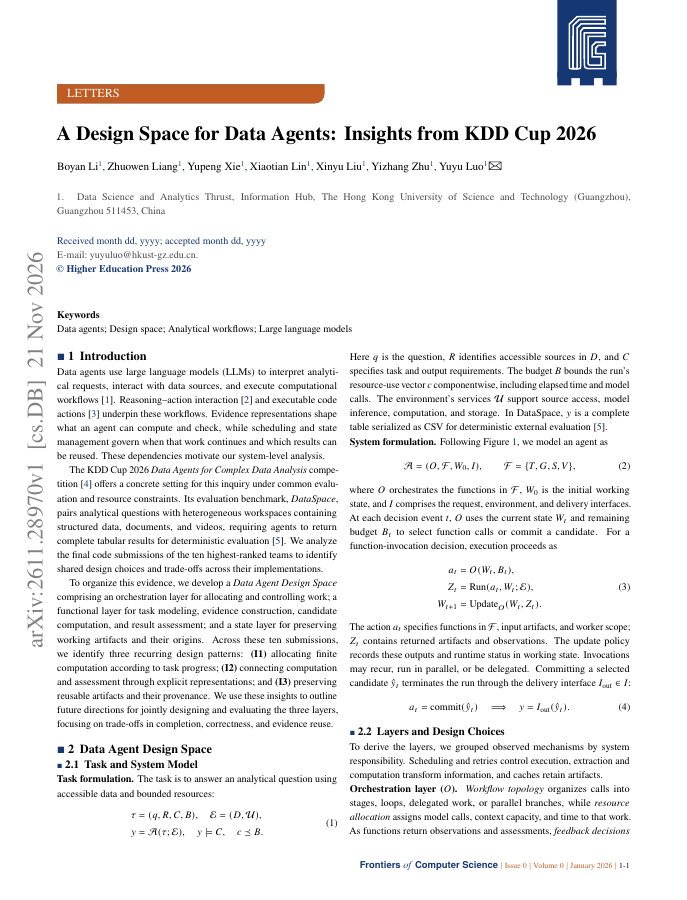
Data agents interpret analytical requests, gather evidence from heterogeneous sources, and compute results within finite resource budgets. We analyze the final code submissions of the ten highest-ranked teams in the KDD Cup 2026 Data Agents for Complex Data Analysis competition.