4 Jul 2026
Relational databases (RDBs) are the primary data infrastructure in many enterprises, yet recent deep learning methods designed for RDBs have been evaluated under inconsistent experimental protocols, making fair comparison difficult.
Trending research and the full catalog - each paper linked to the benchmarks, methods, and models it introduces.
Filtering here covers the 2,000 most recent papers, as much as one page can hold in memory. See the full index of 23,119 papers.
4 Jul 2026
Relational databases (RDBs) are the primary data infrastructure in many enterprises, yet recent deep learning methods designed for RDBs have been evaluated under inconsistent experimental protocols, making fair comparison difficult.
4 Jul 2026
Minimum maximum mean discrepancy (MMD) estimation has emerged as a robust and likelihood-free alternative to maximum likelihood estimation for parameter estimation. Yet, despite its practical success, the associated optimization problem remains poorly understood, with…
4 Jul 2026
Modern supply chains span diverse operational environments, ranging from e-commerce distribution networks to customized production-to-order manufacturing lines. Across these settings, operational efficiency depends on coordinating two highly interdependent stages: order…
4 Jul 2026
The Gaussian Error Linear Unit is usually motivated as the expected output of an input-dependent Bernoulli gate. This work gives an alternative interpretation: GELU is the expected output of a hard linear gate with a Gaussian random threshold.
3 Jul 2026
Scenario-based transportation analysis specifies future assumptions through aggregate population targets, whereas generative population synthesis models produce detailed individual-level realizations.
3 Jul 2026
Policy learning has received substantial attention with the goal of learning policies from observational data for decision-making. A majority of work in this space has focused on developing algorithms for computing policies that minimize regret compared to the optimal policy.
3 Jul 2026
Modern video surveillance systems generate far more video streams than human operators can effectively monitor, making automated analysis essential for timely detection of security events.
3 Jul 2026
Graph-based semi-supervised learning (SSL) propagates a few labels over a similarity graph by minimizing a Dirichlet-type energy. The standard quadratic ($p=2$) energy reduces to a single graph-Laplacian solve, but it degenerates exactly where SSL is most useful when labels are…
3 Jul 2026
We propose PRECEDE, a precedent-guided co-scientist for side-effect-aware drug redesign that revises a parent compound to mitigate a specified side effect while preserving therapeutic function.
3 Jul 2026
Multi-product kitting delivery imposes significant challenges for real-time scheduling in hybrid manufacturing systems that integrate processing and assembly, as dynamic order arrivals simultaneously alter supply dependencies and the set of feasible job-machine assignments.
3 Jul 2026
Adversarial robustness in Unsupervised Domain Adaptation (UDA) remains a significant challenge due to noisy pseudo labels and inherent distributional shifts between the clean source and adversarially perturbed target domains.
3 Jul 2026
Least privilege, the principle that an identity should hold only the permissions strictly required for its task, has been a foundational primitive of access control for decades.
2 Jul 2026
Safe motion planning in advanced driver-assistance systems and autonomous vehicles requires an accurate understanding of how the surrounding traffic scene is likely to evolve.
2 Jul 2026
Electroencephalography (EEG) offers a noninvasive approach for examining neurophysiological correlates of dimensional psychopathology, yet systematic evidence across EEG paradigms and feature granularities remains limited.
2 Jul 2026
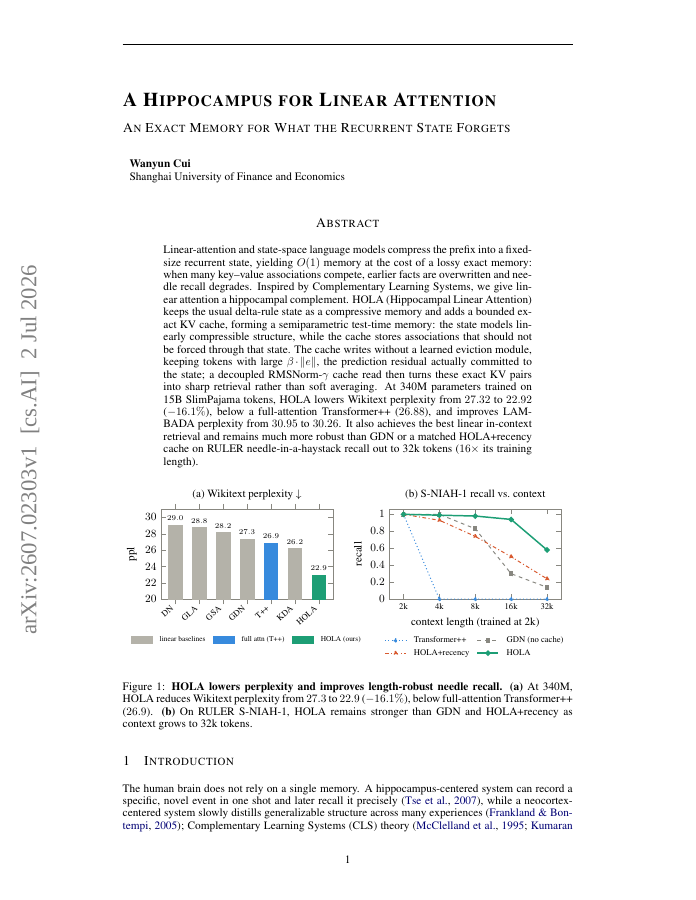
Linear-attention and state-space language models compress the prefix into a fixed-size recurrent state, yielding O(1) memory at the cost of a lossy exact memory: when many key--value associations compete, earlier facts are overwritten and needle recall degrades.
2 Jul 2026
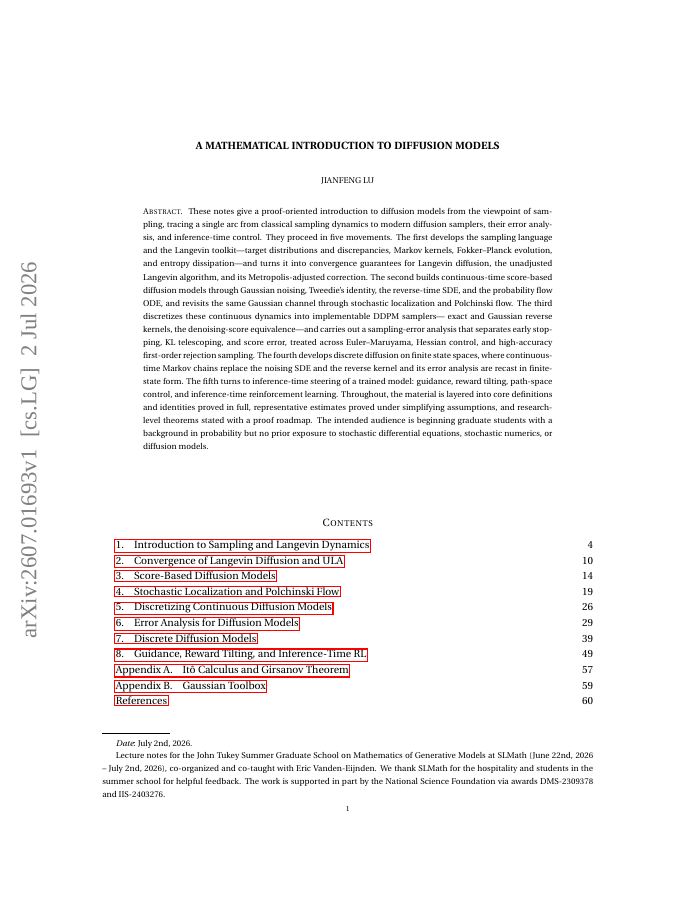
These notes give a proof-oriented introduction to diffusion models from the viewpoint of sampling, tracing a single arc from classical sampling dynamics to modern diffusion samplers, their error analysis, and inference-time control.
2 Jul 2026
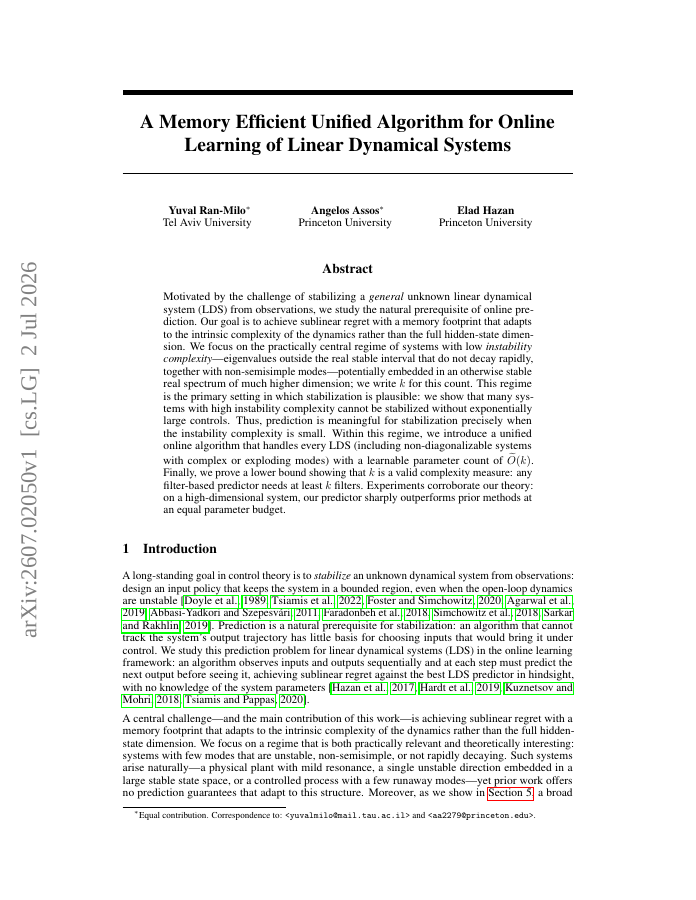
Motivated by the challenge of stabilizing a general unknown linear dynamical system (LDS) from observations, we study the natural prerequisite of online prediction. Our goal is to achieve sublinear regret with a memory footprint that adapts to the intrinsic complexity of the…
2 Jul 2026
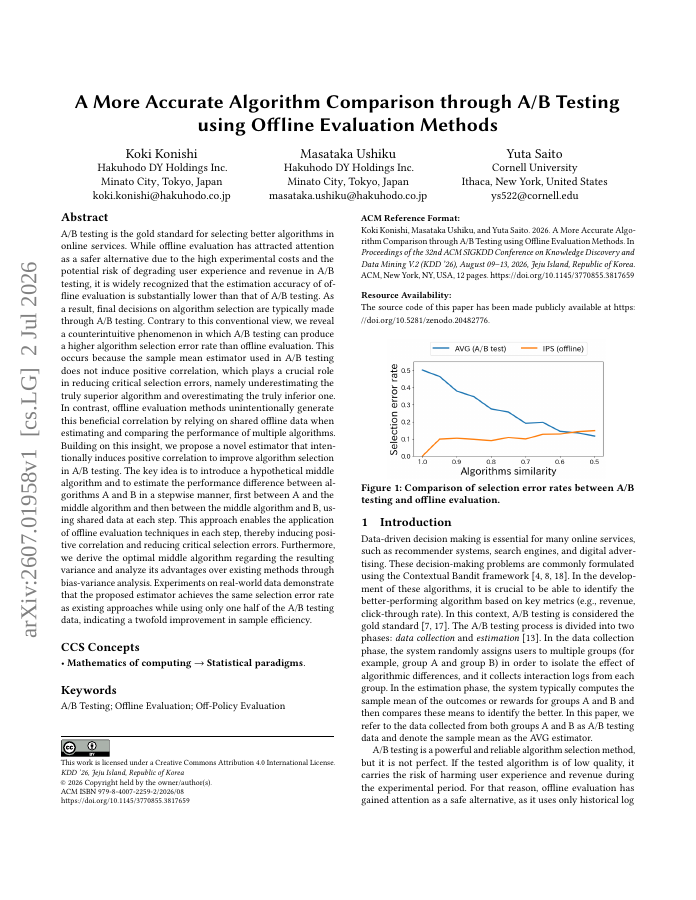
A/B testing is the gold standard for selecting the better algorithm in online services. While offline evaluation has attracted attention as a safer alternative due to the high experimental costs and the potential risk of degrading user experience and revenue in A/B testing, it…
2 Jul 2026
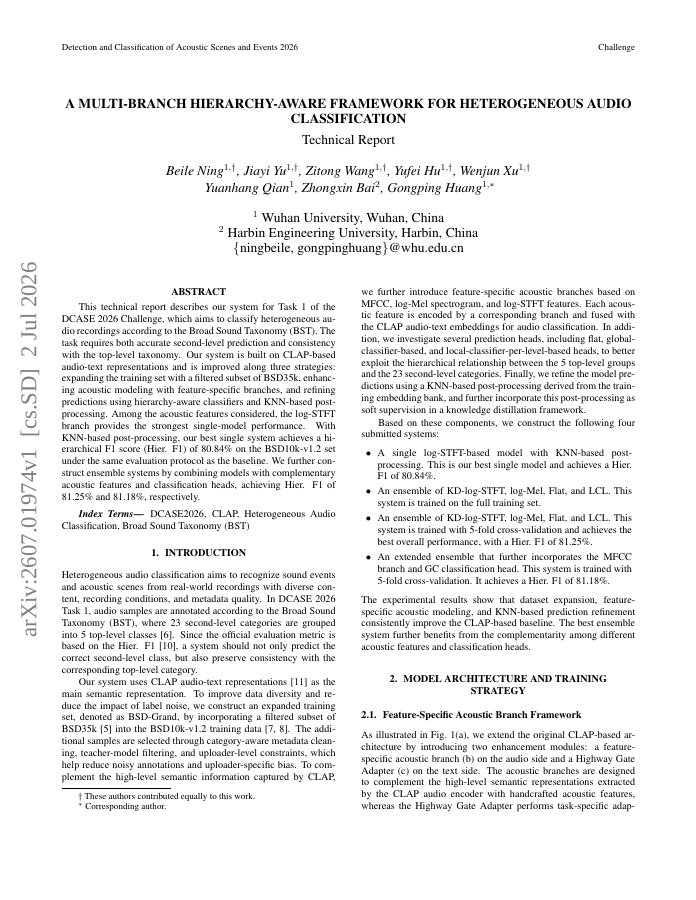
This technical report describes our system for Task 1 of the DCASE 2026 Challenge, which aims to classify heterogeneous audio recordings according to the Broad Sound Taxonomy (BST).
2 Jul 2026
Predictions by machine learning (ML) and artificial intelligence (AI) models are often received skeptically unless they are paired with intelligible explanations. In the context of just-in-time defect prediction, highlighting small portions of a software change (diff) -- beyond…
1 Jul 2026
The game of Taboo requires describing a target word without using a set of forbidden words, so that other players can guess it. This deceptively simple task combines strict lexical constraints with the need for communicatively effective descriptions, making it a compelling…
1 Jul 2026
Quantization has become an invaluable tool to reduce memory requirements and inference speed of modern language models, in particular to make them available for consumer setups and edge devices.
1 Jul 2026
Continuous diffusion language models offer an alternative to autoregressive generation, but their generations may suffer from repetition. We find that unconditional generations from ELF, a recent family of continuous diffusion language models, are more repetitive than human…
1 Jul 2026
Industry pipelines that turn speech into supervised fine-tuning (SFT) data via multi-stage refinement are increasingly adopted but, to our knowledge, have not been publicly ablated stage-by-stage, leaving each stage's marginal value unknown.