9 Oct 2026
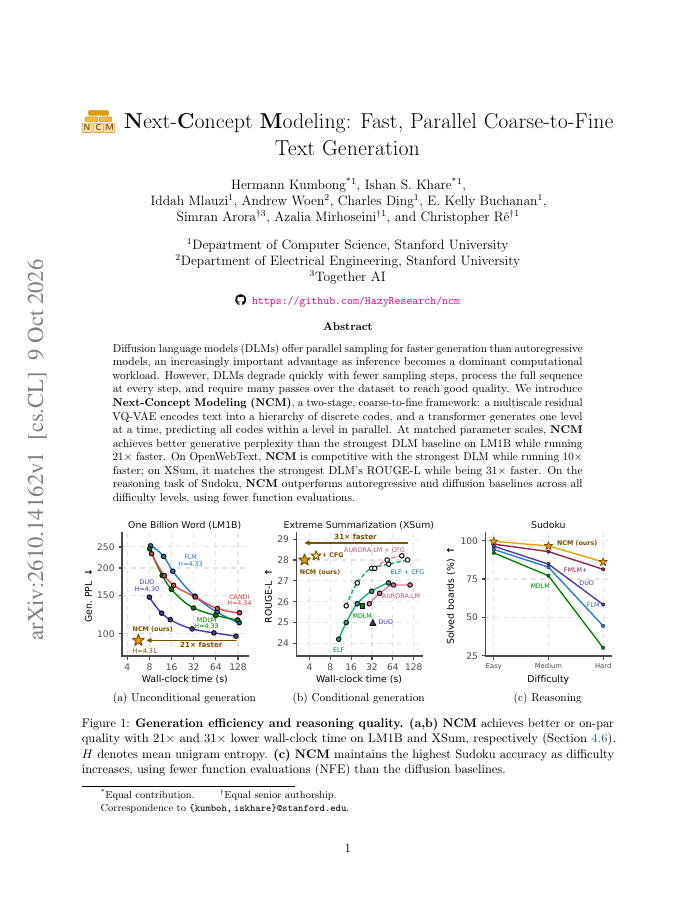
Diffusion language models (DLMs) offer parallel sampling for faster generation than autoregressive models, an increasingly important advantage as inference becomes a dominant computational workload.
Trending research and the full catalog - each paper linked to the benchmarks, methods, and models it introduces.
Filtering here covers the 2,000 most recent papers, as much as one page can hold in memory. See the full index of 22,663 papers.
9 Oct 2026
Diffusion language models (DLMs) offer parallel sampling for faster generation than autoregressive models, an increasingly important advantage as inference becomes a dominant computational workload.
13 Oct 2026
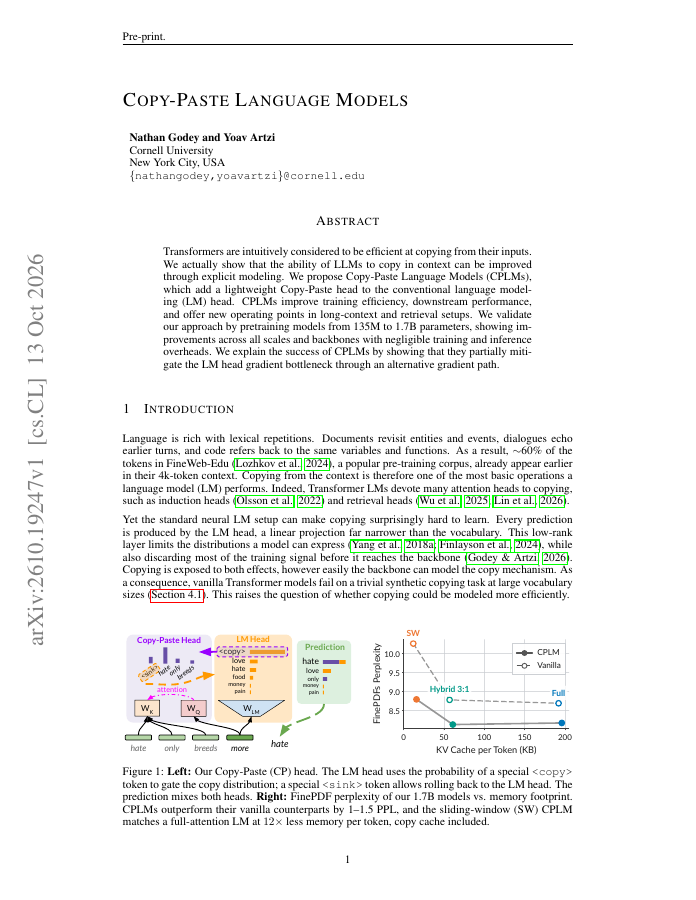
Transformers are intuitively considered to be efficient at copying from their inputs. We actually show that the ability of LLMs to copy in context can be improved through explicit modeling.
15 Oct 2026
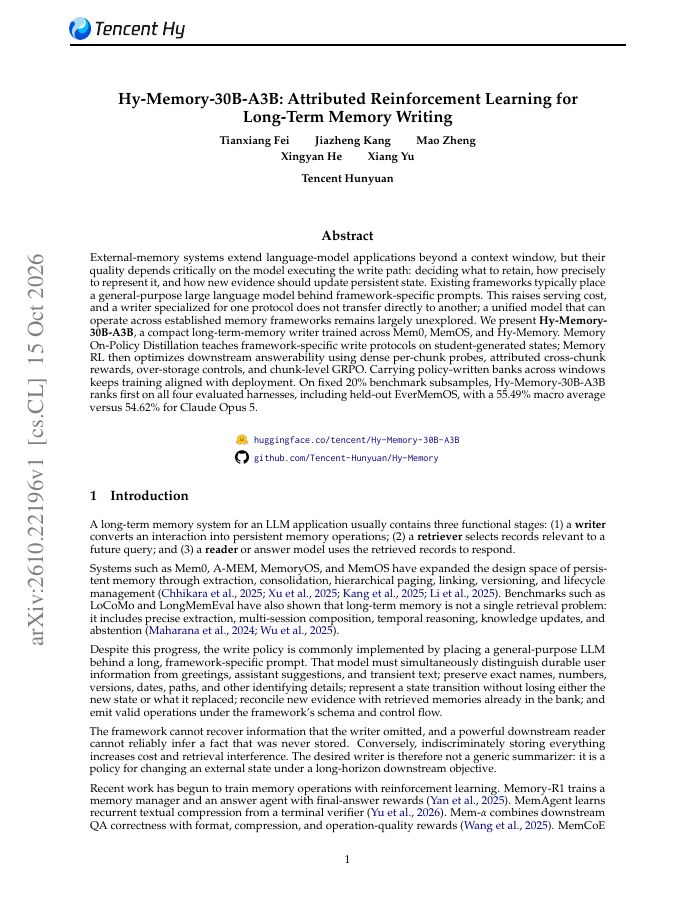
External-memory systems extend language-model applications beyond a context window, but their quality depends critically on the model executing the write path: deciding what to retain, how precisely to represent it, and how new evidence should update persistent state.
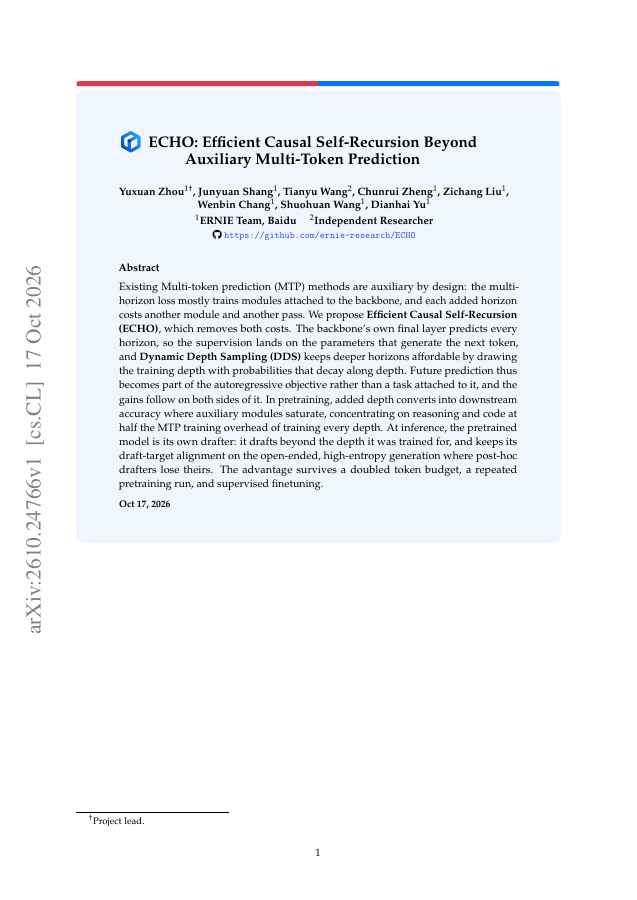
17 Oct 2026
Existing Multi-token prediction (MTP) methods are auxiliary by design: the multi-horizon loss mostly trains modules attached to the backbone, and each added horizon costs another module and another pass.
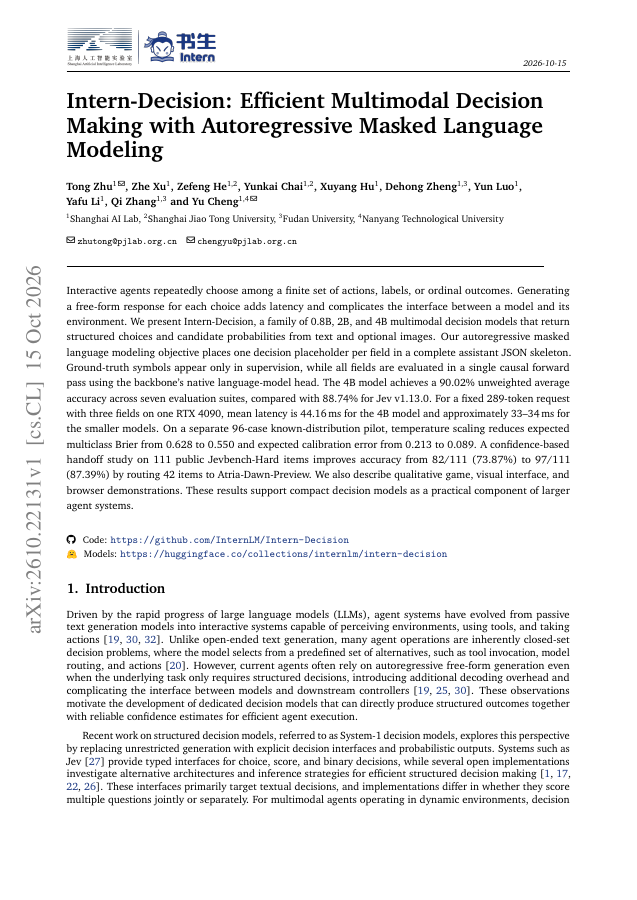
15 Oct 2026
Interactive agents repeatedly choose among a finite set of actions, labels, or ordinal outcomes. Generating a free-form response for each choice adds latency and complicates the interface between a model and its environment.
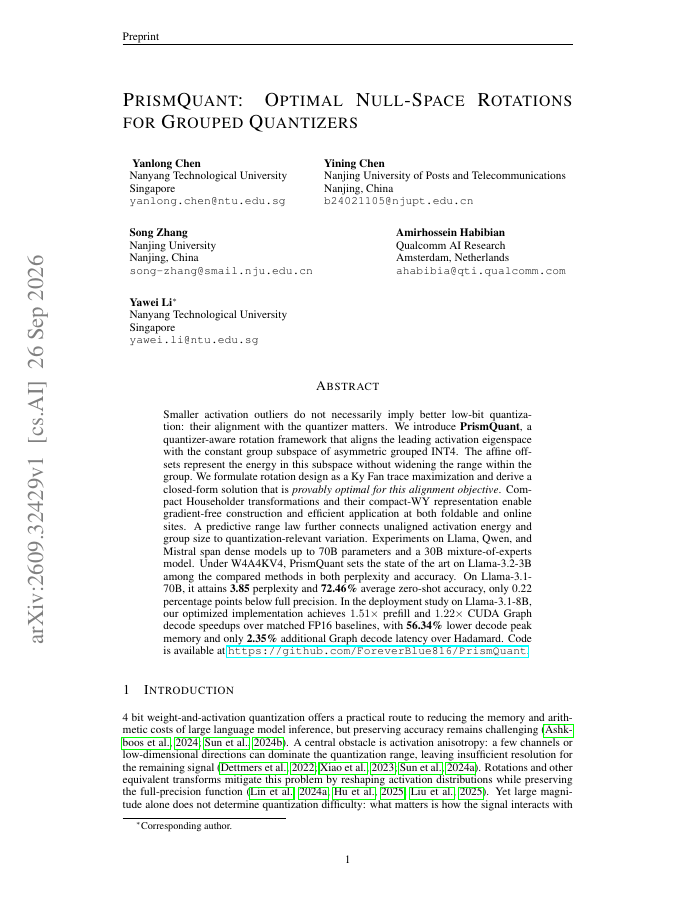
26 Sep 2026
Smaller activation outliers do not necessarily imply better low-bit quantization: their alignment with the quantizer matters. We introduce PrismQuant, a quantizer-aware rotation framework that aligns the leading activation eigenspace with the constant group subspace of…
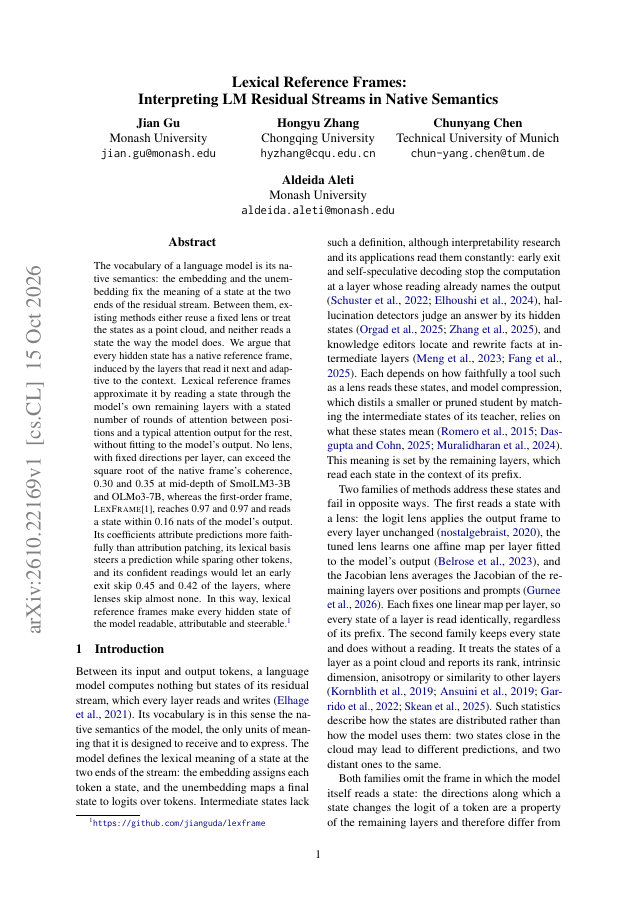
15 Oct 2026
The vocabulary of a language model is its native semantics, and the embedding and unembedding fix the meaning of a state at the two ends of the residual stream. Between them, existing methods reuse a fixed lens or treat states as a point cloud, and neither reads a state as the…
19 Oct 2026
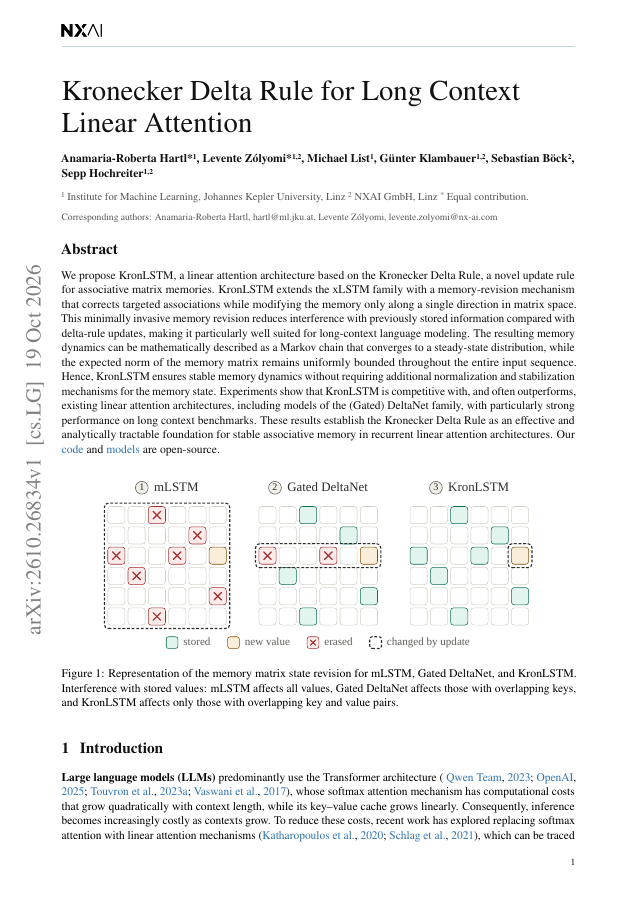
We propose KronLSTM, a linear attention architecture based on the Kronecker Delta Rule, a novel update rule for associative matrix memories. KronLSTM extends the xLSTM family with a memory-revision mechanism that corrects targeted associations while modifying the memory only…
20 Oct 2026
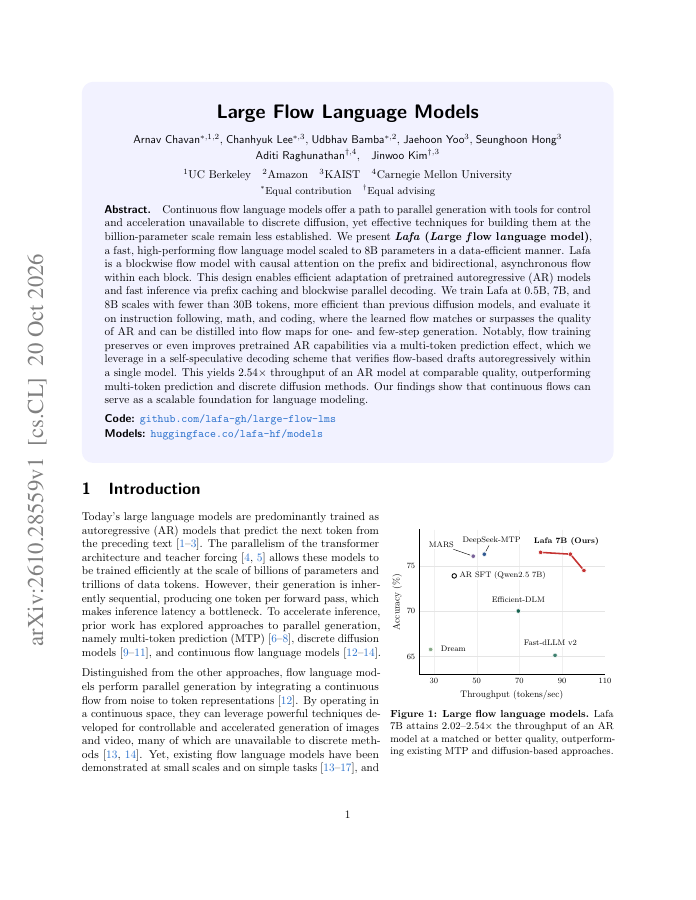
Continuous flow language models offer a path to parallel generation with tools for control and acceleration unavailable to discrete diffusion, yet effective techniques for building them at the billion-parameter scale remain less established.
19 Oct 2026
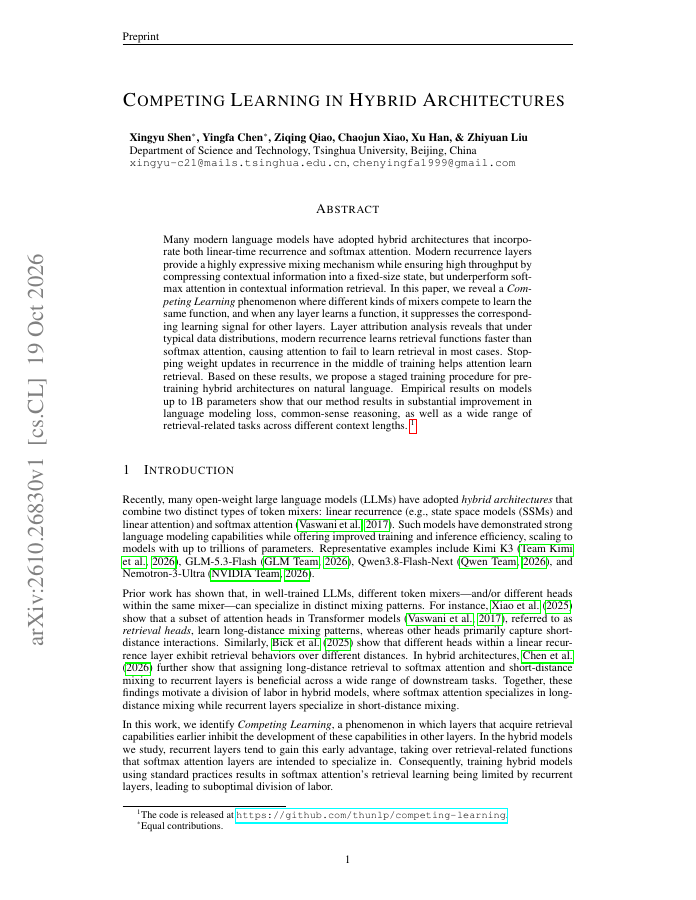
Many modern language models have adopted hybrid architectures that incorporate both linear-time recurrence and softmax attention. Modern recurrence layers provide a highly expressive mixing mechanism while ensuring high throughput by compressing contextual information into a…