16 Sep 2026
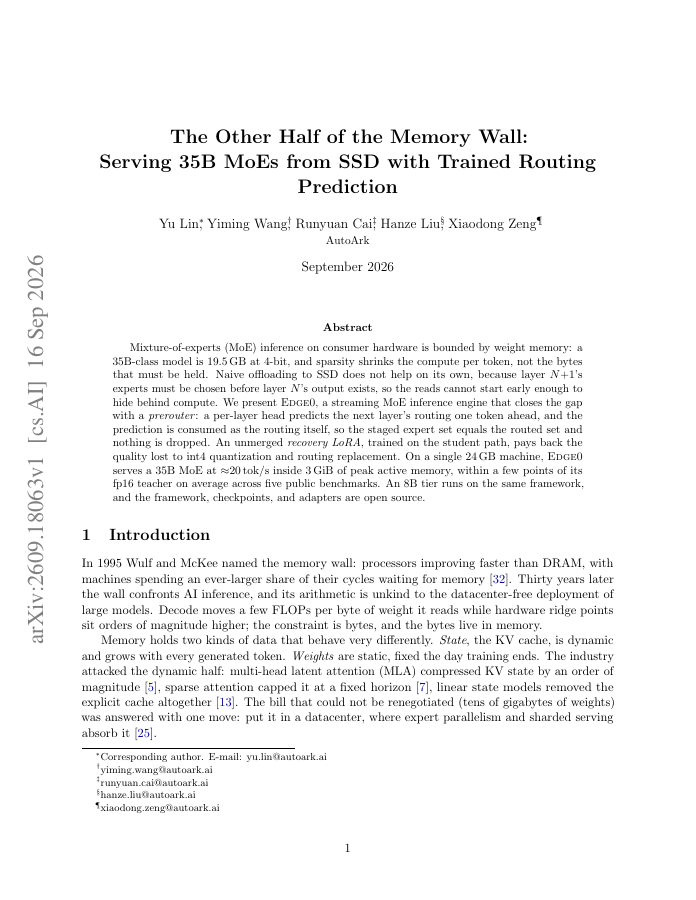
Mixture-of-experts (MoE) inference on consumer hardware is bounded by weight memory: a 35B-class model is 19.5GB at 4-bit, and sparsity shrinks the compute per token, not the bytes that must be held.
Trending research and the full catalog - each paper linked to the benchmarks, methods, and models it introduces.
Filtering here covers the 2,000 most recent papers, as much as one page can hold in memory. See the full index of 22,712 papers.
16 Sep 2026
Mixture-of-experts (MoE) inference on consumer hardware is bounded by weight memory: a 35B-class model is 19.5GB at 4-bit, and sparsity shrinks the compute per token, not the bytes that must be held.
17 Sep 2026
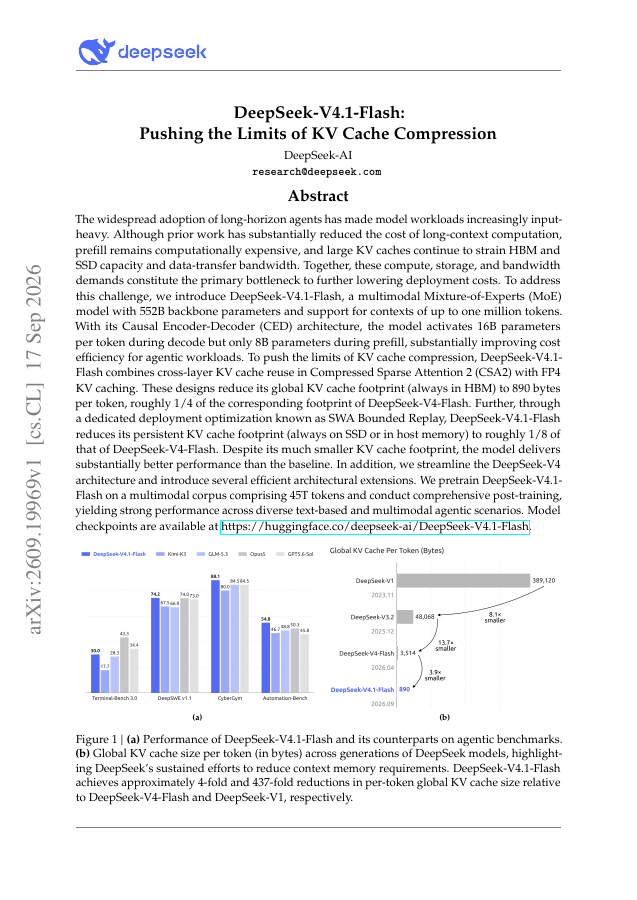
The widespread adoption of long-horizon agents has made model workloads increasingly input-heavy. Although prior work has substantially reduced the cost of long-context computation, prefill remains computationally expensive, and large KV caches continue to strain HBM and SSD…
29 May 2026
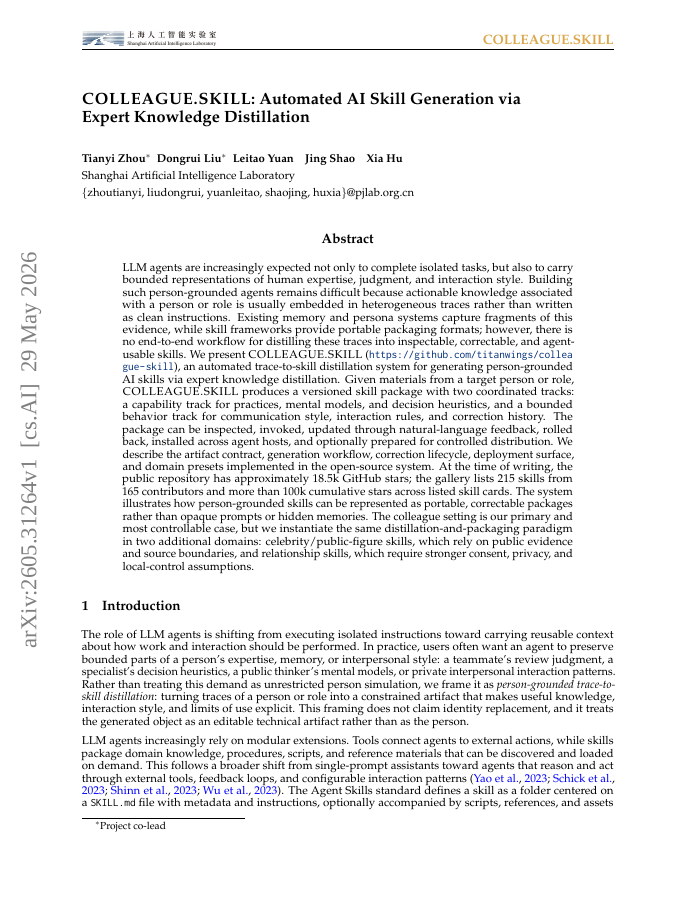
LLM agents are increasingly expected not only to complete isolated tasks, but also to carry bounded representations of human expertise, judgment, and interaction style. Building such person-grounded agents remains difficult because actionable knowledge associated with a person…
2 Jun 2026
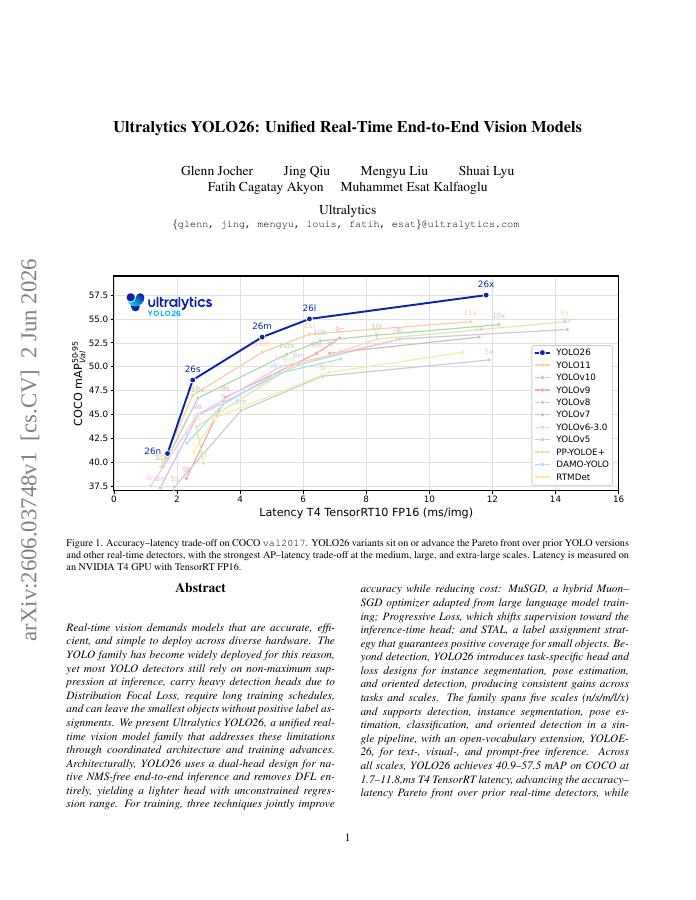
Real-time vision demands models that are accurate, efficient, and simple to deploy across diverse hardware. The YOLO family has become widely deployed for this reason, yet most YOLO detectors still rely on non-maximum suppression at inference, carry heavy detection heads due to…
9 Oct 2026
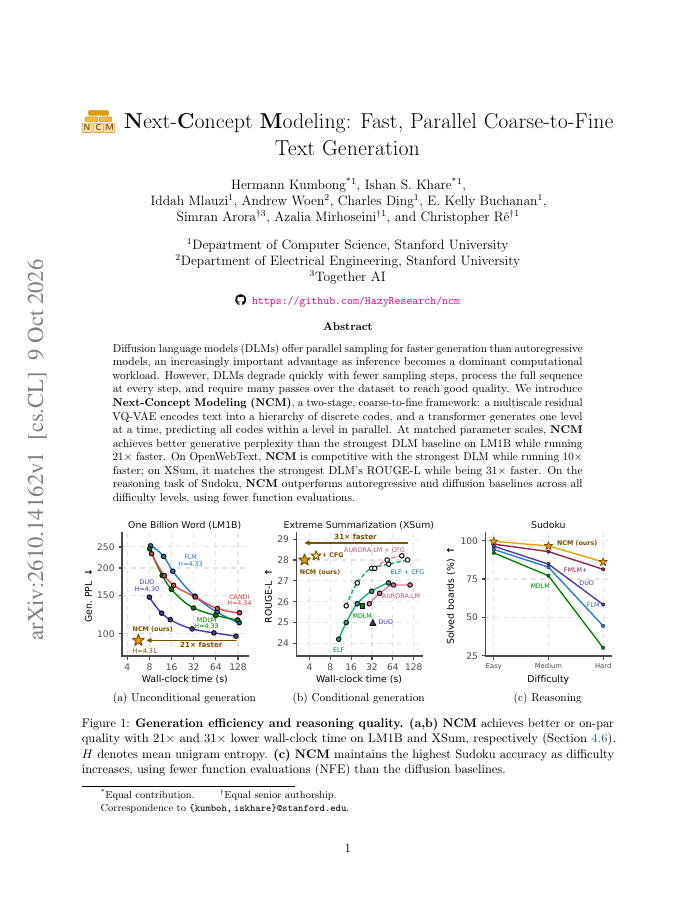
Diffusion language models (DLMs) offer parallel sampling for faster generation than autoregressive models, an increasingly important advantage as inference becomes a dominant computational workload.
13 Oct 2026
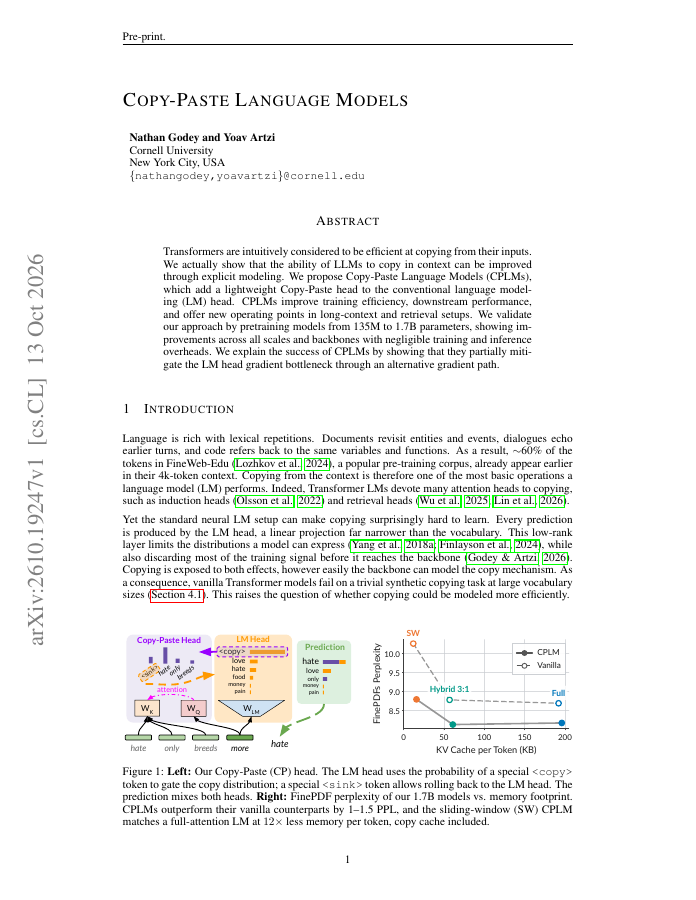
Transformers are intuitively considered to be efficient at copying from their inputs. We actually show that the ability of LLMs to copy in context can be improved through explicit modeling.
26 Aug 2026
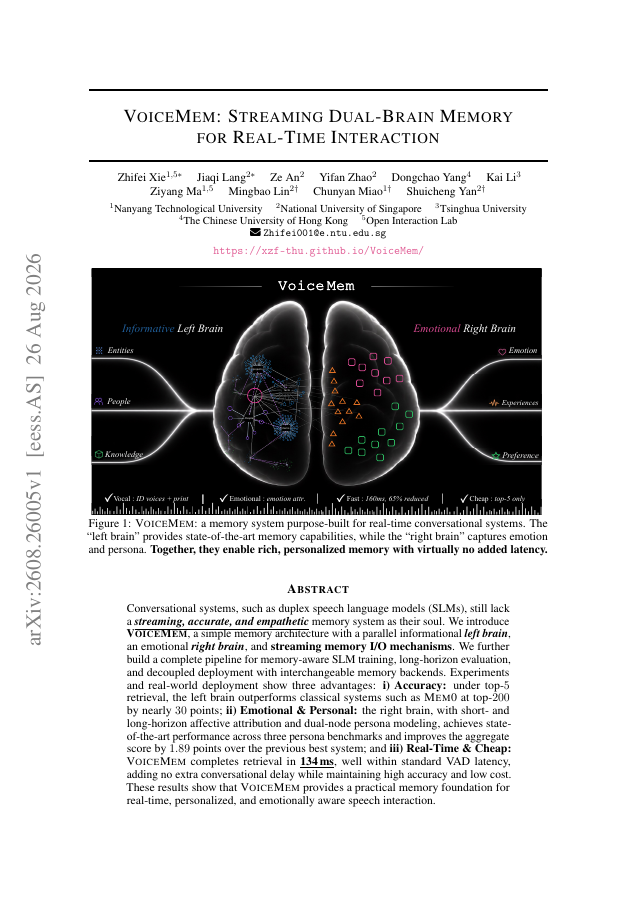
Conversational systems, such as duplex speech language models (SLMs), still lack a streaming, accurate, and empathetic memory system as their soul. We introduce VoiceMem, a simple memory architecture with a parallel informational left brain, an emotional right brain, and…
1 Jun 2026
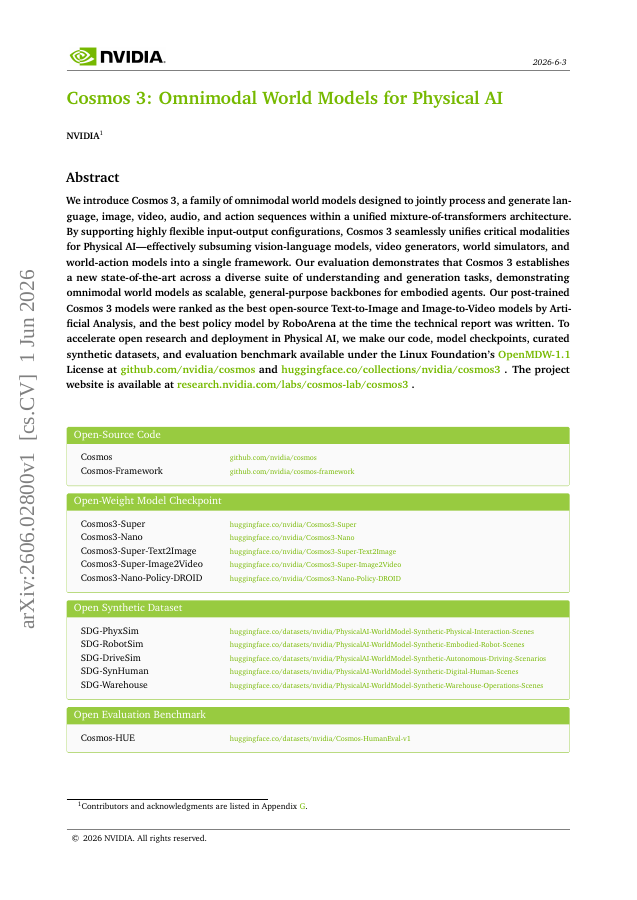
We introduce Cosmos 3, a family of omnimodal world models designed to jointly process and generate language, image, video, audio, and action sequences within a unified mixture-of-transformers architecture.
14 Sep 2026
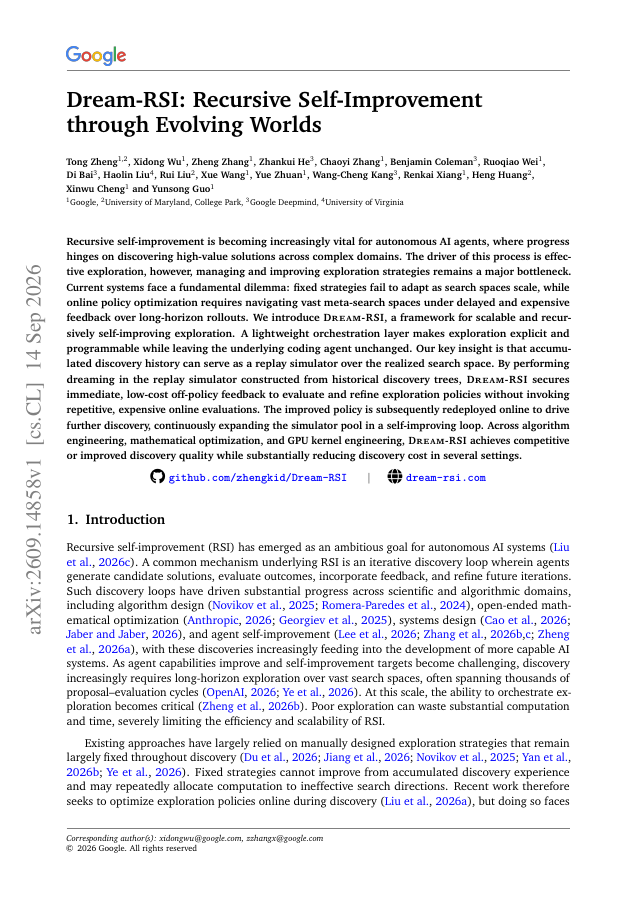
Recursive self-improvement is becoming essential for autonomous AI agents, whose progress depends on discovering high-value solutions across complex domains. Effective exploration drives this process, yet managing and improving exploration strategies remains a major bottleneck.
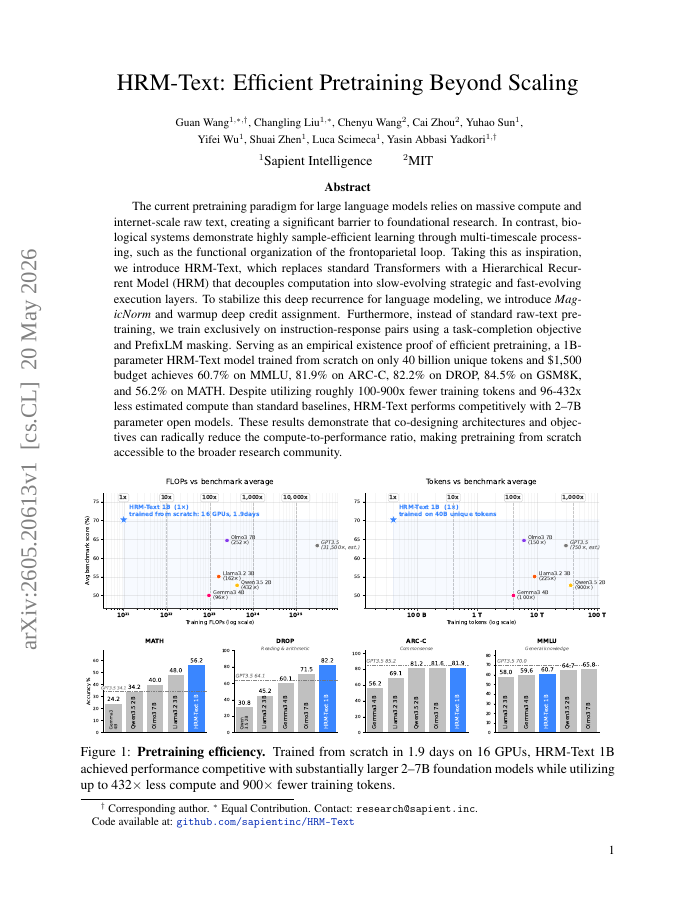
Guan Wang, Changling Liu, Chenyu Wang et al. · 20 May 2026
The current pretraining paradigm for large language models relies on massive compute and internet-scale raw text, creating a significant barrier to foundational research.
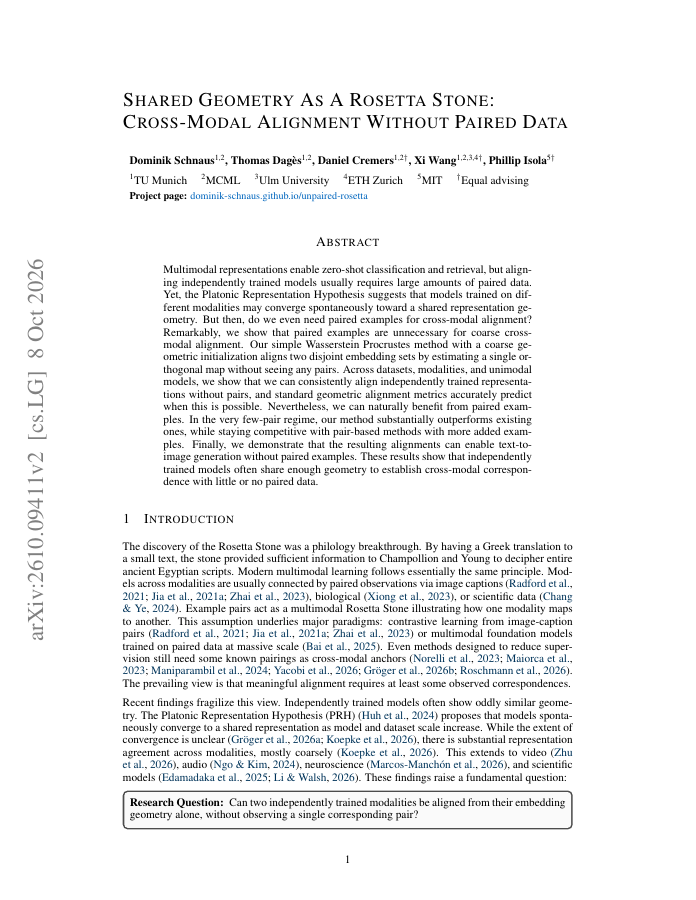
8 Oct 2026
Multimodal representations enable zero-shot classification and retrieval, but aligning independently trained models usually requires large amounts of paired data. Yet, the Platonic Representation Hypothesis suggests that models trained on different modalities may converge…
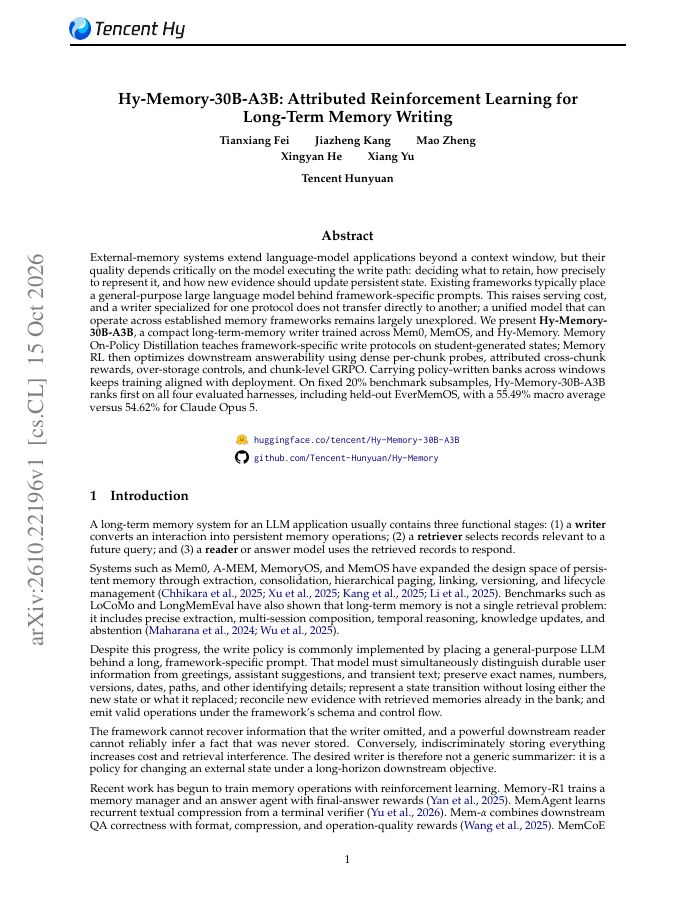
15 Oct 2026
External-memory systems extend language-model applications beyond a context window, but their quality depends critically on the model executing the write path: deciding what to retain, how precisely to represent it, and how new evidence should update persistent state.
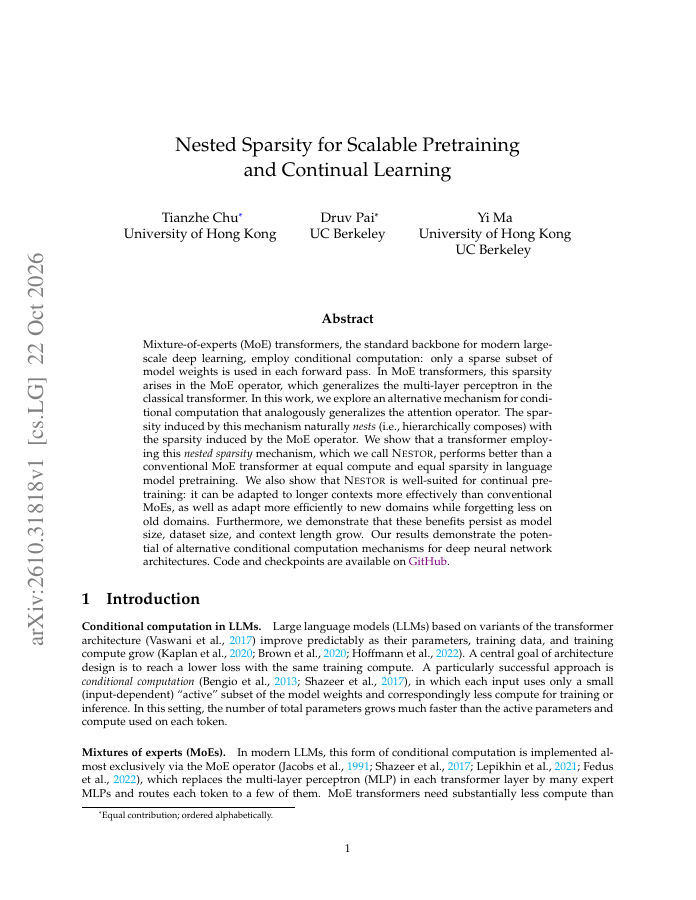
22 Oct 2026
Mixture-of-experts (MoE) transformers, the standard backbone for modern large-scale deep learning, employ conditional computation: only a sparse subset of model weights is used in each forward pass.
22 Oct 2026
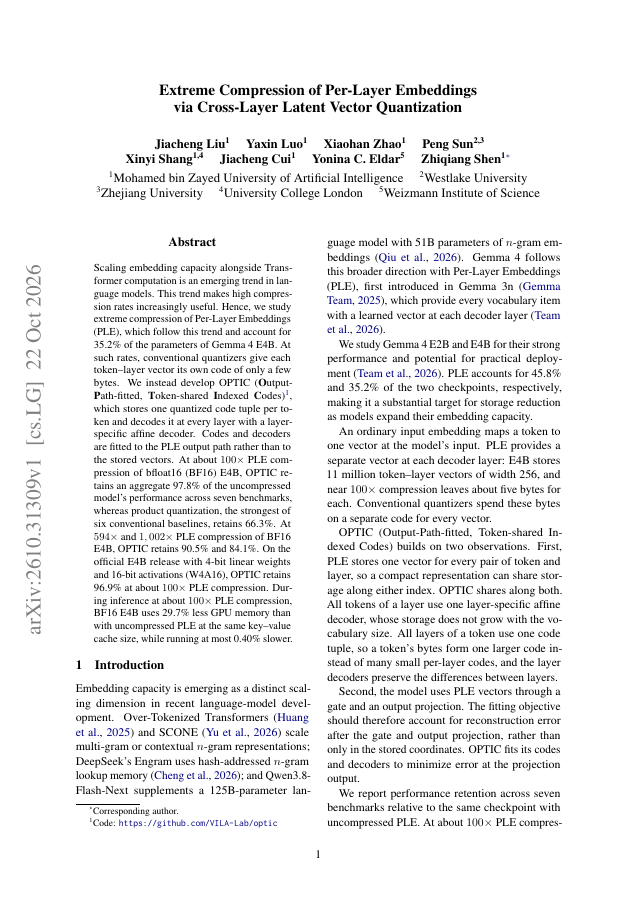
Scaling embedding capacity alongside Transformer computation is an emerging trend in language models. This trend makes high compression rates increasingly useful. Hence, we study extreme compression of Per-Layer Embeddings (PLE), which follow this trend and account for 35.2% of…
22 Oct 2026
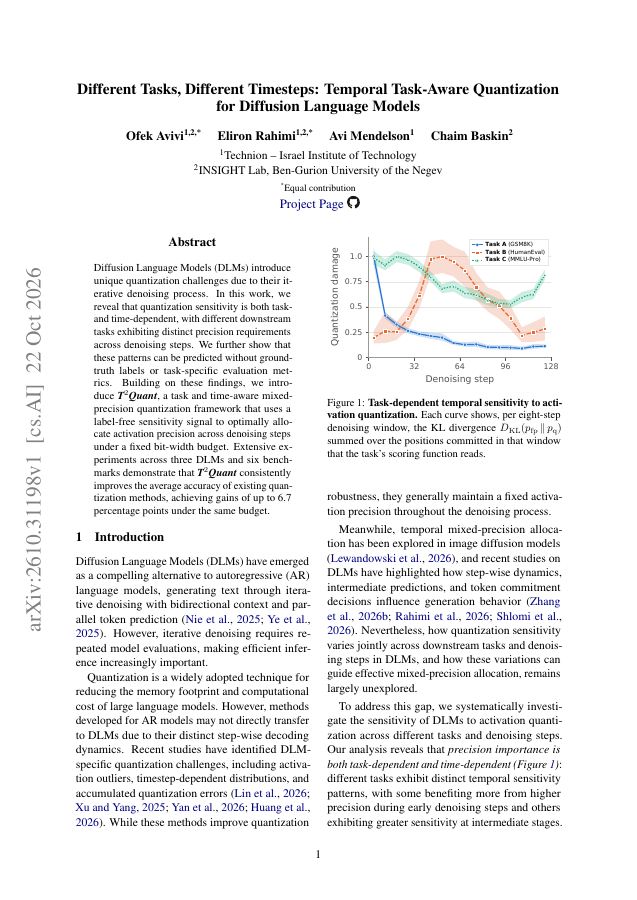
Diffusion Language Models (DLMs) introduce unique quantization challenges due to their iterative denoising process. In this work, we reveal that quantization sensitivity is both taskand time-dependent, with different downstream tasks exhibiting distinct precision requirements…
21 Oct 2026
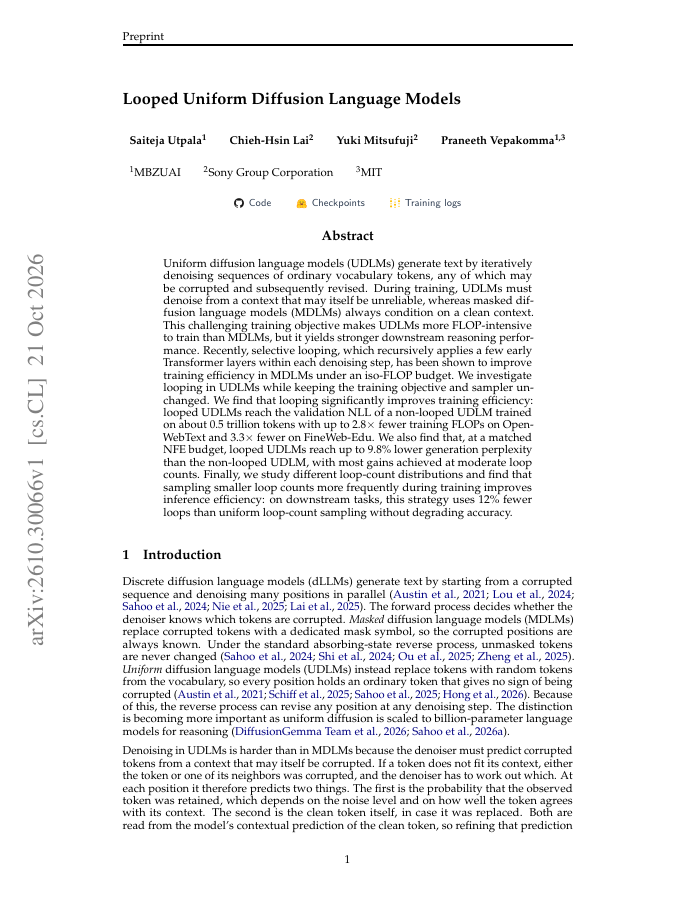
Uniform diffusion language models (UDLMs) generate text by iteratively denoising sequences of ordinary vocabulary tokens, any of which may be corrupted and subsequently revised.