19 Oct 2026
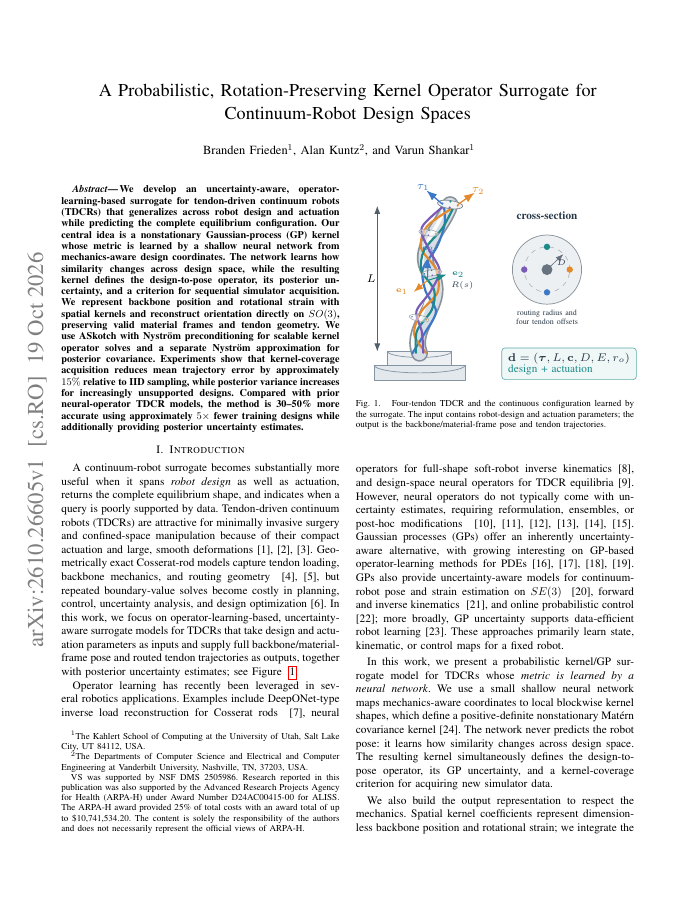
We develop an uncertainty-aware, operator-learning-based surrogate for tendon-driven continuum robots (TDCRs) that generalizes across robot design and actuation while predicting the complete equilibrium configuration.
Trending research and the full catalog - each paper linked to the benchmarks, methods, and models it introduces.
Filtering here covers the 2,000 most recent papers, as much as one page can hold in memory. See the full index of 22,642 papers.
19 Oct 2026
We develop an uncertainty-aware, operator-learning-based surrogate for tendon-driven continuum robots (TDCRs) that generalizes across robot design and actuation while predicting the complete equilibrium configuration.

19 Oct 2026
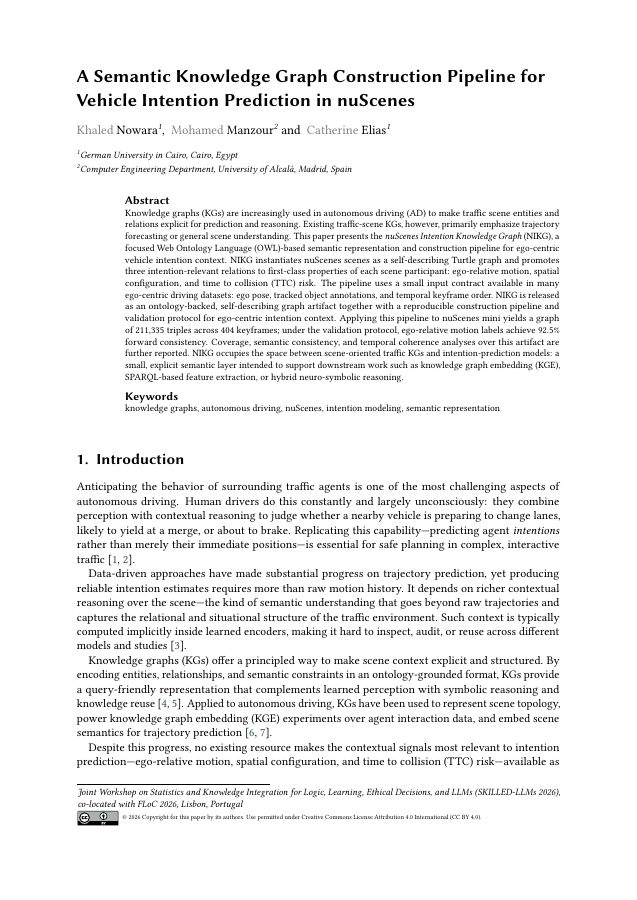
Knowledge graphs (KGs) are increasingly used in autonomous driving (AD) to make traffic scene entities and relations explicit for prediction and reasoning. Existing traffic-scene KGs, however, primarily emphasize trajectory forecasting or general scene understanding.
19 Oct 2026
This paper considers the Bayesian top-$k$ identification problem, wherein a decision maker is tasked with selecting $k$ items from a pool of items of unknown quality. To assess the items, the decision maker adaptively allocates a fixed sampling budget, where each sample of an…
19 Oct 2026
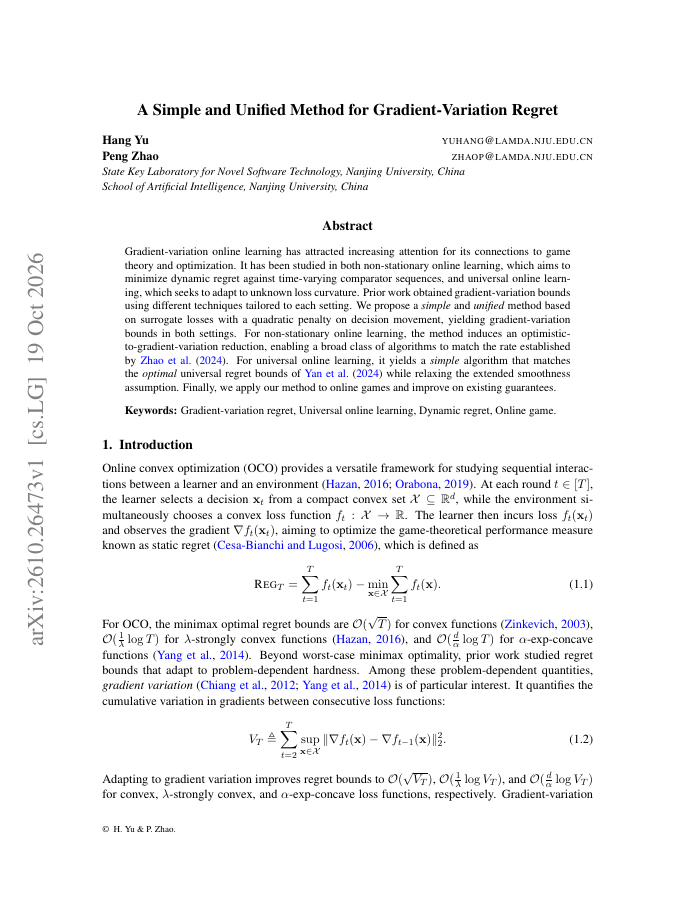
Gradient-variation online learning has attracted increasing attention for its connections to game theory and optimization. It has been studied in both non-stationary online learning, which aims to minimize dynamic regret against time-varying comparator sequences, and universal…
19 Oct 2026
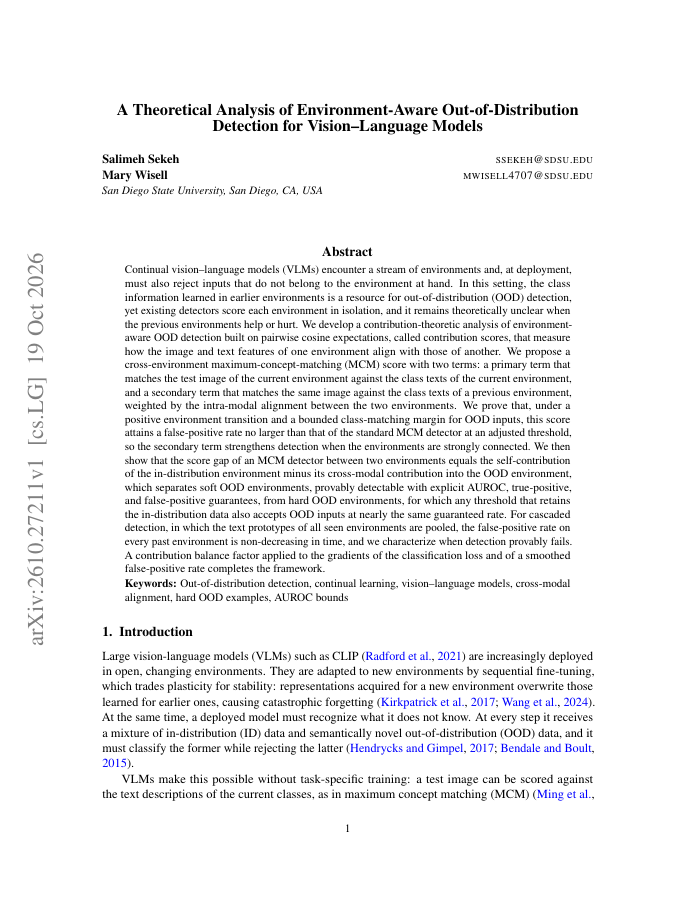
Continual vision-language models (VLMs) encounter a stream of environments and must also reject inputs that do not belong to the environment at hand. Class information from earlier environments can aid out-of-distribution (OOD) detection, yet existing detectors score each…
18 Oct 2026
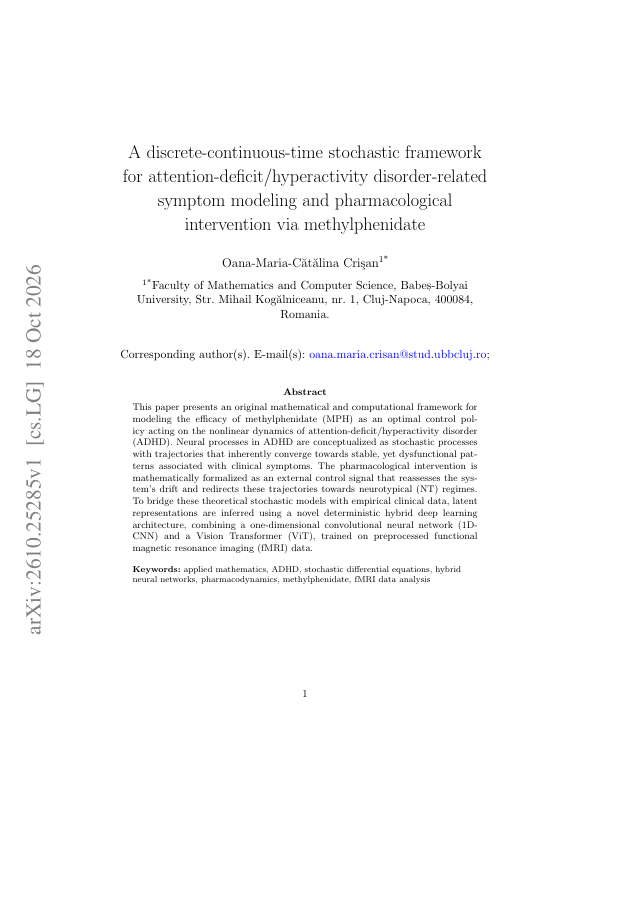
This paper presents an original mathematical and computational framework for modeling the efficacy of methylphenidate as an optimal control policy acting on the nonlinear dynamics of attention deficit hyperactivity disorder.
18 Oct 2026
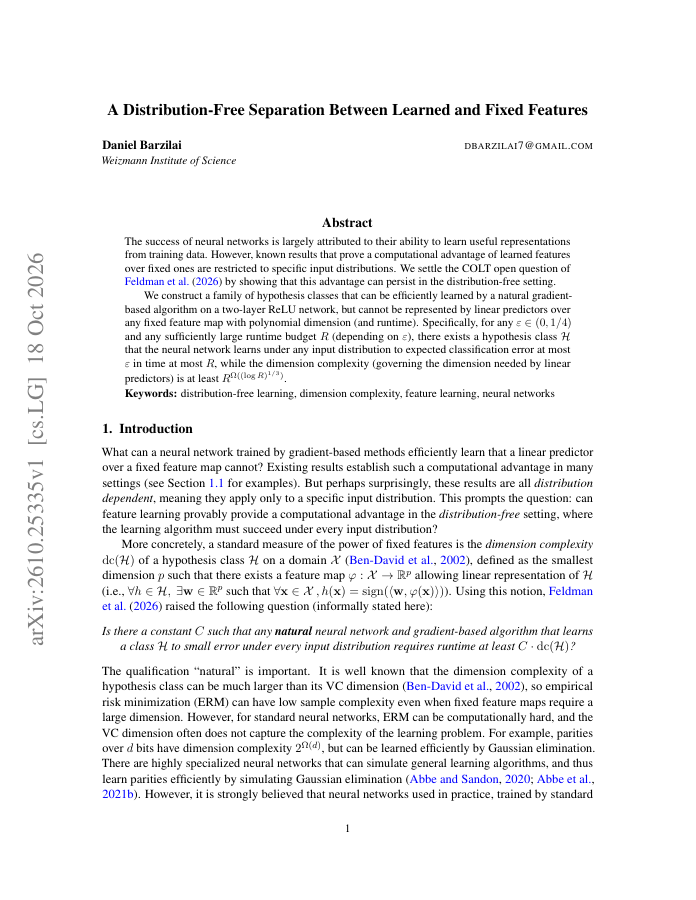
The success of neural networks is largely attributed to their ability to learn useful representations from training data. However, known results that prove a computational advantage of learned features over fixed ones are restricted to specific input distributions.
18 Oct 2026
Vision-language (VL) models are typically built by fine-tuning a language model to attend to visual features in service of a Visual Question-Answering objective. We ask whether this alignment changes how language models represent text---especially on tasks where visualization…
18 Oct 2026
Benchmarking large language model (LLM)-generated text detectors commonly relies on aggregate detector-level metrics such as accuracy, F1 score, and AUC. Although useful for summarizing overall performance, these metrics provide limited insight into how benchmark composition…
18 Oct 2026
Relational triple extraction identifies entity relations from raw sentences without depending on entity type information. The performance of traditional methods is seriously degenerated by ``unseen'' entities, because these methods can't build contextual dependencies relevant…
18 Oct 2026
People can express the same beliefs and desires yet need different reasons to change their minds. What makes an argument relevant depends on how those views arose: experiences shape what a person finds credible, what matters to them, and what could prompt reconsideration.
17 Oct 2026
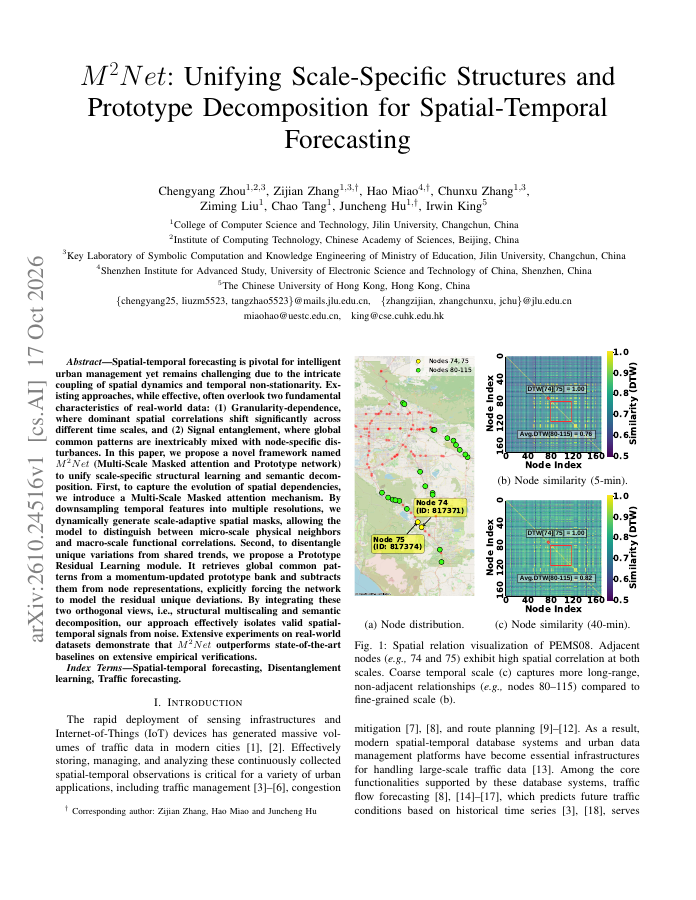
Spatial-temporal forecasting is pivotal for intelligent urban management yet remains challenging due to the intricate coupling of spatial dynamics and temporal non-stationarity.
17 Oct 2026
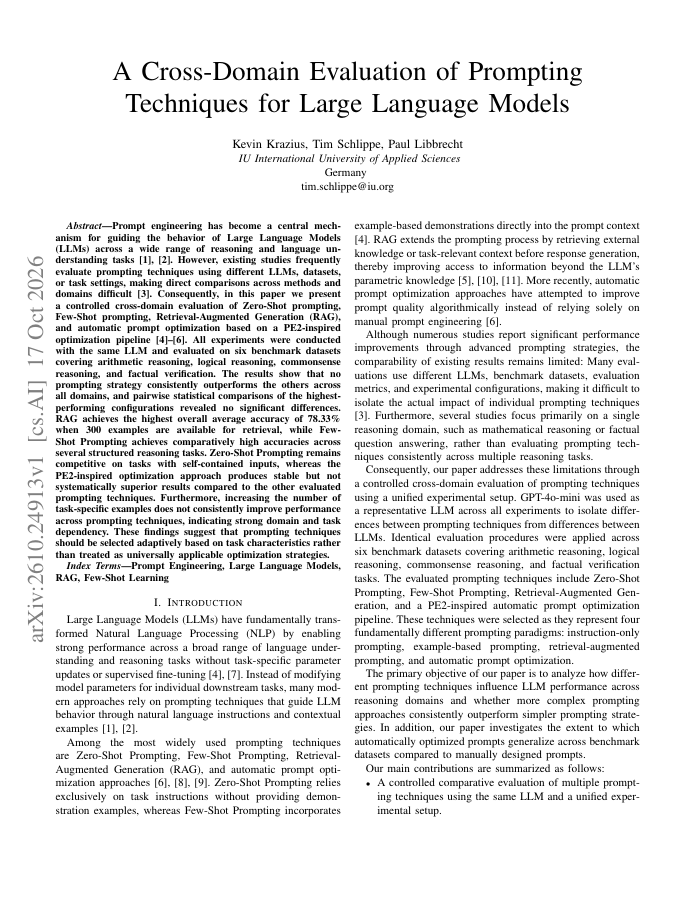
Prompt engineering has become a central mechanism for guiding the behavior of Large Language Models (LLMs) across a wide range of reasoning and language understanding tasks [1], [2].
17 Oct 2026
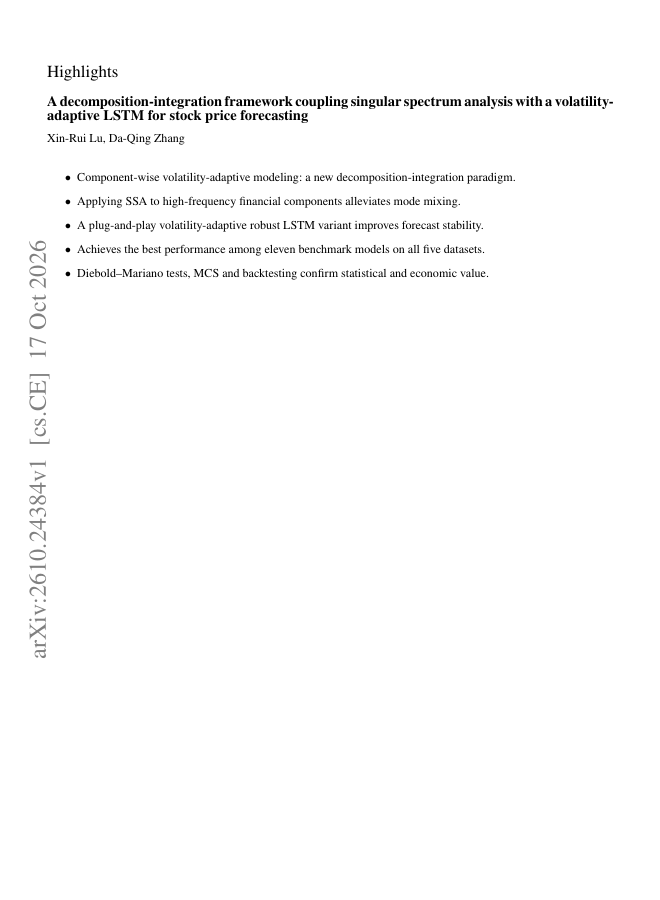
Financial time series exhibit multi-scale, high-noise, and non-stationary volatility dynamics. Decomposition--integration frameworks built on complete ensemble empirical mode decomposition with adaptive noise (CEEMDAN) have advanced this field, yet existing CEEMDAN hybrids…
17 Oct 2026
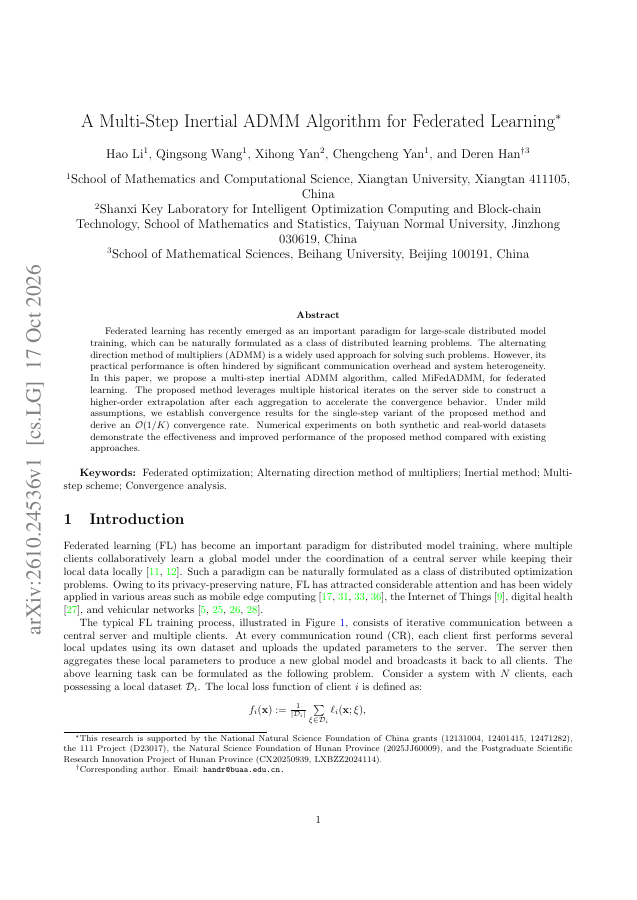
Federated learning has recently emerged as an important paradigm for large-scale distributed model training, which can be naturally formulated as a class of distributed learning problems.
17 Oct 2026
Robotic manipulation is inherently geometric, but what shape does the world take inside the policy that performs it? Prior work on vision-language-action (VLA) policies establishes that task-relevant variables are linearly readable from activations, yet readability certifies…
17 Oct 2026
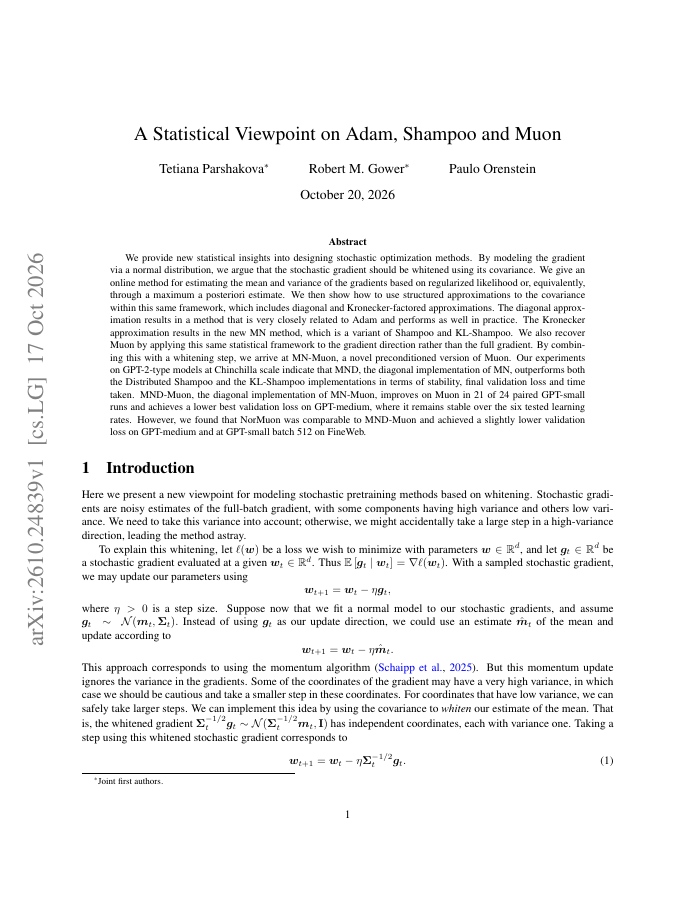
We provide new statistical insights into designing stochastic optimization methods. By modeling the gradient via a normal distribution, we argue that the stochastic gradient should be whitened using its covariance.
17 Oct 2026
Language models can treat semantically distinct inputs as interchangeable at the representation level, creating blind spots that standard sparse autoencoder (SAE) objectives do not target.
17 Oct 2026
Mobile device location-based service (LBS) data provide large-scale spatiotemporal observations that can help airport planners understand air travelers' mobility patterns.
16 Oct 2026
Given a labeled dataset $\{(x_i, y_i)\}_{i = 1}^n$, consider drawing a parameter vector $\hatθ$ uniformly at random from those that interpolate the data within a width-$W$ depth-$D$ ReLU architecture with continuous weights bounded within $[-M, M]$.
16 Oct 2026
What the Web community believes about toxic conversations, such as that toxicity rises in longer and deeper threads, was measured mostly with Google's Perspective API, which is shutting down; large language models (LLMs) will make the next measurements.
16 Oct 2026
The interpretability of artificial intelligence models has become a central concern, especially for black-box models such as multilayer perceptrons (MLPs). Kolmogorov-Arnold Geometry has recently emerged as a framework for analysing the internal representations of these…
16 Oct 2026
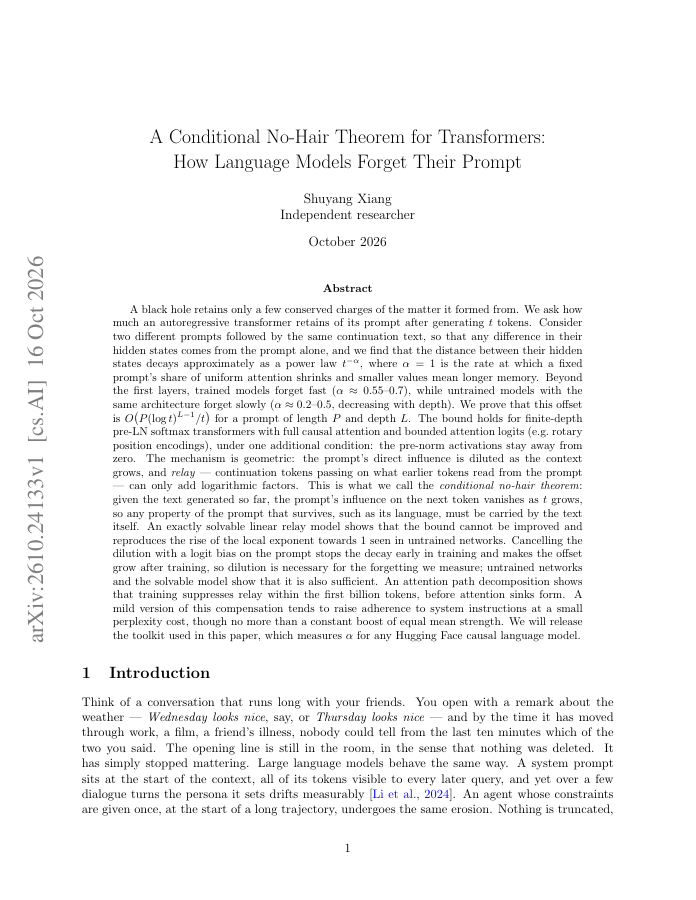
We ask how much an autoregressive transformer retains of its prompt after generating $t$ tokens. Consider two different prompts followed by the same continuation text, so that any difference in their hidden states comes from the prompt alone, and we find that the distance…
16 Oct 2026
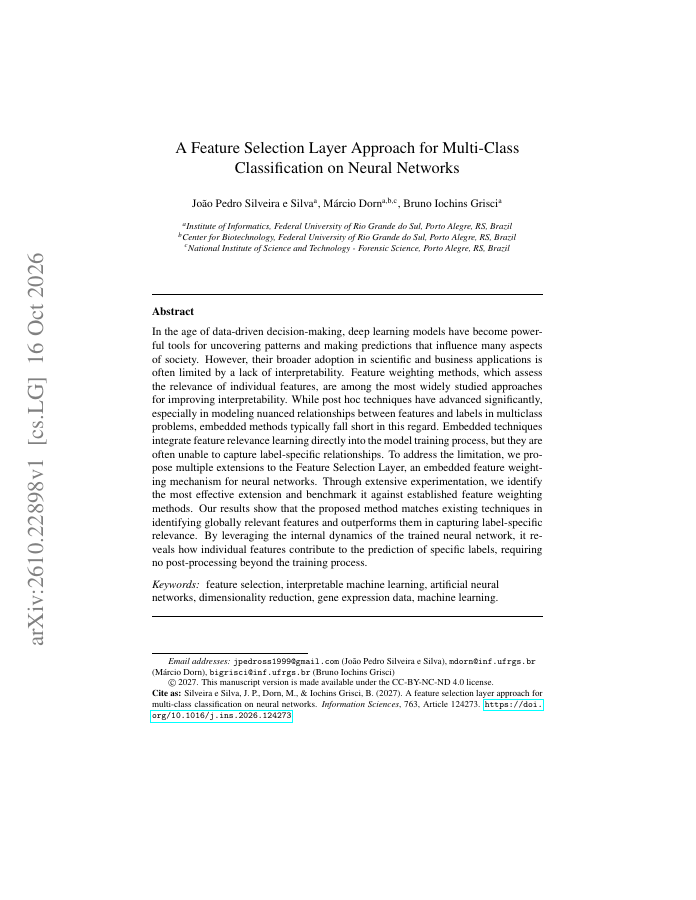
In the age of data-driven decision-making, deep learning models have become powerful tools for uncovering patterns and making predictions that influence many aspects of society.