14 Oct 2026
To operate distributed applications with high availability, operators must rapidly diagnose and mitigate any incident. LLM-based agents can help, but unlike experienced human operators they do not improve as they handle more incidents.
Trending research and the full catalog - each paper linked to the benchmarks, methods, and models it introduces.
Filtering here covers the 2,000 most recent papers, as much as one page can hold in memory. See the full index of 22,642 papers.
14 Oct 2026
To operate distributed applications with high availability, operators must rapidly diagnose and mitigate any incident. LLM-based agents can help, but unlike experienced human operators they do not improve as they handle more incidents.
14 Oct 2026
A self-improving agent has to decide which new skills to keep, and in practice it keeps whatever earns a high reward, convinces a judge model, or compresses its library, even when the skill is wrong.
14 Oct 2026
Legal-content reproduction requires matching the source exactly in section hierarchy, verbatim text, citations, and amendment spans; a dropped citation or mislabeled amendment carries into the products lawyers rely on. We report an industrial pipeline converting U.S.
14 Oct 2026
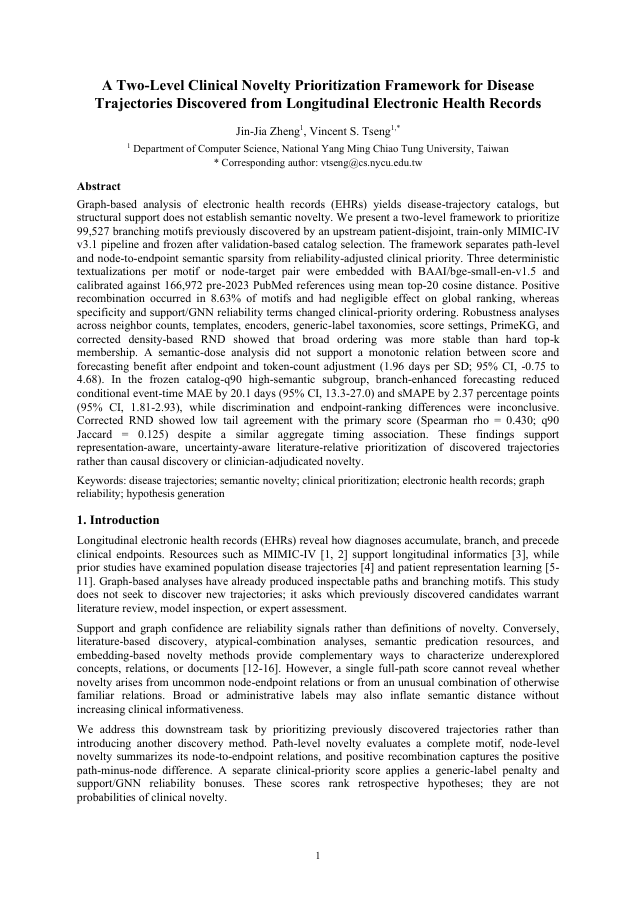
Graph-based analysis of electronic health records (EHRs) yields disease-trajectory catalogs, but structural support does not establish semantic novelty. We present a two-level framework to prioritize 99,527 branching motifs previously discovered by an upstream patient-disjoint,…
14 Oct 2026
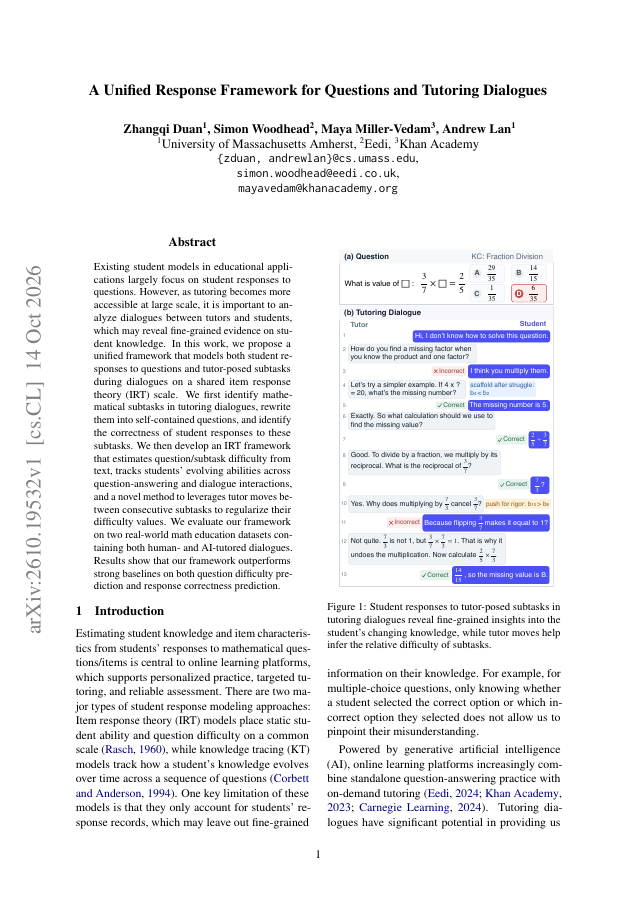
Existing student models in educational applications largely focus on student responses to questions. However, as tutoring becomes more accessible at large scale, it is important to analyze dialogues between tutors and students, which may reveal fine-grained evidence on student…
13 Oct 2026
For video generation in dynamic world modeling, observed static and dynamic content should be efficiently reused to provide conditions for repeated generation at different times and viewpoints.
13 Oct 2026
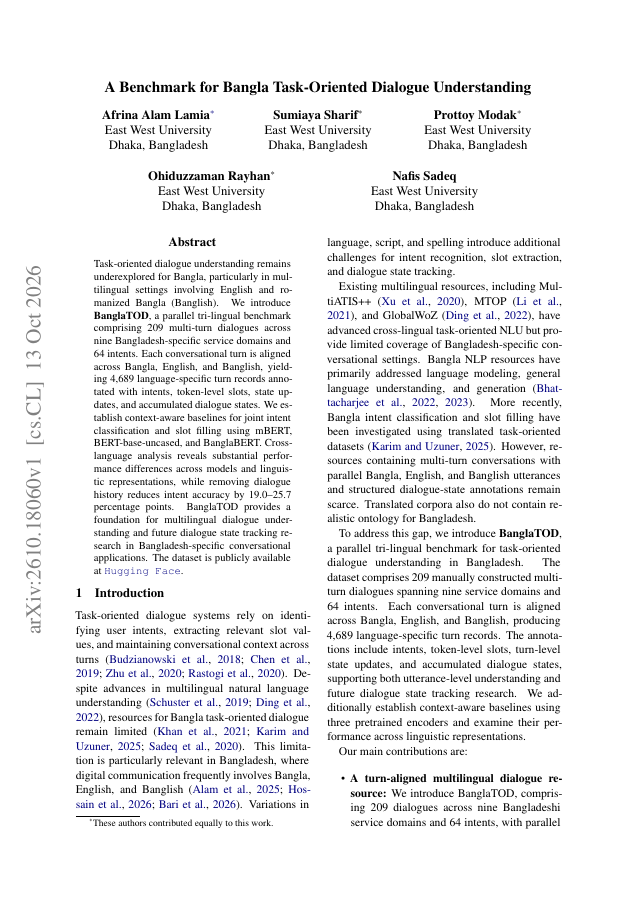
Task-oriented dialogue understanding remains underexplored for Bangla, particularly in multilingual settings involving English and romanized Bangla (Banglish). We introduce BanglaTOD, a parallel tri-lingual benchmark comprising 209 multi-turn dialogues across nine…
13 Oct 2026
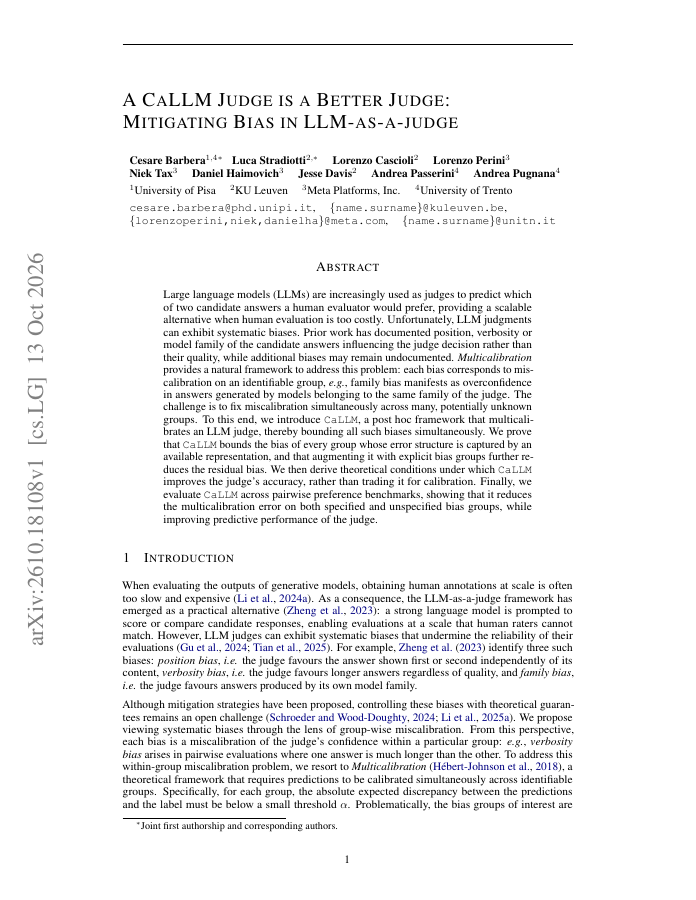
Large language models (LLMs) are increasingly used as judges to predict which of two candidate answers a human evaluator would prefer, providing a scalable alternative when human evaluation is too costly. Unfortunately, LLM judgments can exhibit systematic biases.
13 Oct 2026
Domain-specific curvature is an appealing idea for domain generalization (DG), but curvature learning can denote substantially different computations. This paper evaluates one deliberately narrow implementation: the code calls it HyperDG, but it rescales Euclidean encoder…
13 Oct 2026
Recent progress in autoformalisation of mathematics using AI has been impressive. Measuring this progress requires datasets of formal statements that are both hard and trustworthy.
13 Oct 2026
3D scene graph prediction is commonly supervised with local object and predicate classification losses. Although effective for slot-wise label prediction, this formulation does not provide a graph-level semantic distance between a predicted scene graph and its ground truth:…
13 Oct 2026
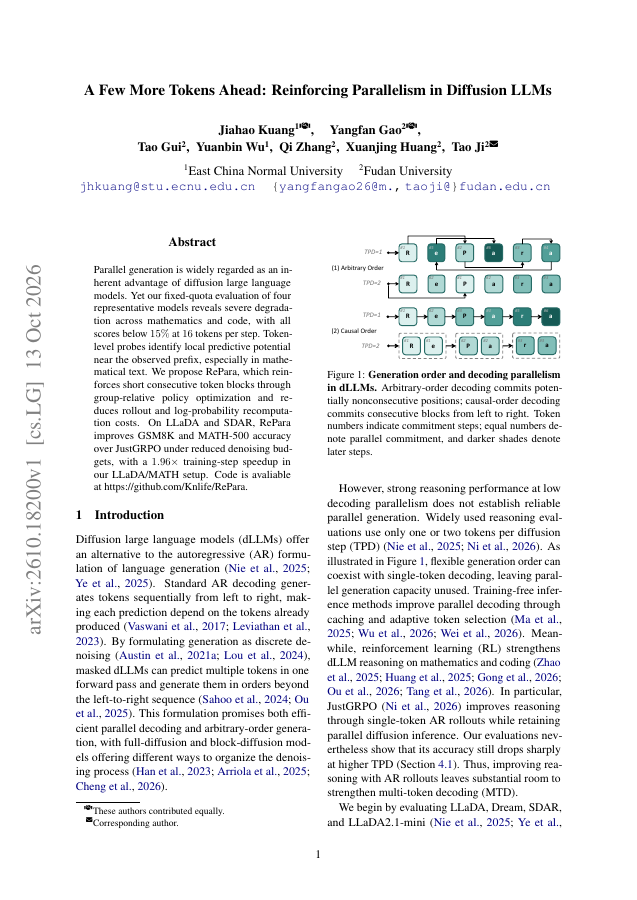
Parallel generation is widely regarded as an inherent advantage of diffusion large language models. Yet our fixed-quota evaluation of four representative models reveals severe degradation across mathematics and code, with all scores below 15% at 16 tokens per step.
13 Oct 2026
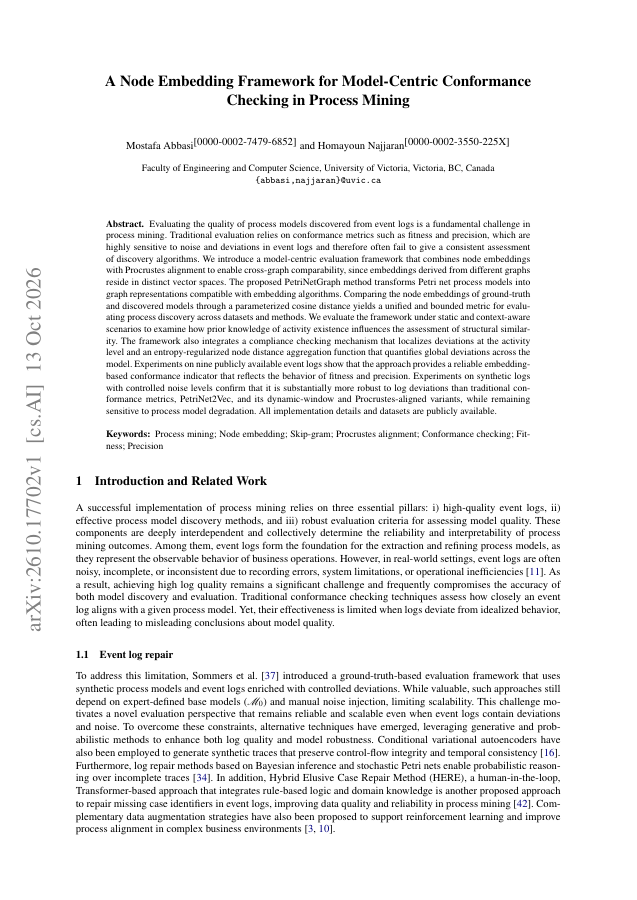
Evaluating the quality of process models discovered from event logs is a fundamental challenge in process mining. Traditional evaluation relies on conformance metrics such as fitness and precision, which are highly sensitive to noise and deviations in event logs and therefore…
13 Oct 2026
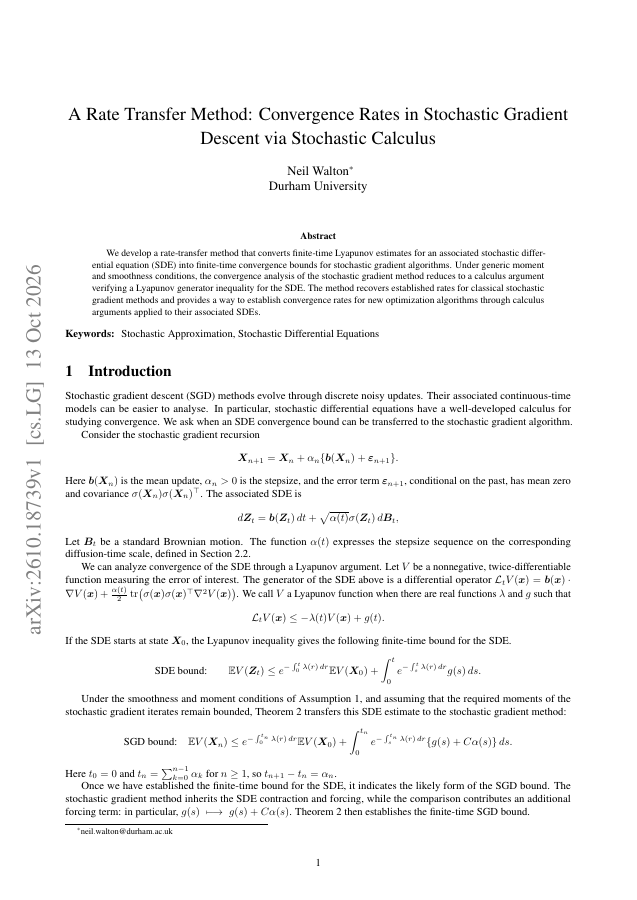
We develop a rate-transfer method that converts finite-time Lyapunov estimates for an associated stochastic differential equation (SDE) into finite-time convergence bounds for stochastic gradient algorithms.
13 Oct 2026
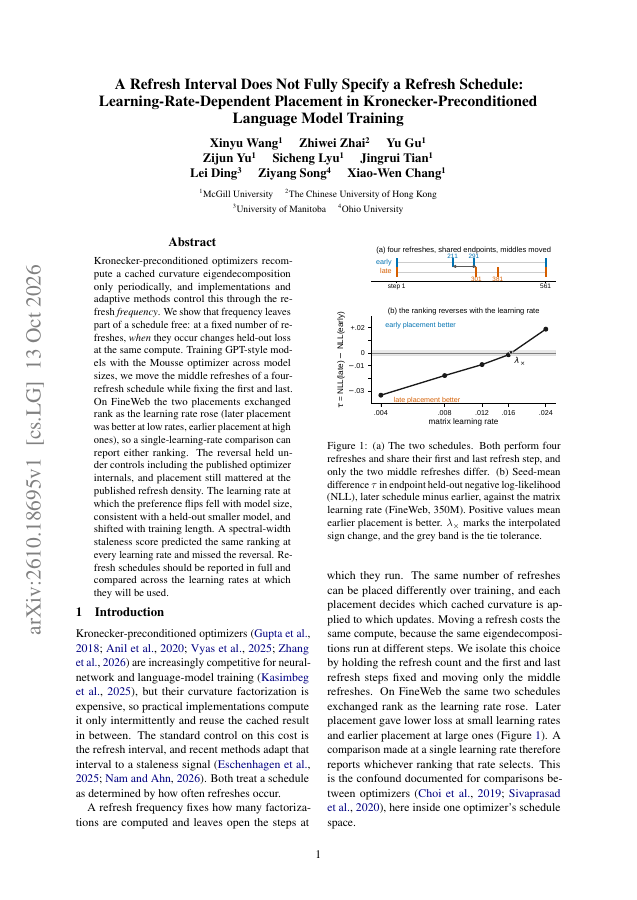
Kronecker-preconditioned optimizers recompute a cached curvature eigendecomposition only periodically, and implementations and adaptive methods control this through the refresh frequency.
13 Oct 2026
Data-driven machine learning (ML) techniques have become an essential tool in many domains of science. Their application to atomistic simulations of matter is particularly widespread and impactful.
13 Oct 2026
Amplitude embedding lets a variational quantum model read many classical features with few qubits, but the model output is then only a quadratic form in the normalized input.
12 Oct 2026
Accurately assessing the convergence of Monte Carlo Markov Chains is crucial for ensuring their validity in Bayesian inference problems. However, convergence assessment in high dimensions is known to be difficult, due to most convergence diagnostics becoming insensitive beyond a…
12 Oct 2026
DNA methylation is a critical epigenetic modification that regulates gene expression and genome stability, primarily catalyzed by the DNA methyltransferase 3 (DNMT3) family of enzymes.
12 Oct 2026
Parallel token proposals need a joint law, not merely accurate token marginals. We construct coordinate-Bethe-ansatz laws from the periodic XXZ chain and compare them with their maximum-entropy pairwise projections at identical one- and two-site moments.
12 Oct 2026
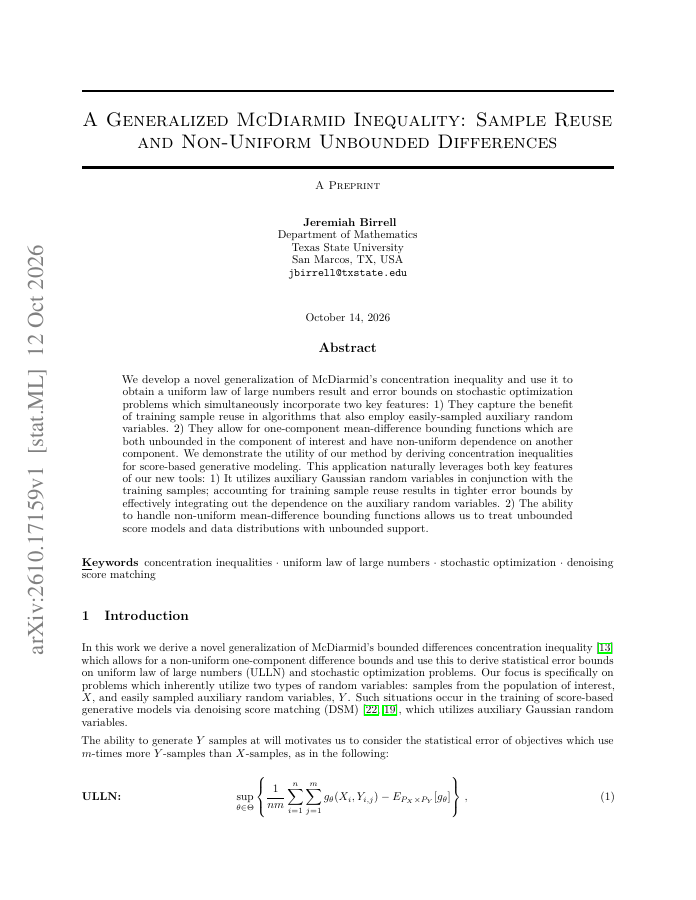
We develop a novel generalization of McDiarmid's concentration inequality and use it to obtain a uniform law of large numbers result and error bounds on stochastic optimization problems which simultaneously incorporate two key features: 1) They capture the benefit of training…
12 Oct 2026
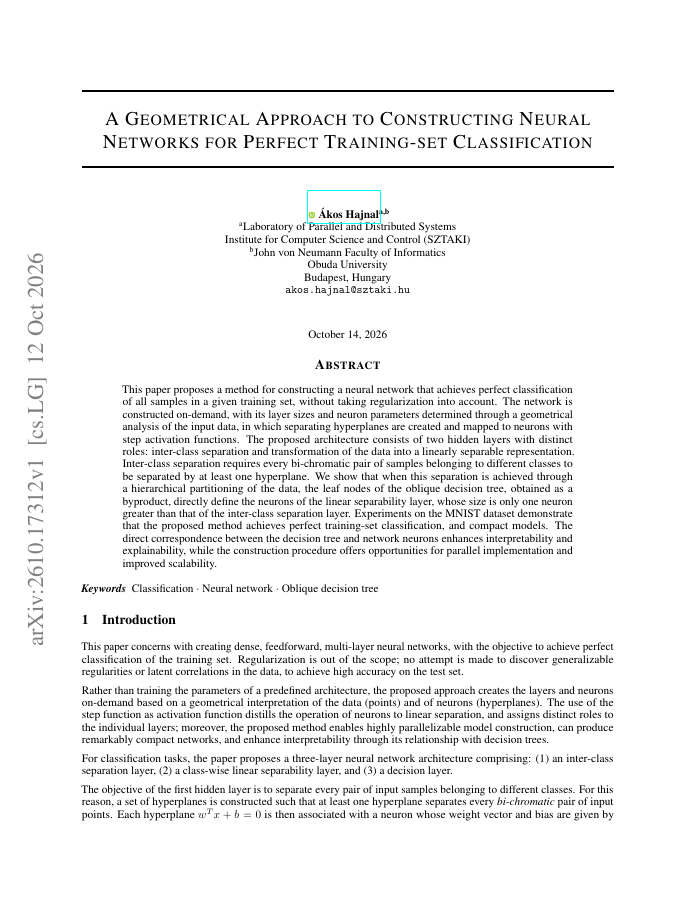
This paper proposes a method for constructing a neural network that achieves perfect classification of all samples in a given training set, without taking regularization into account.
12 Oct 2026
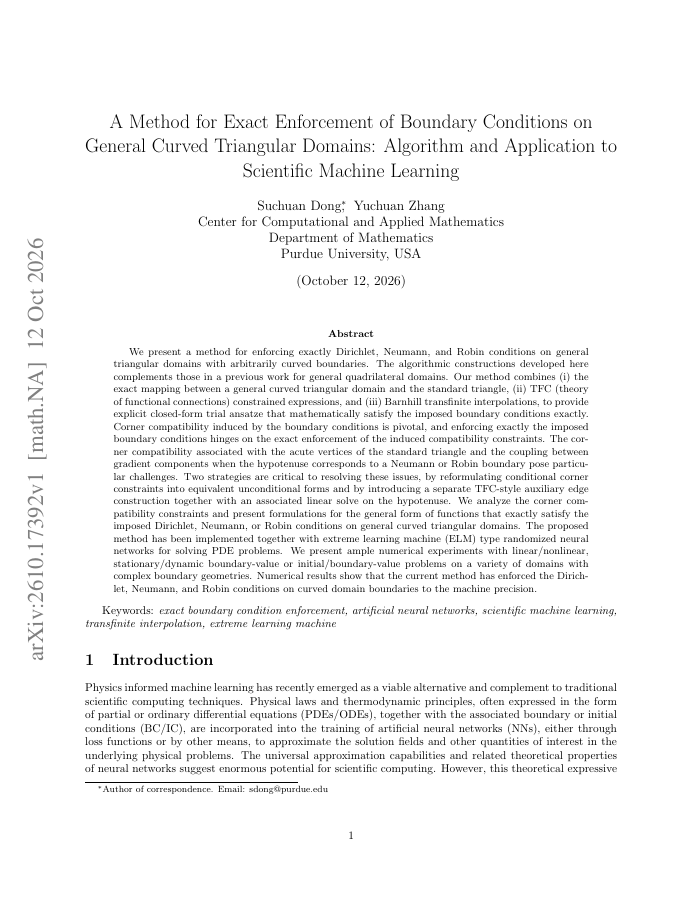
We present a method for enforcing exactly Dirichlet, Neumann, and Robin conditions on general triangular domains with arbitrarily curved boundaries. The algorithmic constructions developed here complements those in a previous work for general quadrilateral domains.
12 Oct 2026
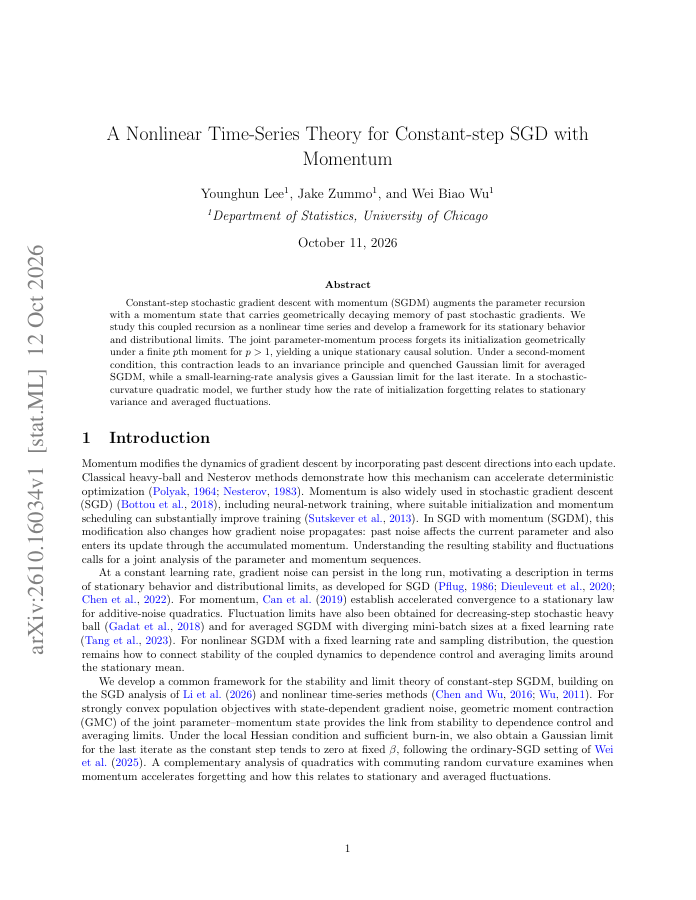
Constant-step stochastic gradient descent with momentum (SGDM) augments the parameter recursion with a momentum state that carries geometrically decaying memory of past stochastic gradients.