23 Jul 2026
Despite rapid progress, most existing vision-language models (VLMs) built from 2D visual inputs often struggle when handling various 3D tasks that require fine-grained spatial understanding and reasoning.
Trending research and the full catalog - each paper linked to the benchmarks, methods, and models it introduces.
Filtering here covers the 2,000 most recent papers, as much as one page can hold in memory. See the full index of 22,642 papers.
23 Jul 2026
Despite rapid progress, most existing vision-language models (VLMs) built from 2D visual inputs often struggle when handling various 3D tasks that require fine-grained spatial understanding and reasoning.
23 Jul 2026
We present CUP, a Greek book retrieval benchmark consisting of 868 catalog records and 104 expert-annotated queries with graded relevance judgments. We evaluate sparse (BM25), dense (sentence-transformers), hybrid, and LLM-assisted retrieval methods in this book-search setting.
23 Jul 2026
Due to the complexity of neural network loss landscapes, optimization theory is forced to rely on idealized models, and there is generally a tradeoff between how theoretically tractable the model is, and how accurately it describes the true optimization dynamics.
23 Jul 2026
Mobile-health interventions increasingly use online learning and decision making algorithms to personalize when to nudge users toward healthier behavior, but a poorly designed algorithm can burden and disengage participants.
23 Jul 2026
We present a traffic-signal control interface in which a shared graph neural network assigns scores to individual traffic movements. Each junction converts these scores into its own variable-sized set of legal signal phases using a deterministic incidence matrix.
23 Jul 2026
Whole-slide survival models commonly provide risk rankings without calibrated statements about individual event times. We evaluate fixed-cutoff drcosarc, a post-hoc conformal wrapper for discrete-time multiple-instance learning survival heads using frozen UNI2-h representations,…
23 Jul 2026
Description logic programs are a powerful formalism for combining rules with ontologies. The well-supported semantics for description logic programs ensures that no answer sets rely on cyclic dependencies.
23 Jul 2026
We study feature-level and node-level explanations for graph neural networks (GNNs) through the lens of Aumann-Shapley attribution. Path-integral methods such as Integrated Gradients provide an axiomatic formulation of attribution, but their practical use in deep GNNs typically…
23 Jul 2026
Large language models (LLMs) have developed rapidly and become valuable tools in everyday life. However, how to align LLMs to a particular set of human values is still an open problem.
22 Jul 2026
Cyber-physical systems (CPS) are typically developed by multiple stakeholders who produce artefacts tailored to their specific domains of expertise. The behaviour of these systems emerges from the interaction between those artefacts and their operational environment.
22 Jul 2026
Quantum federated learning enables distributed clients to train quantum neural networks without sharing local data, making it promising for privacy-aware intelligent services.
22 Jul 2026
Difference-in-differences with staggered adoption identifies group-time average treatment effects ATT(g,t) by comparing each cohort to units not yet treated, which avoids the "forbidden comparisons" that bias two-way fixed-effects estimators when effects are…
22 Jul 2026
The operation of blockchain is governed by consensus algorithms (CA). Several consensus mechanisms require significant computational power, while others necessitate high amounts of stakes to select the participant to validate and verify the transactions in the block, leading to…
22 Jul 2026
As AI agents become integral to business workflows, establishing guiding user experience (UX) principles is crucial for ensuring user trust and successful adoption. To address this, our study uses a multi-method approach - combining participatory design workshop,…
22 Jul 2026
Detecting media bias automatically is difficult because biased framing is often subtle, yet in domains such as news analysis, accurate predictions alone are insufficient without explanations that reflect the model's underlying reasoning.
22 Jul 2026
Kernel methods are powerful tools in machine learning but commonly used full-Gram kernels face three key limitations: (1) quadratic scaling with training set size; (2) the use of fixed, non-trainable kernels; and (3) the absence of an intrinsic formulation for multiclass…
22 Jul 2026
Almost all adversarial attacks add an imperceptible perturbation to fool a model. We instead study the opposite: a large, clearly visible perturbation that causes the model to keep its original, correct prediction, even though a human would no longer recognize the image.
22 Jul 2026
Random-feature methods reduce high-dimensional elliptic PDE collocation to linear coefficient problems, but full-dimensional trial spaces overlook lower-dimensional structure.
22 Jul 2026
Robust out-of-the-box performance is essential for the clinical deployment of deep learning models in medical imaging. An important but underexplored factor affecting model generalisability is intensity normalisation, particularly for magnetic resonance imaging (MRI), where…
21 Jul 2026
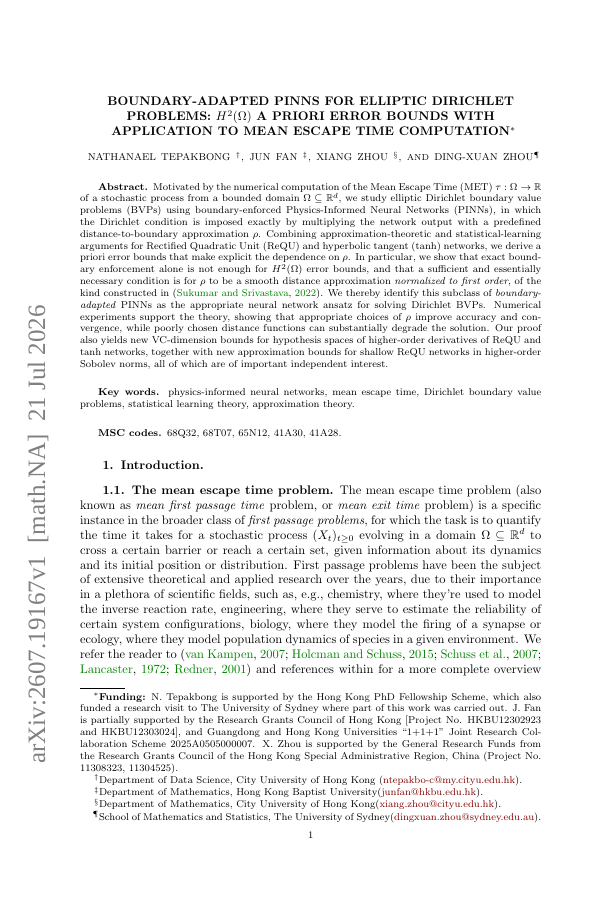
We study the numerical resolution of uniformly elliptic Dirichlet boundary value problems (BVPs) by minimization of the PDE residual over a hypothesis space of Neural Networks made to satisfy exactly the boundary conditions through multiplication by a user-defined…
21 Jul 2026
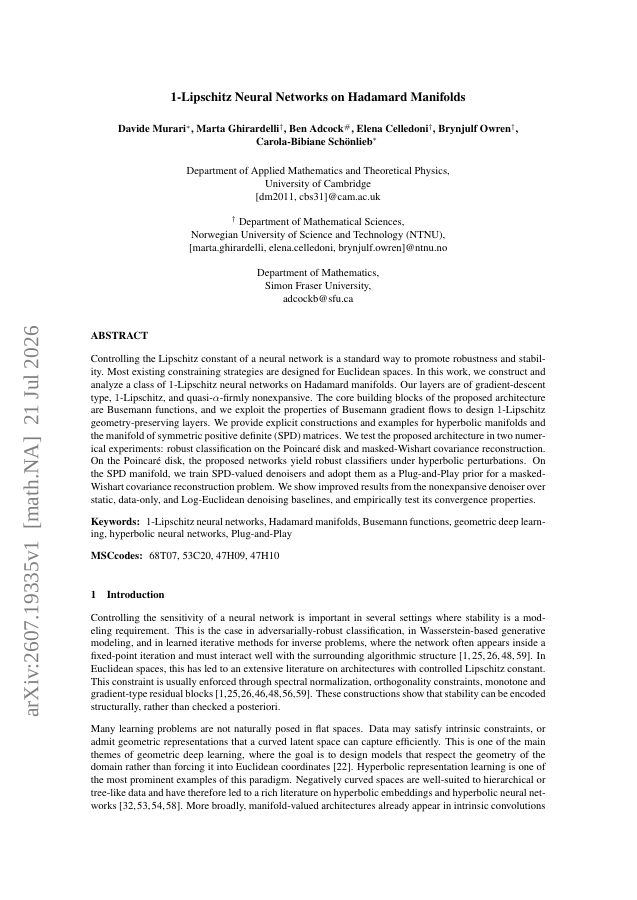
Controlling the Lipschitz constant of a neural network is a standard way to promote robustness and stability. Most existing constraining strategies are designed for Euclidean spaces.
21 Jul 2026
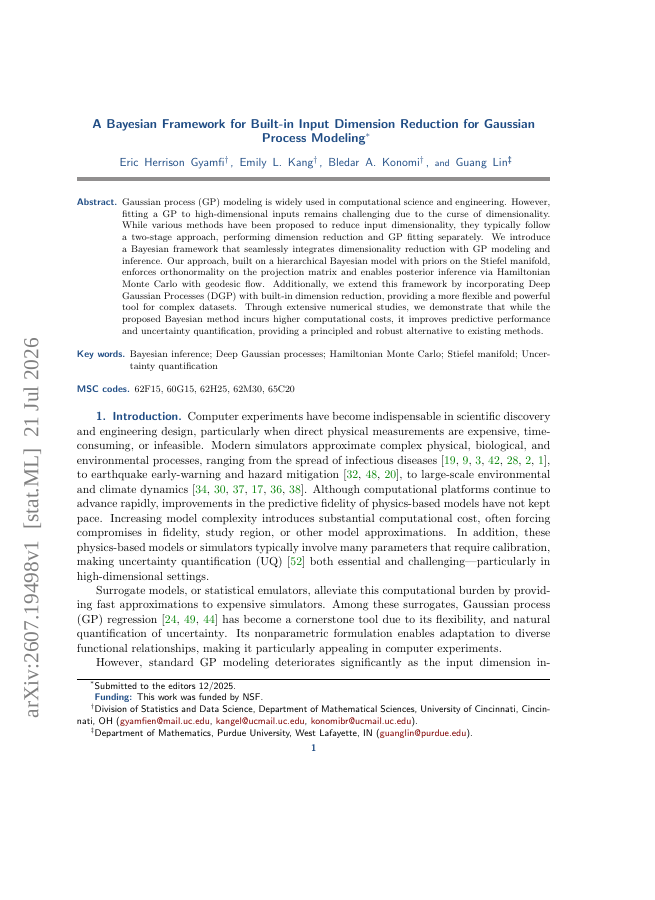
Gaussian process (GP) modeling is widely used in computational science and engineering. However, fitting a GP to high-dimensional inputs remains challenging due to the curse of dimensionality.
21 Jul 2026
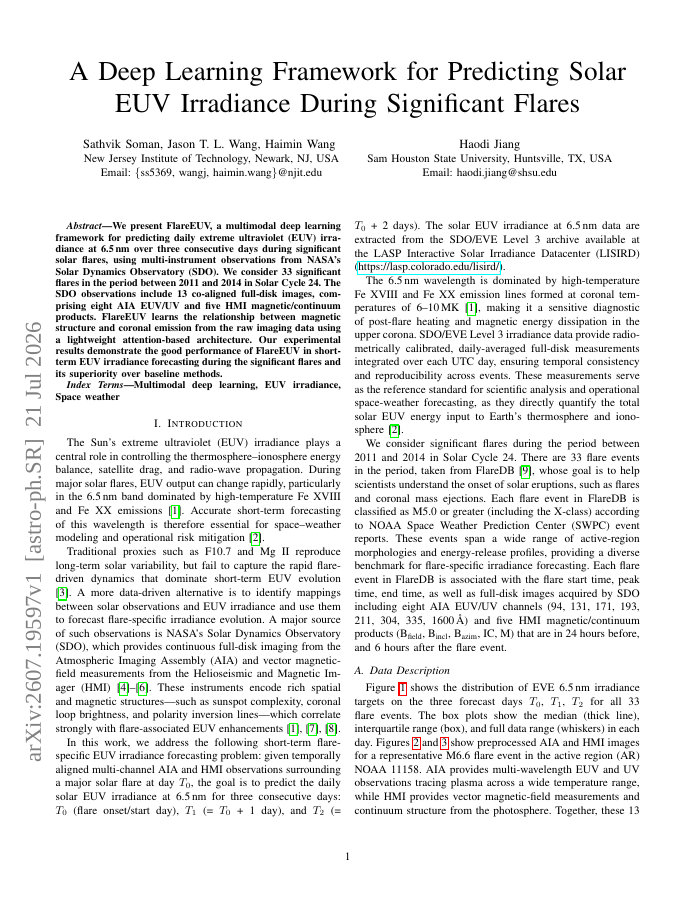
We present FlareEUV, a multimodal deep learning framework for predicting daily extreme ultraviolet (EUV) irradiance at 6.5 nm over three consecutive days during significant solar flares, using multi-instrument observations from NASA's Solar Dynamics Observatory (SDO).
21 Jul 2026
This study introduces a reinforcement learning (RL) framework for generating optimal liquid-fueled reactors to improve lean blowout (LBO) predictions in gas turbine combustors.