17 Sep 2026
Undesired information such as harmful content and private data propagates through Multilingual Large Language Models (LLMs) via direct training and indirect cross-linguistic spread.
Trending research and the full catalog - each paper linked to the benchmarks, methods, and models it introduces.
Filtering here covers the 2,000 most recent papers, as much as one page can hold in memory. See the full index of 22,617 papers.
17 Sep 2026
Undesired information such as harmful content and private data propagates through Multilingual Large Language Models (LLMs) via direct training and indirect cross-linguistic spread.
17 Sep 2026
LLM-based GUI agents increasingly act on behalf of users in digital environments that were designed with human users in mind. These graphical user interfaces were designed to support, but also deliberately steer, the behaviour and decisions of users.
17 Sep 2026
Geographic applications need every object inside a radius that satisfies a semantic threshold, yet embedding indexes return approximate top-ranked lists and may omit qualifying records silently.
17 Sep 2026
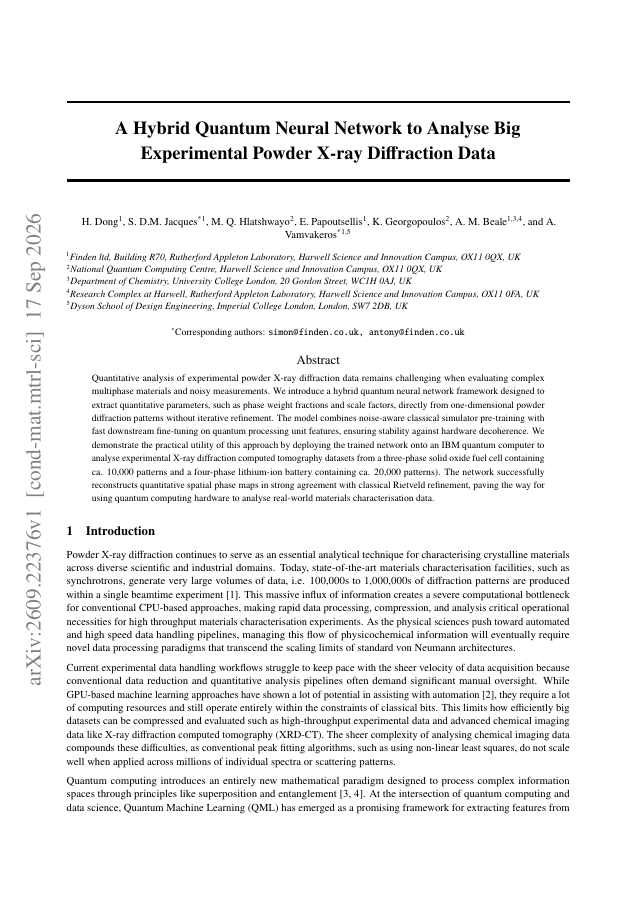
Quantitative analysis of experimental powder X-ray diffraction data remains challenging when evaluating complex multiphase materials and noisy measurements. We introduce a hybrid quantum neural network framework designed to extract quantitative parameters, such as phase weight…
17 Sep 2026
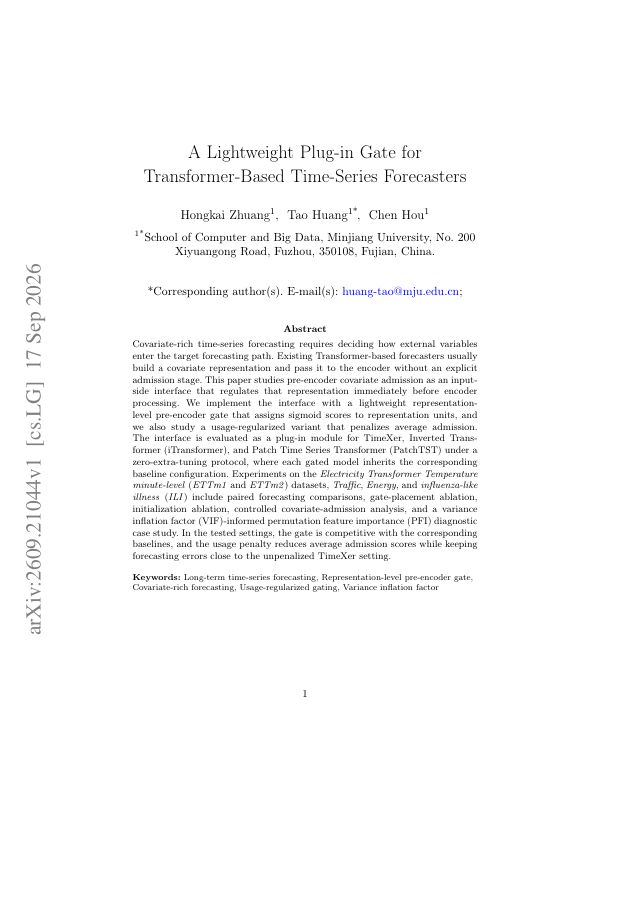
Covariate-rich time-series forecasting requires deciding how external variables enter the target forecasting path. Existing Transformer-based forecasters usually build a covariate representation and pass it to the encoder without an explicit admission stage.
17 Sep 2026
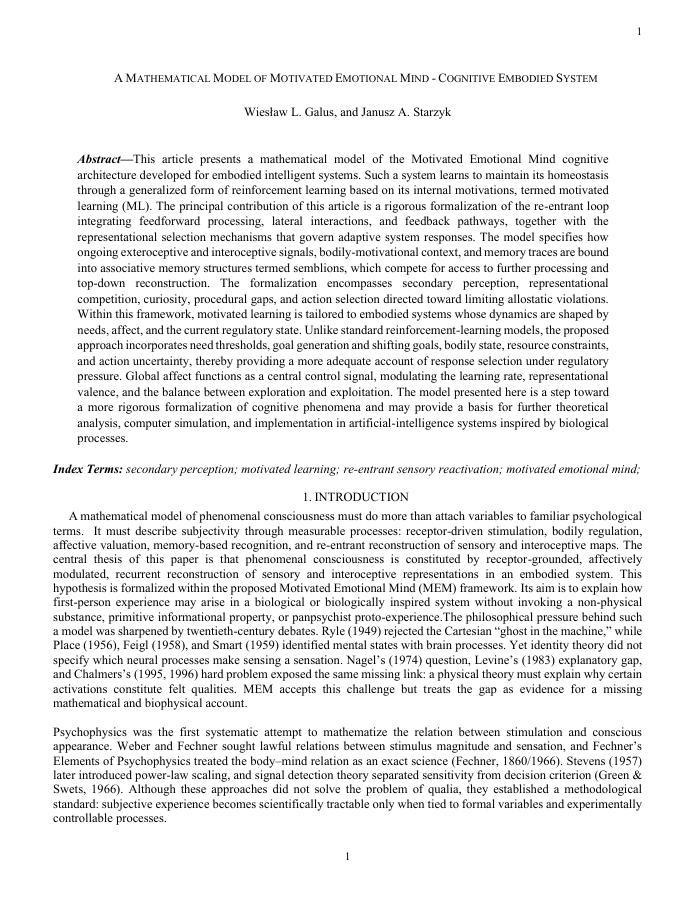
This article presents a mathematical model of the Motivated Emotional Mind cognitive architecture developed for embodied intelligent systems. Such a system learns to maintain its homeostasis through a generalized form of reinforcement learning based on its internal motivations,…
17 Sep 2026
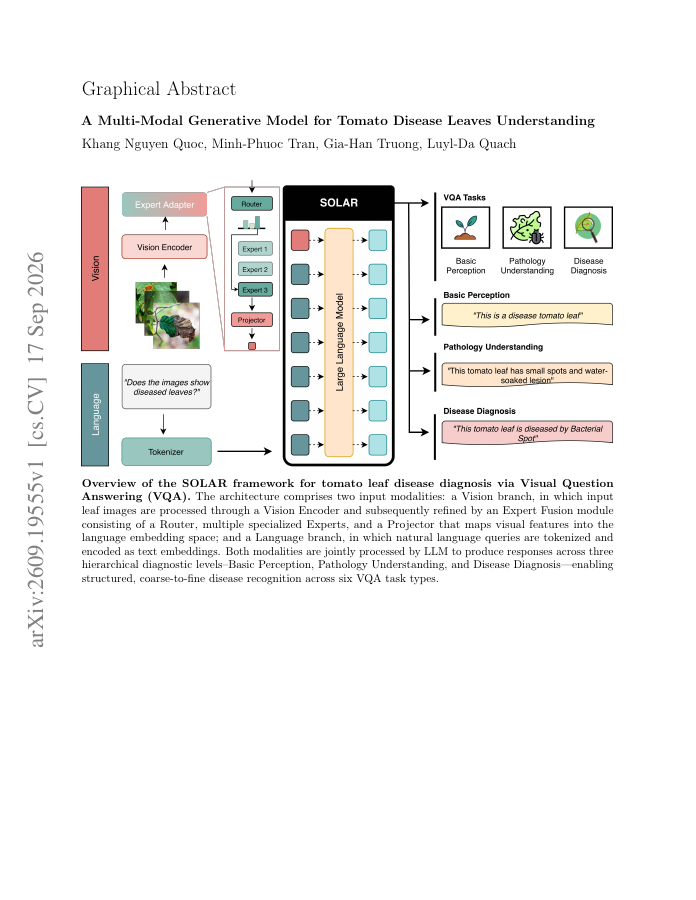
Artificial intelligence for plant disease analysis has advanced from task-specific classifiers to multi-modal models capable of jointly interpreting visual and textual information.
17 Sep 2026
This paper proposes a phonemically comprehensive, ASCII-only romanization scheme for Thai and Lao, treating the two closely related languages as a unified cross-lingual design problem.
17 Sep 2026
Croissant is the de facto machine-readable descriptor for ML datasets: JSON-LD over schema.org. Since version 1.1 it also carries data use conditions, recommending DUO and ODRL for them.
17 Sep 2026
The growing complexity of multi-domain operational environments (land, aerospace, naval, cyber, and electromagnetic spectrum) has increased the volume and velocity of data reaching command-and-control (C2) centers, straining the observe-orient-decide-act (OODA) decision cycle.
17 Sep 2026
Spatial reasoning abilities correlate strongly with performance in STEM fields. Games offer a compelling medium for training these critical skills in developing children who have a natural proclivity for play.
17 Sep 2026
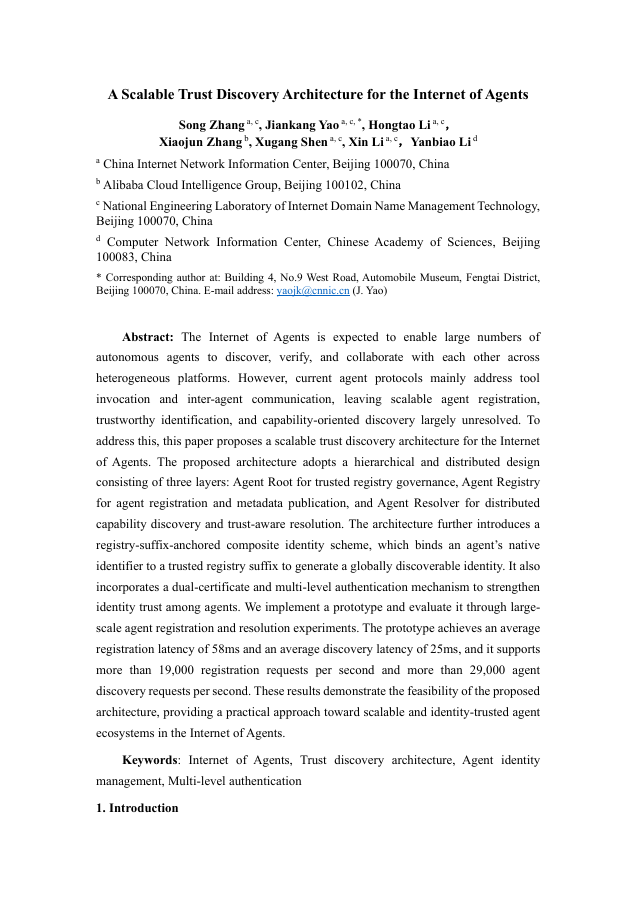
The Internet of Agents is expected to enable large numbers of autonomous agents to discover, verify, and collaborate with each other across heterogeneous platforms. However, current agent protocols mainly address tool invocation and inter-agent communication, leaving scalable…
17 Sep 2026
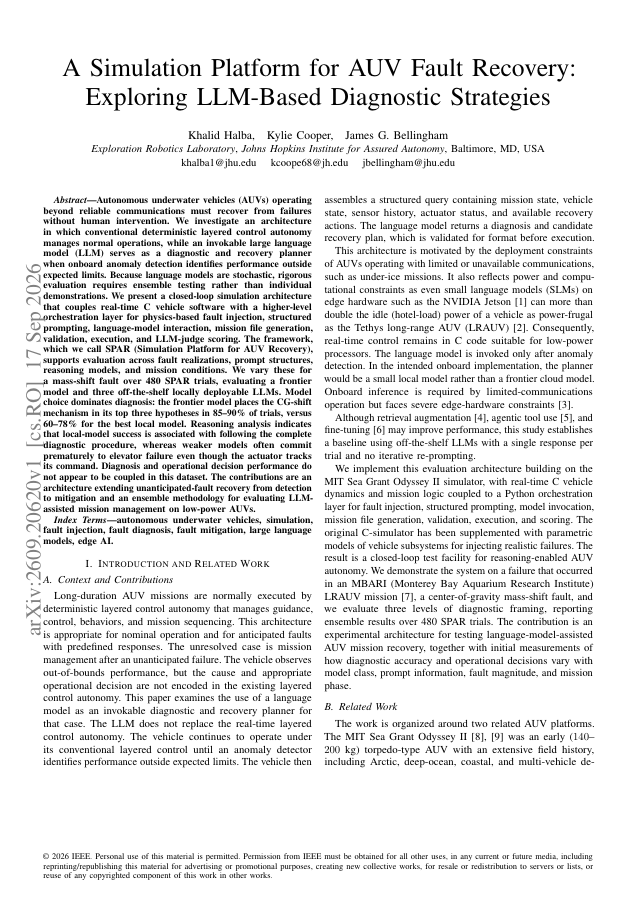
Autonomous underwater vehicles (AUVs) operating beyond reliable communications must recover from failures without human intervention. We investigate an architecture in which conventional deterministic layered control autonomy manages normal operations, while an invokable large…
17 Sep 2026
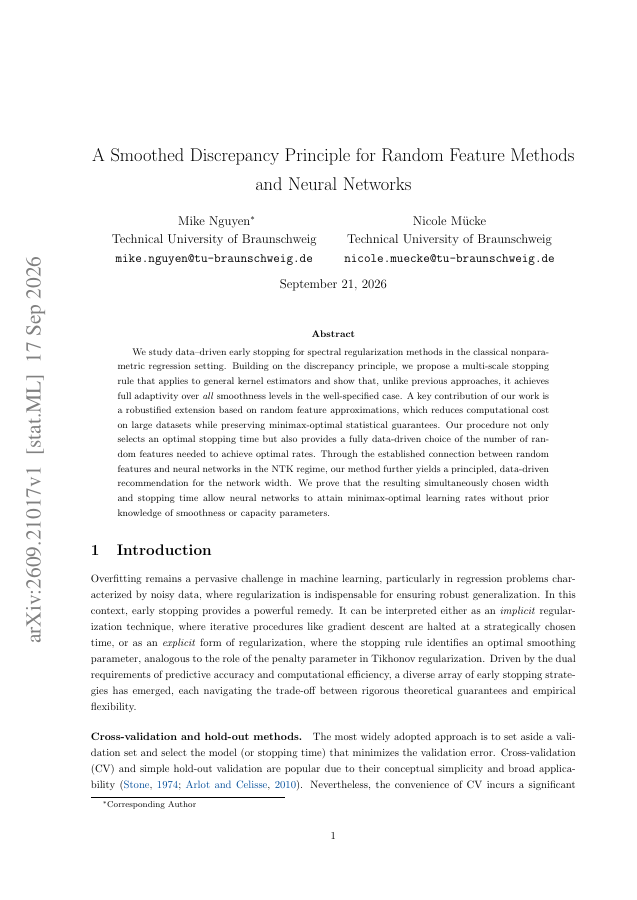
We study data-driven early stopping for spectral regularisation methods in the classical non-parametric regression setting. Building on the discrepancy principle, we propose a multi-scale stopping rule that applies to general kernel estimators and show that, unlike previous…
17 Sep 2026
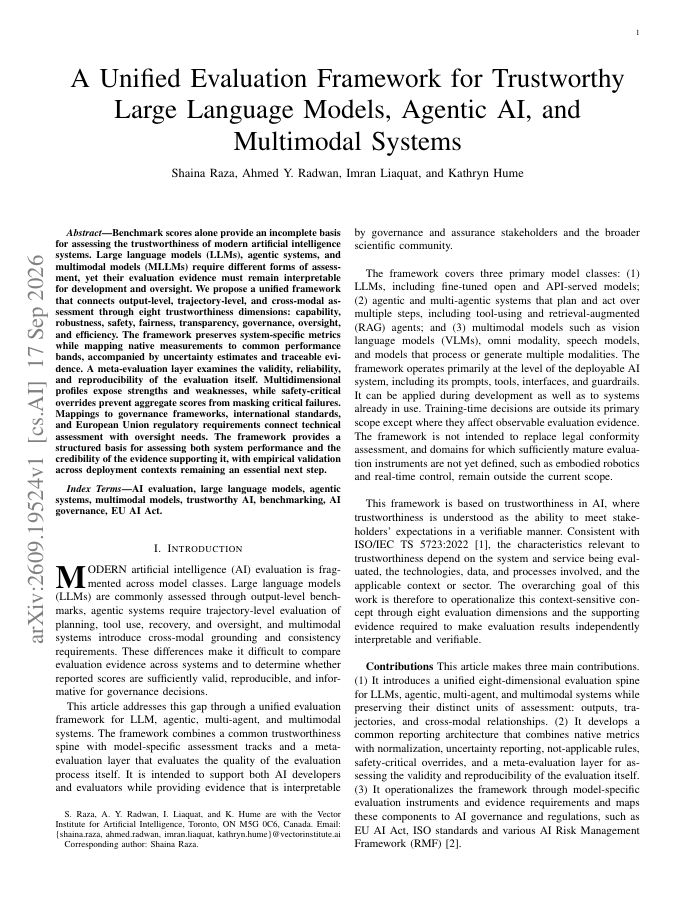
Benchmark scores alone provide an incomplete basis for assessing the trustworthiness of modern artificial intelligence systems. Large language models (LLMs), agentic systems, and multimodal models (MLLMs) require different forms of assessment, yet their evaluation evidence must…
16 Sep 2026
Consumers increasingly use AI chatbots for advice on what to buy. With companies like OpenAI and Google monetising their AI through advertising, this raises difficult questions about the bias and impartiality of such advice.
16 Sep 2026
Existing aviation emissions inventories lack accurate trajectory data for high-resolution social cost and health impact assessment. This paper develops a 3-D emissions map by reconstructing flight trajectories for US west coast hubs to estimate regional environmental and…
16 Sep 2026
Systematic reviews (SR) are essential for evidence-based research, but their screening phase is highly time-consuming and labor-intensive. Large language models (LLMs) offer a promising opportunity to reduce this workload by assisting with article relevance classification.
16 Sep 2026
Large language model optimization is an active research area, spanning quantization of model weights, early-exit methods for skipping layers, and speculative decoding. Each track uses its own quality measures, typically an idiosyncratic benchmark score.
16 Sep 2026
Face recognition is widely deployed in surveillance, access control, and forensic workflows, yet accuracy degrades sharply once the face is occluded by accessories, foreground objects, or the frame edge.
16 Sep 2026
The integration of large-scale foundation models with physical embodiments has led to significant advancements in robotics known as Generative Physical Artificial Intelligence (GPAI).
16 Sep 2026
We establish convergence bounds for deep $V$-learning with horizon $H$. The algorithm fits a scalar value function to targets from executed transitions and selects actions using a predictive model and the value function.
16 Sep 2026
Spontaneous speech offers a scalable, noninvasive signal for respiratory health assessment, yet interpretable models that generalize across languages remain challenging because disease-related acoustic changes are confounded by language-specific phonetic variation.
16 Sep 2026
Full-duplex speech-to-speech (S2S) models provide natural, low-latency conversational interaction and would benefit from the ability to use external tools and complete voice-agent tasks.